
Out of stock

Book
Frans de WAARD
“This Is Supposed To Be a Record Label”
In 1992, Frans de Waard (of Kapotte Muziek, Beequeen and the Korm Plastics label) was asked to work for Staalplaat, then one of the biggest independent labels for experimental and electronic music. Staalplaat was the home for bands like Muslimgauze, :zoviet*france:, Rapoon, O Yuki Conjugate as well as Jaap Blonk, Normally Invisible and Kingdom Scum. With an average of three new releases every month, Staalplaat remained a major player for the next eleven years. Hired to set-up a database and to sell and buy new music, Frans de Waard over the years also assumed a role as (unofficial) business director and A&R man, and came to be regarded as the
head honcho. In 2003 he’d had enough and decided to quit.
This book tells his story about those eleven years, the many high and as many lows of working for a small independent record label, which also functioned as a shop, mail order, radio programme, news outlet, and concert organiser. It’s about embarrassing confrontations with musicians, labels, distributors, and the endless spending on the most unique packaging
CD-Land ever saw.
Including an interview with Staalplaat founder Geert-Jan Hobijn, a transcript of a radio interview with Muslimgauze, a 1980’s account of Staalplaat’s activities, and a discography, among others.
For everyone with an interest in the experimental music scene, and anyone else who wants to read a crazy, funny and sad story about a small struggling record label.
Anyone who is interested in a manual of how (not) to run your record label might want to take notes.
18,00€
Out of stock

book
Frans de WAARD
“Everything But The Reviews – Writing About Music”
Frans de Waard is perhaps best known for Vital Weekly, his online weekly review magazine for all things musical in the realm of experimental, electronic, improvisation, ambient, and noise, distributed for free, since 1995. Over 1200 issues have been published, amounting to some 15,000+ reviews.
However, over the years Frans has also written liner notes, articles, obituaries, tour diaries, letters in support of artist grants, and personal observations.
This book contains liner notes for Roel Meelkop, THU20, John Cage 4'33 CD, If Bwana, Stillupsteypa, Trax Records, Rising From The Red Sand, Vice, press texts for Muslimgauze and Autopsia, tour diary Kapotte Muziek 1993 and 2001, texts about Noise Makers Fifes, Jason Zeh, Andy Ortman, essays about ambient music, electronics music, favourite music, cassette revival, Enno Velthuys, reviewing, Bjerga/Iversen, obituaries for Koji Tano, Christian Nijs, Geert Feytons, John Watermann. And one review, Peter Hook's book on New Order.
90 pages, hardcover.
10,50€
Out of stock

book
SPECTRES
“N° 02 – Résonances”
The second issue of Spectres is devoted to the concept of resonances, with contributions by Maryanne Amacher, Chris Corsano, Ellen Fullman, Christina Kubisch, Okkyung Lee, Pali Meursault, Jean-Luc Nancy, David Rosenboom, Tomoko Sauvage, The Caretaker, David Toop, and Christian Zanési.
To resonate: re-sonare. To sound again—with the immediate implication of a doubling. Sound and its double: sent back to us, reflected by surfaces, diffracted by edges and corners. Sound amplified, swathed in an acoustics that transforms it. Sound enhanced by its passing through a certain site, a certain milieu. Sound propagated, reaching out into the distance. But to resonate is also to vibrate with sound, in unison, in synchronous oscillation. To marry with its shape, amplifying a common destiny. To join forces with it. And then again, to resonate is to remember, to evoke the past and to bring it back. Or to plunge into the spectrum of sound, to shape it around a certain frequency, to bring out sonic or electric peaks from the becoming of signals.
Resonance embraces a multitude of different meanings. Or rather, remaining always identical, it is actualised in a wide range of different phenomena and circumstances. Such is the multitude of resonances evoked in the pages below: a multitude of occurrences, events, sensations, and feelings that intertwine and welcome one other. Everyone may have their own history, everyone may resonate in their own way, and yet we must all, in order to experience resonance at a given moment, be ready to welcome it. The welcoming of what is other, whether an abstract outside or on the contrary an incarnate otherness ready to resonate in turn, is a condition of resonance. This idea of the welcome is found throughout the texts that follow, opening up the human dimension of resonance, a dimension essential to all creativity and to any exchange, any community of mind. Which means that resonance here is also understood as being, already, an act of paying attention, i.e. a listening, an exchange.
Addressing one or other of the forms that this idea of resonating can take on (extending—evoking—reverberating—revealing—transmitting), each of the contributions brought together in this volume reveals to us a personal aspect, a fragment of the enthralling territory of sonic and musical experimentation, a territory upon which resonance may unfold. The book has been designed as a prism and as a manual. May it in turn find a unique and profound resonance in each and every reader.
Spectres is an annual publication dedicated to sound and music experimentation, co-published by Shelter Press and Ina GRM – Groupe de Recherches Musicales.
bilingual edition (English / French), 13,5 x 20 cm (softcover), 196 pages.
14,00€
Out of stock

book
Éliane RADIGUE – Julia ECKHARDT
“Espaces intermédiaires”
In the long interview that forms the body of this publication, Éliane Radigue talks about her work, her reflections and underlying research, as well as her historical context. The publication also contains a commented list of works and Radigue's programmatic text on The Mysterious Power of the Infinitesimal.
Éliane Radigue (born 1932 in Paris) is considered one of the most innovative and influential contemporary composers, from her early electronic music through to her acoustic work of the last fifteen years. Influenced by musique concrète and shaped by regular sojourns in the United States, where she discovered analogue synthesisers, her work unfolds an intensity which is at once subtle and monumental. Through her deep reflections on sound and listening, not only her music but also her working methods have come to shape a widely resonating set of new parameters for working with sound as musical material.
Julia Eckhardt is a musician and curator in the field of the sonic arts. She is a founding member and artistic director of Q-O2 workspace in Brussels, for which she conceptualized various thematic research projects. As a performer of composed and improvised music she has collaborated with numerous artists, and extensively with Eliane Radigue. She has performed internationally, and released a number of recordings. She has been lecturing about topics such as sound, gender and public space, and is (co-)author of The Second Sound, Conversation on Gender and Music, Grounds for Possible Music, and The Middle Matter, Sound as Interstice.
Bilingual french-english edition.
20,00€
Out of stock

book
A-SIDES – A cosmology of audio editions by artists around the Arc Lémanique region
Art & vinyl: an analytic anthology of artist's records in Switzerland.
Since the beginning of its existence, the record has always been used by visual artists as a form of distribution for their sound practice. First experimented with by the early avant-garde movements, the role of these sound supports was later redefined in the context of the proliferation and hybridization of forms between sound and language.
While recording media such as discs or cassettes were used to document happenings, readings, and Fluxus concerts, these media also became a medium in their own right, used by artists to transmit their experiments. Moreover, the current economic and technological context generated a keen interest in editorial and multiple art practices.
A-sides brings into focus on a network of actors linked to the scene of the Lake Geneva region—on the history of artistic encounters and exchanges generating sound productions. The produced works, as well as the methods of exploration of this international network, formed the basis of this anthology of artists' sound publications.
A-sides gives an insight into the conditions and motivations that give rise to the creation of sound recordings as an art form and explores the ambiguity of the relationship between the current technological context, which is moving towards dematerialization, and the persistence of sound practices distributed on tangible recording media.
Edited by Laurent Schmid and Roxane Bovet.
Contributions by Camilla Paolino, Francis Baudevin, Laurence Wagner, Christophe Kihm, Luca Frei, Anne Le Troter, John Armleder, Karl Holmqvist, Charlemagne Palestine, Maurizio Nannucci, Mathieu Copeland, N.U. Unruh, Franz Treichler, FM Einheit, Hannah Weinberger, Daniel Löwenbrück, Jan van Toorn, Ben Schot, Volker Zander, Bruno Sphere, Tzii, Christophe Piette, Benjamin Novello (Blanktapes), d'incise, Frédéric Post, Francesco Cavaliere, Aymeric de Topol, Lieven Martens, Sixto Fernando, Zamzamrec, Ergo Phizmiz, Feldermelder, Joke Lanz.
English edition, 15 x 20 cm (softcover), 224 pages
22,00€
In stock
Book
Ursula BLOCK & Michael GLASMEIER
“Broken music”
*** Back in stock ***
Broken Music is an essential compendium for records created by visual artists. The publication was edited by Ursula Block and Michael Glasmeier and originally published in 1989 by DAAD. Broken Music focuses on recordings, record-objects, artwork for records, and record installations made by thousands of artists between WWII and 1989.
It also includes essays by both editors as well as Theodor W. Adorno, René Block, Jean Dubuffet, Milan Knizak, László Moholy-Nagy, Christiane Seiffert, and Hans Rudolf Zeller, as well as a flexi disc of the Arditti Quartet performing Knizak’s “Broken Music.” The centerpiece of the publication is a nearly 200-page bibliography of artists’ records.
Works chosen for the publication revolved around four criteria: (1) record covers created as original work by visual artists; (2) record or sound-producing objects (multiples/editions/sculptures); (3) books and publications that contain a record or recorded-media object; and (4) records or recorded media that have sound by visual artists.
Artists documented in the volume include Vito Acconci, albrecht/d., Laurie Anderson, Guillaume Apollinaire, Karel Appel, Arman, Hans Arp, Antonin Artaud, John Baldessari, Hugo Ball, Claus van Bebber, John Bender, Harry Bertoia, Jean-Pierre Bertrand, Joseph Beuys, Mel Bochner, Claus Böhmler, Christian Boltanski, KP Brehmer, William Burroughs, John Cage, Henri Chopin, Henning Christiansen, Jean Cocteau, William Copley, Philip Corner, Merce Cunningham, Hanne Darboven, Jim Dine, Marcel Duchamp, Max Ernst, Lawrence Ferlinghetti, Fischli and Weiss, R. Buckminster Fuller, Allen Ginsberg, Philip Glass, Jack Goldstein, Peter Gordon, Hans Haacke, Richard Hamilton, Bernard Heidsieck, Holger Hiller, Richard Huelsenbeck, Isidore Isou, Marcel Janco, Servie Janssen, Jasper Johns, Joe Jones, Thomas Kapielski, Allan Kaprow, Martin Kippenberger, Per Kirkeby, Cheri Knight, Milan Knizak, Richard Kriesche, Christina Kubisch, Laibach, John Lennon, Sol Lewitt, Roy Lichtenstein, Annea Lockwood, Paul McCarthy, Meredith Monk, Josef Felix Müller, Piotr Nathan, Hermann Nitsch, Albert Oehlen, Frank O’Hara, Claes Oldenburg, Yoko Ono, Dennis Oppenheim, Nam June Paik, Charlemagne Palestine, A.R. Penck, Tom Phillips, Robert Rauschenberg, The Red Crayola, Ursula Reuter Christiansen, Gerhard Richter, Jim Rosenquist, Dieter Roth, Gerhard Rühm, Robert Rutman, Sarkis, Thomas Schmit, Conrad Schnitzler, Kurt Schwitters, Selten Gehörte Musik, Richard Serra, Robert Smithson, Michael Snow, Keith Sonnier, Strafe für Rebellion, Jean Tinguely, Moniek Toebosch, Tristan Tzara, Ben Vautier, Yoshi Wada, Emmett Walsh, Andy Warhol, William Wegman, and Lawrence Weiner.
Ursula Block is a curator living in Berlin, Germany. From 1981 until 2014, she ran gelbe Musik, a gallery and record shop in Berlin that featured work by artists at the crossroads between music and art.
Michael Glasmeier is a professor, writer, and editor living in Berlin, Germany. Since the early 1980s, he has curated dozens of shows that explore the intersection between the visual arts, music, film, and language.
34,00€
Out of stock

book
THE SOUND PROJECTOR
“#24”
Interviews with: Miguel A. García: “I have accepted all my facets; the music can go anywhere, it can take any direction”. Sébastian Borgo: “I am utterly pessimistic as far as my vision of the world is concerned. Man will disappear in the near future, self destroying himself.” Simon Whetham: “Boring is a completely subjective term anyway, isn’t it…I could quite easily be as bored watching someone playing guitar and pulling faces as someone frowning at a laptop”. Philip Perkins: “Cage influenced everyone, me included, if only by seeming to give permission to do whatever we wanted”.
Contributions from Stuart Marshall, Jennifer Hor, Steve Pescott and Paul Khimasia Morgan.
Numerous pages of record reviews, fully indexed, profusely illustrated throughout.
Original price was: 14,00€.7,00€Current price is: 7,00€.
In stock

book
Jim LINDERMAN
“The birth of Rock and Roll: Photographs from the collection of Jim Linderman”
Photographs from the collection of Jim Linderman plus a conversation with Joe Bonomo. Hardcover book with 134 photographs. Size: 160 pages, 12” x 9.75” format.
Jim Linderman has arranged a storyboard of sorts that dramatizes the spirit, if not the chronology, of rock and roll. Poetically, the photos evoke without naming, and have little to do with conventional iconography of the birth of rock and roll. Instead they document, and celebrate, the pure but indefinable essence of rock. Wherever there is an urge to make acoustic or electric music—whether helping at a rent party, busking in front of a crowd, or testifying in the name of Jesus—there’s an uncredited photographer there to snap an image. Thankfully Jim Linderman has shared these one-of-a-kind photos from his collection so we can explore one of the most transformative times for American music.
“We have this notion that rock’n’ roll started in Memphis in 1955, and it really didn’t. Bob Wills was playing in the ’30s and ’40s in Oklahoma, and Chuck Berry modeled ‘Maybellene’ on a Bob Wills song. The roots of rock go back a lot further than we realize. It came from the church, from vaudeville, from the music played in after-hours clubs, from juke joints. Some of it came from Ireland. It’s such a conglomeration, and that diversity is the real back story of rock ’n’ roll. Without any trouble at all, I was able to include people of all races in this book. I was able to show the melting pot in America, which came together to create this phenomenon. I was especially happy to be able to include so many women performers, because they never got their due. Which is why we don’t know who they are now. I love being able to illustrate how broad the music used to be, because now it’s so narrow and pigeonholed. It seems we’ve lost some of the breadth that used to be there.” - Jim Linderman speaking to Lisa Hix, Collectors Weekly
Original price was: 28,50€.15,00€Current price is: 15,00€.
In stock
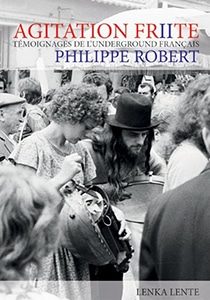
Book
Philippe ROBERT
“Agitation frite – Témoignages de l’underground français. Vol.2”
Preface by Guillaume Belhomme. French edition, 15 x 19,5 cm (softcover), 400 pages (b/w ill.).The second volume of the publication dedicated to the French underground musical scene.This volume documents the practice of bands and solo musicians (Fille qui Mousse, Ilitch, Ruth, Étant Donnés, Toupidek Limonade, Sister Iodine, Henri Chopin, Isidore Isou, Look de Bouk, Hellebore, Tonton Macoute, Prohibition, Etron Fou Leloublan, Ferdinand et Les Philosophes, Heldon, Schizotrope, Dustbreeders, Orbes, Sleaze Art, Ankh…), music labels (Rectangle, Sonoris, Bisou, À Bruit Secret, In-Poly-Sons, Tago Mago, Saravah), one free press magazine (Le Parapluie), and of an art collective (Bazooka).It features interviews with Gilles Yéprémian, Henri-Jean Enu, Ferdinand Richard, Emmanuelle Parrenin, Thierry Müller, Raymond Boni, Pascal Bussy, Pierre Barouh, Fabrice Baty, Denis Tagu, Véronique Vilhet, Pascal Comelade, Henri Roger, Romain Slocombe, Richard Pinhas, Maurice G. Dantec, Lucien Suel, Michel Doneda, Marc Hurtado, Michel Henritzi, Arnaud Labelle-Rojoux, Frédéric Le Junter, Kasper T. Toeplitz, Frank Laplaine, Noël Akchoté, Lionel Fernandez, Emmanuel Holterbach, eRikm, Frédéric Acquaviva, David Fenech, Quentin Rollet, Didier Lasserre, François Ibanez, Grégory Henrion, and Arnaud Maguet.
27,00€
In stock

book
THEORAL
“N°2”
This is a book (size A5) with a conversation in English with Mira Sidawi (theater) speaking about being palestinian in Beyrouth, theater, love and death and another one in French with Xavier Charles (clarinet) speaking about beig an artist, real and unreal, and his istrument.
Original price was: 12,00€.4,00€Current price is: 4,00€.
In stock

book
SURFACE TENSION-SUPPLÉMENT N°1
Edited by Ken Ehrlich and Brandon LaBelle. Essays by Jennifer Gabrys, Robin Wilson, Michael Rakowitz, Claudine Isé, Octavio Camargo, Kathy Battista, Brandon Lattu, Simparch, e-Xplo, James O’Leary, Kristin Kreider, et al. “Following the success of Surface Tension: Problematics of Site, Surface Tension: Supplement No. 1 presents contemporary site-based practices in art, architecture and performance through writing, documentation and projects. It offers readers a string of moments when artistic practice actively discovers, defines and recreates public space, and asks what role that kind of practice might play in defining contemporary culture and society. Issues of design activism and the role of media in spatial experience are explored in critical essays by Jennifer Gabrys on Fresh Kills Landfill in New York, Michael Rakowitz on the Hungarian-based team Big Hope, and in Claudine Is’s Vanishing Point, an exhibition questioning the aesthetics of urban non-spaces. Ken Ehrlich contributes a piece on the infrastructure of signage in Los Angeles as seen through the photographs of Brandon Lattu. In addition, readers will find documentation of projects by the artist groups Simparch and e-Xplo, along with Kristin Kreider and James O’Leary’s works designed specifically for the book.”
Original price was: 17,00€.8,00€Current price is: 8,00€.
Out of stock

book
PORTRAITS POLYCHROMES 3
GILLES RACOT
“Le jeu des contraintes tangibles: de quelques accidents passagers dans l’art sonore de Gilles Racot” par P.A.Castanet, entretien de Gilles Racot avec E.Gayou, “Introduction à l’écoute de Subgestuel” par Frédéric Kahn, catalogue des œuvres…
9,00€
Out of stock
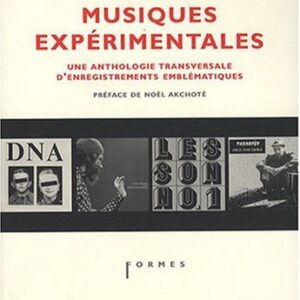
book
Philippe ROBERT
“Musiques expérimentales”
Only in French, a selection of different recordings of experimental music. With among others Luigi Russolo, Walter Ruttmann, Kurt Schwitters, Halim El-Dabh, Isidore Isou, Henri Chopin, Pierre Schaeffer, Edgar Varèse, Harry Partch, Raymond Scott, Moondog, Robert Ashley, Iannis Xenakis, Jean Dubuffet, William S. Burroughs, Terry Riley, Philip Corner, Alvin Lucier, Henry Flynt, Tony Conrad, La Monte Young, Albert Ayler, Luc Ferrari, Earle Browne, John Cale, AMM, Yoko Ono & John Lennon, Sonny Sharrock, Annette Peacock, Derek Bailey, Cornelius Cardew, Joe Jones, Evan Parker, Dean Roberts, Dominique Petitgand, Eric Aldéa, Alan Licht, Toshimaru Nakamura, Jason Khan, Taku Sugimoto, Martin Tétreault, MIMEO, Francisco Lopez, RRR, Rhodri Davies, Kaffe Matthews, Merzbow, Mnortham, eRikm, Sachiko M, Bhob Rainey & Greg Kelley, Lê Quan Ninh & Günter Müller… Préface de Noël Akchoté.
24,00€
Out of stock

Out of stock

book
PORTRAITS POLYCHROMES 4
BERNARD PARMEGIANI
New edition with more texts. “Bernard Parmegiani, matière et continuité” par Régis Renouard-Larivière, entretien de Bernard Parmegiani avec Evelyne Gayou, “A propos de De Natura Sonorum” par Guy Reibel, “L’œil écoute”, commentaires analytiques de Philippe Mion et Jean Christophe Thomas, Parmegiani et le service de la recherche par Philippe Langlois, “La crème des hommes” par Bernard Fort, textes de Parmegiani, catalogue des œuvres.
12,00€
In stock
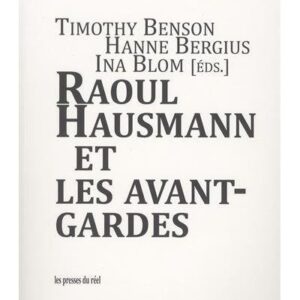
book
COMPILATION
RAOUL HAUSMANN ET LES AVANT-GARDES
Published in February 2015. French edition. 17 x 24 cm (softcover). 512 pages (80 b/w ill.).
Edited by Timothy Benson, Hanne Bergius, Ina Blom. Texts by Timothy Benson, Hanne Bergius, Ina Blom, Jean-François Chevrier, Bertrand Clavez, Michel Giroud, Andreas Haus, Adelheid Koch-Didier, Ghislain Lauverjat, Arndt Niebisch, Pascal Rousseau, Adrian Sudhalter, Hubert Van Den Berg & Lidia G uchowska, Michael White.
This publication aims to explore how the multiple production of Raoul Hausmann, a central figure of Dada, has helped to shape the art of modernity.
26,00€
Out of stock
In stock

book
COMPILATION
EREWHON CALLING : EXPERIMENTAL SOUND IN NEW ZEALAND
Erewhon Calling: experimental sound in New Zealand is a lavishly-illustrated new publication from the Audio Foundation and CMR. It is a survey of how a bunch of antipodean misfits and malcontents have forged new ways and new reasons to make noise, here at the end of the earth. Edited by Bruce Russell (the Dead C.), in association with Richard Francis and Zoe Drayton; the aim of this volume is to survey the full range of ‘non-standard’ audio practices in contemporary NZ culture. The book’s remit runs from the borders of composed art music, through improvised noise, to deconstructed rock’n pop filth’; and every genre, every scene, every permutation of unconventional audio practice,in-between. The aim is not to be comprehensive, there is literally too much vitality and diversity for,any book!). The hope is to ‘throw a good handful of gravel into the pool’. While not every eel will have been hit, the surface will have been rippled from shore to shore, which is more than anyone else has even attempted before. Erewhon Calling makes room for many voices, allowing multiple and possibly conflicting voices and points of view. A range of artists and informed commentators mainly tell their own stories, describe their own work, and outline their own goals in working on the fringes of audio culture. The readers of this important new source book will be able to discern their own meanings and make their own connections from this thought-provoking and unique publication. Edited by Bruce Russell in association with Richard Francis and the Audio Foundation. Text / page works by Branden W. Joseph, Phil Dadson, Bruce Russell, Michael Morley, Byron Coley, Alastair Galbraith, Empirical, White Saucer, Clayton Noone, Andrew
Clifford, Jeff Henderson, Daniel Beban and Nell Thomas, Su Ballard, Jon Bywater, Dan Vallor, Clinton Watkins, Witcyst, Andrew Scott, Campbell Kneale and Antony Milton, Vitamin S, Jon Dale, Mark Williams, Lee Noyes, Nathan Thompson, Beth Dawson, Sean O’Reilly, Kraus, Sean Kerr, Peter Stapleton, Stephen Clover, Dugal McKinnon, Omit, Peter Wright, Jo Burzynska, Ian-John
Hutchinson, Kim Pieters, Paul Winstanley, Gentle Persuasion, Zoe Drayton, Simon Cuming, Stevie Kaye, Rachel Shearer, Richard Francis, Rosy Parlane, Kiran Dass, None Gallery, Zita Joyce, mr sterile Assembly, Ben Spiers. Designed by Richard Francis. Co-published by Audio Foundation and CMR, August 2012. Soft-cover. 192 pages (black and white). Edition of: 900. Dimensions: 170mm x 240mm x 16mm. Individually shrinkwrapped.
27,00€
Out of stock
book
COMPILATION
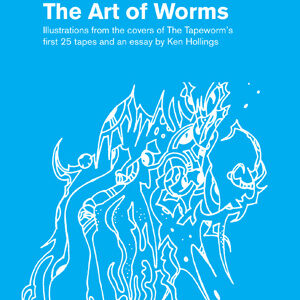
THE ART OF WORMS
The first publication from The Bookworm. Contents: “Parasitic Infestation”, an essay by Ken Hollings. Illustrations from the first 25 Tapeworm tapes, including works by SavX, Derek Jarman and Leif Elggren. 66pp, 110mm x 117mm, soft cover, thread bound booklet - no ISBN. Edition of 250 copies only.
5,50€
In stock
book
Juliette VOLCLER
“Contrôle. Comment s’inventa l’art de la manipulation sonore”
In French only.
After sound as weapon, here’s sound as a social manipulation through the story of Harold Burris-Meyer.
Juliette Volcler is a producer of audio documentaries for the radio program « L’Intempestive», broadcasted on the independent local radio stations : Radio Galère et Fréquence Paris Plurielle. She is also a regular contributor to the independent newspapers CQFD and article 11.
14,00€
Out of stock
book
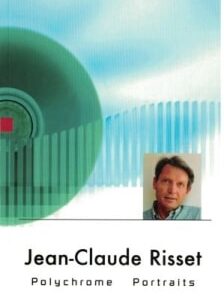
PORTRAITS POLYCHROMES 19
JEAN-CLAUDE RISSET
Jean-Claude Risset, today considered one of the major pioneers of computer music, was born in France in 1938 and pursued simultaneous studies in music and science. In the 1960s he worked as a young researcher in the Bell Telephone Laboratories alongside the “father of computer music”, Max V. Mathews.
This book originally published in French presents recent articles by composers and musicologists, often published in English for the first time, concerning the aesthetic, ideas, repertory and career of JC Risset. Texts by Pierre-Albert Castanet, Olivier Meston, Daniel Teruggi, Fabien Lévy, Daniel Teruggi, Jean-Claude Rissetr, Pierre Couprie.
12,00€
In stock
book
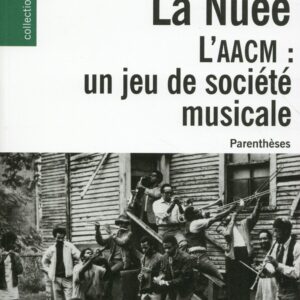
Alexandre PIERREPONT
“La Nuée. L’AACM : un jeu de société musicale”
The history of Association for the Advancement of Creative Musicians (AACM) ! In French only. With a postface from George E. Lewis.
19,00€
In stock
book
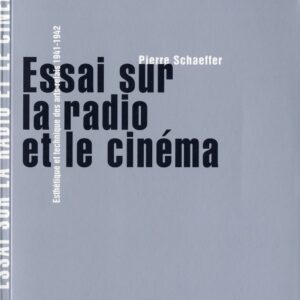
Pierre SCHAEFFER
“Essai sur la radio et le cinéma”
An essay around radio and cinema that Pierre Schaeffer called “arts-relais” in 1941-42. This book has been made by Sophie Brunet and Carlos Palombini who did collect Pierre Schaeffer’s texts.
15,00€
Out of stock
book
Matthieu SALADIN
“Esthétique de l’improvisation libre – Expérimentation musicale et politique”
Improvisation as musical and political experimentation (essay). With AMM, Spontaneous Music Ensemble et Musica Elettronica Viva. In French only.
26,00€
Out of stock

book
PORTRAITS POLYCHROMES
FRANÇOIS BAYLE
Avant-propos, by Pierre-Albert Castanet. “La recherche de François Bayle”, portrait de l’artiste” by Gianfranco Vinay. “Hasard et nécessité” entretien de François Bayle avec Evelyne Gayou. “Entrons dans Camera Oscura et son Labyrinthe avec l’auteur” par Jean-Christophe Thomas. “Camera oscura, regard sur l’œuvre et sa chorégraphie”, par Solange Barrachina. “Mes images” de François Bayle.
9,00€
Out of stock

book
PORTRAITS POLYCHROMES 10
FRANCIS DHOMONT
In french only. “Entretien avec Francis Dhomont “ by Évelyne Gayou, “Phénomènes” by François Bayle, “Charme discret du simulacre chez Francis Dhomont” by Jean-Christophe Thomas, “Du poétique au poïétique” by Francis Dhomont, “Points de fuite, analyse d’une errance existentielle” by Stephane Roy, “Types de sons et comportements sonores dans Novars” by Andrew Lewis, “ Forêt profonde - Fragment, implication et déflexion” by Anna Rubin, “ Pareil à un voyageur perdu” by Katharine Norman, “Catalogue des œuvres de Francis Dhomont” by Annette Vande Gorne, “Bibliographie - Discographie”.
9,00€
In stock
book
John CAGE
“Silence”
New edition. The book of John Cage, “Silence” from 1961, translated into French by Vincent Barras.
28,00€
In stock
book
Michael NYMAN
“Experimental music”
New edition of this French translation (by Nathalie Gentili) fromt his very important book written in 1974.
25,00€
Out of stock

book
PORTRAITS POLYCHROMES 12
MAX MATHEWS
English version. Interviews with Max Mathews by Evelyne Gayou, Max Mathews and the digital age, by Jean-Claude Risset, Max Mathews at Ircam, and afterwards, by Gerald Bennett, Max and Ccrma, by Chris Chafe and John Chowning, Max’s importantce to field of electroacoustic muysic, by Jon Appleton, Letkrowsky’s Will ‘SF short story), by Max Mathews, Annnotated Catalog of the writing of Max Mathews, by Marc Battier. Annotated Catalog of the musical compositions, by Max Mathews.
9,00€
Out of stock

Out of stock

book
John CAGE
“Diary: How to Improve the World (You Will Only Make Matters Worse) Continued Part Three (1967)”
The third in Cage’s series of “Diary” essays (the other parts were published in different contexts), defined broadly as “collections of thoughts that develop out of working and being alive.” The text is formally and discursively roving: its margins, typeface, and color undergo continuous alteration by chance methods as Cage contemplates computers, Erik Satie; life on the road with Merce Cunningham; death; encounters with Mies van der Rohe, Duchamp, and Marshall McLuhan; books; cold remedies, and more. Above all, Diary seems to confront the problem of truly ecumenical thought. Dick Higgins, as the publisher’s original printing technician, meticulously engineered the variations in color, and as such, this may be the most outwardly beautiful of the Great Bears series.
Originally published by Something Else Press between 1965 and 1967, the Great Bear Pamphlet series was envisioned by founding editor Dick Higgins as a “poor man’s keys to the new art,” or a means of exposing the most vital work of the time to a mass-market audience, and vice versa. The series made uncompromisingly radical work maximally accessible, with slim, chapbook-like publications of a mostly uniform, pared down design. Taken together, the pamphlets constitute a firsthand survey of the sixties avant-garde (Higgins, Barbara Moore, and Emmett Williams all had a hand in the editorial process) that is both sweeping and utterly unique, transmitting a still-vibrant signal of expanded possibility in art, music, and poetry. Presented here in a facsimile edition, the Great Bears epitomize the utopian vision of Higgins and Something Else.
5 x 8 inches, 16 pages, Paperback, B&W.
7,50€
In stock
book
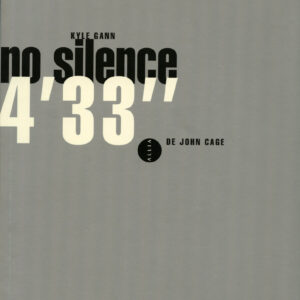
Kyle GANN
“No silence. 4’33” de John Cage”
French translation from this book around the work of John Cage published in 2010.
15,00€