
Out of stock

book + 2 CD
Steve RODEN
“…i listen to the wind that obliterates my traces”
*** 2021 restock ***
Edited by Steve Roden. 184 page hardback book with 2 CDs. 150 full-color photographs. The CDs feature 51 vintage recordings from 1925-1955.
“… i listen to the wind that obliterates my traces brings together a collection of early photographs related to music, a group of 78rpm recordings, and short excerpts from various literary sources that are contemporary with the sound and images. It is a somewhat intuitive gathering, culled from artist Steve Roden’s collection of thousands of vernacular photographs related to music, sound, and listening. The subjects range from the PT Barnum-esque Professor McRea - “Ontario’s Musical Wonder” (pictured with his complex sculptural one man band contraption) - to anonymous African-American guitar players and images of early phonographs. The images range from professional portraits to ethereal, accidental, double exposures - and include a range of photographic print processes, such as tintypes, ambrotypes, cdvs, cabinet cards, real photo postcards, albumen prints, and turn-of-the-century snapshots. The two CDs bring together a variety of recordings, including one-off amateur recordings, regular commercial releases, and early sound effects records. there is no narrative structure to the book, but the collision of literary quotes (Hamsun, Lagarkvist, Wordsworth, Nabakov, etc.). Recordings and images conspire towards a consistent mood that is anchored by the book’s title, which binds such disparate things as an early recording of an American cowboy ballad, a poem by a Swedish Nobel laureate, a recording of crickets created artificially, and an image of an itinerant anonymous woman sitting in a field, playing a guitar. The book also contains an essay by Roden.”
37,00€
In stock

Book, 2 CD
Philip SAMARTZIS
“Antartica, an absent presence”
Antarctica is a paradox of the sublime and prosaic: with its vast expanses of ice, snow and mountains—and traces of human habitation, from weathered huts to abandoned machinery. It is a blank space bordered by nothingness concealing a confounding set of encounters for those fortunate enough to breach its frozen perimeter. This book is an invitation to share in a remarkable journey to a place that is for all intents and purposes simply incomprehensible. The book is accompanied by two CDs of soundscape compositions documenting natural and anthropogenic characteristics of the frozen continent and its surrounding ocean.
Philip Samartzis is a sound artist, scholar and curator with a specific interest in the social and environmental conditions informing remote wilderness regions and their communities. His art practice is based on deep fieldwork where he deploys complex sound recording technology to capture natural, anthropogenic and geophysical forces. The recordings are used within various exhibition, performance and publication outcomes to demonstrate the transformative effects of sound within a fine art context. He is particularly interested in concepts of perception, immersion and embodiment in order to provide audiences with sophisticated encounters of space and place. Philip is an Associate Professor within RMIT School of Art, and the artistic director of the Bogong Centre for Sound Culture.
Hardcover, 208 pages (24.8 x 2.5 x 18.8 cm)
30,00€
Out of stock

book + 2 CD
VIVENZA
“Fondements bruitistes”
Deluxe double-CD book, 108 pages in three languages: French, English, Japanese. Included The Art Of Noises - Futurist Manifesto - by Luigi Russolo (1913). “The Bruitist Foundations of Action” (French title “Fondements Bruitistes d'Action”), which came out in october 1984, opens the period in Vivenza’s work on Bruitist sound when he started to incorporate the question of the relationship that holds between the technological and mechanical industrial fabric - which makes up the reality of the modern world - and the human and social environment. It is released in double albums as two separate vinyl LPs in the context of the Archives of Industrial Music from France.
23,00€
Out of stock

book + 2 CD
NURSE WITH WOUND
“Spiral Insana”
Same content as the vinyl reissue but on two CDs inside an art book with screenprinted artworks.
20,00€
In stock
book + 2 CD
Charles DUVELLE & Hisham MAYET
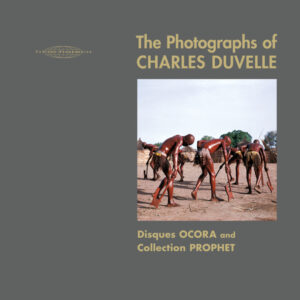
“The Photographs Of Charles Duvelle – Disques Ocora And Collection Prophet”
Limited edition. One time printing.
Disques Ocora, a French label dedicated to capturing and publishing the sounds of folkloric culture from around the world, is held in the highest possible regard in the realms of professional and amateur ethnomusicology. Instigated in 1958 by Pierre Schaeffer, the founder of musique concrète, Disques Ocora’s sterling reputation is largely built on composer and musicologist Charles Duvelle’s pioneering field recordings, as well as his now-iconic photographs and graphic design.
Charles Duvelle’s (1937 - 2017) work is indisputably one of the most important contributions to the human understanding of the rich biodiversity of our planet’s music and language. In 1977, his field recordings from Benin were selected by Carl Sagan for inclusion on the Voyager Golden Records, which were carried into outer space by the Voyager spacecraft to stand as an example of humanity’s highest musical expressions for the universe’s unknown listeners.
Sublime Frequencies’ most ambitious project to date, this 296-page fine-art photography book comprises an exhaustive collection of Charles Duvelle’s field photography from 1959 to 1978, demonstrating that this master musicologist had an equally unerring eye for photography. It also contains an exhaustive interview with Charles Duvelle by Hisham Mayet, detailing the history of the label and offering Duvelle’s unique insights into the discipline of field recording. The package includes two full-length CDs of archival recordings (some of which have never been published) selected by Duvelle himself.
In a tribute to Disques Ocora’s exquisite design sensibility, the book is printed on 170gsm Lumisilk matte artpaper and bound in grey buckram with gold foil stamping on the cover and spine. The front cover includes a tipped-on glossy photograph by Charles Duvelle.
Contents
• 188 black & white and 58 color photographs selected by Charles Duvelle and Hisham Mayet from five regions surveyed during his time with Ocora: West Africa, Central Africa, Indian Ocean, Pacific Islands, and SouthEast Asia.
• Two CDs of music compiled exclusively for this volume by Charles Duvelle with fully annotated track listings and recording details.
• An interview with Charles Duvelle by Hisham Mayet (French and English facing text).
• “Disques Ocora / Charles Duvelle Discography, 1959–1974,” a complete overview illustrated with 94 full-color album thumbnails.
• “The Prophet Collection, 1999–2004,” a discography of Duvelle’s post-Ocora label, illustrated with 41 full-color album thumbnails.
• Ocora catalogues, 1964–1973.
• A photo index listing the details of each photograph in the book.
• “Eastern Music in Black Africa,” a 17 page report prepared by Charles Duvelle at the request of UNESCO, February 1970.
Produced and edited by Hisham Mayet.
55,00€
In stock

book + 2 CD
Teddy HULTBERG
“Öyvind Fahlström on the Air – Manipulating the world”
Reissue ! Under the motto: “Manipulate the world - take care of the world”, Fahlström set up a variety of meeting-places in which participants were invited to take part in an interdiciplinary game of purposeful discovery. He introduced elements of popular culture into his work early on and made substantial contributions to a critical assessment of the “medialisation” of art. In this, the most extensive book about Öyvind Fahlström to date, Teddy Hultberg charts the artist’s predominant lines of creative development and shows how his cross-genre endeavours were based on a few central ideas: character forms, signs, games and life materials.
The present study focuses on two innovative and extraordinary compositions for radio: “Birds in Sweden” (1963) and “The Holy Torsten Nilsson” (1966). These works can be heard on the two accompanying CD records and are also included here in written form. Some unique and hitherto unpublished visual and textual material, the result of several years of research by Teddy Hultberg, is also included in the book. All text material in the book is written both in English and in Swedish.
48,00€
In stock
book + 2 CD
Olivier CAPPAROS & Lionel MARCHETTI
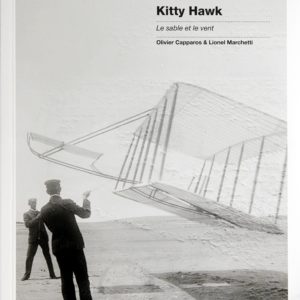
“Kitty Hawk, le sable et le vent”
A composition by Olivier Capparos & Lionel Marchetti. For string quartet, two voices and three loudspeakers. An oratorio of musique concrète and instrumental music about “Kitty Hawk” the city where the Wright brothers did the first experiment with plane.
18,00€
Out of stock

book + 2 CD
Guy DEBORD
“Enregistrements magnétiques (1952-1961)”
A book and two CDs where we can discover texts and voice of Guy Debord from the beginning of Internationale Lettriste (1952-1957) to the middle of Internationale (1957-1961). Great document ! With also the voices from Serge Berna, Michèle Bernstein, Jacques Fillon, Abdelhafid Khatib, Gil J Wolman, Claude Frère, Serge Korber, Giors Melanotte.
19,50€