
Out of stock

2 CD
Laetitia SONAMI
“Dangerous Women: Early Works 1985-2005”
2025 release
Laetitia Sonami was born in France, where she studied with Eliane Radigue. She moved to the United States to study electronic music, first with Joel Chadabe at SUNY Albany, then at Mills College where she was mentored by Robert Ashley and David Behrman. Laetitia Sonami is not only a gifted composer/designer of electronic music, but a compelling presence on stage. This collection of early works covers a period when Sonami transitioned from live mixing with cassettes, homemade analog synths and objects in the early eighties, to working with MIDI, MAX software and "off the shelf" synths and samplers. At the same time, she begins a long collaboration with Melody Sumner Carnahan, using her dramatic texts to evoke characters and behaviors to inhabit musically and visually. All but two of the works on this release utilize Sumner Carnahan's stories, and all but one use Sonami's famous invention, the lady's glove, an arm-length tailored glove fitted with movement sensors allowing the perform to fluidly control digital sound parameters and processing, as well as motors, lights and video playback. Sonami has since moved on to works for another of her inventions, the Spring Spyre, which applies Machine Learning to real time audio synthesis.
23,50€
Out of stock

2 CD
Matt ROGALSKY
“Visitations And Revisitations”
2024 release
With Visitations and Revisitations, Matt Rogalsky continues lines of work that seem to inevitably revolve around explorations and honoring of place, people, and memory. Ambient, expansive and immersive, twelve new songs without words invite listeners on travels through spectral sound worlds. All the compositions combine elements of acoustic and electronic sound, where the electronic sound is often derived from underlying acoustic sources which often remain unheard while their liminal, spectral qualities are evoked in new ways. On this collection, two "Visitations" bracket ten "Revisitations." Each "Revisitation" identified by a letter is an investigation into the work of a composer or musician whose work has meant much to Rogalsky: "The 'Revisitations' all function as homage compositions, in an alphabetical series of 26, where each letter references a composer whose work has touched me, and whose sounds I have spectrally explored in a new response piece." The "Visitations" are different from the "Revisitations" in their referencing of intensely personal conditions: one derives from the resonances of a family upright piano which came from Rogalsky's maternal side, and one evokes experiences in movement, sound and community around the base of Sacred Buffalo Guardian Mountain in Banff Alberta. The range of influences Rogalsky explores on Visitations and Revisitations span from musicians and poets in his local sphere, to internationally well-known contemporary and historical figures in music and sound. Some sources are revealed and others kept private as a guessing game for listeners. A number of the tracks on the album are based in recordings of live performances while others are purely studio compositions. Matt Rogalsky is based in Kingston/Katarokwi, in Ontario Canada where he runs the Sonic Arts Studio at Queen's University. He previously released a double CD album Memory Like Water on XI Records in 2006 (XI 131CD).
15,00€
Out of stock

2 CD
Merce BLASCO – Lucie VITKOVA
“Blasco/Vitkova/Anette”
2023 release
On this album, Lucie Vítková and Merche Blasco explore cyborgness through their relationships with their instruments. Lucie perceives the accordion as an extension of their body -- sound, matter, and movement locked in a self-generating cybernetic loop. Merche built Anette, a 3D printer, as her interlocutor and companion in the performance space; in return, Anette printed thimble-microphones Merche wears on her fingers, which render the machine's unique electromagnetic voice audible to human ears. Performed through an octophonic system, the wearable microphones expand Merche's hand gestures to sonically fill the performance space, surrounding the audience with the sensation of being within Anette's busy, mechanical body. For this album, the eight signals broadcast by Merche's thimble-microphones were later mixed down to stereo, replicating the spatial image created live. This album is the record of an inter-material conversation among the trio of Vítková, Blasco, and Anette (technically a quartet since Merche was six months pregnant at the time), in which human and nonhuman elements of the cyborgian system are in constant interflow. The album includes a text written by Shelley Hirsch.
15,00€
In stock

2 CD
Michael WINTER
“Counterfeiting in Colonial Connecticut / a lot of tiles (trivial scan)”
2022 release
XI Records announce the release of a double-CD set of Michael Winter's music organized by guitarist Elliot Simpson. Each CD features a single composition, demonstrating different sides of Winter's work.
The first, "Counterfeiting in Colonial Connecticut", is a socially-engaged piece written for Simpson and in honor of George Floyd. The second, a lot of tiles (trivial scan), derives music from a set of mathematical tilings (often referred to as tessellations). The album art features reprints of altered and counterfeit colonial Connecticut bills as well as custom-made, hand-stamped prints of the tilings. "Counterfeiting in Colonial Connecticut" interleaves guitar passages with readings of excerpts from the book of the same title written by Kenneth Scott and published by the American Numismatic Society in 1957. Readings from the Scott Compendium are complemented with readings of texts written by Winter reflecting events that occurred during the composition of the piece; particularly the protests sparked by the death of George Floyd, a black man brutally murdered by police while being arrested for allegedly using a counterfeit $20 bill. Simpson is accompanied by Gemma Tripiana Muñoz on piccolo and the texts are read by Simpson, Winter, and animator Mandy Toderian.
"a lot of tiles (trivial scan)" is based on a set of rectangle substitution tilings explored by Chaim Goodman-Strauss in his seminal paper "Lots of aperiodic sets of tiles". A rectangle substitution tiling is generated by dissecting a rectangle into four smaller rectangles, which are then dissected into eight even smaller rectangles, and so on. The parenthetical in the title, "trivial scan", refers to the method of sonification. Sonic parameters of the music are determined by scanning and reading the tilings. The piece is quite open. As Simpson explains about Winter's music in the notes: "Although his music covers a wide range of forms, formats, and concerns, there seems to always be a careful consideration of the adaptability of his works... They can expand and contract to accommodate diverse instrumentations, durations, spaces, and situations... There is an understanding that the myriad of possibilities defined by the scores will never be exhausted; new constellations of materials, performers, and contexts will always exist." In the recording of "a lot of tiles (trivial scan)", this variability is explored through different combinations of electronic, synthesized, and acoustic sounds featuring Simpson and saxophonist Omar López, the dedicatee of the work.
15,00€
In stock

2 CD
Eamon SPROD (TARAB)
“Foil Void Join Avoid”
Eamon Sprod (previously working as TARAB) works with sound collected from mundane or neglected urban spaces, pursuing an anti-naturalist field recording practice to draw oblique narratives and listening spaces from the everyday and its outer edges. Rather than describing spaces, he attempts to shape them, by working to include everyday spaces as active participants in aural experiences instead of only acting as their container.
Eamon Sprod / TARAB has presented performances through out Australia, Europe, Japan, Korea, North and South America; compositional works have been published on labels including Naturestrip (AU), nonlinear (AU), 23five (US), Unfathomless (BE), Aposiopese (FR), Swarming (FR), Cronica (PT), Semperflorens (RU), Hemisphäreの空虚 (AU) and also his own sonicrubbish imprint formed in 2018.
16,00€
In stock

2 CD
NURSE WITH WOUND
“Shipwreck Radio Volume One”
Remastered & expanded 2CD
Back in the summer of 2004 Nurse With Wound (Steven Stapleton and Colin Potter) were invited by Kunst I Nordland to visit the Arctic Lofoten Islands for a number of weeks. A small studio was set up in their apartment and their task was to collect sounds from the area and create a series of unexpected radio transmissions that were broadcast on the local radio station over a period of two months. A substantial amount of material was produced and the broadcasts were released as double CDs, the first being Shipwreck Radio Volume 1. This has long been out of print, so we are now re-releasing it with additional tracks from the original project. The audio has been carefully remastered by Colin Potter.
18,50€
In stock

2 CD
NURSE WITH WOUND
“Terms And Conditions Apply”
This expansive 2CD collection from Nurse With Wound compiles a range of experimental works from 2008-2011, offering a glimpse into their cut-and-paste sonic universe. Opening with the jarring 'Cruisin' For A Bruisin'', the set quickly plunges into a diverse array of sound, blending drones, rhythms and odd vocal samples. The first disc is split into 'The Bacteria Magnet' and 'Rushkoff Coercion', while the second features 'Erroneous, A Selection of Errors,' likely showcasing unreleased material.
2025 repress
17,00€
In stock

2 CD
JUNG AN TAGEN
“Revenge of the Speaker People”
In 1978, at the University of London, the Physicist David T. Kemp made an unusual discovery. Kemp noticed that faint sounds, known as Otoacoustic emissions (OAEs), revealed the existence of the cochlear amplifier, a mechanism responsible for sound sensitivity and frequency resolution. This discovery proved that the ear is an active rather than passive organ.
Following this discovery the experimental music world embraced these findings by incorporating them into sound works. Maryanne Amacher was a notable early pioneer of this technique resulting in large scale sound works, the likes of which audiences had never encountered prior. Since these early explorations the use of OAEs has spread more widely in the experimental music landscape, notably by Editions Mego artists Florian Hecker and Marcus Schmickler.
“I believe the kick of techno can be an agent to shapeshift sounds and infiltrate settings” - Jung An Tagen
Stefan Juster aka Jung An Tagen is known for conceptual works and has a large back catalogue of intriguing ideas and sounds. Revenge of the Speaker People is another adventurous release, one which takes the Otoacoustic discoveries of David T. Kemp and applies them to a techno framework. OAEs are fragile and can collapse quickly when combined with other elements. Jung An Tagen’s success in combining OAEs with beats is therefore quite an achievement, without precedent.
The first CD comprises the results of Juster’s experiments, resulting in some of the strangest techno committed to digital since the initial burst of the Mego label. A series of head spinning, ear tickling extreme electronic miniatures bleed in a continuous form. This adventurous and playful music would likely have many a raver run to the bathroom. There is a tangible subversive delight in mixing in such sounds to what is ostensibly ‘club music’.
Because the record had this clear divide of beat + otoacoustics the idea came to see how the material would lend itself to a series of remixes. The second CD has remix contributions from a selection of artists from the Editions Mego stable alongside Juster’s own ETAT imprint along with DJ Nervoso from the Príncipe crew. The results are a headspinning variety of Otoacoustic mayhem as the likes of Evol, Thomas Brinkmann, Ellen Phan, Nik Colk Void and others fold these initial bizarre sounds into even more twisted shapes. Revenge of the Speaker People is a daring, playful and audacious release. One that will baffle your ears, neighbours and dancefloor clients.
21,00€
Out of stock

2 CD
Vanessa ROSSETTO
“Pictures Of The Warm South”
Erstwhile presents Pictures Of The Warm South, Vanessa Rossetto's the seventh Erstwhile release, her second ErstSolo. Mastered by Giuseppe Ielasi, designed by Matthew Revert. Double CD, six-panel digipak. Primarily focused on composing works that draw on a diverse pallet of chamber instrumentation, field recordings, electronics and a wide array of different objects, with a practice that explores each through a combination of extended and traditional techniques, Vanessa Rossetto has been working at the boundaries of the American vanguard for well over a decade, producing beautiful and challenging solo efforts for a diverse number of imprints, including Kye, Another Timbre, No Rent, Erstwhile, and numerous others, as well as collaborations with figures like Michael Pisaro, Sarah Hennies, and Lee Patterson.
22,00€
In stock

2 CD
Kevin DRUMM
“Sheer Hellish Miasma II”
Kevin Drumm - electronics, tapes, microphone, computer assistance
Greg Kelley - trumpet
26,00€
In stock

2 CD
Anouck GENTHON – Lionel MARCHETTI
“Suite blanche”
Double CD with Suite blanche, composition, and Angelica, a live concert.
The Genthon_Marchetti duo works on a composition that takes space into account as one of the essential vectors in the sense that an acoustic response, through the arrangement of loudspeakers and sound volumes, becomes the very substratum on which the music will naturally rest. Inventing a form of duet in which the body of the violin itself seems to melt into the plasticity of the synthetic sounds, the two instrumentalists build, by subtly staging the loudspeaker projection, a musical work insisting on spatial emanation from a focal point – like a single eye, a lighthouse, a beacon that would indicate the path of an enchanting myth, or at least a direction to be considered as a life line, a magnetic pole.
CD1 : SUITE BLANCHE
Une écoute acousmatique / Acousmatic listening - 45:16
Anouck Genthon : violon / violin. Lionel Marchetti : synthétiseur, électroacoustique / synthesizer, electronics. Composition, tournages sonores, mixage / Composition, field recordings, mix : Anouck Genthon, Lionel Marchetti. Mastering : Lionel Marchetti
1: Le sol prend feu - 17:38
2: Verticale de l'est - 6:16
3: Le silence se déplace - 3:27
4: Les voutes, les cascades, les grottes... - 8:50
5: Coda - Nuit (le temps se défait) - 9:45
CD2 : Angelica
Anouck Genthon, violon / violin. Lionel Marchetti, synthétiseur, électronique / synthesizer, electronics. Concert live (41:16) enregistré par / recorded by Gianluca Turrini 11/02/2022, Teatro San Leonardo - Centro di Ricerca Musicale, Angelica Bologne Italie / Italy.
Mixage, mastering : Lionel Marchetti
19,00€
In stock

2 CD
Christof MIGONE
“Wet Water (Let’s Dance)”
Christof Migone's 'Wet Water (Let’s Dance)' immerses you in a mysterious soundscape, characterised by electronic noise and watery flows. Each piece explores inarticulation and the struggle to communicate, challenging traditional notions of sound and language. In the work captured in this collection, the relation between elements is abstract, entangled, puzzle-like in its weirdness, and all the more rewarding for that.
The four pieces constituting The Release (Into Motion), which take up the entirety of disc two, are different, more conventionally ‘musical’ in structure and style, but still sharing, as with all of Migone’s work, a conceptual sensibility and feeling of underlying logics at work. In each piece, layers of roughly pitched electronics tones flow into and around each other, as if mirroring the dynamic surfaces, continuous motion, interference patterns, and interacting currents of ocean waves. These sounds derive from a performance work in which Migone held a tomato frozen in a block of ice in his mouth while it slowly melted over more than thirty minutes—a painful looking exercise, based on the documentation images. How such an endurance ritual produced these sounds is mysterious and oblique, but at the same time highly suggestive. Like so much of the work captured and documented in this collection, the relation between elements is abstract, entangled, puzzle-like in its weirdness, and all the more rewarding for that.
— Joel Stern
16,00€
In stock

2 CD
GOODIEPAL – BANANSKOLEN
“The Pruttipal Index”
What is - or rather: what could be - a "Pruttipal Index"? In books, libraries and databases, an index is usually a concise overview or inventory. It suggests that this album could be a mini-encyclopedia of the work of its makers. In economics, indexes are measurements of the current state of an economy; which, in the case of this album, could be a vitality metrics of the Goodiepal & Pals/GP&PLS/BananSkole collective that produced it. In semiotics, an index is a sign that functions as a trace (like smoke as an index of fire). Because of their technology, vinyl records are indexical (with their grooves being indexes of sound waves), but in addition, this album could also be seen as a series of sonic traces, or footprints, left by the various activities of GP&PLS and Pruttipal over the eight years of their collective existence.
Everyday life, creative and social practice, learning and experimentation are constantly interwoven in these recordings. This is reminiscent of other experimental living, learning and music-making communities since the early 1970s, such as the French experimental ICEM/Freinet schools.
While the solo artist also known as Goodiepal can still be heard on this album - in spoken tracks and what sounds like half-improvised electronic pieces -, s/he has become gradually disguised and dissolved. The "Pruttipal Index" is thus a record of their latest self-reinvention, as they have been reinventing themselves periodically since the 1990s, including their latest identity Pruttipal, taken from the Danish word "prut" meaning "fart". Pruttipal may have become a boring old fart, or the fart may be a joke on the perceived noises of experimental music or the seeming casualness of the recordings.
There is, audibly, an eclectic stylistic mix of theater, group improvisation, choirs, folk music and children's songs, campy-ironic modular synthesizer electronics, highly-produced art rock and no wave jazz, heavy metal, techno, punk and catchy Scandinavian dance pop tunes interspersed with mock-conspiracy podcasting. Much of it could be called functional music derived from collective social performances to be reused for new collective social performances.
14,00€
In stock

2 CD
David JACKMAN
“Steadfast”
This is the seventh and last release in the Die Stadt CD series. Even though David Jackman gets the credit in the title, the music itself is pure Organum electronics—dense, noisy, and exactly what fans would expect. Emerging as a meditative gesture within the long and enigmatic arc of David Jackman’s output, Steadfast stands as both a summation and a deepening of concerns that have occupied him for decades. Issued as a double CD by Die Stadt, the release captures Jackman—best known for his work under the Organum moniker—at a moment of stark clarity and quiet force. His legacy, shaped through collaborations with figures like David Tibet and Steven Stapleton, has always occupied a space between austerity and intensity, drawing on minimalism, drone, and ritualized abstraction to forge a language uniquely his own.
Across the two discs of Steadfast, we find a music that is neither strictly acoustic nor electronic, but something in between—an environment, a slow unfolding. Analog synthesizers swell and recede like distant weather systems; field recordings and incidental sounds rise with spectral insistence before dissolving again into silence. There is a patience here, a sense of refusal, of staying with the sound long after others might have let go. Moments verge on the imperceptible, only to bloom suddenly into passages of engulfing texture.
Rather than a document of change, Steadfast feels like a portrait of duration—of persistence in listening and making. It does not seek to impress but to inhabit; it asks for time and gives it back in kind. For those familiar with the ceremonial gravity of Organum or the liminal poetics of Nurse With Wound, this work may feel at once familiar and startlingly new—a quiet epiphany from one of the most singular voices in experimental sound.
19,00€
In stock

2 CD
David JACKMAN
“Schining”
"Music and musical releases can be controversial for many reasons. Lyrical content, shocking covers, too loud, too quiet: David Jackman’s music is controversial for none of these reasons. His music isn’t noisy or silent, with no lyrical content or a shocking cover. I am not on any discussion group online and never was, but I can imagine a discussion with the topic: “Is David Jackman doing the same thing over and over again?”. I don’t know the answer, but I can guess. We can say the last few releases (and I am discounting his Organum Electronics releases; they are in a different league) contain the same musical elements.
I copy from my last review, “A drone, Shruti-like, some low gong sound, the occasional bang on the piano, a church bell and some crows flying overhead”. The crows may have flown away, but the other elements are there. I also wrote, “The drone is continuous here; the others appear irregularly. The whole work is slow and majestic. The music has a funeral aspect, like a black-and-white picture from an Edgar Allen Poe story. It is very similar to much of his recent work, and it is hard to figure out the difference(s). All of this fits my pop-art theory. I love this mystique and playing around with similar ideas and notions. I am sure this mystery will never be unravelled” - Frans de Waard
19,00€
In stock

2 CD
Marc NAMBLARD
“L’autre rive”
14-track album + 15-track bonus album
20-page booklet with translations of Wayãpi songs and dialogues into French / Booklet also available in English
At the end of 2023, Marc Namblard set out to record sounds in French Guiana for the purposes of a documentary film. Through a series of circumstances, he found himself in Bas-Oyapock with director Kevin Brunet to meet Sara and Saraka, a couple of Wayãpi originally from Brazil. They both shared the lives of their hosts for two weeks, engaging in traditional activities (preparing cachiri and cassava, maintaining the garden, singing, dancing...) along with «troubling» experiences and daily gestures...
From this stay, The Other Bank was born, a sound piece where the forest, the river, and both human and non-human voices intertwine and merge, inseparable, without any hierarchy, while simultaneously offering a testimony of a relationship with the world on the brink of vanishing...
17,00€
In stock

2 CD
A HANDFUL OF DUST
“Dream Songs”
Another collaboration of Romain Perrot with Bruce Russell related projects. Liner notes are from Bruce Russell, those recordings have never been released before, those are the last ones before drummer Peter Stapleton passed away....
18,00€
In stock
2 CD
RLW
“C.D.”
Ralf Wehowsky is one of the most respected practitioners of radical music of our day. He was the founding member of the seminal German group P16.D4 and ran the legendary experimental label Selektion whose ground-breaking releases influenced many working in today's experimental music scene. Previous releases have seen him collaborate with such well known and diverse artists such as Merzbow, Andrew Chalk, Jim O'Rourke, Achim Wollscheid, Lionel Marchetti, Kevin Drumm, Kouhei Matsunaga and Bruce Russell.
Colonia Dignidad was the settlement of a German evangelical sect.
After being prosecuted for child abuse in Germany, the group fled to Chile in 1961. Like similar religious sects, it was characterized by the outward appearance of a unified, godly community with well-tempered cultural activities and social welfare, but inwardly and in its environment by oppression, sexual abuse, and exploitation. In the 1970s, it unquestioningly inserted itself into Pinochet's regime of terror, aiding in the imprisonment and torture of political prisoners, weapons production, etc. Since the end of the 1980s, there has been a legal reappraisal of the C.D.'s crimes in Chile. Its successor organization makes a living from tourism.
The C.D. project uses, on the one hand, a series of documentary recordings of contemporary witnesses, and on the other, a set of melodic improvisations (MIDI files), improvised in the spirit of the impressions of terror, tension, claustrophobia and fear associated with the Colonia. CD 2 (Knochenstückchen) directly reflects this atmosphere. CD 1 (Reue?) on the other hand, is characterized by the contradictory breadth of the statements found after the dissolution of the sect: Denial of atrocities to glorification of the C.D. by leaders who returned to Germany against the professed traumas of formerly abused inmates and exploited community workers.
For this purpose, the eyewitness recordings were sound-modified to a considerable extent. The MIDI files were played back with a variety of virtual instruments (piano, guitar, sax, turntable, lung machine, barrel organ, synths, etc.) in a multitude of modifications (speed, pitches, loops, harmonic and tonal variations), so that the 11 pieces from CD 1 and the 16 pieces from CD 2 each represent a closely interwoven overall composition.
17,00€
In stock
2 CD
COMPILATION
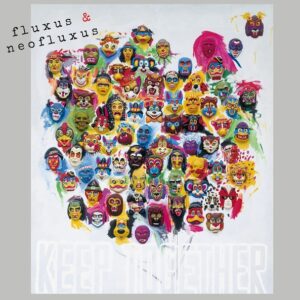
“Fluxus & Neofluxus: Keep Together (Part II)”
In April 2023, the first part of the Fluxus edition called Stolen Symphony was released. Now, in 2024, there is the second part, called Keep Together. At the center of this edition was a broken piano, acquired by the Opening Performance Orchestra for the purpose of making live and studio recordings. During this time other new works for this broken piano were written by diverse Fluxus and non-Fluxus composers. In the spring of 2022, the Opening Performance Orchestra and the broken piano participated in an event hosted by Mieko Shiomi. This was a new version of her early work Spatial Poem, documentation of which was presented at the 2022 Aichi Triennale in Tokyo. At present, the broken piano lies in the open air in Prague and is subject to gradual decay. This edition contains new and old pieces, live and studio recordings, finished pieces and scores to be performed, solos and pieces for ensemble, using classical and special instruments from 33 Fluxus artists, which have been played by ten soloists and four ensembles. There are new essays and articles from 15 writers on the theme Fluxus, as well as original photos and other documentation in the booklets. The Belgian label Sub Rosa provided technical support and a good place for the grand-scale release. The audio restauration and mastering were done by Gabriel Séverin at Laboratoire central, Brussels, and Kakaxa, 3bees, Prague. Archivio Conz in Berlin provided access to their extensive archives and Edizioni Conz provided co-production. Ursula and René Block made possible the realization of John Cage's historical composition "Mozart Mix" from the Edition Block archive. The photographic material comes from Marie Knízáková and Milan Knízák's private archive, the German photographer Wolfgang Träger, Archivio Conz's Fluxus archive, the private archives from diverse Fluxus artists and Opening Performance Orchestra's digital archive. Milan Knízák, Henning Christiansen, La Monte Young, Philip Corner, Bengt af Klintberg, George Maciunas, Takako Saito, Toshi Ichiyanagi, John Cage, Geoffrey Hendricks, Nam June Paik, Sara Miyamoto, Ken Friedman, Yoko Ono, Josef Anton Riedl, Giancarlo Cardini, Ay-O, and George Brecht.
20,00€
In stock
2 CD
Stefan PRINS
“Inhabit”
Inhabit, the second release by Stefan Prins on Sub Rosa, brings together four recent, large-scale compositions in which traditional instruments-from bass woodwind trio to electric guitar and symphonic orchestra-merge seamlessly with electronics, feedback, and field recordings. inhabit once again serves as a testament to how Prins, whose work is performed worldwide by some of the most celebrated musicians, ensembles, and orchestras, continues to stay attuned to the pulse of contemporary music. His compositions offer a refreshing, gripping, and consistently surprising exploration of the increasingly porous boundaries between the acoustic and electronic realms. The first disc of this double album, co-produced by Deutschlandfunk Kultur, opens with "Inhibition Space #1," a piece for amplified bass woodwind trio and feedback, delivered in a masterful performance by the Berlin-based Ensemble Mosaik. This exploration of instrumentally controlled feedback is juxtaposed with an acoustic chamber orchestra in the multidimensional "inhabit_inhibit," captured during a gripping live performance by Ensemble Kollektiv Berlin, conducted by Max Murray at Ultraschall Berlin in 2023. The second disc features Prins' provocative electric guitar concerto, "under_current," performed by the formidable Yaron Deutsch on electric guitar and the dream-team of the BBC Scottish Symphony Orchestra under the baton of conductor Ilan Volkov. In this expansive sonic landscape, ranging from delicate flageolet whispers to ear-splitting outbursts-the orchestra functions as an acoustic meta-amplifier for the electric guitar, enhanced by a range of effect pedals. The album concludes with "Mesh" for five instruments, feedback, electronics, and field recordings, in which the traditional boundaries between human, technology, and nature are completely deconstructed. In their place, Prins creates a world where unexpected sonic connections emerge and dissolve, like acoustic mirages. The Belgian Nadar Ensemble, which Prins co-directs, once again demonstrates why it is such a sought-after ensemble on the international concert stage, and one of Prins' principal musical ambassadors. Additionally, this release includes an exclusive, insightful 12-page booklet on these compositions by music journalist, researcher, and novelist Joep Christenhusz. This release is a co-production with Deutschlandfunk Kultur and BBC Radio 3 and was made possible by the generous support of the Flemish Community (Flanders State of the Art), the Nadar Ensemble, Ensemble Mosaik, and Ensemble Kollektiv Berlin, along with all the musicians involved.
16,00€
In stock
2 CD
Baudouin De JAER
“Five Traces: Geomungo Compositions Vol. III”
Five Traces is a wordless opera in three acts. Its sound includes words and images. The notes must speak: "This wordless opera is certainly my most daring experiment with text in sound. Over the ten years I spent discovering the majestic Geomungo, the six-string Korean bass zither played with a suldae plectrum, working on Héros de la pensée gave soft, poetic, melodious and appeasing sounds. Some of my studies continued the reduction process I had started for the piano and the violin (and then for the Gayageum), in the compositions I wrote between 1986 and 2023, attempts at extreme reducing and simplifying down to lines, music stated on one and single note (with exceptions). Lines allows the interpreter to express themselves within the scope of rhythm, nuance, vibratos, stresses and attacks, and to show the many unheard orchestral possibilities at the root of this unique instrument. In stark contrast, Chanson Cubique (Vol II) or Trace III include moments with an excessive variety of notes driving the instrument into a corner. With the warm timbres of the recordings featuring on the first two CD volumes, the listener is an accomplice to the interpreter, standing in the wings while they rub strings on fret, prepare their fingers and release the strings, tune the instrument while playing, etc. On the other hand, 'Traces' (once every five of them have been listened to) offers a more panoramic view, a look at the geometric structures of the compositions. Vol I was my doorway to the geomungo, while the compositions gathered in Vol II were explorations (experiments, studies) with a more technical aspect, in preparation for the writing of Five Traces." --Baudouin De Jaer
16,00€
In stock
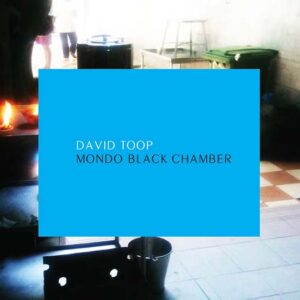
2 CD
David TOOP
“Mondo Black Chamber”
Sub Rosa recordings 1996-2003: the complete series of works made by David Toop for their label. David Toop (born May 5, 1949) is an English musician and author, and as of 2001, was visiting Research Fellow in the Media School at London College of Communication. He was notably a member of The Flying Lizards. He released New and Rediscovered Musical Instruments (with Max Eastley) on Brian Eno's Obscure label (1975) plus many solo albums including 37th Floor at Sunset (2000) and Black Chamber (2003) on Sub Rosa. He was a prominent contributor to the British magazine The Face. He is a regular contributor to The Wire. Toop published his pioneering book on hip-hop, Rap Attack, in 1984. Eleven years later, Ocean of Sound appeared, described as Toop's "poetic survey of contemporary musical life from Debussy through ambient, techno, and drum 'n' bass."
17,00€
In stock
2 CD
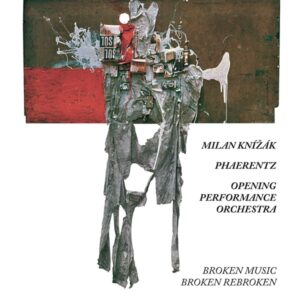
Milan KNIZAK & PHAERENTZ & OPENING PEFORMANCE ORCHESTRA
“It’s Not Quite That Inventive (Sixty Years with Broken Music)”
The album, featuring Milan Knizak, Petr Ferenc (aka Phaerentz) and Opening Performance Orchestra, includes Knizak's 1973 private recording Broken Music, released as a multiple of forty copies by Armin Hundertmark in 1983 on Edition Hundertmark, and a live version of Broken Rebroken, performed in January 2020 at the Museum of Czech Music in Prague. The album comes with a comprehensive 24-page booklet that includes an interview with Milan Knizak on the topic of Broken Music, an extended essay by Petr Ferenc that originally appeared in Czech Music Quarterly, visual documentation from the archives of Maria Knizakova and Opening Performance Orchestra, as well as Anna Bastyrova photographic documentation from the 2020 performance of Broken Rebroken. The cover of the album consists of photographs of Milan Knizak's now-defunct 1963 assemblage. Mastering was done by Stephan Mathieu and Gabriel Séverin, who also made the audio restoration of the archival recording Broken Music.
15,00€
In stock

2 CD
NURSE WITH WOUND / irr. app. (ext)
“A Topography of Lucid Confusion”
A double CD in a deluxe 6-panel digipak, with gorgeously mind blowing new art from Mrs Santini and MS Waldron. Just under 3 hours of insane sonic exploration to fry your synapses. Constructed/reconstructed from hours & hours of live & 'rehearsal' recordings, featuring a cast of thousands. Meticulous & amazing.
25,00€
In stock

2 CD
NURSE WITH WOUND
“She And Me Fall Together in Free Death”
The long awaited reissue of the legendary She and Me Fall Together In Free Death album, with over 45 minutes extra material, most previously unreleased. Housed in a deluxe 2 CD digipak gloss heavy gauge, on United Dairies, with new art by Babs Santini, remastered by Colin Potter.
25,00€
Out of stock
2 CD
The DEAD C
“Deux nuit à Paris”
Emerging from the ethereal realms of sonic mastery, New Zealand’s most audacious experimental outfit, The Dead C, presents ‘Deux nuits à Paris’, two complete live sets that ensnares and exemplifies their ever-evolving sonic journey. From the pulsating metaphysical city of Dunedin, the band - Bruce Russell, Michael Morley, and Robbie Yeats - became a testament to the country’s under ground music scene, stirring the waters with their unorthodox sound landscapes since the late ‘80s. Profoundly philosophical and unapologetically experimental, The Dead C gracefully brush strokes onto the canvas of sound that are those recordings.
This double live album is not merely a recollection of a time and place but an exhibition of raw energy, spontaneous creativity, and the irreplaceable reverberations of improvisation and somehow, songs. The Dead C places the listener at the center of a spiraling vortex of fractured guitar notes, sprawling feedback, cathartic drums manipulations and enigmatic, submerged lyrics -- a complete immersion into their aural architecture. Each night is a journey towards the unknown, challenging the listener to embrace the implicit tension between the familiar and the strange. Experiencing this double live recording which happened in Paris at the iconic venue Les Instants Chavires, is wading through streams of consciousness, where every moment springs forth a new sensory revelation, the echoes of sonic experimentation ricocheting off the walls of reality.
The atmosphere thickens and lightens, enveloped in the three-piece’s enthralling ability to balance raw chaotic dissonance with a overwhelming overall flow of unfiltered expression.
19,50€
Out of stock
2 CD
Graham LAMBKIN – James RUSHFORD
“Gondolas”
First collaborative work between Graham Lambkin and James Rushford. Mastered by Stephan Mathieu, artwork/design by Graham Lambkin. Double CD, eight-panel digipak.
22,00€
In stock
2 CD
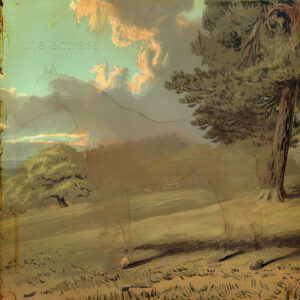
Vanessa ROSSETTO
“The Actress”
Vanessa Rossetto's solo album. Mastered by Giuseppe Ielasi
Designed by Matthew Revert. Double CD, six-panel digipak.
24,00€
Out of stock

2 CD
NURSE WITH WOUND
“The Sylvie And Babs Hi-Fi Companion”
Re-press of the long sold out deluxe re-issue of this 80’s classic from NWW. Expertly re-mastered by Denis Blackham. Now packaged in 6 panel matt laminated digipac, with special matt 12 page booklet with artwork by Babs Santini.
Includes a bonus disc of outtakes, unreleased material and remixes.
18,50€
Out of stock

2 CD
COMPILATION
“Fluxus & NeoFluxus: Stolen Symphony (Part I)”
Double-CD version comes in digipack; includes 72-page booklet.
All in all, there are more than 50 pieces, new and old, live and studio, finished pieces and scores to be performed, acoustic and classical, solos and pieces for ensemble, using classical and special instruments. This Fluxus edition features (in alphabetical order): Eric Andersen, Ay-O, George Brecht, John Cage, Giancarlo Cardini, Giuseppe Chiari, Henning Christiansen, Philip Corner, Öyvind Fahlström, Ken Friedman, Sten Hanson, Geoffrey Hendricks, Toshi Ichiyanagi, Joe Jones, Bengt af Klintberg, Milan Knízák, Alison Knowles, Larry Miller, George Maciunas, Sara Miyamoto, Nam June Paik, Yoko Ono, Opening Performance Orchestra, Benjamin Patterson, Josef Anton Riedl, Terry Riley, Takako Saito, Tomas Schmit, Dieter Schnebel, Mieko Shiomi, Yasunao Tone, Ben Vautier, Yoshi Wada, and La Monte Young. The musicians and performers Anna Clementi, Agnese Toniutti, Deborah Walker, Werner Durand, Luciano Chessa, Miroslav Beinhauer, Petr Bakla, Nicolas Horvath, Petr Ferenc, and Premysl Ondra have played, performed and declaimed the Fluxus pieces, Arditti Quartet and S.E.M. Ensemble provided one piece from their archives. Milan Knízák, Petr Rezek, Petr Kotík, Olaf Hanel, Eric Andersen, Per Brunskog, Peter van der Meijden, Pavlína Morganová, Natasha Lushetich, Joseph Nechvatal, Natilee Harren, Martin Patrick, Diedrich Diederichsen, Christopher M. Reeves, and Hubertus von Amelunxen have written Fluxus-themed texts. Archivio Conz in Berlin provided access to their extensive Fluxus archives and Edizioni Conz provided coproduction. Ursula and René Block made possible the realization of John Cage's historical composition "Rozart Mix" from the Edition Block archive. The photographic material comes from Marie Knízáková and Milan Knízák's private archive, the German photographer Wolfgang Träger, Archivio Conz's Fluxus archive and Opening Performance Orchestra's digital archive. The cover themes are paintings by Milan Knízák, while the graphic design is the work of Jaroslav Buzek.
20,00€
In stock

2 CD
Eliane RADIGUE
“Naldjorlak”
Saltern presents a thrilling new live recording of Naldjorlak for solo cello, composer Éliane Radigue's first piece for an acoustic instrument, paired with a remastered version of the long out-of-print, original 2006 recording. Composed in 2005 in close collaboration with cellist Charles Curtis, Naldjorlak marked a striking shift in the music of Radigue, who has since composed exclusively for instrumentalists with her celebrated Occam series. This double-CD album brings together two complete performances by Curtis, recorded nearly 15 years apart (Paris in 2006 and Los Angeles in 2020), drawing attention to the evolution of the piece and to its inherent mutability. The sound and spirit of Naldjorlak are centered around the re-tuning of the entire cello to the wolf tone, a uniquely unstable frequency, creating a haunting, almost feedback-like resonance within the instrument itself. Mastered by Stephan Mathieu with custom packaging and screen printing by Alan Sherry. Includes extensive liner notes by Gascia Ouzounian, Radigue, and Curtis, and a reproduction of Radigue's never-before published original drawing of Naldjorlak.
From Gascia Ouzounian's liner notes: "Even as it expands conceptions of what sound is, and thus what music can be, to understand Naldjorlak only as music would be to limit its scope. It is music, but it is also physics and philosophy. Naldjorlak is a detailed investigation of the physical properties of resonating bodies and dynamic systems; it is a meditation on the condition of instability; it is a metaphysics of chaos and uncertainty."
21,00€
In stock
2 CD
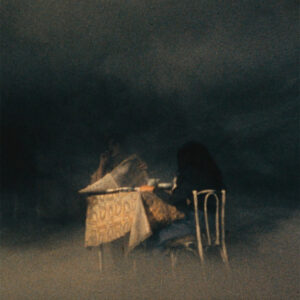
Michèle BOKANOWSKI
“Musique de courts métrages, Music of Patrick Bokanowski’s short films”
*2023 repress*
This double CD edition collects, for the first time, all the original music composed by Michele Bokanowski for the short films of her husband, Patrick Bokanowski.
Covering a time spectrum of almost 50 years, from "La Femme Qui Se Poudre" dated 1972 to "Vers Syracuse" of 2019.
Michele Bokanowski's sounds are visionary, sometimes disturbing and grotesque, sometimes ecstatic.
Some compositions are suites of grim musique concrete, an obscure ambient perhaps like never heard before, others are liquid abstractions of "expanded" music where it is easy to lose the ordinary awareness of one's senses, and find oneself experimenting with new ways of approaching listening as in the best tradition of experimental music .
The work of Michele Bokanowski and Patrick Bokanowski is essential for all avant-garde and visionary art lovers.
La Femme Qui Se Poudre (1972) 15:28
Déjeuner Du Matin (1974) 12:03
La Plage (1991) 12:12
Au Bord Du Lac (1993) 05:11
Flammes (1998) 03:35
Le Canard à L’orange (2002) 07:37
Battements Solaires (2008) 17:43
L’envol (2016) 07:26
L’indomptable (2017) 03:48
Vers Syracuse (2019) 05:40
18,00€