
Out of stock

CD
NEW MONUMENTS
“Long pig”
“New Monuments is a trio of C. Spencer Yeh on violin and electronics, Ben Hall on trap set (looking at the cover I believe this to be drums) and Don Dietrich on saxophone and electronics. Hall is for me the unknown factor here and Yeh and Dietrich earned their wings in the world of improvisation, the latter through his alliance with Borbetomagus - for me the best group ever when it comes to noise and saxophones. The recordings here where made at Studio L in New York on May 8th 2012 and it's what you expect this to be. If your expectations would have been some mild jazzy improvisation record, then you clearly don't know the history of these men (although, thinking about it: it would be nice for a radical change of tune one day). This is very much along the lines of Borbetomagus, except it's not two saxophones and a guitar, but drums, violin, saxophones and electronics. I expect a lot of electronics actually. It's screaming with noise and distortion, especially on the violin and saxophone side, with the drum kit being splattered around like animal from the Muppet show. It’s forceful, it’s loud, and it’s wild even while it has a moment of quietness here and there. It's not one blast from beginning to end, but rather well defined pieces with a beginning and an end. It sometimes even rocks, like good free rock should be when Hall plays more consecutive rhythms. Much mayhem, much excitement.” (FdW in Vital)
10,00€
Out of stock

CD
Tomasz KRAKOWIAK
“Moulins”
“Tomasz Krakowiak’s latest work on Bocian Records is a purely sonic affair. Performed on acoustic percussion instruments, it has little to do with percussion music. Each piece is named after a particular location and/or a sonic event present there. Krakowiak’s monotonous playing a specific instrument seems to achieve an effect of a field recording made at the given location. What makes this effort successful is a broad range of his techniques and sonic intuition. These excellent recordings oscillate between subtle, single vibrations of metal and meaty wall of sound, with mechanical rasping in the middle of the spectrum. Abstract, yet very physical, and surprisingly direct. This is one of the most interesting free improv projects of this year, even though it isn’t typical improvised music as it features structures characteristic of sound sculpture - no dramatic effects or themes, it is all about the texture of sound and interaction between its layers. Moulins seems to be an example of an interesting trend among drummers who play with free-improv groups but in their solo work focus on purely sonoristic explorations - see the latest releases from Will Guthrie (Sticks, Stones and Breaking Bones, 2012), Chris Corsano (Cut, 2012) or Eli Keszler (Cold, 2011). Krakowiak’s release stands out here, though, owing to its originality. [Daniel Bro ek "Canti Iluminati"]”
10,00€
Out of stock

CD
Reinhold FRIEDL
“Golden quinces, Earthed”
In April 2003, Reinhold Friedl was invited by Elke Moltrecht, the former music curator at Podewil in Berlin to perform a piano recital on the Neo-Bechstein. She had the idea to bring him together with David Balzer, a Berlin-based piano constructor, who owns a beautiful Neo-Bechstein of which there are only seventeen known exemplars world-wide. Friedl’s concept was to create an “orchestra sound” using his inside-piano-techniques on the Neo-Bechstein
About instrument: Between 1929 and 1931 the physicists Walther Nernst and his assistant Hans Driescher developed the Neo-Bechstein Grand Piano at the Heinrich Hertz Institute in Berlin. The idea was to construct an instrument for live radio transmission, because good quality microphones did not exist for this purpose. This was coincidently a difficult time for the piano industry. Piano makers tried to be modern and Bechstein even had their own department for electronic music instruments, as this seemed to be the future!
The main difference to a traditional piano is that instead of amplifying the strings with the help of a wooden soundboard, they are transformed by eighteen humbucker pickups into electrical signals. These signals are sent to a valve amplifier and emitted by a mono loudspeaker. As the piano did not need
a soundboard anymore, the traditional hammer mechanics had to be made differently and much lighter. A lot of sophisticated technical transformations were made. The instrument was built in co-operation with Telefunken who were responsible for the electronic devices and Bechstein who designed the mechanical parts of the instrument. No more than 150 copies of the instrument were produced and it is assumed that only a few instruments still exist, ten are now known to be in various museums. A curiosity of the instrument was the built-in radio receiver. This receiver made it possible to route both the radio signal and the instrument signal simultaneously to the output and mix them. A soundboard in a traditional piano does not only amplify the tone, it also cuts the very high frequencies and damps the oscillation of the strigs due to its mass...” Recorded mixed and mastered by Rashad Becker.
10,00€
Out of stock

CD
Reinhold FRIEDL
“Mutanza”
“This CD presents compositions for piano using the instrument in an unorthodox way. The strings are bowed with nylon strings, stimulated by E-Bows, rubbed with metal, the keys’ sound is examined as a corrugated surface and staccato rhythms are repeated in a narrow register. On the one hand, the pieces introduced here explore new ways of playing the piano. In this sense they are "enlarged playing techniques", as they have been developed for most instruments in the second half of the twentieth century. On the other hand, the works confine themselves to selected material and raise the question to what extent the material already is the composition. To me, it seems less interesting to answer this question, which can hardly be answered unambiguously than to observe that the development of the present music was substantially inspired by electronic music. Mario Bertoncini has expressed this, Helmut Lachenmann has introduced the concept of a "musique concrete instrumentale", Phill Niblocks’ loop-like composed music was inspired by the interference between his Harley Davidson and a droning truck ascending the serpentines of the Rocky Mountains. The present CD is a homage to electronic music and moreover, it documents attempts to clear out a gentrified piece of furniture and technically, to catapult the piano into the present”. “Guero” (Helmut Lachenmann), “Epitaff” (Reinhold Friedl), “Music in Fifths” (Philip Glass), “An American Dream” (Mario Bertoncini), “Mutanza” (Witold Szalonek), “Music for Piano with Magnetic Strings” (Alvin Lucier), “Pan Fried 11” (Phill Niblock). Co-released with Bô t Records.
10,00€
Out of stock

CD
Paal NILSSEN-LOVE & Mats GUSTAFSSON
“Sin-gas”
Mats Gustafsson, tenor, baritone and bass saxophone. Paal Nilssen-Love, drums. Recorded by Martin Siewert in Vienna 2013.
10,00€
Out of stock

CD
Mike MAJKOWSKI
“Bright astonishment of the night”
Mike Majkowski, double bass. Recorded July 2014 in Berlin by himself. Mastered by Werner Dafeldecker.
10,00€
Out of stock

CD
Kasper T. TOEPLITZ
“Fluster”
Composition for electric bass from Zbigniew Karkowski performed by Kasper T. Toeplitz. One hour of extreme sound divided into 3 parts between sub-bass, wall of noise and high frequencies. A commission from GRM.
10,00€
Out of stock

CD
Ikue MORI – Maja S.K. RATKJE
“Scrumptious sabotage”
“A recording of live performances which brought together two essential figures of the contemporary scene: an oustanding Norwegian composer and vocal artist Maja S.K. Ratkje and a celebrated improviser and composer, former DNA drummer, Ikue Mori. The common sound territory, created together by Mori and Ratkje, balances between quietly growing tension and powerful outbursts of unrestrained, relentless noise. Within this harmony, Ratkje takes adventurous excursions towards the borders and unknown facets of sound, using treated voice as well as an acoustic and electronic workshop, while Mori’s thoughtful laptop provides a strong frame and a sense of deep focus. In these carefully crafted, long and nuanced compositions, both artists maneuver between meditative, ritual areas and irregular, elusive noise blots. The most astonishing element of this superb performance is the realization that even though the compositions are entirely intuitive, created without any previous planning, guidelines or negotations, the listener can sense a nearly palpable sense of deep connection and understanding between the artists. Their knowledge and keen, immediate communication create an invisible harness, which naturally directs the stream of improvisation. This engaging, exhaustive listen is a contemplative retreat and a daring, dizzying somersault at once”. (-) Olga Drenda. All music composed and performed by Maja Solveig Kjelstrup Ratkje and Ikue Mori. Recorded live by Barry Hollywood at Black Box, Belfast, March 31, and by Dan Fox and Simon Hanson at The Lanternhouse, Ulverston, March 29, 2012 UK. Mixed and mastered by Maja S.K. Ratkje in Svartskog, Norway. Cover design by Lasse Marhaug.
10,00€
Out of stock

CD
Howard STELZER & Frans de WAARD
“Pink pearl”
Composed in Lowell MA (USA) and Nijmegen (NL) by HS and FdW, 2011-2012.
All sounds were extracted from live, studio and mail collaborations 2002-2011.
Cover photography by Ashley Stelzer. Cover design by Mirt. Mastering by SEC_. Frans de Waard (1965) has been producing music since 1984. First as Kapotte Muziek, but throughout the years, he also worked as Beequeen (with Freek Kinkelaar), Goem (with Roel Meelkop & Peter Duimelinks, both of whom are also a member of Kapotte Muziek these days), Zebra (with Roel Meelkop) and such solo projects as Freiband, Shifts as well as his own name. He played various solo concerts as Goem-FDW in Japan, as part of a package tour with Pan Sonic. Frans de Waard also likes to play sets of improvised music with whoever is available, just as he did with people like Guiseppe Ielasi, Jaap Blonk, Howard Stelzer, Roel Meelkop, Andrew Liles, Radboud Mens and the mayor of his home city Nijmegen. In 2008 film maker Harrie Timmermans made a small documentary about his work with Kapotte Muziek under the title “What You See Is What You Hear”. He has given workshops and lectures at various places, such as Extrapool, the art academy of Maastricht en ’s-Hertogenbosch, the Glinka Conservatorium in Moscow and Lithuania. With Scott Foust he formed the duo The Tobacconists in 2009 and with Wouter Jaspers the duo Ezdanitoff in 2010. Howard Stelzer has been active as a composer and performer of electronic music since 1992. His music exploits the unique sonic and physical qualities of cassette tapes and tape players: gritty hiss, the squeal and hum of cheap motors taxed until (and sometimes well beyond) their breaking point, amplified plastic clatter, and play speed altered by pressure from fingers applied to the tapes’ reels. Early work was stubbornly low fidelity, with awkward pauses and jarring a-musical transitions assembled roughly into rather linear collages. Stelzer’s music has evolved over the years, and now seems to sit still for longer durations. Tapes and cassette artifacts are densely layered, treated, layered some more, thrown into a bin and shaken up, then smoothed back out into pleasantly boring stasis with lots of sharp tacks buried within. Stelzer ran the Intransitive Recordings label from 1997 until 2012.
All sounds were extracted from live, studio and mail collaborations 2002-2011.
Cover photography by Ashley Stelzer. Cover design by Mirt. Mastering by SEC_. Frans de Waard (1965) has been producing music since 1984. First as Kapotte Muziek, but throughout the years, he also worked as Beequeen (with Freek Kinkelaar), Goem (with Roel Meelkop & Peter Duimelinks, both of whom are also a member of Kapotte Muziek these days), Zebra (with Roel Meelkop) and such solo projects as Freiband, Shifts as well as his own name. He played various solo concerts as Goem-FDW in Japan, as part of a package tour with Pan Sonic. Frans de Waard also likes to play sets of improvised music with whoever is available, just as he did with people like Guiseppe Ielasi, Jaap Blonk, Howard Stelzer, Roel Meelkop, Andrew Liles, Radboud Mens and the mayor of his home city Nijmegen. In 2008 film maker Harrie Timmermans made a small documentary about his work with Kapotte Muziek under the title “What You See Is What You Hear”. He has given workshops and lectures at various places, such as Extrapool, the art academy of Maastricht en ’s-Hertogenbosch, the Glinka Conservatorium in Moscow and Lithuania. With Scott Foust he formed the duo The Tobacconists in 2009 and with Wouter Jaspers the duo Ezdanitoff in 2010. Howard Stelzer has been active as a composer and performer of electronic music since 1992. His music exploits the unique sonic and physical qualities of cassette tapes and tape players: gritty hiss, the squeal and hum of cheap motors taxed until (and sometimes well beyond) their breaking point, amplified plastic clatter, and play speed altered by pressure from fingers applied to the tapes’ reels. Early work was stubbornly low fidelity, with awkward pauses and jarring a-musical transitions assembled roughly into rather linear collages. Stelzer’s music has evolved over the years, and now seems to sit still for longer durations. Tapes and cassette artifacts are densely layered, treated, layered some more, thrown into a bin and shaken up, then smoothed back out into pleasantly boring stasis with lots of sharp tacks buried within. Stelzer ran the Intransitive Recordings label from 1997 until 2012.
10,00€
Out of stock

CD
Fred LONBERG-HOLM – Ken VANDERMARK
“Resistance”
Personnel: Fred Lonberg-Holm, cello, electronics; Ken Vandermark, reeds.
“Resistance recorded live in 2013 is an expected performance of unforeseen music. That said, it boosts Vandermark’s stock (not that he needs it) as a soloist. He has, of late, stepped out of his role as composer, arranger, and organizer of ensembles to perform solo and in improvising duos with Nate Wooley, Agustí Fernandez, Mats Gustafsson, and Tim Daisy. Freed from all the duties associated with large ensembles, he can focus on improvising. Here his saxophone and various clarinets weave, bounce, and at times, collide with Lonberg-Holm’s cello and electronics. The music here, all improvised, fills a gap in both their discographies, and it was a long time coming”. (www.allaboutjazz.com)
“Resistance recorded live in 2013 is an expected performance of unforeseen music. That said, it boosts Vandermark’s stock (not that he needs it) as a soloist. He has, of late, stepped out of his role as composer, arranger, and organizer of ensembles to perform solo and in improvising duos with Nate Wooley, Agustí Fernandez, Mats Gustafsson, and Tim Daisy. Freed from all the duties associated with large ensembles, he can focus on improvising. Here his saxophone and various clarinets weave, bounce, and at times, collide with Lonberg-Holm’s cello and electronics. The music here, all improvised, fills a gap in both their discographies, and it was a long time coming”. (www.allaboutjazz.com)
10,00€
Out of stock

CD
Fred LONBERG-HOLM – Adam GOLEBIEWSKI
“Relephant”
Fred Lonberg-Holm (cello, electronics) and Adam Golebiewski (drums, cymbals, objects).
Fred Lonberg-Holm born in 1962, composer, improviser. He began formal cello studies at the age of 10. Former student of Anthony Braxton, Morton Feldman, Bunita Marcus and Pauline Oliveros. Fred was active in a number of projects, including the Peter Brötzmann Tentet, XMarsX (with Mars Williams), VCDC, ADA Trio (with Peter Brötzmann and Paal Nilssen-Love), the Vandermark 5, and many others that are still active today. Ongoing projects of which he is a member include Joe McPhee s Survival Unit III (with Michael Zerang), NRG Ensemble and Witches and Devils (with Mars Williams), Fast Citizens, Friction Brothers, Party Knüllers (with Stale Liavik), Boxhead Ensemble, Screw and Straw, and Ballister (with Paal Nilssen-Love and Dave Rempis) as well as many others. He has worked with a wide variety of improvisers Lotte Anker, Jaap Blonk, Peter Brötzmann, John Butcher, Anthony Coleman, Tim Daisy, Axl Dörner, Hamid Drake, Peter Evans, Frode Gjerstad, Adam Golebiewski, Mats Gustaffson, Shelly Hirsch, Charlotte Hug, Sofia Jernberg, Mazen Kerbaj, Ikue Mori, Paal Nilssen-Love, Rob Mazurek, Andrea Neumann, Jim O’Rourke, Jeff Parker, Avreeayl Ra, Akira Sakata, Ken Vandermark, Nate Wooley, Michiyo Yagi, and Michael Zerang, as well as numerous others. His extensive discography includes free improvised and free jazz recordings as well as new music, pop, rock and noise. Adam Go biewski born in 1984, percussionist, improviser, musicologist. Involved mainly in improvised and experimental music and free jazz. In his work he focuses on the ultimate extension of the potential of the drum set and percussion instruments as to their anatomy, sound and expressiveness, which results in a direct and intense sound language. He has been invited to collaborate with such icons of experimental music and art as Yoko Ono and Thurston Moore. He has performed and recorded with leading representatives of improvised music: Mats Gustafsson, Fred Lonberg-Holm, Ken Vandermark, Kevin Drumm, John Edwards, Mazen Kerbaj, Sharif Sehnaoui, Mike Majkowski, Tim Daisy, Miko aj Trzaska and many others. He lives and works in Pozna , Poland.
12,00€
In stock

CD
Antoine CHESSEX – APARTMENT HOUSE – Jérôme NOETINGER
“Plastic Concrete – Accumulation”
This collaboration between Swiss composer Antoine Chessex, French electronic wizard Jérôme Noetinger and iconic UK experimental group Apartment House presents two pieces of dense electro-acoustic music recorded live at London’s Cafe OTO in 2014 and 2015.
Chessex’s compositions are characterized by textural density and microtonal tensions resulting in sound-masses exploring the physical dimensions of different acoustic spaces. In both pieces, titled “Plastic Concrete” & “Accumulation”, the scores have been conventionally written for the acoustic ensemble and feature Noetinger’s real time tape machine manipulations blurring the boundaries between classical notation and spontaneous improvisation. The result is a thrilling collective work, an evocative multilayered structure morphing into dark sonic abstractions.
“Plastic concrete” (2014) features a score for chamber music ensemble scattered
around Cafe Oto. The acoustic textures performed by the Apartment House’s musicians are modified in real time by analog electronics, thus abstracting the acoustic timbres of the instruments, and further diffused on the quadraphonic sound system resulting in an immersive piece of experimental music
Apartment House: Andrew Sparling: Clarinet. Dominic Lash: Double Bass. Ruth Ehrlich: Violin. Andrew Connington & Andrew White: Trombones. Anton Lukoszevieze: Cello. Seth Josel: E-guitar. + Jérôme Noetinger: reel to reel tape recorder, electronics. Antoine Chessex: composition, backtape & live diffusion.
“Accumulation” (2015) for amplified string quartet and electronics. Chessex wrote a score for Apartment House featuring dense clusters of acoustic textures treated in real time by Jérôme Noetinger with his analog setup made of two reel-to-reel tape recorders. Electronic accumulations and manipulations by the tape recorders transform the strings into dissonant layers resulting in an intense piece of experimental music.
Apartment House: Gordon MacKay, violin, Hilary Sturt, violin, Bridget Carey, viola, Anton Lukoszevieze, cello + Jérôme Noetinger, reel to reel tape recorders, electronics. Antoine Chessex, composition & live diffusion.
10,00€
Out of stock

CD
Oren AMBARCHI & Thomas BRINKMANN
“The Mortimer trap”
“The Mortimer Trap is an epic 77min “variation” of Morton Feldman’s For Bunita Marcus constructed by German experimentalist and techno icon Thomas Brinkmann and Australian sound artist Oren Ambarchi. Pulsating waves of claustrophobic ambience generated from who-knows-what patiently builds into a throbbing rhythmic pulse of gorgeous sonic density. Since the 80s Thomas Brinkmann has experimented with sound, its textures and its construction methods. His custom built two-arm turntable on Concept 1, the sampling of damaged records on Klick and various experiments with carved-groove vinyl are just a handful of career highlights that mark Brinkmann out as a true musical pioneer. Oren Ambarchi, primarily known for his solo guitar records for the Touch label, has worked with a diverse array of artists such as Keiji Haino, Fennesz, Phill Niblock, Jim O’Rourke, Voice Crack, Keith Rowe and Sunn 0))). Ambarchi and Brinkmann first worked together in in Japan in January 2011 in a trio with Mika Vainio. The Mortimer Trap is their first collaborative work as a duo.”
15,00€
Out of stock

CD
Keiji HAINO – Jim O’ROURKE – Oren AMBARCHI
“now while it’s still warm let us pour in all the mystery”
CD version. Keiji Haino, guitar, flute, voice. Jim O’Rourke, bass. Oren Ambarchi, drums. Special guests on first track, Charlemagne Palestine and Eiko Ishibashi, wineglasses. "Following on from 2012’s acclaimed Imikizushi (BT 007CD/LP), Now While It’s Still Warm Let Us Pour in All the Mystery is the fourth release from the established power trio of Keiji Haino, Jim O’Rourke, and Oren Ambarchi, recorded in January 2012 at their yearly concert at SuperDeluxe, Tokyo. While the trio’s two previous 2 LP releases featured sprawling, side-long performances, the music here is presented in six shorter pieces, each one displaying a different side of the trio’s interactions, from holy minimalism to cave-man rock. The record begins with the trio joined by special guests Charlemagne Palestine and Eiko Ishibashi, conjuring ghostly tones from wine glasses as an accompaniment to Haino’s angelic vocals. This 10-minute piece, which moves from near silence and the sound of onstage footsteps to a stunning passage of clean guitar work from Haino, is steeped in the same mysterious atmospherics as Haino’s great folk-drone project, Nijumu. When Haino turns to the flute on the LP’s second track, a performance that clearly demonstrates the importance of the special concept of space and silence (ma) that Haino has developed from traditional Japanese aesthetics, O’Rourke and Ambarchi transform into the delicate and probing rhythm section of a classic ’70s fusion side. When the trio returns to the crushing free-rock of their last two records, O’Rourke’s heavily effected bass rolling alongside Ambarchi’s tumbling rhythms as Haino’s guitar squeals and slashes above them, their performances display a new purposefulness and concision. Now truly operating as a band after a number of years of playing together, the pieces here feel like instant rocks songs -- O’Rourke and Ambarchi instantly locking into solid riffs over which Haino alternates between jarring no-wave chords, intense soloing and his signature vocalizations. When the trio slow down and stretch out, the rhythm section plods like an abstracted Crazy Horse on the brink of collapse, and Haino elicits long, mournful solos reminiscent of the first classic Fushitsusha double live LP. Perhaps more accessible than the trio’s previous recordings because of its range and concision, Now While It’s Still Warm... exudes the dark, alien quality of Haino’s greatest recordings and testifies to the strength of the musical bond that has developed between these three players. --Francis Plagne, Jan 2013." Limited edition LP in a lavish gatefold with a printed inner sleeve. Design by Stephen O’Malley with high quality live shots by Ujin Matsuo and stunning artwork by Shunichiro Okada.
15,50€
Out of stock

CD
FUTURO ANTICO
“Dai primitivi all’electronica”
An outstanding raga-like drone LP with a distinctive cosmic vibe, Futuro Antico was a short living collaboration between the two italian Walter Maioli (Aktuala), Riccardo Sinigaglia and Gabin Dabiré (from Burkina Faso). The synthesis between ancient, ethnic and analog electronic music is just perfect, the minimalist repetition with slight changes gives associations of a slow growth; cyclic repetition gives the listener an opportunity to discover the sounds, to meditate, to go into the music, join the same journey trough ancient, primitive cultures and modern electronic soundscapes. Originally released in 1980, the sound is completly analog and warm, the reissue maintain the first tape artwork + info and photos.
15,00€
Out of stock

CD
RLW
“The pleasure of burning down churches”
“Black Rose Recordings are proud to present the stunning new solo release by Ralf Wehowsky. He is currently one of the most respected electronic composers of our day. With this release he not only utilises his highly complex trademark electro-acoustic and electronic sounds, but also carefully edits in field recordings he made whilst in Vietnam. This description may sound familiar, but RLW always manages to stay far ahead of any contempories. This release will still sound fresh and relevant in years to come. Ralf Wehowsky was one of the founder members of the seminal German group P16.D4 and the label Selektion whose groundbreaking releases influenced many working in today’s experimental music scene.”
9,00€
Out of stock

CD
Asmus TIETCHENS
“Fast ohne Titel, Korrosion”
Black Rose Recordings are proud to present the exceptional new album by Asmus Tietchens. Corrosion is a degradation mechanism. It is an insidious process often difficult to recognise until deterioration is well advanced. Are these new pieces a comment on the current state of noise music, serious music or both ?
As a pioneer of electronic composition his work spans over three decades and doesn’t fit easily into any one category. Early recordings ranged from experiments with tape machines and electronic sound through to experimental pop. Later works were a more sculptural blend of abstract microelectronics, industrial sounds and musique concrete.
Never straightforward or obvious, always unpredictable and innovative his ground breaking music influences many working in today’s experimental music scene. He has worked almost exclusively as a solo artist but recent releases have seen him collaborate with well known and diverse artists such as Dieter Moebius (Cluster & Harmonia), Thomas Koener and Richard Chartier.
12,00€
In stock

CD
The DEAD C
“Patience”
“Patience is both appropriate and inappropriate as a title for the latest release by The Dead C. Inappropriate because its been only two years since the last album, which in Dead C Time is but the flicker of a candle; appropriate since the key to enjoying the Dead C is willingness to sit down, listen and let the music take over your mind. With an unforgiving and intense four tracks, Patience will not be confused with the work of any other band.” label info
15,00€
In stock
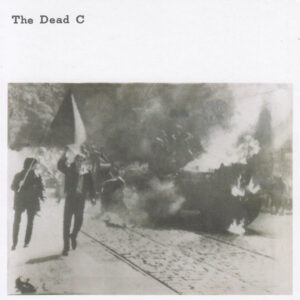
CD
The DEAD C
“Armed courage”
With nary a praising documentary, coffee table photo book or tribute band to their name, The Dead C are nonetheless one of the most respected, longest surviving groups in the history of rock. Still sporting the original band members (Michael Morley on guitar, vocals, Bruce Russell on guitar, Robbie Yeats on drums) from their first assemblage in 1987, The Dead C’s renown has a lot to do with their stubborn unwillingness to compromise in any form. With a varied and challenging discography, the band has never released an album requiring later apology. No The Elder. No Diabolus in Musica. No Trans. Each release demands appraisal on its own merits and exists separate from any temporal trends in underground music, save for whatever influence they’ve had on others. Armed Courage reaffirms their epochal career. With two side-long tracks, the record epitomizes the elements which elevate The Dead C to a level of worship. Compositions assemble and pivot, colliding new landscapes while undermining their very foundations. The Dead C exists on an intuitive sphere, with music never over-thought, yet rewarding when contemplated. 2013 marks the first time The Dead C has ever appeared on the cover of a magazine, and how appropriate that it was in The Wire, the only international music rag to celebrate anti-traditionalism. It is easy to view this as a highpoint of recognition, but the real achievement happens whenever that cognitive switch flips in the listener’s head, and they suddenly think, “I get it” - because from that point on, the promise of future satisfaction is guaranteed.
15,00€
In stock

CD
Richard CHARTIER
“Removed”
Back in stock. Very last copies !
Limited Edition, embossed sleeve 300 copies.
In 2000, The Wire wrote of Chartier’s work: “it’s worth stretching the ears in search of Chartier’s sequences of exquisitely sculpted sonic events, as gorgeous detail bodies forth out of the shadows”… the same holds true today.
Formed over the course of 5 years, Removed was a process of removal/erasure.
Only trace elements appear from what was. Their interactions merely a ghost of a composition - subtle echoes across the sound spectrum. A glacially paced progression of discreet relational sonic events and flows.
Inspired in part by the rigorous line drawings of American visual artist Linn Meyers, whose 2011 untitled drawing graces the cover, Removed draws the listener in to follow patterns. Meyers often creates large scale on-site works that transform a space into durational installations of seemingly endless lines. Seen from a distance these lines appear as almost natural ripples in a wall surface, but deeper, upon closer inspection, the delicate echoes and fluctuations of the artist’s hand arise from the density of details.
Chartier’s precise sound compositions work in a similar manner. Austere and shimmering, the two compositions of Removed beg for careful listening on headphones. Or let these 2 compositions play quietly amplified across your space. Either way, a physically captivating dimensional experience.
Removed is a continuing reflection on major aesthetic elements of Chartier’s artistic language as it has evolved through the years. This is Chartier’s first new solo studio album since 2013’s field recording exploration Interior Field and 2012’s purely digital Recurrence, both released on LINE, US.
13,00€
In stock

CD
Joseph HAMMER
“Roadless travel”
LAFMS musician Joseph Hammer creates unparalleled works of tape manipulation. However, as yet there are comparatively few solo albums by this phenomenal artist. To rectify this situation, Art Into Life has decided to release Roadless Travel, his latest album. The album comes with a dense 24 page booklet of liner notes (essentially a full history of Hammer) by T. Sakaguchi, who has enjoyed a long friendship with him and is the foremost Japanese historian of the LAFMS scene. Liner notes - Takuya Sakaguchi. Translation - Alan Cummings.
17,00€
In stock

CD
Yvan ETIENNE
“Feu”
Yvan Etienne : Serge Modular, Field recordings, Hurdy gurdy. Recorded at “2 princesses” and EMS/Stockholm. French artist/activist Yvan Etienne, is engaged in research in the field of sound art (specific site installations, concerts, etc.). As a musician, he composes and plays pieces using electronic, phonography, analog synthesizers and the hurdy-gurdy. His sound art research questions the perception and physicality of sound spaces. He has played with Phil Niblock, Yann Gourdon, Richard Glover, Brice Jeannin, Patrice Grente, Robert Poss, Paul Panhuysen, Marie Verry…
13,00€
In stock
CD
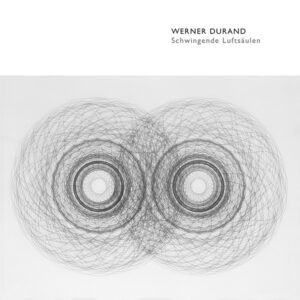
Werner DURAND
“Schwingende Luftsäulen”
“Schwingende Luftsäulen” (Vibrating Air Columns) was composed, played and recorded by Werner Durand between Fall 2010 and Spring 2011, using the Pan-Ney, an instrument that he invented in 1984 and used in these recordings as the only sound source. This is music made of air. Built from air, transmitted by air. Durand’s work is conceived starting from the properties of the air passing thru the plastic tubes that constitutes the Pan-Ney. In the stream of acoustic phenomena applied to musical construction, by way of his ethno-minimalistic approach, this music talk to us about the most ancient feeling and the most contemporary concept in music. A music coming from the far times and made for the future times. The music is accompanied/underlined by the beautiful drawings by Karlheinz Bux, that, as in his own words: “... are abstracted emblems of figures set in rotation. In their appearance, they may resemble oscillating air columns…” This music is dedicated to Tony Conrad, whose piece “Ten Years Alive On The Infinite Plane” from 1972 inspired this particular tuning.
Cardboard Folded cover, 8 pages insert with liner notes in german and english. Edition of 300 copies.
12,00€
In stock

CD
MOHAMMAD
“Segondè Saleco”
34°N - 42°N / 19°E - 29°E study vol.3
Mohammad proudly present Segondè Saleco, the third and final installment of a trilogy that explores the sounds of the geographical area between 34°- 42° & 19° - 29°. Segondè Saleco is the final catharsis which signals a dramatic change of atmosphere in the trio's signature sound. It includes “Sagaraki” featuring Erifili Giannakopoulou on vocals. The first and second volumes , Zo Rèl Do (Lp/Cd) and Lamnè Gastama (Lp/Cd) were released in spring and fall 2014 respectively.
Chamber doom, Sonic rape, Religious, Extremely Dark, Harrowing, Monolithic, Born in Heaven, Electrocution, The opposite of a nightmare: Words used to describe Mohammad's music. Mohammad produce their sound through custom made instruments, bringing together low frequencies, inter-modulations, dark textures, and distant folk nuances. Mohammad are Nikos Veliotis, Coti k & ILIOS. They operate as Mohammad since 2009.
Mohammad proudly present Segondè Saleco, the third and final installment of a trilogy that explores the sounds of the geographical area between 34°- 42° & 19° - 29°. Segondè Saleco is the final catharsis which signals a dramatic change of atmosphere in the trio's signature sound. It includes “Sagaraki” featuring Erifili Giannakopoulou on vocals. The first and second volumes , Zo Rèl Do (Lp/Cd) and Lamnè Gastama (Lp/Cd) were released in spring and fall 2014 respectively.
Chamber doom, Sonic rape, Religious, Extremely Dark, Harrowing, Monolithic, Born in Heaven, Electrocution, The opposite of a nightmare: Words used to describe Mohammad's music. Mohammad produce their sound through custom made instruments, bringing together low frequencies, inter-modulations, dark textures, and distant folk nuances. Mohammad are Nikos Veliotis, Coti k & ILIOS. They operate as Mohammad since 2009.
11,00€
In stock

CD
MOHAMMAD
“Lamne gastama”
Lamnè Gastama is the second volume of a trilogy that explores the sounds of the geographical area between 34° - 42° & 19° - 29° .
In this second volume Mohammad descend further down into the bowels of darkness unleashing sonic monoliths and Promethean melodies and rhythms. Lamnè Gastama, a veritable tour de force including Hapsía the first ever vocal track by the trio so far featuring Sakis Tolis of Rotting Christ.
Segondè Saleco, the third volume and final catharsis is expected in spring 2015. Tirage limité de 500 copies.
In this second volume Mohammad descend further down into the bowels of darkness unleashing sonic monoliths and Promethean melodies and rhythms. Lamnè Gastama, a veritable tour de force including Hapsía the first ever vocal track by the trio so far featuring Sakis Tolis of Rotting Christ.
Segondè Saleco, the third volume and final catharsis is expected in spring 2015. Tirage limité de 500 copies.
10,50€
Out of stock
CD
MOHAMMAD
“Spiriti”
Reissue of the 3LP release on CD format.
“Exactly a year after Roto Vildblomma Mohammad come back with a new release entitled Spiríti. Recorded during 2010 - 2011 in Salonica, Athens and the Island of Tinos. Spiríti is the culmination of Mohammad’s adventures in physical sound and intermodulations. It thrives in powerful low frequencies and rich resonances at the same time being utterly homogenous and monolithic. The atmosphere is dark but exhilarating, heavy but cathartic filled with distant “melodic echoes” from beyond. Mohammad are Nikos Veliotis (cello), Ilios (oscillators) and Coti (double bass).”
11,00€
Out of stock
CD
Miguel A. GARCIA & Miguel SOUTO
“The Lurking Fear”
This album is a collaboration between the prolific Basque sound artist Miguel A. Garcia (a.k.a. Xedh) and the Galician musician Miguel Souto, entitled "The Lurking Fear" as a homage to the American cult horror and science-fiction writer Howard Phillips Lovecraft. More than 50 minutes of dark electronic music in compact disc. Authentically dark and gnarled, a nightmarish opera that encompasses electroacoustic music, noise, dark ambient and drone.
For those who don’t know Anoxia yet, Anoxia Records is a Spanish independent record label whose main objective is to claim music as a form of art beyond mere entertainment or a superficial communication. With this objective we aim to release unique works of art beyond genres or tags.
7,00€
In stock

CD
INSUB META ORCHESTRA
“13 & 27”
Co-ordinated and composed by Cyril Bondi & d’incise.
Alexis Degrenier (hurdy-gurdy), Anna-Kaisa Meklin (viola da gamba), Angelika Sheridan (flutes), Antoine Läng (voice), Anouck Genthon (violin), Bertrand Gauguet (saxophone), Brice Catherin (cello), Bruno Crochet (laptop) - Christophe Berthet (saxophone), Cyril Bondi (harmonium, bass drum), d’incise (laptop), Daniel Tyrrell (acoustic guitar), Dorothea Schürch (voice, singing saw), Eric Ruffing (analogue synthesizer), Gerald Perera (electric double bass), Hans Koch (clarinet), Heike Fiedler (voice), Ivan Verda (electric guitar), Jamasp Jhabvala (violin), Luc Müller (floor-tom, melodica), Maxime Hänsenberger (bowl, harmonium), Raphaël Ortis (laptop), Regula Gerber (double bass), Rodolphe Loubatière (bowl, cymbal), Sébastien Branche (saxophone), Sandra Weiss (bassoon), Steve Buchanan (saxophone), Thierry Simonot (laptop), Violeta Motta (flutes), Vinz Vonlanthen (electric guitar), Wanda Obertova (voice), Yann Leguay (electronics).
“For the ‘13 unissons’, we split the orchestra in 13 subgroups (2-3 musicians) playing just one note as a unison. Every group can play as much as they want but never have more than 3-4 groups playing together. The silence is used as a moment of breath, giving a certain articulation between the musical moments. The main idea is to create different structures and associations between the groups.
‘27 times’ was a difficult piece to record because the structure is quite complex even if the result seems quiet and peaceful. For years our main goal with the orchestra was to convince everybody to feel the ensemble as a whole and not as a collection of individuals. For this piece we ask them exactly the opposite. We started with the idea that each musician had to choose his or her ‘most unique, personal sound’. But obviously, as this is so subjective, we had to find a way to have some coherence.
During this 30 minute piece, each musician has to play 27 times. The orchestra is divided into 4 groups (percussions, strings, winds and electronics), playing at 3 moments. In each moment, the musicians has to play 3 times a sequence of 3 times. Which is at the end 3x3x3, so 27 times, but always the same sound.” Cyril Bondi
Alexis Degrenier (hurdy-gurdy), Anna-Kaisa Meklin (viola da gamba), Angelika Sheridan (flutes), Antoine Läng (voice), Anouck Genthon (violin), Bertrand Gauguet (saxophone), Brice Catherin (cello), Bruno Crochet (laptop) - Christophe Berthet (saxophone), Cyril Bondi (harmonium, bass drum), d’incise (laptop), Daniel Tyrrell (acoustic guitar), Dorothea Schürch (voice, singing saw), Eric Ruffing (analogue synthesizer), Gerald Perera (electric double bass), Hans Koch (clarinet), Heike Fiedler (voice), Ivan Verda (electric guitar), Jamasp Jhabvala (violin), Luc Müller (floor-tom, melodica), Maxime Hänsenberger (bowl, harmonium), Raphaël Ortis (laptop), Regula Gerber (double bass), Rodolphe Loubatière (bowl, cymbal), Sébastien Branche (saxophone), Sandra Weiss (bassoon), Steve Buchanan (saxophone), Thierry Simonot (laptop), Violeta Motta (flutes), Vinz Vonlanthen (electric guitar), Wanda Obertova (voice), Yann Leguay (electronics).
“For the ‘13 unissons’, we split the orchestra in 13 subgroups (2-3 musicians) playing just one note as a unison. Every group can play as much as they want but never have more than 3-4 groups playing together. The silence is used as a moment of breath, giving a certain articulation between the musical moments. The main idea is to create different structures and associations between the groups.
‘27 times’ was a difficult piece to record because the structure is quite complex even if the result seems quiet and peaceful. For years our main goal with the orchestra was to convince everybody to feel the ensemble as a whole and not as a collection of individuals. For this piece we ask them exactly the opposite. We started with the idea that each musician had to choose his or her ‘most unique, personal sound’. But obviously, as this is so subjective, we had to find a way to have some coherence.
During this 30 minute piece, each musician has to play 27 times. The orchestra is divided into 4 groups (percussions, strings, winds and electronics), playing at 3 moments. In each moment, the musicians has to play 3 times a sequence of 3 times. Which is at the end 3x3x3, so 27 times, but always the same sound.” Cyril Bondi
13,00€
Out of stock
CD
DAVIES-PATTERSON-TOOP
“Wunderkammern”
“David Toop laptop, steel guitar, flutes, percussive devices. Rhodri Davies harp, ebows, electronics, preparations. Lee Patterson amplified devices, field recordings. Recorded by Dave Hunt at Dave Hunt Studio, London, 24 July 2006. Magnificent, tight studio recordings from 2006 by a trio of UK improvisers of different generations, coming together to create a rich and strange soundworld of whispered, scraped and quietly haunting reverberations.” label info
11,00€
In stock
CD
Tiziana BERTONCINI-Thomas LEHN
“Horsky park”
“Tiziana Bertoncini (violin) and Thomas Lehn (analogue synthesiser). Recorded in Milan, Italy in july 2006. Recorded in Heidelberg, Germany in november 2010. Galaverna was recorded on November 11th, 2010 at Festival Pulsi, Triennale Bovisa, Milano, Italy. Moss agate was recorded on July 30th, 2006 at art ort Festival, Heidelberg, Germany.Recorded, mixed and mastered by Thomas Lehn and Tiziana Bertoncini.” label info
14,00€
Out of stock
CD
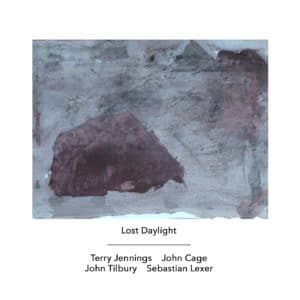
Terry JENNINGS-John CAGE
“Lost daylight”
“The compositions on ‘Lost Daylight’ (at10) by John Cage and the almost-forgotten American Fluxus composer Terry Jennings date from between 1958 and 1966. Yet in the hands of John Tilbury and Sebastian Lexer they sound astonishingly modern. Jennings’ solo pieces couldn’t be more conventional in using only pure keyboard notes, but they could hardly be more radical in the way in which the notes are reduced, isolated and surrounded with silences. As Michael Pisaro’s sleevenotes say, “It is music of simplicity and great mystery. There are bar lines, but nothing feels counted: things happen in moments not measures… The sounds drift, suspended in a dense medium of some kind. The shape of a piece emerges gradually, like the hills appearing as the marine layer burns off. Each piece feels like a small event extended in time.” The score for John Cage’s ‘Electronic Music for Piano’ is nothing more than a few sketchy suggestions for ways in which David Tudor might combine Cage’s ‘Music for Piano’ with the use of electronics. On ‘Lost Daylight’ Sebastian Lexer has transformed John Tilbury’s performance with an alchemical array of electronic techniques, using - as Cage had suggested - star charts and other random processes to determine the editing of the 40 minute interpretation. The result is the first recording of the piece that really sounds like ‘electronic music for piano’ rather than piano music subjected to a minor electronic treatment.”
12,00€
In stock
CD
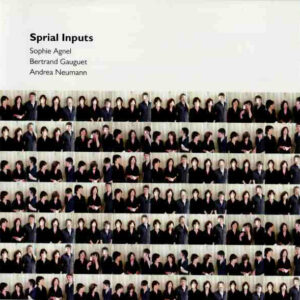
Sophie AGNEL-Bertrand GAUGUET-Andrea NEUMANN
“Spiral inputs”
Sophie Agnel (piano), Bertrand Gauguet (alto and soprano saxophones) and Andrea Neumann (piano frame & electronics). Recorded in Mulhouse, february 2010 and Le Garric, june 2008. Mixed on 23rd and 24th September 2010 at GMEA studio, Albi (81). With the support of GMEA, National Centre for Musci Creation, Albi. The recordings took place during a first residency in June, 2008 at GMEA, National Centre for Music Creation, Albi and during a second residency in February, 2010 at Meteo Festival, Mulhouse. label info
14,00€