
In stock
LP
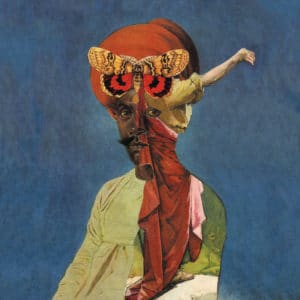
BLOOD STEREO – HAIR & TREASURE
First split LP in a brand new series of collaborations, pairing artists working on the fringes- or not at all. This first split pairs Brighton’s Blood Stereo’s tape gonk with Hair & Treasure’s farm life loops.
Blood Stereo are Dylan Nyoukis and Karen Constance, a British institution, the sound complete immersion for people who don’t immerse easily. Idiot twins Burchill and Slim may behave as though they own Sussex, but Constance and Nyoukis are immune to their surroundings, making livid eyes at confused glitter vixens up and down this squalid Isle.
Hair & Treasure are Alex Jones and Gonçalo F Cardoso, a prankster randy dust duo from nowhere dwelling on tape loops and webbed finger piano ballads. The material was culled from a mound of who cares electro-acoustic improv sessions as an offering to the associated deities of the zwieback buttermilk trade.
Press :
“They explore hand-cranked 20th century technology in combination with epiglottal gymnastics and free music modes inherited as much from punk rock's mutilated aesthetic as utopian art styles.” David Keenan
“In their masks or out, they sow confusion like wheat.” Byron Coley
“So go ahead & let them get a little bit of their saliva on you.” Angela Sawyer
Blood Stereo are Dylan Nyoukis and Karen Constance, a British institution, the sound complete immersion for people who don’t immerse easily. Idiot twins Burchill and Slim may behave as though they own Sussex, but Constance and Nyoukis are immune to their surroundings, making livid eyes at confused glitter vixens up and down this squalid Isle.
Hair & Treasure are Alex Jones and Gonçalo F Cardoso, a prankster randy dust duo from nowhere dwelling on tape loops and webbed finger piano ballads. The material was culled from a mound of who cares electro-acoustic improv sessions as an offering to the associated deities of the zwieback buttermilk trade.
Press :
“They explore hand-cranked 20th century technology in combination with epiglottal gymnastics and free music modes inherited as much from punk rock's mutilated aesthetic as utopian art styles.” David Keenan
“In their masks or out, they sow confusion like wheat.” Byron Coley
“So go ahead & let them get a little bit of their saliva on you.” Angela Sawyer
17,00€
Out of stock
LP
Yannick DAUBY
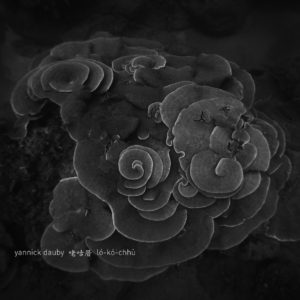
“ló-kó -chhù : Penghu Experimental Sound Studio Vol.2”
Yannick Dauby returns to Discrepant for Vol2 of his ongoing study of the sounds and sights on the Penghu Archipelago, Taiwan.
ló-kó -chhù - means, in Taiwanese, Coral House. Penghu Experimental Sound Studio Vol2 uses interviews, field recordings, found objects and subtle electronic manipulation to transpose Yannick’s impressions of the island’s natural beauty.
All sounds, field recordings and improvisations on electronic instruments, are from Penghu, Taiwan.
Interviews of children extracted from the film “Childhood of an Archipelago”, by Yannick Dauby & Wan-Shuen Tsai. The second session of Penghu Experimental Sound Studio was located in Husi village, during Summer and Autumn 2015 whilst the album was assembled in the hills of Taipei, during the Spring 2016.
ló-kó -chhù - means, in Taiwanese, Coral House. Penghu Experimental Sound Studio Vol2 uses interviews, field recordings, found objects and subtle electronic manipulation to transpose Yannick’s impressions of the island’s natural beauty.
All sounds, field recordings and improvisations on electronic instruments, are from Penghu, Taiwan.
Interviews of children extracted from the film “Childhood of an Archipelago”, by Yannick Dauby & Wan-Shuen Tsai. The second session of Penghu Experimental Sound Studio was located in Husi village, during Summer and Autumn 2015 whilst the album was assembled in the hills of Taipei, during the Spring 2016.
15,50€
Out of stock
LP
Yannick DAUBY
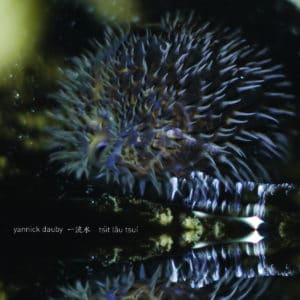
“Tsit lâu tsui. Penghu Experimental Sound Studio Vol.1”
Tsit lâu tsui means, in Taiwanese, a cycle of tide. Yannick Dauby is a French sound artist based in Taiwan since 2007. He relentless explores the soundscapes of his adopted island through field recording, audio documentaries and community projects. He also composes electroacoustic music and he's often found performing live using found objects, analogue devices and digital processing. He has created soundtracks and sound environments for contemporary dance, public art and films as well as being involved in various ecological and local traditional activities.
Dauby stayed in Peng-Hu, an archipelago located in the Taiwan Strait during several months in the first half of 2013. His daily activities included beachcombing, study and documentation of the reef animals, field recording, some teaching and also composing musique concrète in a temporary and probably the first experimental music studio, settled in Shili, a narrow village just between the inner and outer seas. From this old building he hear the seashores and announcements of the itinerant sellers as well as the rituals from a temple nearby. Immersed in this natural and cultural environment, Yannick composed the two sides on this record, using the sounds of the underwater fauna, the omnipresent waves, soundscapes of harbours, music played during funerals, shortwave radio broadcasts , in-site or indoor improvisations using old artefacts collected on the beaches and various sessions using analog electronic instruments. This LP becomes kind of a aural sketchbook of his stay and wandering in these islands on the invitation of the Penghu Citizens Foundation.
Mastered and cut by Rashad Becker @ D&M. Pressed at Optimal. 300 units, black vinyl.
Dauby stayed in Peng-Hu, an archipelago located in the Taiwan Strait during several months in the first half of 2013. His daily activities included beachcombing, study and documentation of the reef animals, field recording, some teaching and also composing musique concrète in a temporary and probably the first experimental music studio, settled in Shili, a narrow village just between the inner and outer seas. From this old building he hear the seashores and announcements of the itinerant sellers as well as the rituals from a temple nearby. Immersed in this natural and cultural environment, Yannick composed the two sides on this record, using the sounds of the underwater fauna, the omnipresent waves, soundscapes of harbours, music played during funerals, shortwave radio broadcasts , in-site or indoor improvisations using old artefacts collected on the beaches and various sessions using analog electronic instruments. This LP becomes kind of a aural sketchbook of his stay and wandering in these islands on the invitation of the Penghu Citizens Foundation.
Mastered and cut by Rashad Becker @ D&M. Pressed at Optimal. 300 units, black vinyl.
15,00€
In stock
LP
Mike COOPER
“Reluctant Swimmer – Virtual Surfer”
The ‘icon of post-everything’, Mike Cooper, returns to Discrepant with a recording of a live set recorded at the Controindicazioni Festival of Improvised Music in Rome in 2003.
The music moves very slowly through four movements: “Reluctant Swimmer”, “Movies is Magic”, “Virtual Surfer” and “Dolphins”. “Floating in out of the exotic ether and disappearing like smoke, engulfed in the alien hugeness of nature... a very elegant set by a visionary artist.”
Mike Cooper says “the first half is played on my old 1920s National tri-plate lapsteel guitar and the second half on my vietnamese electric lap steel. I also sing two songs along the way. “Movies is Magic” by Van Dyke Parks and “Dolphins” by Freid Neil. It was the first time I had ever sung the last song.”
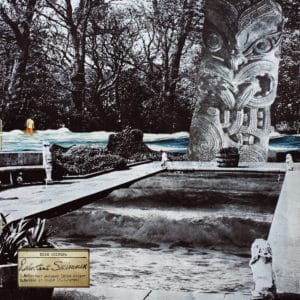
LP artwork is a specially commissioned collage by US artist Evan Crankshaw.
The music moves very slowly through four movements: “Reluctant Swimmer”, “Movies is Magic”, “Virtual Surfer” and “Dolphins”. “Floating in out of the exotic ether and disappearing like smoke, engulfed in the alien hugeness of nature... a very elegant set by a visionary artist.”
Mike Cooper says “the first half is played on my old 1920s National tri-plate lapsteel guitar and the second half on my vietnamese electric lap steel. I also sing two songs along the way. “Movies is Magic” by Van Dyke Parks and “Dolphins” by Freid Neil. It was the first time I had ever sung the last song.”
LP artwork is a specially commissioned collage by US artist Evan Crankshaw.
15,00€
Out of stock
LP
Gonçalo F. CARDOSO & Ruben PATER
“A Study into 21st Century Drone Acoustics”
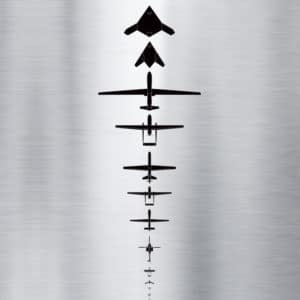
Much attention is focused on drones as ‘eyes in the sky’. However for people on the ground, the sound of the drones is much more pervasive. Military drones fly at high altitudes and are more often heard than seen. The word drone itself is rooted in sound, referring to the noise of the male honeybee. The sound of drones in areas of conflict create frightening soundscapes that go on for many hours on end. The sound gives them nicknames like Zanana (buzz) in Palestine.
In this project, designer Ruben Pater (Drone Survival Guide) and composer Gonçalo F. Cardoso (Discrepant) join hands to focus on the auditive aspects of drones. What engines do drones have, and what do they sound like? Side A features recordings of 17 drone types, ranging from small consumer drones to large military drones, as contemporary bird songs. The B side presents a soundscape by Gonçalo F. Cardoso, inspired by the abusive and destructive power or drone technology. The composition focus on the conceptual (sound) life and death of an aerial drone machine in the 21st century.
Mastered by Rashad Becker. Printed on a metallic finish sleeve. LP + 12 page booklet.
In this project, designer Ruben Pater (Drone Survival Guide) and composer Gonçalo F. Cardoso (Discrepant) join hands to focus on the auditive aspects of drones. What engines do drones have, and what do they sound like? Side A features recordings of 17 drone types, ranging from small consumer drones to large military drones, as contemporary bird songs. The B side presents a soundscape by Gonçalo F. Cardoso, inspired by the abusive and destructive power or drone technology. The composition focus on the conceptual (sound) life and death of an aerial drone machine in the 21st century.
Mastered by Rashad Becker. Printed on a metallic finish sleeve. LP + 12 page booklet.
20,00€
Out of stock

LP
Félix BLUME
“Death in Haiti: Funeral Brass Bands & Sounds from Port au Prince”
Recorded in Port au Prince by sound artist Félix Blume in early December 2016, Death in Haiti plunges the listener into a world of pain, loss and solemn celebration as each funeral comprises of its own live jazz band as well as a plethora of characters like the joker (le blaguer) who cracks jokes and tales about the recently deceased.
A beautiful document of a thriving tradition, a counterpart or updated version of those famous Dirge Jazz records such as the New Orleans’ Eureka Brass Band on Folkways.
About the artist:
Félix Blume is a sound artist and sound engineer. His personal work is based on field-recordings and uses sound as a raw source, in sound pieces, radio plays, videos, actions and installations. A particularity of his work is that the audio and visual aspects are closely intertwined. As a sound collector, he has a large sound library recorded from different parts of the world that he freely shares on the Internet. His work as sound engineer focuses on sound recording, sound design for documentaries, feature films and video art, collaborating with different directors and visual artists.
A beautiful document of a thriving tradition, a counterpart or updated version of those famous Dirge Jazz records such as the New Orleans’ Eureka Brass Band on Folkways.
About the artist:
Félix Blume is a sound artist and sound engineer. His personal work is based on field-recordings and uses sound as a raw source, in sound pieces, radio plays, videos, actions and installations. A particularity of his work is that the audio and visual aspects are closely intertwined. As a sound collector, he has a large sound library recorded from different parts of the world that he freely shares on the Internet. His work as sound engineer focuses on sound recording, sound design for documentaries, feature films and video art, collaborating with different directors and visual artists.
16,00€
Out of stock

LP
CM von HAUSSWOLFF
“Operations of spirit communication”
Small repress of the classic album from 2000 which is partly based on (and also dedicated to) the work of Friedrich Jürgenson who recorded the “voices of the dead”. Gatefold cover. Clear vinyl. 300 copies.
17,00€
Out of stock

LP
Luciano CILIO
“Dialoghi Del Presente”
Faithful to the 1977 pressing, exclusive edition available in very limited supply. Clear Vinyl and an original insert that functions as Obi. Edition made in collaboration with Btf/Universal.
Dialoghi Del Presente represents a truly unique approach to music making where each instrument and each sound are given ample time and space to develop. For the recording sessions leading to this remarkable work Luciano Cilio took up a role as multi-instrumentalist, performing on piano, guitar, flute, bass and mandola, also joined by musicians coming from different experiences and areas, who supply strings, extra woodwind and percussion. Almost impossible to define, the all-acoustic music of Cilio occupies a space between the devotional music of Popol Vuh’s Florian Fricke and the deep spiritual places of what would later be called holy minimalism (without any of the religious intents of the afore-mentioned references), with a surprising anticipation of the crystalline sparseness of pieces like “Fur Alina” by Arvo Part, and a feeling of intense suspension of time that can be associated to some of the most intimate compositions of Ligeti or Morton Feldman, yet maintaining a definite position outside the contemporary music of serial and academic inspiration.
“These recordings sound as they feel self contained, introspective, and determined, you can feel in the music a sort of necessity that can be rarely found, as in Bill Fay’s “Time of the Last Persecution”, or in Nick Drake's “Pink Moon”: this enormous weight that is bearing on it's creators, the absolute need to exorcize it from their lives, a moment in time where you are invited to hear artists truly in contact with their existence. Luciano Cilio holds that moment in time, an authentic emotional testament, something to be cherished" has written Jim O’Rourke in his inspiring liner notes.
Dialoghi Del Presente represents a truly unique approach to music making where each instrument and each sound are given ample time and space to develop. For the recording sessions leading to this remarkable work Luciano Cilio took up a role as multi-instrumentalist, performing on piano, guitar, flute, bass and mandola, also joined by musicians coming from different experiences and areas, who supply strings, extra woodwind and percussion. Almost impossible to define, the all-acoustic music of Cilio occupies a space between the devotional music of Popol Vuh’s Florian Fricke and the deep spiritual places of what would later be called holy minimalism (without any of the religious intents of the afore-mentioned references), with a surprising anticipation of the crystalline sparseness of pieces like “Fur Alina” by Arvo Part, and a feeling of intense suspension of time that can be associated to some of the most intimate compositions of Ligeti or Morton Feldman, yet maintaining a definite position outside the contemporary music of serial and academic inspiration.
“These recordings sound as they feel self contained, introspective, and determined, you can feel in the music a sort of necessity that can be rarely found, as in Bill Fay’s “Time of the Last Persecution”, or in Nick Drake's “Pink Moon”: this enormous weight that is bearing on it's creators, the absolute need to exorcize it from their lives, a moment in time where you are invited to hear artists truly in contact with their existence. Luciano Cilio holds that moment in time, an authentic emotional testament, something to be cherished" has written Jim O’Rourke in his inspiring liner notes.
25,00€
Out of stock
LP
Lino Capra VACCINA
“Antico Adagio”
2017 small repress.
Notes to the release: Deluxe edition, silver and gloss varnish print with printed inner sleeves housing a transparent anti-static record sleeve, limited to 300 copies. Includes insert with notes in Italian and English.
Before an aberrant idea of progress and workaholic ethic ludicrously sped up our daily lives, even in the hectic city of Milan it was possible to “play slowly” – with no pressure, simply following the path your art was showing you. After a classic artistic journey and an experimental stint with Aktuala and other brilliant fellow musicians (like Franco Battiato, above all), Lino Capra Vaccina, near the end of the 70s, recorded Antico Adagio. It was an amazing album, anticipating countless future experiments in the field of new age and world music but also in avantgarde and electronic music. Apart from a few violin parts and the extraordinary vocal lines (sung by Vaccina himself and Juri Camisasca), Antico Adagio is an album fully built on percussions. But, at the same time, it’s the farthest thing from the typical idea of percussions. You won’t find a single trace of African or primitive beats: instead, this is a collection of rather long, subtle and thoughtful compositions, crafted with vibraphones, marimbas and gong. Together they create a work which will remain unique – both in Capra Vaccina’s discography as well as in a more general sense.
From Kieran Hebden/FourTet liner notes: «There are records I have found in my life that I was almost wishing existed before hearing them. Recordings with new combinations of sound and atmosphere I knew could be wonderful to me if I ever discovered them, and then on discovery the sound was even better than I could have imagined. I felt this way when first hearing music by Alice Coltrane (Journey to Satchidananda) and Don Cherry (Organic Music Society) and I also felt it with Antico Adagio. The combinations of the rhythms and melodies resonate with me in a very clear way and I feel transported by this music every time I hear it.… I first heard this record when it was posted on the Mutant Sounds blog a few years ago and am very happy to see it get another release. The music is timeless and brilliant and maybe there are other people out there wishing for a sound like this too who will now have chance to find it».
Notes to the release: Deluxe edition, silver and gloss varnish print with printed inner sleeves housing a transparent anti-static record sleeve, limited to 300 copies. Includes insert with notes in Italian and English.
Before an aberrant idea of progress and workaholic ethic ludicrously sped up our daily lives, even in the hectic city of Milan it was possible to “play slowly” – with no pressure, simply following the path your art was showing you. After a classic artistic journey and an experimental stint with Aktuala and other brilliant fellow musicians (like Franco Battiato, above all), Lino Capra Vaccina, near the end of the 70s, recorded Antico Adagio. It was an amazing album, anticipating countless future experiments in the field of new age and world music but also in avantgarde and electronic music. Apart from a few violin parts and the extraordinary vocal lines (sung by Vaccina himself and Juri Camisasca), Antico Adagio is an album fully built on percussions. But, at the same time, it’s the farthest thing from the typical idea of percussions. You won’t find a single trace of African or primitive beats: instead, this is a collection of rather long, subtle and thoughtful compositions, crafted with vibraphones, marimbas and gong. Together they create a work which will remain unique – both in Capra Vaccina’s discography as well as in a more general sense.
From Kieran Hebden/FourTet liner notes: «There are records I have found in my life that I was almost wishing existed before hearing them. Recordings with new combinations of sound and atmosphere I knew could be wonderful to me if I ever discovered them, and then on discovery the sound was even better than I could have imagined. I felt this way when first hearing music by Alice Coltrane (Journey to Satchidananda) and Don Cherry (Organic Music Society) and I also felt it with Antico Adagio. The combinations of the rhythms and melodies resonate with me in a very clear way and I feel transported by this music every time I hear it.… I first heard this record when it was posted on the Mutant Sounds blog a few years ago and am very happy to see it get another release. The music is timeless and brilliant and maybe there are other people out there wishing for a sound like this too who will now have chance to find it».
24,50€
In stock
LP
Stephen O’MALLEY
“Gruidés”
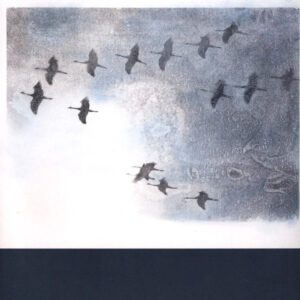
The dark interpreter, Stephen O’Malley ov Sunn 0))), presents his towering debut orchestral composition ‘Gruidés’; commissioned by French 35-piece improv orchestra ONCEIM - l’Orchestre de Nouvelles Créations, Expérimentations et Improvisation Musicales - and released thru Demdike Stare’s DDS label.
In early 2014 O’Malley was approached by pianist and composer Frédéric Blondy to write a work for the orchestra, comprised of exceptional musicians from the fields of contemporary, jazz, experimental, improvisation and classical. Understandably intimidated by the prospect, but encouraged to “just be punk rock about it”, the preternaturally gifted composer has conceived a technically demanding - for the players at least - and richly rewarding longform drone piece intently focussed on harmonic experimentation and overtone study.
During its 35 minute lifespan, ‘Gruidés’ requires the musicians to sustain pitches for several minutes (which is difficult enough for strings, and a real feat of endurance for woodwind), yielding a gloaming spectra of eliding dissonance rent in sliding tone clusters and lucent geometries punctuated by a similar whipcrack percussion as used in his Scott 0))) collaboration.
It makes great use of the acoustic qualities of Saint Merry church, central Paris, as captured in the recording of IRCAM’s Augustin Muller and mastered by Matt Colton with a detached spaciousness evocatively distilled in the cover art by Jean-Luc Verna. It’s an incredibly immersive piece that comes highly recommended if you’re into the work of Phill Niblock, Alvin Lucier, Ellen Fullman, Harley Gaber and, indeed, Sunn 0))).
24,00€
Out of stock
LP
Hélène BRESCHAND
“Les incarnés”
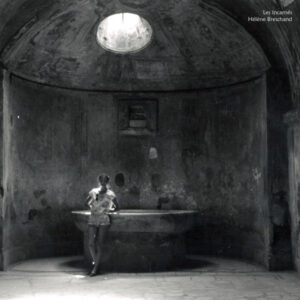
New solo recorded in Paris, December 2013. Harp, acoustic and electric, voice. “Hélène Breschand demonstrating her readiness to deconstruct her instrument’s identity...”. Julian Cowley - The Wire
17,00€
In stock

LP
Rie NAKAJIMA
“Four forms”
Rie Nakajima is a Japanese artist based in the UK. She has exhibited and performed all over the world charming audiences with her inventive works of mechanical bricolage. In 2014 she received the Arts Foundation prize for Experimental Music. She co-curates the event series “Sculpture” with David Toop and has collaborated with Miki Yui, David Cunningham, Phill Niblock, Pierre Berthet and many others.
Consumer Waste is pleased to release Nakajima’s debut LP, which contains four pieces recorded in Oxford in January 2014: “sources of sound that have the lives of small creatures, maybe small creatures that hibernate in darkness but then come to life when exposed to the light. These creatures of which I speak are activated to perform their own cycles of drumming or scraping, all working together as if moving inexorably toward the sudden miraculous synchronicity of flashing light that a few fortunate observers have seen in firefly displays. What I am saying, should it be unclear, is that this is a kind of intensely rhythmic music performed by an extra-human ensemble not susceptible to the orthodoxies of human culture, in a sense a step into another dimension.” David Toop
20,00€
In stock
LP
Hermann NITSCH
“Orgien Mysterien Theater – 25. Aktion (wiederaufgeführt)”
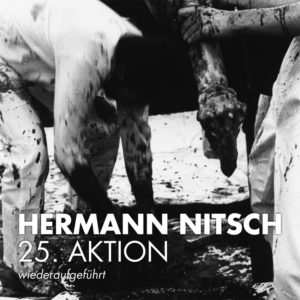
Re-Performance of the 25. Action, March 1982 in the gallery Pakesch, Vienna (Premiere was in New York 1968). Hermann Nitsch, Austria, painter, performance-artist and composer, was a crucial founding artist of “Viennese Actionism”. Exhibitions and performances all over the world since the 60s.
The idea of the very sensual and archaic “Orgien Mysterien Theater” was developed in the late 50s and is performed in variations untill today.
Nitsch works out all settings of the rituals, the feast in great detail, precisely composes days of art, performance, food, wine and music – to celebrate the existence of mankind…
25,00€
In stock
LP
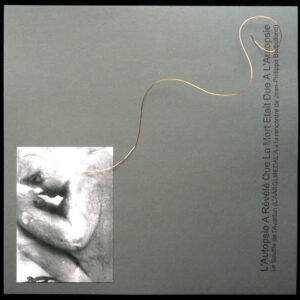
L’AUTOPSIE A RÉVÉLÉ QUE LA MORT ÉTAIT DUE À L’AUTOPSIE
“Le souffle de l’avorton”
With Franck de Quengo, Alan Courtis, Nicolas Marmin and Sébastien Borgo.Work with the music scores of 17th century dead at birth composer Jean-Philippe Borbollono. Handmade sleeve + inserts & liner notes + two postcards + poster.
17,00€
Out of stock

LP
Günter MÜLLER – Norbert MÖSLANG
“vlan_voilà”
Günter Müller, ipods, electronics. Norbert Möslang, cracked everyday electronics. Recorded April 10, 2016, cave12, Geneva.
A beautifull record from two Swiss masters of electronic music. Like an imaginary landscape full of pulses, resonances, ghostly voices and nice noises !
20,00€
In stock
LP
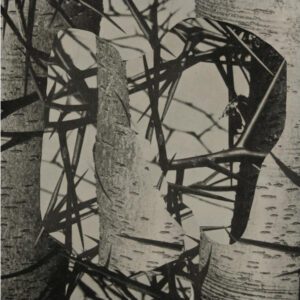
FEMME
“Chroma”
“When it comes to head-scratchers, no one plows into the scalp like Bruit Direct. For their 24th release, they’ve ponied up this melange by the duo Femme, whose lp, Chroma, summons forth a soundscape of stellar post trance, electro magma. As dense as it is deft. The 10 gurgling innards effortlessly spewed out here rank it alongside other Moltenadelic CO-2 snuffers such as Ilitch’s ‘Periodik Mindtrouble’ & Junji Hirose + Yoshihide Otomo’s ‘Silanganan Ingay’. Lush, foreboding & fantastical, ‘Chroma’s’ pocket universe of seductive dread could spook the sheen right off’ve Moebius’ Airtight Garage & there ain’t a damn thing Major Grubert or Jerry Cornelius gonna do about it. The future doesn’t get anymore Untopian than this.” Tom Lax
Femme is the duo of Arno Bruil (Descendeur / France Sauvage) and Jo Tanzprocesz (Fusiller / Opera Mort).
19,00€
Out of stock

LP
Kevin DRUMM
“Crowded”
Recorded, mixed, edited at Pathetic Bubble Studio 2009-2012. Source material for Repetitive Algae recorded in 2007. Spectral editing and time domain consultation on Repetitive Algae by Russell Haswell. “[…] The two side long pieces here seem to be two different sides of the same coin. ’Rediki’ is a piece of electronics, loud at times, swirling-beating-oscillating most of the times and piercing right through your ears, without mercy, but it’s also, at the same time, not y’r typical noise record. The deep end has a menacing/treating/oppressing sound that adds a lot of tension to the piece. Here is where the true power of the piece lies, and what sets the great composer aside from those who try their hands at noise. But alright it’s a noise indeed, and for me the really great/even better piece of music is on the other side, ’Reptitive Algae’, which seems to me all acoustic, and perhaps if not all, then at least for a greater part. Maybe it’s here where Drumm got the idea for the title of the record. One side is crowded with buzzing and ringing of tones and on the other it’s just crowded with sounds. Multi-layered with tons and tons (it seems) of acoustic sounds, rubbing against each other. Sound source: unknown. There is a bit of electronica in there, but don’t ask me how this works. Well, perhaps I could guess: lots of loops of different lengths playing at the same time, so that they hardly make the same connection very soon again. Music with a great deal of tension, like a horror movie soundtrack. The graveyard shakes and all the bodies rise like one man, rattling their cages. This record is reminder I should play some Kevin Drumm soon again.” (-) Frans de Waard, Vital Weekly.
15,00€
In stock

LP
Kevin DRUMM
“Phantom jerk”
6 oscillators recorded July 2013 at Single Room Occupancy, Chicago IL. Vinyl issue of his 2013 CDr release, “Phantom Jerk”. In the tradition of “Imperial Distortion”. Black vinyl.
15,50€
Out of stock

LP
Jérôme NOETINGER – ENSEMBLE PHOENIX
“Les voix de l’invisible”
“In June 2012, Ensemble Phoenix Basel commissioned me to create a work for them to play.
It was the first time in my life I had received such a request. After several months of reflection, I accepted and began working on a way of communicating a music with other musicians.
Not knowing classical notation, I decided to do what I do know: that being, working with recording and loops, and thereafter, ask the musicians to play by ear.
After a first session, having their interpretations in mind, I could reorganise it all taking into account the physical limits of each instrument.
I am very happy with this experience and warmly thank everyone in the Ensemble Phoenix for having made this possible.
The title, “Les voix de l'invisible” (The voice of the invisible) is inspired by Pascal Quignard's book, “La haine de la musique” (The hate of music).” Jérôme Noetinger (translated by Liz Racz)
Ensemble Phoenix Basel. Christoph Bösch, flute. Toshiko Sakakibara, clarinet. Raphael Camenisch, saxophone. Samuel Wettstein, synthesizer. Maurizio Grandinetti, electric guitar. Aleksander Gabrys, doublebass. Daniel Buess, percussion and electronics. Thomas Peter, electronics.
Jérome Noetinger, composition, Revox tape machines.
Recorded live at Gare du Nord Basel, 14 & 15 June 2013.
Recorded, mixed and mastered by Alex Buess.
16,00€
Out of stock

LP
Ikue MORI – Maja S.K. RATKJE
“Scrumptious sabotage”
Now as a vinyl also. “A recording of live performances which brought together two essential figures of the contemporary scene: an oustanding Norwegian composer and vocal artist Maja S.K. Ratkje and a celebrated improviser and composer, former DNA drummer, Ikue Mori. The common sound territory, created together by Mori and Ratkje, balances between quietly growing tension and powerful outbursts of unrestrained, relentless noise. Within this harmony, Ratkje takes adventurous excursions towards the borders and unknown facets of sound, using treated voice as well as an acoustic and electronic workshop, while Mori’s thoughtful laptop provides a strong frame and a sense of deep focus. In these carefully crafted, long and nuanced compositions, both artists maneuver between meditative, ritual areas and irregular, elusive noise blots. The most astonishing element of this superb performance is the realization that even though the compositions are entirely intuitive, created without any previous planning, guidelines or negotations, the listener can sense a nearly palpable sense of deep connection and understanding between the artists. Their knowledge and keen, immediate communication create an invisible harness, which naturally directs the stream of improvisation. This engaging, exhaustive listen is a contemplative retreat and a daring, dizzying somersault at once”. (-) Olga Drenda. All music composed and performed by Maja Solveig Kjelstrup Ratkje and Ikue Mori. Recorded live by Barry Hollywood at Black Box, Belfast, March 31, and by Dan Fox and Simon Hanson at The Lanternhouse, Ulverston, March 29, 2012 UK. Mixed and mastered by Maja S.K. Ratkje in Svartskog, Norway. Cover design by Lasse Marhaug.
16,00€
Out of stock

LP
Sarah HENNIES
“Embedded Environments”
Through a remarkable and singular body of work, over the course of the last decade, like storm beginning as whisper on the horizon, the composer and percussionist Sarah Hennies has slowly emerged as one of the definitive voices of her generation. Initially coming to focus as a member of Austin’s experimental music scene during the early 2000’s, before relocating to upstate New York, with a delicate, clattering grace, she has continuously offered vision, conceptual armature, crucial understanding for the contemporary proximity of avant-garde and experimental practice. Entirely of her moment, she defies what we know and expect, owing allegiance to none. Hennies has been darting around the edges of modern composition for years, but that world has never been an entirely comfortable fit, nor is it the best framework and context within which to approach her work. She is better understood in the proximity of figures like Jim O’Rourke, a creator of a countercultural music, which incorporates everything, while owing loyalty to none. Though not for aesthetics, Hennies could equally be framed with composers like Steve Reich, Arthur Russell, Julius Eastman, and Mary Jane Leach, all of whom struggled to create more inclusive musical hybrids, attacking the institutions as they stood. As these figures once were, Hennies’ position within the contemporary landscape is challenging, bristles, and requires work to understand. Her music isn’t always what it seems. What is unquestionable, is that it is entirely of this moment, and not a product of appropriation or pastiche. What she has to say, has never been said.
Comprised of two site specific compositions - Foragers, and Embedded Environments, recorded in a silo in Buffalo, NY, these recordings are a crowing moment within the long arc of Hennies’ practice. Each work is composed for a quartet of percussionists - Jason Bauers, Tim Feeney, and Bob Fullex, with Hennies contributing on vibraphone and percussion. While Foragers, and Embedded Environments are products of Hennies’ quest for elemental meaning and relationships within sound - those which lay beyond traditional understandings of structure, beat, and tone, here there is a third and unfamiliar actor in play, the space itself. Activated by the silo for which they were composed, Hennies’ broken, staggering rhythms and resonances are offered new freedom through a seductive Trojan horse, pushing them toward even more complex and jarring depths.
Foragers, and Embedded Environments delves into a realm of ideas, proximity, and place, offering a new vision for our sonic present, and what may be to come. Visionary, challenging, bristling, pared to only the essential beats or tones, this music, while beautiful and elemental, is a product of a rigorous form of conceptualism, often unfamiliar within the world of organised sound.
Comprised of two site specific compositions - Foragers, and Embedded Environments, recorded in a silo in Buffalo, NY, these recordings are a crowing moment within the long arc of Hennies’ practice. Each work is composed for a quartet of percussionists - Jason Bauers, Tim Feeney, and Bob Fullex, with Hennies contributing on vibraphone and percussion. While Foragers, and Embedded Environments are products of Hennies’ quest for elemental meaning and relationships within sound - those which lay beyond traditional understandings of structure, beat, and tone, here there is a third and unfamiliar actor in play, the space itself. Activated by the silo for which they were composed, Hennies’ broken, staggering rhythms and resonances are offered new freedom through a seductive Trojan horse, pushing them toward even more complex and jarring depths.
Foragers, and Embedded Environments delves into a realm of ideas, proximity, and place, offering a new vision for our sonic present, and what may be to come. Visionary, challenging, bristling, pared to only the essential beats or tones, this music, while beautiful and elemental, is a product of a rigorous form of conceptualism, often unfamiliar within the world of organised sound.
21,00€
Out of stock

LP
Peter CUSACK
“After Being In Holland For Two Years”
The music you are about to hear defies categorisation. Peter Cusack’s debut long player from 1977 is a peak into one of the most varied and experimental musical scrapbooks you are likely to hear. Infused with natural sounds and a healthy dose of musical abstraction, it is difficult to pigeonhole this record into any genre. It is the kind of record you wished existed while nothing really came close to the mark.
A solo album of guitar and environmental sounds, a montage filled with montages where references to and resonances of varied, often disparate soundworlds spill in every direction. The music manages to be both blatant and covert at the same time; it’s clearly, acutely disjointed and polyvocal yet strangely out of focus in regard to intent. But that’s a thing about montages: by having nothing lead causally, conventionally to the next, a radical, imaginary simultaneity occurs; you continue to experience the presence of each previous section (even though you no longer hear them) even as a new one abruptly presents itself - all this without the actual physical interference that happens with collage. Presented here for the first time since its initial pressing with extensive new liner notes by Toronto-based composer-performer Martin Arnold, writing that compliments the utterly singular notes Cusack provided for the initial release, reproduced here as well. The LP comes as a limited Edition pressing in full color cover with a fold-up tri-panel inner sleeve housing a Nagaoka anti-static record sleeves, green colored vinyl and Obi.
Peter Cusack is an improvising guitarist, field recording artist and occasional whistler. He founded Bead Records in 1974 to release the only LP by Touch Of The Sun – his shortlived duo with clarinetist Simon Mayo, but the label went on to become a collectively run initiative that produced more than 30 albums of improvised music. The following year he was among those who founded both the journal Musics and London Musicians Collective, both of which were important focal points for London’s nascent improvising community.
Cusack was a member of the eclectic freeform group Alterations with Steve Beresford, Terry Day and David Toop, as well as their irreverent seaside covers spin-off The Promenaders. He formed significant musical relationships with instrument builder Max Eastley, multi-wind instrumentalist Clive Bell, vocalist Vivienne Corringham and sampling trombone player and composer Nicholas Collins.
A solo album of guitar and environmental sounds, a montage filled with montages where references to and resonances of varied, often disparate soundworlds spill in every direction. The music manages to be both blatant and covert at the same time; it’s clearly, acutely disjointed and polyvocal yet strangely out of focus in regard to intent. But that’s a thing about montages: by having nothing lead causally, conventionally to the next, a radical, imaginary simultaneity occurs; you continue to experience the presence of each previous section (even though you no longer hear them) even as a new one abruptly presents itself - all this without the actual physical interference that happens with collage. Presented here for the first time since its initial pressing with extensive new liner notes by Toronto-based composer-performer Martin Arnold, writing that compliments the utterly singular notes Cusack provided for the initial release, reproduced here as well. The LP comes as a limited Edition pressing in full color cover with a fold-up tri-panel inner sleeve housing a Nagaoka anti-static record sleeves, green colored vinyl and Obi.
Peter Cusack is an improvising guitarist, field recording artist and occasional whistler. He founded Bead Records in 1974 to release the only LP by Touch Of The Sun – his shortlived duo with clarinetist Simon Mayo, but the label went on to become a collectively run initiative that produced more than 30 albums of improvised music. The following year he was among those who founded both the journal Musics and London Musicians Collective, both of which were important focal points for London’s nascent improvising community.
Cusack was a member of the eclectic freeform group Alterations with Steve Beresford, Terry Day and David Toop, as well as their irreverent seaside covers spin-off The Promenaders. He formed significant musical relationships with instrument builder Max Eastley, multi-wind instrumentalist Clive Bell, vocalist Vivienne Corringham and sampling trombone player and composer Nicholas Collins.
17,00€
Out of stock

LP
Mary Jane LEACH
“Pipe Dreams”
Two astonishing archival works by Mary Jane Leach are now available on vinyl for the first time, and a landmarkfrom the highly fertile 1970-80s New York minimalist scene. Having moved to New York during the middle 1970’s, she entered fray during a crucial period in the city’s creative and cultural life, joining a community of remarkably talented and ambitious Downtown composers, which, among others, included Julius Eastman (following his untimely death, she become the great champion and protector of the composer’s legacy), Arnold Dreyblatt, Arthur Russell, Ellen Fullman and Philip Corner.
Long overdue, these works are an open door - an entry into a body of thought and sound which has lingered just out view, issuing its quiet influence over the past four decades. They are the light shone on the shadows of neglect, illuminating Leach as one of the most important and underrecognized voices in her generation - those New York composers who followed the Minimalist.
Première release, available in an edition of 300 copies, a shifting and simmering body of tone and tension, doubling as meditative sonic immersion, an other-worldly sound environment, etched in wax.
Long overdue, these works are an open door - an entry into a body of thought and sound which has lingered just out view, issuing its quiet influence over the past four decades. They are the light shone on the shadows of neglect, illuminating Leach as one of the most important and underrecognized voices in her generation - those New York composers who followed the Minimalist.
Première release, available in an edition of 300 copies, a shifting and simmering body of tone and tension, doubling as meditative sonic immersion, an other-worldly sound environment, etched in wax.
21,00€
Out of stock

LP
Jocy DE OLIVEIRA
“Estórias Para Voz, Instrumentos Acústicos e Eletrônicos”
The legendary debut of Jocy De Oliveira - and a landmark classic from the 70s Brazilian Electronic music scene. To quote Keith Fullerton Whitman, this is the “lost Tropicalia / Psych / free-Vocal / Ring-Modulator freakout / jam hybrid that you’ve only dreamt about!” It is difficult to overstate the importance of Jocy De Oliveira. Defined by a body of singular music spanning seven decades, within the histories and continuing legacies of avant-garde practice, she is without equivalent. Her work is a lens - a window into breadth, idealism, and actualities of her many eras - of all the possibilities they’ve held. While she remains a widely celebrated voice in her own country - Brazil, perhaps more than any other figure, Oliveira’s life and career, with her album Estórias Para Voz, Instrumentos Acústicos e Eletrônicos from 1981 - resonating through a shimmering body of organised sound, unveils truths lingering in the shadows - histories long suppressed and lost - the sins suffered by the Latin American avant-garde, with the actualities of its astounding heights.
Oliveira began her career as a concert pianist, dedicated to the cutting edge works of the avant-garde. She left Brazil at young age to study in America and Europe, before being recruited by major orchestras across both continents - working under Stravinsky, and having pieces written for her and premiering of works by Berio, Xenakis, Santoro, Cage, and Manuel Enriquez. Her rendering of Messiaen’s Catalogue D’Oiseaux is still widely held as the definitive version. During the early 1960’s, Oliveira shifted her efforts toward composition. A wildly restless creative mind, she embarked on a process of folding organised sounds across nearly every context it could inhabit - public and private interventions, theatre, installations, film, video, tape, as much as the concert hall - blurring the lines between performance and composition, incorporating diverse media well beyond the world of sound. In 1961, within a collaborative theatre work written with Luciano Berio - Berio Apague Meu Spot Light, she instigated the first performance of electronic music staged in Brazil. In 1968 she joined Pauline Oliveros and Annea Lockwood as one of the only women asked to contribute to the legendary publication Source: Music of the Avant Garde - entering its fourth and seventh editions, and became its sole Latin American contributor. Only the beginnings of what, over the coming decades, would rise as her singular and astounding body of achievement and work.
Released in 1981, during the last years of her country’s military dictatorship, Estórias Para Voz, Instrumentos Acústicos e Eletrônicos was met by controversy before quickly sinking from view - heard by almost no one beyond Brazil’s borders. Among the most astounding realisations of electroacoustic process ever recorded - a work of shimmering beauty and potential, across its two sides, Oliveira yields works which level the field. A series of sonic stories for voice, and acoustic and electronic instruments - prepared piano, violin, percussion, synthesizers, electric celesta, etc, it the album’s singularity, culture, humanity, and introspection which can not be displaced. Like its composer, Estórias Para Voz, Instrumentos Acústicos e Eletrônicos is Brazilian, and to be Brazilian, is to be many things at once. It’s works draws on a diverse range of the country’s musics and percussion traditions, as well as Indian raga structures, and Japanese Shomyo singing - inspired in part by the sounds of immigrant communities within Sao Paulo, the city where Oliveira grew up. Across the album’s breadth, electronic music returns home - distilling the entirety of Oliveira’s being, radically diverse culture, and idealism. A work of profound democracy, optimism, and truth - reforming history, and in so doing, placing the future of the avant-garde back into its own hands.
Reissued for the first time since it original release, this marks the return of one of the 20th century’s most important electronic works. Presented with the care and craft for which Blume editions has become known, these are the wonders of art - the towering heights of sounds - the realm where countless possible utopias unfold. The LP comes as a limited edition, in full color cover with a printed inner sleeve housing a Nagaoka anti-static record sleeve, Red colored vinyl and an original insert that functions as Obi as well.
Oliveira began her career as a concert pianist, dedicated to the cutting edge works of the avant-garde. She left Brazil at young age to study in America and Europe, before being recruited by major orchestras across both continents - working under Stravinsky, and having pieces written for her and premiering of works by Berio, Xenakis, Santoro, Cage, and Manuel Enriquez. Her rendering of Messiaen’s Catalogue D’Oiseaux is still widely held as the definitive version. During the early 1960’s, Oliveira shifted her efforts toward composition. A wildly restless creative mind, she embarked on a process of folding organised sounds across nearly every context it could inhabit - public and private interventions, theatre, installations, film, video, tape, as much as the concert hall - blurring the lines between performance and composition, incorporating diverse media well beyond the world of sound. In 1961, within a collaborative theatre work written with Luciano Berio - Berio Apague Meu Spot Light, she instigated the first performance of electronic music staged in Brazil. In 1968 she joined Pauline Oliveros and Annea Lockwood as one of the only women asked to contribute to the legendary publication Source: Music of the Avant Garde - entering its fourth and seventh editions, and became its sole Latin American contributor. Only the beginnings of what, over the coming decades, would rise as her singular and astounding body of achievement and work.
Released in 1981, during the last years of her country’s military dictatorship, Estórias Para Voz, Instrumentos Acústicos e Eletrônicos was met by controversy before quickly sinking from view - heard by almost no one beyond Brazil’s borders. Among the most astounding realisations of electroacoustic process ever recorded - a work of shimmering beauty and potential, across its two sides, Oliveira yields works which level the field. A series of sonic stories for voice, and acoustic and electronic instruments - prepared piano, violin, percussion, synthesizers, electric celesta, etc, it the album’s singularity, culture, humanity, and introspection which can not be displaced. Like its composer, Estórias Para Voz, Instrumentos Acústicos e Eletrônicos is Brazilian, and to be Brazilian, is to be many things at once. It’s works draws on a diverse range of the country’s musics and percussion traditions, as well as Indian raga structures, and Japanese Shomyo singing - inspired in part by the sounds of immigrant communities within Sao Paulo, the city where Oliveira grew up. Across the album’s breadth, electronic music returns home - distilling the entirety of Oliveira’s being, radically diverse culture, and idealism. A work of profound democracy, optimism, and truth - reforming history, and in so doing, placing the future of the avant-garde back into its own hands.
Reissued for the first time since it original release, this marks the return of one of the 20th century’s most important electronic works. Presented with the care and craft for which Blume editions has become known, these are the wonders of art - the towering heights of sounds - the realm where countless possible utopias unfold. The LP comes as a limited edition, in full color cover with a printed inner sleeve housing a Nagaoka anti-static record sleeve, Red colored vinyl and an original insert that functions as Obi as well.
21,00€
Out of stock

LP
Bruce NAUMAN
“Soundtrack From First Violin Film”
When speaking of most artists, critical value is generally gauged by evaluating contributions to existing fields. Bruce Nauman is different. His influence is singular. The change his ideas provoked, unequaled. Since the mid 1960’s, he has laid the groundwork – in thought, context, practice, and materiality, for nearly every fine-artist that has followed in his wake. He is the towering pillar of conceptual thinking. Even those who do not directly draw on the ground he gained, must contended with a world in his image.
Initially issued by Tanglewood Press in 1969 - a component of the art multiples edition 7 Objects/69 (also including David Bradshaw, Eva Hesse, Stephen Kaltenbach, Alan Saret, Richard Serra, and Keith Sonnier), Soundtrack from First Violin Film is a crucial element in Nauman’s diverse the canon of contributions - bridging the emerging practices of performance, video, and sound. For an artist smashing boundaries and building anew, it is a near perfect work. Blume’s release (along with the Die Schachtel's one), marks the first time this seminal work has been available to a broader audience, making it a historic event.
Soundtrack from First Violin Film, while resembling music, is one of the earliest gestures of sound art as it has come to be understood. It falls within Nauman’s larger body of solitary actions and performances. In 1968, the artist moved briefly to New York, occupying Jasper Johns’ then vacant studio in the Hamptons, beginning to build the body of work for his first solo show at Leo Castelli Gallery - documenting them in what became the very first works of video art. Within the larger body of effort, emerged a series of works featuring him playing the violin. It is from this world, that the LP Soundtrack from First Violin Film, with its disembodies sounds, grew.
Nauman’s violin works, as the exist in the world, are only distant cousins of performance and compositions. They are objects - doubling the signifiers of music and the body back upon themselves. Rather seeking entirely new and liberated sonic realms, they employ conceptual practice, instrument, and rhythm to strike direct confrontation - sculpting something far more challenging and difficult to define. These works resemble music, challenge expectations of it, but are not that thing. They could be understood as a conceptual inversion of recordings by John Cage or of Musique Concrète. Rather than seeking to utilize non-instrumental sources to create music, Nauman used instrumental sounds and references to make something which is not music at all – the figuration of an idea - highlighting the dimensional possibilities of meaning, and the elasticity of language. In addition to being seminal works of conceptual art, among the earliest gestures which propose sound as a singular material surrogate for painting and sculpture, Soundtrack from First Violin Film - which also includes the works Violin Problem Two (Playing Two Notes Very Close Together) and Rhythmic Stamping (Four Rhythms in Preparation for Video Tape Problems) is a member of the body of work which established the terms for nearly all Sound Art to follow. Often overshadowed by its creator’s astounding body of work during this period, when isolated, it is profoundly important gesture with the history of art and experimental practice.
Edition of 300 copies, the LP comes in full color cover with printed inner sleeve housing a Nagaoka anti-static record sleeve, yellow colored vinyl and an original insert that functions as Obi as well.
Initially issued by Tanglewood Press in 1969 - a component of the art multiples edition 7 Objects/69 (also including David Bradshaw, Eva Hesse, Stephen Kaltenbach, Alan Saret, Richard Serra, and Keith Sonnier), Soundtrack from First Violin Film is a crucial element in Nauman’s diverse the canon of contributions - bridging the emerging practices of performance, video, and sound. For an artist smashing boundaries and building anew, it is a near perfect work. Blume’s release (along with the Die Schachtel's one), marks the first time this seminal work has been available to a broader audience, making it a historic event.
Soundtrack from First Violin Film, while resembling music, is one of the earliest gestures of sound art as it has come to be understood. It falls within Nauman’s larger body of solitary actions and performances. In 1968, the artist moved briefly to New York, occupying Jasper Johns’ then vacant studio in the Hamptons, beginning to build the body of work for his first solo show at Leo Castelli Gallery - documenting them in what became the very first works of video art. Within the larger body of effort, emerged a series of works featuring him playing the violin. It is from this world, that the LP Soundtrack from First Violin Film, with its disembodies sounds, grew.
Nauman’s violin works, as the exist in the world, are only distant cousins of performance and compositions. They are objects - doubling the signifiers of music and the body back upon themselves. Rather seeking entirely new and liberated sonic realms, they employ conceptual practice, instrument, and rhythm to strike direct confrontation - sculpting something far more challenging and difficult to define. These works resemble music, challenge expectations of it, but are not that thing. They could be understood as a conceptual inversion of recordings by John Cage or of Musique Concrète. Rather than seeking to utilize non-instrumental sources to create music, Nauman used instrumental sounds and references to make something which is not music at all – the figuration of an idea - highlighting the dimensional possibilities of meaning, and the elasticity of language. In addition to being seminal works of conceptual art, among the earliest gestures which propose sound as a singular material surrogate for painting and sculpture, Soundtrack from First Violin Film - which also includes the works Violin Problem Two (Playing Two Notes Very Close Together) and Rhythmic Stamping (Four Rhythms in Preparation for Video Tape Problems) is a member of the body of work which established the terms for nearly all Sound Art to follow. Often overshadowed by its creator’s astounding body of work during this period, when isolated, it is profoundly important gesture with the history of art and experimental practice.
Edition of 300 copies, the LP comes in full color cover with printed inner sleeve housing a Nagaoka anti-static record sleeve, yellow colored vinyl and an original insert that functions as Obi as well.
21,00€
Out of stock

LP
Alessandra NOVAGA
“Movimenti Lunari”
Alessandra Novaga delivers a stunning new LP album, a compelling investigation of her resonantly spacious guitar playing, which dismantles the instrument’s unique properties through relentlessness. Movimenti Lunari speaks of the relentlessness of natural forces. Something that seems to have no development, but instead advances inexorably. A form developing out of a memory progressively coming into focus; never still, constantly pulsating and vibrating with new elements. Beyond any rational, analytic thought, a sound that belongs to remembrance.
Sandro Mussida’s In Memoria questions this relationship between movement and stillness in the form of a piece of music. The piece is a meditation around memory, technology and sound: the repeating theme recalls bells chiming over and over that, drawn out into lines as long as the horizon. Francesco Gagliardi’s Untitled, January, speaks of a sound evoked by an image. A photograph. A foggy landscape seen from a train. Accompanied by a single instruction: ‘A drone, or drones. Any duration’.
Simultaneosuly timely and timeless, Movimenti Lunari has the feel of artistic invention, a canvas of delicacy melding into intense streams of sound.
Sandro Mussida’s In Memoria questions this relationship between movement and stillness in the form of a piece of music. The piece is a meditation around memory, technology and sound: the repeating theme recalls bells chiming over and over that, drawn out into lines as long as the horizon. Francesco Gagliardi’s Untitled, January, speaks of a sound evoked by an image. A photograph. A foggy landscape seen from a train. Accompanied by a single instruction: ‘A drone, or drones. Any duration’.
Simultaneosuly timely and timeless, Movimenti Lunari has the feel of artistic invention, a canvas of delicacy melding into intense streams of sound.
17,00€
In stock

LP
Will GUTHRIE
“People Pleaser”
Black Truffle presents People Pleaser, the new LP from Nantes-based drummer and percussionist Will Guthrie. Initially rising to prominence in Australia as a drummer in the fields of jazz and improvised music, Guthrie later turned increasingly toward electronics and amplified percussion, developing an idiosyncratic style of electro-acoustic performance characterized by shimmering metallic textures, rapid-fire textural transformations and aggressively high volume. Recent years have seen a return to the drum kit in both solo and collaborative work, in performances where Guthrie uses duration and endurance to push at the limits of his formidable technical abilities as a player in the free jazz tradition, working variations on short rhythmic units into an endless flow of non-metered pulse.
Although drawing on many aspects of Guthrie’s past work, People Pleaser stands alone in the catalogue of his recorded work. Working fast and intuitively over a period of three weeks, Guthrie has crafted a suite of song-length pieces that combine his drumming with electronics, field recordings, and sampled detritus. Inspired by rough and ready sampling style of producers like RZA, J Dilla and Knxwledge, and by the endless possibilities of musique concrète, People Pleaser uses a highly divergent array of sound sources, building pieces from drum and percussion tracks left over from other projects, audio ripped from skate videos, noise electronics, fragments of a police interrogation, and anything else ready to hand. Guthrie’s unique rhythmic sensibility is the thread drawing all these elements together, his drum performances propulsively rhythmic yet insistently irregular in a way that sometimes brings to mind the uniquely open rhythmic space carved out in the early Weather Report and other classic fusion. Drawing together a manifold of influences in an entirely sui generis way, People Pleaser is a raw, exciting, and surprisingly accessible peak into the laboratory of a unique sensibility.
Although drawing on many aspects of Guthrie’s past work, People Pleaser stands alone in the catalogue of his recorded work. Working fast and intuitively over a period of three weeks, Guthrie has crafted a suite of song-length pieces that combine his drumming with electronics, field recordings, and sampled detritus. Inspired by rough and ready sampling style of producers like RZA, J Dilla and Knxwledge, and by the endless possibilities of musique concrète, People Pleaser uses a highly divergent array of sound sources, building pieces from drum and percussion tracks left over from other projects, audio ripped from skate videos, noise electronics, fragments of a police interrogation, and anything else ready to hand. Guthrie’s unique rhythmic sensibility is the thread drawing all these elements together, his drum performances propulsively rhythmic yet insistently irregular in a way that sometimes brings to mind the uniquely open rhythmic space carved out in the early Weather Report and other classic fusion. Drawing together a manifold of influences in an entirely sui generis way, People Pleaser is a raw, exciting, and surprisingly accessible peak into the laboratory of a unique sensibility.
18,00€
Out of stock

LP
Riccardo VILLALOBOS & Oren AMBARCHI
“Hubris Variation”
Oren Ambarchi’s recent Editions Mego release Hubris gets the remix treatment courtesy of electronic music legend Ricardo Villalobos.
Villalobos expertly tranforms Ambarchi’s layered web of countless sustained and pulsating palm-muted guitars into a funky, mesmerising and propulsive long-form piece.
Key selling points: Electronic music legend Ricardo Villalobos remixes Oren Ambarchi. Original track by Oren Ambarchi taken from the album HUBRIS (Editions Mego EMEGO 227). Villalobos expertly tranforms Ambarchi’s layered web of countless sustained and pulsating palm-muted guitars into a funky, mesmerising and propulsive long-form piece. Photograph by Estelle Hanania - Sculptures by Daniel Druet. Design by Stephen O'Malley. Vinyl cut by Rashad Becker at Dubplates & Mastering.
Villalobos expertly tranforms Ambarchi’s layered web of countless sustained and pulsating palm-muted guitars into a funky, mesmerising and propulsive long-form piece.
Key selling points: Electronic music legend Ricardo Villalobos remixes Oren Ambarchi. Original track by Oren Ambarchi taken from the album HUBRIS (Editions Mego EMEGO 227). Villalobos expertly tranforms Ambarchi’s layered web of countless sustained and pulsating palm-muted guitars into a funky, mesmerising and propulsive long-form piece. Photograph by Estelle Hanania - Sculptures by Daniel Druet. Design by Stephen O'Malley. Vinyl cut by Rashad Becker at Dubplates & Mastering.
17,00€
Out of stock

LP
Oren AMBARCHI
“Stacte Karaoke II”
What happens when Ambarchi is backed up by the world’s greatest monster riff legends from his beloved homeland? Find out in the 2nd volume of this infamous series where endless riffing and ecstatic shredding is the order of the day. Bonus intro track features some band from New York.
Yah Boobay!
Yah Boobay!
14,30€
Out of stock

LP
Max EASTLEY – Steve BERESFORD – Paul BURWELL – David TOOP
“Whirled Music”
“Black Truffle is honored to present the first ever reissue of Whirled Music by Max Eastley, Steve Beresford, Paul Burwell and David Toop, one of the key documents of the inventive and energetic scene around the London Musicians Collective in the late 1970s and early 1980s. Originally released on Toop’s own Quartz label in 1980, the LP features a remarkable series of performances made entirely with whirled and swung instruments and objects.
Part of the second generations of British free improvising musicians, the prolific scene centered around the performers heard here chafed at the limitations present within the music and ideology of improvising legends such as Derek Bailey, Evan Parker, Tony Oxley and John Stevens. Where the first generations of British free improvisers often demonstrated a rigorous commitment to non-idiomatic free improvisation and instrumental virtuosity, musicians like Beresford reconnected with the dada antics of figures like Han Bennink and surrendered to joyful musical promiscuity, gleefully disrupting expectations around ‘serious’ improvised music through quotations (of anything from Betthoven to reggae) and deliberate amateurism.
However, where many recordings by various groupings of these musicians made around this time are gloriously anarchic real-time collages – see the classic Alterations LPs – Whirled Music is a singularly focused affair. Beginning in 1979, Whirled Music was the title given to a series of performances in which a variety of instruments and objects, both home made and store bought, traditional and invented, would be whirled to produce sound. In addition to variations on traditional instruments such as the bullroarer, Whirled Music also made use of whirled whistles, hand drums, radios and microphones. Due to the danger this represented for both performers and audiences, the performers wore protective masks and were separated from the audience by a net.
As Toop points out in the newly commissioned notes contained in this reissue, these events were somewhere between ‘composition, installation, and improvisation’, at once sharply focused and wildly uncontrolled. Presented in glorious cassette-recorded room fidelity, the LP’s first side features a single extended live performance in which percussive chattering, resonant gong-like tones, mysterious wind tones and swells of delirious noise join together to create a sonic landscape as reminiscent of an environmental recording (wind in the trees, the squawking of birds) as of an ethnographic recording of the music of an unknown civilization. Although purely acoustic, the music has an unstable, dispersed quality reminiscent of the pioneering live electronics of the Sonic Art Union or even early Voice Crack. The LP’s second side presents a series of shorter excerpts, including some beautifully sparse outdoor recordings where the sounds of the whirled instruments blend indistinguishably into the backdrop of environmental sounds.
A stunning document from a still under-recognised moment, Whirled Music is here presented in a stunning gatefold sleeve and 24-page booklet containing new liner notes by David Toop alongside contemporary reviews, flyers, notes on the instruments and performance documentation. Remastered and cut at 45RPM by Rashad Becker at D&M Belin for maximum fidelity.” Francis Plagne
Part of the second generations of British free improvising musicians, the prolific scene centered around the performers heard here chafed at the limitations present within the music and ideology of improvising legends such as Derek Bailey, Evan Parker, Tony Oxley and John Stevens. Where the first generations of British free improvisers often demonstrated a rigorous commitment to non-idiomatic free improvisation and instrumental virtuosity, musicians like Beresford reconnected with the dada antics of figures like Han Bennink and surrendered to joyful musical promiscuity, gleefully disrupting expectations around ‘serious’ improvised music through quotations (of anything from Betthoven to reggae) and deliberate amateurism.
However, where many recordings by various groupings of these musicians made around this time are gloriously anarchic real-time collages – see the classic Alterations LPs – Whirled Music is a singularly focused affair. Beginning in 1979, Whirled Music was the title given to a series of performances in which a variety of instruments and objects, both home made and store bought, traditional and invented, would be whirled to produce sound. In addition to variations on traditional instruments such as the bullroarer, Whirled Music also made use of whirled whistles, hand drums, radios and microphones. Due to the danger this represented for both performers and audiences, the performers wore protective masks and were separated from the audience by a net.
As Toop points out in the newly commissioned notes contained in this reissue, these events were somewhere between ‘composition, installation, and improvisation’, at once sharply focused and wildly uncontrolled. Presented in glorious cassette-recorded room fidelity, the LP’s first side features a single extended live performance in which percussive chattering, resonant gong-like tones, mysterious wind tones and swells of delirious noise join together to create a sonic landscape as reminiscent of an environmental recording (wind in the trees, the squawking of birds) as of an ethnographic recording of the music of an unknown civilization. Although purely acoustic, the music has an unstable, dispersed quality reminiscent of the pioneering live electronics of the Sonic Art Union or even early Voice Crack. The LP’s second side presents a series of shorter excerpts, including some beautifully sparse outdoor recordings where the sounds of the whirled instruments blend indistinguishably into the backdrop of environmental sounds.
A stunning document from a still under-recognised moment, Whirled Music is here presented in a stunning gatefold sleeve and 24-page booklet containing new liner notes by David Toop alongside contemporary reviews, flyers, notes on the instruments and performance documentation. Remastered and cut at 45RPM by Rashad Becker at D&M Belin for maximum fidelity.” Francis Plagne
21,00€
Out of stock

LP
Keiji HAINO – Jim O’ROURKE – Oren AMBARCHI
“This Dazzling, Genuine “Difference” Now Where Shall It Go?”
With This Dazzling, Genuine “Difference” Now Where Shall It Go, Black Truffle presents the 8th full-length release from the trio of Keiji Haino, Jim O’Rourke and Oren Ambarchi. Over the course of four LP sides, the October 2014 concert documented here ranges from rock power trio dynamics to maelstroms of analogue electronics. Once again, the three demonstrate their commitment to pushing into new areas of instrumental exploration and group interaction. Where previous releases from the trio have often featured extended vocal workouts from Haino, at times suggesting abstracted folk song, Haino’s vocalizations here are restricted to the occasional impassioned cry, putting the focus squarely on instrumental interplay. More than ever before, this feels like the work of three equals, with O’Rourke or Ambarchi taking the lead role as often as Haino does.
The four pieces presented here each focus on extended development. The first side is propelled by Ambarchi’s busy, Jack DeJohnette-esque cymbal and tom work, which provides a skittering yet insistent pulse over which Haino and O’Rourke’s FX-saturated strings rise and fall, momentarily converging for passages of near stasis before again pulling apart to continue wandering through areas of gently sour discord; O’Rourke’s use of a six-string bass here boosts the harmonic density of the music and often makes his contribution difficult to distinguish from Haino’s guitar. On the second side, O’Rourke uses his pedals to make his bass near unrecognizable, generating a squelching, harmonically unstable riff that Ambarchi accompanies with a semi-martial snare pattern, the two driving home the idea for the duration of the side while Haino moves between frenetic octave-doubled fuzz riffing and streams of feedback.
The third side presents some of the most abstract music heard from the trio since their first release (Tima Formosa, BT04). Continuing Haino’s explorations of new instruments, the side opens with a long passage of toy piano, an instrument that in his hands is at once childlike and imbued with a mysterious gravity. Alongside occasional vocal interjections from Haino (singing in English), Ambarchi creates delicate textures on cymbals and metallic percussion while O’Rourke, for the first time in this group, performs on the EMS Synthi. In a long passage in the middle of the side, he provides ample evidence of his mastery of the instrument, crafting a complex texture from pointillist stabs and rapid sweeps that possesses the same unpredictable yet controlled feeling of classic live-electronics documents like Pierre Henry’s ‘Corticalart’ series. With Haino joining in with his own electronics, the side eventually builds to a chaotic climax.
Beginning with a sequence of ‘fourth world’ drums and flute, the final side unfolds an epic build-up over a hypnotic foundation of pounding toms. Moving from flute to vocals to electronics, Haino eventually picks up the guitar in the second half of the piece, igniting a spectral blur over driving rhythms from bass and drums that eventually builds to a frenzied climax.
The four pieces presented here each focus on extended development. The first side is propelled by Ambarchi’s busy, Jack DeJohnette-esque cymbal and tom work, which provides a skittering yet insistent pulse over which Haino and O’Rourke’s FX-saturated strings rise and fall, momentarily converging for passages of near stasis before again pulling apart to continue wandering through areas of gently sour discord; O’Rourke’s use of a six-string bass here boosts the harmonic density of the music and often makes his contribution difficult to distinguish from Haino’s guitar. On the second side, O’Rourke uses his pedals to make his bass near unrecognizable, generating a squelching, harmonically unstable riff that Ambarchi accompanies with a semi-martial snare pattern, the two driving home the idea for the duration of the side while Haino moves between frenetic octave-doubled fuzz riffing and streams of feedback.
The third side presents some of the most abstract music heard from the trio since their first release (Tima Formosa, BT04). Continuing Haino’s explorations of new instruments, the side opens with a long passage of toy piano, an instrument that in his hands is at once childlike and imbued with a mysterious gravity. Alongside occasional vocal interjections from Haino (singing in English), Ambarchi creates delicate textures on cymbals and metallic percussion while O’Rourke, for the first time in this group, performs on the EMS Synthi. In a long passage in the middle of the side, he provides ample evidence of his mastery of the instrument, crafting a complex texture from pointillist stabs and rapid sweeps that possesses the same unpredictable yet controlled feeling of classic live-electronics documents like Pierre Henry’s ‘Corticalart’ series. With Haino joining in with his own electronics, the side eventually builds to a chaotic climax.
Beginning with a sequence of ‘fourth world’ drums and flute, the final side unfolds an epic build-up over a hypnotic foundation of pounding toms. Moving from flute to vocals to electronics, Haino eventually picks up the guitar in the second half of the piece, igniting a spectral blur over driving rhythms from bass and drums that eventually builds to a frenzied climax.
24,00€
Out of stock

LP
Keiji HAINO
“ 1973 live – milky way”
Black Truffle is thrilled to present the first vinyl issue of Keiji Haino’s Milky Way. Originally released as a limited CD in Japan by the short lived Mom ‘n’ Dad Productions in 1993, this release documents a blistering live performance recorded in Kyoto in 1973, five years before the formation of the first line-up of Fushitsusha, and eight years before Haino’s first solo album. Working with a mysterious set-up including primitive electronics, homemade acoustic instruments, piano and voice, Haino lets loose a single 48-minute psychedelic maelstrom, marrying the immersive echo-fields of kosmische music to the rough and ready hands-on feel of classic 1960s live electronics à la MEV or Ashley’s Wolfman. Despite the absence of guitar, this recording clearly lays the groundwork for the epic blowouts which were to make Haino’s name in years to come, building up to a point of almost unbearable intensity in its final minutes as Haino’s voice wails over a wall of distorted DIY electronics. At times presaging the psychedelic noise of C.C.C.C., Milky Way shows Haino’s singular intensity and ritualistic performance style already in full flower at this early date in his long career. Presented in raw and immediate room fidelity (complete with dramatic tape drop-out), this is both an essential historical document and a classic performance in its own right.
Presented in a deluxe heavyweight sleeve with an inner sleeve featuring Haino’s poetry in Japanese, with English translation by Alan Cummings Original design by Keiji Haino & Yasunori Arai. LP reissue design via Stephen O’Malley
Presented in a deluxe heavyweight sleeve with an inner sleeve featuring Haino’s poetry in Japanese, with English translation by Alan Cummings Original design by Keiji Haino & Yasunori Arai. LP reissue design via Stephen O’Malley
20,00€