
Out of stock
LP
DOME
“Dome 1”
With the demise of the group Wire in 1980, founder members Bruce Gilbert and Graham Lewis joined forces to create Dome. With the assistance of engineer Eric Radcliffe and his Blackwing Studio Dome took the ethic of “using the studio as a compositional tool” and recorded and released three Dome albums on their own label in the space of 12 months: DOME (July 1980), DOME 2 (October 1980) and DOME 3 (October 1981). A final fourth album, WILL YOU SPEAK THIS WORD: DOME IV was released on the Norwegian Uniton label in May 1983.
These albums represent some of the most beautifuly stark and above all timeless exercises in studio experimentation from early 1980s alternative music scene.
B.C. Gilbert: Voices, Guitars, Bass, Percussion, Tapes, Drums
G. Lewis: Voices, Guitars, Bass, Percussion, Tapes, Synthesiser
A.M.C.: Voice: Cruel When Complete
Engineer: Eric Radcliffe.
Asst. Engineer: John Fryer
Recorded at Blackwing Studio
Floating-point re-master by Russell Haswell, August 2011. Cut at Dubplates & Mastering by Rashad Becker, August 2011.
New artwork and layout: Dave Coppenhall
16,00€
Out of stock

LP
Alvin CURRAN
“Canti Illuminati”
An occupant of the present and thread to the past - a rare juncture between diverse polarities of experimental practice, from free improvisation and modern classical composition, to primitivism, electronic music, and extended techniques, for more than half a century Alvin Curran has stood as beacon in the landscape of organized sound. From his efforts within Musica Elettronica Viva, the collective which he helped found in 1966 with Frederic Rzewski and Richard Teitelbaum, to those as a solo-performer and composer, his sounds and ideas have effected immeasurable change.
Canti Illuminati, composed and recorded between 1973 and 1977, stands as one of the great documents from the golden era of Curran's singular brand of creative radicalism - combining a deep sense of social and political consciousness, with creative humanism and visionary compositional ideas. Blume Editions is proud to present the first ever vinyl reissue of this seminal master-stoke by one of the most important composers working today.
A bridge between the American and European traditions of experimental music, Canti Illuminati, Curran's tribute to the human voice - "the most natural source of music", delves toward the very origins of music itself. In lyrical and poetic form, it rethinks the possibilities and potential of organized sound, seeking something fundamentally human - an optimistic vision of the future, born of the primitive past. Standing apart from canonical definition, it contributes to a more complex and nuanced understanding of what musical Minimalism is. Consciously conceived by Curran for the format of the LP, the album takes form as a single work in two parts - Canti Illuminati, For Choir, Synthesizer, Piano And Tape - a structured choral improvisation, built from the contributions and voices of Alessandro Bruno, Antonella Talamonti, Antonio Cesareni, David Thorner, Elisabetta Bordes-Page, Giorgio Caruano, Luca Miti, Manuela Garroni, Nicola Bernardini, Pierluigi Castellano, and Sista Carandini, and Canti Illuminati, For Voice, Synthesizer, Tape, which Curran realised as a solo performer with his own voice, tape delayed feedback, and a Serge synthesizer and sequencer.
Sinfully under celebrated and all too rarely heard since its initial release, Canti Illuminati remains a profoundly compelling and moving body of sound - unavoidably beautiful - a landscape of sustained tone, rippling texture, and structural intervention. Necessity stripped to the elemental, while challenging, endlessly surprising, and complex. A crucial component in Curran's life long musical quest for something deeply human and fundamentally representative - that elusive thing which connects us all. Fully remastered by Giuseppe Ielasi, with brand new expanded liner text written by Bradford Bailey.
21,00€
Out of stock
2 LP
Philip GLASS
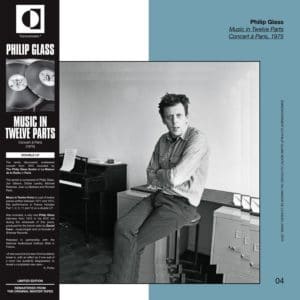
“Music in Twelve Parts (Live in Paris, 1975)”
The newly discovered and unreleased concert from 1975 recorded by the Philip Glass Sextet at La Maison de la Radio, Paris.
The sextet is composed of Philip Glass, Jon Gibson, Dickie Landry, Michael Riesman, Joan La Barbara and Richard Peck.
Music in Twelve Parts is a set of twelve pieces written between 1971 and 1974. This performance in France includes part 1, 2, 3, 11 and 12 on a double LP.
Also included a very rare Philip Glass interview from 1974 in his NYC loft during the rehearsals of this piece, produced for the French radio by Daniel Caux - musicologist and co-founder of Shandar Records.
A never before released –Philip GLASS (1975) live recordings, released in partnership with the National Audiovisual Institute – INA.
"A new sound and a new chord suddenly break in, with an effect as if one wall of a room has suddenly disappeared, to reveal a completely new view." - A. Porter
24,00€
Out of stock

LP
URUK
“The Descent Of Inanna”
"An over-stimulating immersive auditive dive with exceptional depth. URUK carries the listener away within a phenomenal landscape of dark ambient and subterranean drones with constant rich textures generating an atmosphere of extraordinary intensity.
A journey into an opaque world of prodigious sound flows, not without luminous touches at times, from which we do not want to come back again.
Excellent and masterful sound drifts by two very high-caliber musical heroes from the audacious international scene. Uruk is the outstanding musical encounter between two titans of the international exploratory scene, the Italian bassist MASSIMO PUPILLO (member amongst others of the cult trio ZU) and THIGHPAULSANDRA, one of the majestic brains / electronic thinkers hiding behind the oh so very cult entity COIL." (Label note)
20,00€
Out of stock
10"
Andrew CHALK
“Painted Screens”
Edition of 250 copies in tipped-on sleeves with Japanese obi, insert and postcard. Entirely handmade sleeve edition of Painted Screens – designed & assembled at Impression Lointaine.
Music box : intimate music with a large palette of instruments ; Voices and sounds, mixed feelings and mysteries…A window opened on travelling memories, half-awakened thoughts and shared moments – dreamed and nocturnal wandering atmospheres, with undulating rays sporadically lighting a subconscious painting.
In this album (originally released in 2014), newly remastered for this vinyl edition, Andrew Chalk plays musical arrangements along with Federico Durand, Daisuke & Naoko Suzuki, Francis Plagne & Timo Van Luijk.
21,00€
In stock

LP
Harutaka MOCHIZUKI / Kawashima MAKOTO
“Free Wind Mood”
Comes in a heavy old style silkscreened jacket with obi (black, dark green or grey), postcards & inserts. Printed by Alan Sherry, liner notes by Michel Henritzi
"During the past decade, a number of free music players in Japan have fiercely, with no compromise, continued to grapple with the questions that lay at the heart of the solo saxophone recital: how to tease and tear new formations out of the interface between human breath, human flesh and skeleton, and the instrument itself, its keys, holes, pads, reed, and brass body.
With Free Wind Mood, An’archives splits one vinyl record down the middle, giving a side each to two of the most rigorous, exciting, and committed players from the scene: Harutaka Mochizuki and Makoto Kawashima.
While there are elements of their playing that places them in a history of Japanese free blowing, from Kaoru Abe through Masayoshi Urabe to now, they both have a singular voice: Harutaka more stringent and tart, Kawashima, perhaps, more melancholy. Tellingly, they’ve both intersected with rock music and free sound ensembles, with Kawashima working alongside Nishizawa Naoto of EXIAS-J (Experimental Improvisers’ Association of Japan), while Harutaka has worked in a duo Tomoyuki Aoki of psych-rock group Up-Tight, and guitarist Kondo Hideaki (also of EXIAS-J).
But both of them have made their most massive strides forward with their own solo releases, Kawashima’s potent Homo Sacer one of the final releases on PSF, and Harutaka’s Pas LP and Through The Glass CD exploring new terrain for the nexus of breath and brass. Moving on from those releases, Free Wind Mood is a devastating listening experience, blood and guts on the floor as the players fully inhabit the architecture of the space, and of the self, and play like their lives depend on it."
Jon Dale
21,00€
In stock

LP
Walter MAIOLI & Nirodh FORTINI
“Taraxacum”
An amazing adventure of a musicological and botanical research on the psychoacoustic qualities of the green world. It's the investigation of an organic symbiosis, real and mysterious at the same time, between the pharmacological properties of the plant and the sound emitted by the same material essence. From the single natural element comes the vibration permeating the whole universe; an indissoluble binomial for which "everything that makes up existence contains the information of itself in all its parts". Here, the visionary Walter Maioli (Aktuala, Futuro Antico, Synaulia) collaborates with the music therapist and eclectic composer Agostino Nirodh Fortini, for more than thirty years specialist in the field of sound and video applied to body therapies and meditation. By exposing the archetype breath of the stem, slowing its speed and manipulating and filtering it electronically, the two explorers create a bath of harmonic games with purifying and regenerating powers; a deep and nebulous drone inhabited by insects, alien sounds similar to the vibrates of Fender Rhodes or tonal interludes with plays of stones in water, on the surface of an inner lake, learning to observe and dive into love and awareness.
19,50€
Out of stock

LP
Robin HAYWARD
“Words of Paradise”
Robin Hayward (b. 1969 in Brighton, England) is a tuba player and composer based in Berlin. Since the 1990s, he has been concerning himself with experimental and radical playing techniques on brass instruments, initially through the discovery of the "noise-valve", later through development of the first fully microtonal tuba in 2009. In 2012, he invented the Hayward Tuning Vine as an interface for exploring the harmonic space implicit within the instrument, which exists both as a software version and as a physical prototype. Hayward's microtonal tuba and, on some occasions, the tuning vine have appeared on numerous recordings with various ensembles, e.g. Tonaliens – who have released a double LP on Edition Telemark in 2017 –, Chora(s)san Time-Court Mirage, and Microtub.
"Words of Paradise" is a 2016 recording performed by Zinc & Copper, Hayward's long-running brass chamber ensemble, featuring himself on tuba and tuning vine, Hilary Jeffery on trombone, and Elena Kakaliagou on horn. The piece was inspired by the ideas of 16th-century Dutch linguist Johannes Goropius Becanus, who thought he had shown the Flemish dialect Brabantic to be the original language spoken in Paradise. Observing Brabantic to have a higher proportion of single-syllable words compared to other languages, he reasoned that as the first language must have been the simplest, all languages must be derived from it. The composition draws on the sound of 13 single-syllable words that Becanus used to support his theories. Using half-valve and muting techniques, the inflections of speech and vowel sounds are imitated on the brass instruments, to which the Hayward Tuning Vine is played as a harmonic reference.
LP Picture Disc replicating the multi-coloured circular scores of the horn and trombone parts of "Words of Paradise", housed in a black die-cut sleeve with liner notes on the rear side. Edition of 300.
26,00€
In stock

LP
Werner DAFELDECKER
“Small Worlds”
"Small Worlds" (2004) a is 42-minute composition for improvising sextet by Austrian double bassist, composer and improviser Werner Dafeldecker. The score is written for any instrument and divides the players into two virtual trios whose constellations change every 3 minutes. No restrictions are made regarding material or playing techniques, the only specification is that in each 3-minute trio, one player has the role of the "dynamic leader" which means that no other player within the trio should play louder than the one on that leading position. Apart from that, the only other restriction concerns how pauses are to be made when two players interchange their positions within the trios.
According to Dafeldecker, the object of the piece is to provide a structure that doesn't curtail the qualities of the musicians, yet forces them to listen very closely to each other and make focused decisions about parameters that are often overlooked in completely free improvisation. Especially, the given structure avoids the emergence of certain clichés that are often present in Free Improvisation, while retaining a very high level of openness with regard to how the piece is performed.
The first published recording of "Small Worlds", by Australian ensemble Quiver, was released in 2017 on CDr by Tone List. This LP contains a recording made in 2004 at Taktlos Festival in Basel, Switzerland, that features the line-up that Dafeldecker originally had in mind when he wrote the piece: Burkhard Beins (percussion), Martin Brandlmayr (percussion), Werner Dafeldecker (double bass), Klaus Lang (organ), Michael Moser (cello), and John Tilbury (piano). Partly, this constellation later also played together in the long-running avant-garde group Polwechsel.
Edition of 300 in regular sleeve with three inserts: two featuring an extensive conversation between Werner Dafeldecker and Matthias Haenisch discussing "Small Worlds", Polwechsel and Free Improvisation in general (German and English), the third reproducing the score of the piece.
21,50€
In stock

2 LP
William ENGELEN
“Today, the organ has played beautifully again”
William Engelen (born 1964 in Weert, The Netherlands) is a sound and visual artist living and working in Berlin. After having studied visual arts, his focus shifted over time from solely visual to multi-disciplinary works that oscillate between sound and visual arts, between exhibition and performance, and incorporate installational, sculptural and compositional elements. He now considers himself a conceptual artist who works with sound. Many of his works are site-specific and have been presented and performed in museums, galleries, concert halls, private apartments, parks, urban spaces, a.o. Unlike other sound artists, Engelen does not primarily try to make a space sound, but rather to develop works that resonate and reflect the specific surroundings where they are presented.
"Today, the organ has played beautifully again" (2018) is Engelen's second LP release after "Partitur Belval" in 2016. The piece was written for his solo exhibition "Heute hat die Orgel wieder schön gespielt" at Kunsthalle Osnabrück in Lower Saxony, Germany. The Kunsthalle building was once a Dominican monastery which, in 1713, became home to a pipe organ made by the famous Klausing workshop in Herford. In 1819, after the monastery had been secularized, the organ was moved to St. Matthäus church in Melle where it continues to be played to the present day. For the exhibition, Engelen decided to virtually bring back the organ to its original place. The piece was performed first for an audience at St. Matthäus church on October 14th, 2018, then turned into an 8-channel sound installation for the Kunsthalle exhibition from November 2018 to January 2019. During the rehearsals and the concert, video recordings were made that were compiled into a 2-channel work. The fourth iteration of the piece is this double LP album, recorded in the night of October 18th, 2018, and presented in a full-colour gatefold sleeve with printed inner sleeves. Co-released by Kunsthalle Osnabrück and Edition Telemark.
"The air supply for this historic instrument can either be pumped by a motor or by sheer force, literally by stepping or pressing on the large bellows. Together with Stephan Lutermann, the church's regular organist, I explored and pushed the sonic boundaries and possibilities of the Klausing organ – from the barely audible to the astonishingly raucous. While Stephan played the console, I served as the so-called calcant, or bellows blower, and in this role could decide the length and force of the air supply. Only four of the twelve parts are played with the help of the motor." (William Engelen)
30,50€
In stock

2 LP
Paul DEMARINIS
“Songs Without Throats”
Paul DeMarinis is a key figure in the history of electronic music since the 1970s. Collaborator with the likes of Robert Ashley, David Behrman, and David Tudor, DeMarinis is a pioneer in the development of gallery sound installation and digital music technologies. Black Truffle is thrilled to announce the release of a double-LP collection, selected in collaboration with the artist, focussing on DeMarinis’s exploration of synthesized voice and the digital analysis and manipulation of speech sounds. Drawing together tracks dispersed on compilations along with a number of pieces previously unheard in any form, Songs Without Throats offers a revelatory look into DeMarinis’s alternately accessible and uncompromising production between 1978 and 1995.
Opening with a mesmerizing piece from 1978 pairing the voice and tamboura playing of Anne Klingensmith with strings of letters spat out by a Speak n’ Spell to the accompaniment of the randomised melodic patterns of DeMarinis’s homebuilt electronic instrument ‘The Pygmy Gamelan’, the record then dispenses with the live human voice in favour of its recorded and synthetic doubles. We follow DeMarinis’s restless probing of the possibilities of new technologies, from the hacked Speak n’ Spell (which gives us the austere ‘Et Tu, Klaatu’ 1979, another duet with Klingensmith, this time on bowed psaltery, in which the toy’s synthetic voice is stretched into an alien song) through to the use of digital audio samples manipulated with home computer technology in the early 1990s (including a remarkable dream-like collage piece that weaves a rare recording of Stalin’s voice and bird-like electronic twittering derived from its formant-glides into a rich tapestry of samples reflective of the dictator’s musical life).
In between we get a rich sampling of DeMarinis’s signature work with speech melodies – usually unnoticed melodic inflections that lie within speech patterns – which he analyses and translates into synthesized musical accompaniment. These pieces draw on a wide variety of textual and vocal sources, which range from the hilarious to the menacing (‘Cincinatti [1830-1850]’ sets a detailed description of butchering techniques, for example) and an equally broad range of musical conceptions, combining elements as seemingly unlikely as Beethoven’s Opus 31 pianos sonatas and the sounds of 80s synth pop. The results are an extraordinary combination of the alien and the familiar. As DeMarinis himself characterises his work with vocal synthesis, this is ‘a kind of signal that simultaneously carried and obscured meaning and ideation, even as it created a sound world totally alien in esthetic’.
Presented in a deluxe gatefold sleeve with archival images and liner notes by Paul DeMarinis.
Design by Stephen O’Malley. Mastered and cut by Rashad Becker at D&M, Berlin
29,50€
Out of stock

LP
Ruedi HÄUSERMANN
“Galerie Randolph”
Black Truffle is excited to announce the release of the first-ever vinyl reissue of Ruedi Häusermann’s Galerie Randolph, a masterpiece of solo multi-tracking originally released on CD by Unit Records in 1995. Born in 1948 and residing in the medieval Swiss town of Lenzburg, and virtually unknown outside of the German-speaking world, Häusermann is a multi-instrumentalist and enormously prolific composer who works primarily in the medium of absurdist music-theatre. A virtuoso wind player and free improviser who also composes for traditional classical instrumentation, his work is characterised by subtly surreal humour and the unlikely combination of extended technique and simple, at times almost child-like, melodic ideas.
Named after his rehearsal room in Lenzburg, Galerie Randolph uses an enormous array of instruments to craft a work of singular compositional vision. Each of the twelve pieces begins from the same two elements: a woozy, sliding scatter of tones played on a home-made contraption stretching two guitar strings between the top of Häusermann’s alto saxophone and an amplified cup, and a series of uneasy block chords sounded on accordion and reeds. On each piece these two elements (whose pitch gradually raises throughout the record) are complemented by entirely different material, all of it played by Häusermann. Ranging from layered flutes to one-finger piano melodies to unintelligible vocals to musique concrete interjections to free jazz saxophone explosions, these additional layers combine with the endlessly returning idée fixe of the foundational elements to create a truly dream-like listening experience, a gently deranged realm in which we lose all sense of linear time.
Calling up the most unlikely combinations of possible predecessors – Erik Satie, Gerry Mulligan, and Helmut Lachenmann perhaps? –Galerie Randolph ultimately defies comparison. Almost unknown except to a select group of cognoscenti such as Jim O’Rourke, yet destined to become a cult classic, Galerie Randolph is an instance of that most rare thing: music the likes of which you have never heard before.
Presented in a deluxe gatefold sleeve with gorgeous archival images by the composer.
Design by Stephen O’Malley. Mastered and cut by Rashad Becker at D&M, Berlin
Original price was: 20,00€.10,00€Current price is: 10,00€.
In stock
LP
Ellen FULLMAN & Okkyung LEE
“The Air Around Her”
This record documents music made by two women — one American and one Korean — who have both made a profound impact within experimental music. Ellen Fullman’s Long String Instrument has been a long-term life-work of incredible ambition and dedication. The results are immediate, exciting and inspirational. Okkyung Lee has completed rewritten the possibilities for the cello in solo and group improvisation whilst maintaining a steadfast defiance to the many attempts to contain her work within pre-defined genres.
‘The Air Around Her’ was recorded on 20 February 2016 during the First Edition Festival for Other Music in Stockholm, Sweden at Kronobageriet — the former bakery to Swedish Royalty that dates back to the 17th Century and is now the site of the city’s Performing Arts Museum. The Edition Festival was given access to the space while renovations took place and Fullman allowed the requisite time to install and tune her long string instrument along the full 26 metre length of the room.
17,00€
In stock
LP
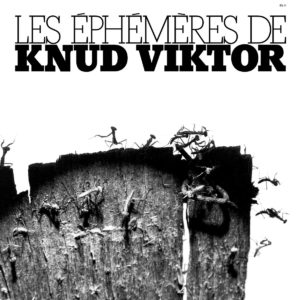
Knud VIKTOR
“Les Éphémères”
The lost masterpiece Les Éphémères by the self labeled ‘sound painter’ Knud Viktor (1924-2013) now sees its first ever release by Institute for Danish Sound Archaeology – 40 years after it was conceived. Viktor’s pioneering work – his Images Sonores – are composed of field recordings of insects, animals and his surroundings. His only earlier releases, the much sought-after Images and Ambiances from 1972, were re-issued by Institute for Danish Sound Archaeology in 2017 to great critical acclaim.
A finished master tape and even a complete cover layout for Les Éphémères was found in Viktor’s archives after he passed away in 2013. The phenomenal piece was originally commissioned by the French radio station France Musique in 1977. The twenty short ‘sound images’ of Les Éphémères were originally broadcast as vignettes in-between other radio programs. Working with Allo la Terre, the association in charge of the estate of Knud Viktor, we at Institute for Danish Sound Archaeology are thrilled to finally be able to release this central and evocative work.
From the middle of the 1970’s Viktor began composing almost exclusively for four channels. He invented his own intuitive quadraphonic mixer – the Tetramix – to realise his spatial visions for his Image VI – The Lubéron Symphony, and from then on worked with quadraphonic sound, thus making the release of his works difficult. Les Éphémères is close in time and also holds close ties to The Lubéron Symphony, which Viktor considered his magnum opus. Perhaps most strikingly is the shift in the way he uses the recordings of insects, birds and animals in both The Lubéron Symphony and Les Éphémères: Often untreated and clearly recognizable, the field recordings leave the inherent melody and rhythm of the animal sounds to sing for themselves, layering recordings to create simple and elegant sound images. In two of the twenty pieces Viktor’s own voice blends with the animals, as he recites two poems. One about the singing vineyard populated by musical crickets, the other painting an autumn picture with wine bubbling in the barrels as we hear the wine flies humming.
22,00€
In stock
2 LP
Knud VIKTOR
“Ambiances – Images”
*** New edition. Available before end january ***
Re-issue of rare releases by Danish sound artist Knud Viktor. The Institute for Danish Sound Archaeology is re-issuing the Danish sound artist Knud Viktor’s only two releases. Ambiances and Images – both released in 1972 – are longtime sought-after rare collector’s items.
These are now re-issued as a 2 LP from the original master tapes with liner notes by poet and sound artist Morten Søndergaard.
Overlooked and unheard Danish sound art Knud Viktor (1924-2013) graduated from The Royal Danish Academy of Fine Arts in Copenhagen as a painter. In the 1960’s he moved to the Luberon valley in southern France to paint the Provençal light and nature. However, Viktor left the painting and gradually moved towards filming and recording the sounds of nature. He used the field recordings as raw material for a series of abstract electronic compositions, which also served as soundtracks for his filmworks. A selection of these compositions were released in 1972 on the two records Images and Ambiances on the French label L’Oiseau Musicien. The records came in very limited editions, and therefore Knud Viktor’s works have remained largely unknown. With the re-issue of these records The Institute for Danish Sound Archaeology wishes to revitalize Knud Viktor and his contribution to the history of sound art.
The small sounds of nature Knud Viktor is recognized as an important figure in the field of sound art in France and he is regarded as a pioneer within field recording and acoustic ecology. During the 1970’s he turned his house in Provence into one large mixing desk with a myriad of homebuilt microphones and cables spiralling into the surrounding landscape. From here he would carefully record the sounds of snoring rabbits in their holes, the rhythmic songs of cicadas in the night – even termites gnawing through an old cupboard in the bedroom As the Danish poet Morten Søndergaard writes in the essay A Sonic Seismograph, which accompanies the release: “Light became sound. The most fascinating aspect of Knud Viktor’s world is perhaps that there is a universal coalescence of all things: of artistic expressions and natural science, of painting, sculpture and installation. A paintbrush becomes a microphone. Music becomes sound.”
By re-issuing Ambiances and Images, The Institute for Danish Sound Archaeology hopes to contribute to a revitalization of Knud Viktor’s important work, and that more listeners will engage and lend the deserved attention to these works.
The Institute for Danish Sound Archaeology is an independent association with the overall purpose of uncovering and releasing historical Danish electronic music and sound art.
29,00€
Out of stock

LP
Éliane RADIGUE
“Geelriandre – Arthesis”
Geelriandre/Arthesis is named for the pieces that fill its two sides. Geelriandre, realized on an ARP 2500 synthesizer in 1972, features Gérard Fremy on prepared piano. Arthesis, realized using the University of Iowa's Moog in 1973, comprises the full duration of side B.
Eliane Radigue has received much deserved praise for her transcendent compositions for tape, synthesizers and acoustic instruments. Her work is deep, slowly changing and timelessly resonant with slowly shifting timbres so dense that they seem infinite. Accute physicality, overtones and psychoacoustic activity fills your space, follows you, grounds you, pulls you in or lets you go. It's all here/hear.
24,00€
Out of stock

2 LP
Pauline OLIVEROS
“Reverberations 1”
Pauline Oliveros Home Electronic Music Studio (1961)
Time Perspectives 19:38
San Francisco Tape Music Center (1964-1966)
Mnemonics I (15:09)
Mnemonics II (9:55)
Mnemonics III (17:34)
Mnemonics IV (18:64)
In 2012 Important Records released a historic 12 CD box set compiling much of Pauline Oliveros' early and unreleased electronic work. Reverberations 1 is the first release in an ongoing series dedicated to releasing the entire 12 CD box set on vinyl.
Organized chronologically by studio, the complete Reverberations not only documents Pauline's earliest electronic music but it also functions as an early history of electronic music itself.
Pauline Oliveros, composer, performer and humanitarian was an important pioneer in American Music. Acclaimed internationally, for four decades she explored found, forging new ground for herself and others. Through improvisation, electronic music, ritual, teaching and meditation she has created a body of work with such breadth of vision that it profoundly effects those who experience it and it eludes many who try to write about it.
In partnership with the Pauline Oliveros Trust, Imprec will be releasing essential titles from Pauline Oliveros' catalog on vinyl including the complete Reverberations box set, Tara's Room, Sounding/Way (with Guy Klucevsek) and many more.
"On some level, music, sound consciousness and religion are all one, and she would seem to be very close to that level." John Rockwell
"Through Pauline Oliveros and Deep Listening, I now know what harmony is. It's about the pleasure of making music." John Cage
31,50€
In stock
LP
Reinhold FRIEDL
“Music for Piano, … Spring/Flower/Cracker/Stream”
Zeitkratzer’s boss revisits the piano guts some years after his much acclaimed and genre-defying album Inside Piano (2011). While Friedl’s first solo album defined the practice of playing on the strings of a grand piano and revealed the source of sounds we couldn’t identify on some of Zeitkratzer’s recordings, Music For Piano, … Spring/Flower/Cracker/Stream, brings concrete and quasi electroacoustic sounds together with clearly articulated piano notes. In the enigmatically titled Music For Piano, … Spring/Flower/Cracker/Stream, Reinhold Friedl moves freely from plain motifs, to walls of noise and from screeching sounds to pure tones, while keeping strong compositional structures and transparent musical forms. A truly beautiful and ear-pleasing record that unashamedly shows the composer’s and performer’s love for the piano.
Beside his activities as composer and as leader of the internationally acclaimed new music group zeitkratzer, Reinhold Friedl is renowned for his passionate and peerless piano performances. He invented numerous new techniques of playing a grand piano directly on the strings and baptised it “inside piano”. “Reinhold Friedl has developed his “inside piano” technique to such a level of delicacy and precision that the tonalities extracted from the instrument bear little resemblance of their acoustic source.”, wrote The Wire Magazine London. Phosphormagazine stated: “Unbelievable that one can creates such sounds with a grand piano!” and the Australian Realtime attested “tremendous power. Overwhelming!”
Reinhold Friedl studied with piano with Renate Werner and Paul Schwarz in Stuttgart, Alexander von Schlippenbach and Alan Marks in Berlin, composition with Mario Bertoncini (nuova consonanza) and Witold Szalonek. He has collaborated with musicians like Phill Niblock, Elliott Sharp, Alvin Lucier, Keiji Haino, Lou Reed, Carsten Nicolai, Laurie Anderson, ...
14,50€
In stock
LP singled side
Stefan ROIGK
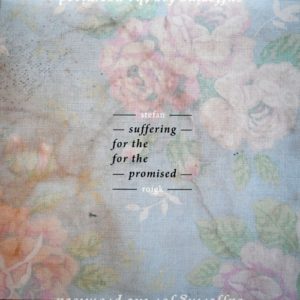
“Suffering For The Promised”
Being in the making – or un-making – for the past 14 years, Stefan Roigk's »Suffering For The Promised« has gone through many stages, from being finished, revoked, left untouched, reworked, discussed to finally getting banned onto vinyl in its ultimate and irrevocable form. An atmospherically intense but yet utterly fragile piece, combining concrete sounds, field recordings and devotional vocal fragments to an eclectic and highly intimate composition, consolidating Roigk's position as one of the top players in the game.
Single side LP. Edition of 316 copies on black vinyl, incl. full-colour inner sleeve w/ text by Stefan Roigk.
Stefan Roigk (b 1974) is a multi-disciplinary artist living in Berlin. Roigk deals with the borders between sound collages, sculptures, installations, film and graphical scores. His artistic strategy lays in the combination of different types of media to one single composition. Roigk's previous musical works have been released by labels such as Tochnit Aleph and Senufo Editions.
18,50€
Out of stock

LP
Luc FERRARI
“L’escalier des aveugles”
L’Escalier des Aveugles, or The Stairway of the Blind, was commissioned in November 1990 by Spanish National Radio (Radio Nacional de España). Asked for a piece to premiere as part of the European Day of Music, Luc Ferrari returned with a radiophonic concept that organised his anecdotal music into montage form, sequencing short, elusive narratives in a successive way.
The completed composition is formed of thirteen chapters containing a mixture of environmental and synthesised sound, commentary, chatter, and encounters with people and places. Each focuses on a small event within this playbook, and Ferrari notes that each “in addition to being a realistic photograph, will be the subject of a ‘setting to music’: fragments of voice and atmosphere will be sampled and will produce musical matter or a ‘song’.”
The sonic language of Madrid forms the setting to which Ferrari lays out the persistent theme of the piece, that of the composer being guided throughout the city by a young woman. Using a game-like structure (liners for this edition include Ferrari’s “Regles de Jeu”, or “Rules of the Game” which act as a script or score to the piece) the motivation is posed: imagine that one day you are told “I know a place in Madrid that sounds amazing (or bizarre)”, to which you reply “Let’s go to it together.” The recordings toy with the relationships between guide and tourist, translator, director and actress, and masculine and feminine that emerge as Ferrari and the actresses follow this action, documenting the shared experience and connections they make as they visit these places.
Six actresses guide Ferrari (and the listener) through locations simultaneously ordinary and sonically rich: the metro; the El Corte Inglés department store where we hear the gossip from changing rooms set against music emanating from the PA; vagabonds declaiming their political stance in the Conde de Barajas plaza; interactions buying apples in a market; the reverberant and spacious halls of the Prado Museum where one actress gives a moving description of her favourite painting - Goya’s The 3rd of May 1808.
Ferrari replies in French to their comments in Spanish, and there are several self-referential plots, devices, and word games that flirt with the poetics and rhythm of language and sound. A recital of Lorca’s poem "La Casada Infiel" in “Hommage À Lorca” in amongst the location recordings feels striking, and the call and response of “La Nouvelle de L’Escalier”, where one of the actresses descends the staircase of the blind - a long stone stairway in Madrid proposed to Ferrari as an interesting location to visit during the trip by producer José Iges. She replies to Ferrari’s vocal enunciation of the place (and title) in French - L’Escalier des Aveugles - with the place-name in Spanish: La Escalera de los Ciegos.
Using this repeated title and image of the staircase of the blind as a symbolic place, a line is drawn to a situational landscape experienced and diffused through snapshots and allusion rather than holistically overviewed, sound conjuring pictures within the imagination. In the sensorial qualities of Ferrari’s treatment of emotion and language—fortified with electro-acoustic motifs and musical properties—the piece accelerates towards a render that is truthful, beautiful, yet also surreal; somewhere between theatre and reality, a gonzo cinema of the ear.
23,90€
In stock

LP
O YAMA O
s/t
YAMA O explores a certain domestic and democratic quality of everyday life, born through associations to folk music of Japan and a folding of myth, tradition, and routine; the non-spectacular and the sublime.
Formed of musician and artist Rie Nakajima and Cafe OTO co-founder Keiko Yamamoto, the group has performed since 2014 at venues and festivals such as noshowspace, Ikon Gallery, Wysing Arts Centre, Supernormal, Borealis Festival, Mayhem, and allEars Festival.
Nakajima’s performance often focuses on the use of found and kinetic objects, using modest items such as rice bowls, toys, clockwork, balloons and small motors as instruments to create a “micro orchestra”. Elements are layered into impressive and immersive atmospheres. Yamamoto alternatively floats and charges through this with body and voice; chanting, incanting, thundering, whispering, stamping on the floor.
Their debut album consolidates their musical conversations into keenly paced studio music, the duo working with additional instrumentation and a resolved focus on melody to provide vivid portraits of folkloric Japan in song.
They move between pop and the philosophical, defined by the overall space afforded to texture and movement. In small, delicate sound an intimate musical climate is established that reflects on life, telling stories of improvised clockwork, whispered dreams, small movements of the hand and the rhythm to be found in the shuffle of a deck of cards.
Grandly theatric and dramatic flourishes add solidity to these illustrations, operas driven by the swooping energy and power of Yamamoto’s voice can be playful or emotionally charged, particularly when the duo arrange themselves in ensemble with violinist Billy Steiger and percussionist Marie Roux. Production by David Cunningham creates the shadowy presence of a leftfield Flying Lizards dubwise depth that adds subtle strangeness to the atmosphere. The result is something raw, full-bodied; full of energy, grace and mystery.
17,00€
Out of stock

LP
Evan PARKER
“The snake decides”
One of the final Incus releases and one that was written up in The Penguin Guide to Jazz as ‘an essential document of modern music’. Otoroku is proud to release the first ever vinyl re-issue of Evan Parker’s legendary recording The Snake Decides. Featuring 4 solos recorded in 1986 in St. Paul's Church, Oxford by the late Michael Gerzon. The Snake Decides is a groundbreaking example how far the language of a particular instrument can be taken.
From Brian Morton’s liner new notes:
“The Snake Decides attracts a certain array of adjectives - intense, radical, fearsome, hypnotic, virtuosic – and occasionally allows a more ambitious reviewer to avoid platitude by talking more specifically about 32nd harmonics, circular breathing, multiphonics and Gerson's exact choice and placement of microphones. But this misses a point, too. Listening to this record, either for the first or the fortieth time, is an arousing experience.”
Remastered by Giuseppe Ielasi and housed in a reverse board sleeve with new liner notes by Brian Morton this is the ultimate document of one of the most important recordings in all of Parker’s extensive and exploratory catalogue. Edition of 500 copies.
21,00€
Out of stock

LP
ORGUE AGNES
“A Une Gorge “
**** Back in stock, our favourite record since months ****
This is electrified ping-pong music. This music pings and pongs.
Ping-pong balls are commonly used in experimental piano music.
They are chancey things. And they are cheap; you can buy a wack of them for next to nothin’.
Orgue Agnès bounces in loose time and dances and reflects. It is reflective bouncing dance music.
With little effort - or little to no intention – ping-pong balls set off a derive of small detailed sounds.
They are lit alive - light and lighthearted.
They jump for joy. I am talking about Orgue Agnès and ping-pong balls.
A lot of A Une Gorge sounds like it was made with electrifc ping-pong balls bouncing inside of a throat or
a mouth.
A mouth-full of electricity.
A throat (like a mouth) is a filter.
« wah wah woah wow-wah. »
A mouth-throat is a wah. Une gorge is a dancehall.
Orgue Agnès A Une Gorge and this music sounds like it was made inside of one.
As strange and wonderful as it sounds."
Eric Chenaux
15,50€
In stock
LP
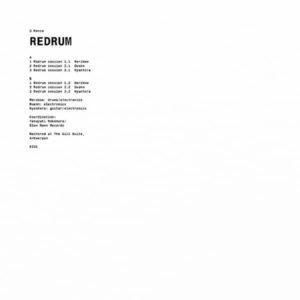
3 RENSA
“Redrum”
Merzbow: drums/electronics
Nyantora: guitar/electronics
Duenn: electronics
Recorded at Red Bull Studios in Tokyo on 3 August 2017
over the course of three hours. All the music on this LP
was improvised and only edited for length.
Limited edition of 250 copies
Out of print at the label.
(all the copies we have are very lightly bumped at one corner)
16,00€
Out of stock

LP
SMALL CRUEL PARTY
“Resin, Parched, Chthonic”
Cassette released in 1991 on the label A State Of Flux, reworked and rebuilt so that it can match the duration of a vinyl.
The ambience of this album is noisy, drone, abstract, shamanic.
Mastering by Giuseppe Ielasi. 300 copies.
18,00€
Out of stock

2 LP
Julius EASTMAN
“Crazy Nigger / Evil Nigger / Gay Guerrilla”
Only a handful of years ago, the name Julius Eastman would have been met by a unanimous blank look. The legacy of this once darling of the New York post-minimal avant-garde had, since his untimely death at the age of 49, in 1990, been almost entirely lost. Eastman's story is as fascinating as they come – black, angry, and queer in an all too polite, straight white musical world. A prodigy and genius whose music took him to astounding heights, and whose unwillingness to conform and play by the rules took him to overwhelming lows, leading down the path of drug abuse, homelessness, and with it the loss of his scores and body of work. Even before his death, he was already a forgotten name.
Eastman belongs to a generation of composers who inherited the mantel left by 1970's Minimalism, making it their own – sometimes more simple and direct, others with tonal and structural complexity which bent the ear. Despite composing rigorously and being highly respected by his peers, was only given a slim number of chances to record his work, relegating most of voice as singer and pianist to the realization of others's work. It was Eastman who conducted the iconic recording of Arthur Russell's Tower of Meaning, an whose piano cuts its way across the 1976 recording of Morton Feldman's For Frank O'hara, not to mention a slew of recordings by Peter Maxwell Davies and Meredith Monk. Other than a single work, found on an obscure cassette complication, Tellus
4, his singular voice was no where to be found. It's likely that Eastman's would have been entirely lost, had it not been for rigorous efforts of a few close friends, the most persistent of whom was the composers, Mary Jane Leach, who spent years tracking down his lost scores. These efforts eventually led to the comprehensive cd collection, Unjust Malaise, issued by New World Records in 2005. It was the beginning of the turning tide, over the 13 years since, Eastman's singular voice has slowly returned to the audience he always deserved. It also represented the recorded debut of some his most thrilling and controversial work, three compositions for piano from what he called the Nigger Series - Gay Guerrilla, Evil Nigger, and Crazy Nigger, all proofs of his creative brilliance and contentious politics in a single force. Now issued across two LPs in their first ever vinyl release by Blume Editions, offering extensive liner notes by Mary Jane Leach and Bradford Bailey, these three seminal works by one of the most important, but neglected, American composers of the 1970s and 80s, return to the light once more. Not only are Gay Guerrilla, Evil Nigger, and Crazy Nigger an entire rethinking of Musical Minimalism, but they ferociously blow the doors of what classical music can be seen to be.
4, his singular voice was no where to be found. It's likely that Eastman's would have been entirely lost, had it not been for rigorous efforts of a few close friends, the most persistent of whom was the composers, Mary Jane Leach, who spent years tracking down his lost scores. These efforts eventually led to the comprehensive cd collection, Unjust Malaise, issued by New World Records in 2005. It was the beginning of the turning tide, over the 13 years since, Eastman's singular voice has slowly returned to the audience he always deserved. It also represented the recorded debut of some his most thrilling and controversial work, three compositions for piano from what he called the Nigger Series - Gay Guerrilla, Evil Nigger, and Crazy Nigger, all proofs of his creative brilliance and contentious politics in a single force. Now issued across two LPs in their first ever vinyl release by Blume Editions, offering extensive liner notes by Mary Jane Leach and Bradford Bailey, these three seminal works by one of the most important, but neglected, American composers of the 1970s and 80s, return to the light once more. Not only are Gay Guerrilla, Evil Nigger, and Crazy Nigger an entire rethinking of Musical Minimalism, but they ferociously blow the doors of what classical music can be seen to be.
42,00€
Out of stock

LP
Julius EASTMAN
“Evil Nigger / Gay Guerrilla”
« Gay Guerrilla » and « Evil Nigger », both composed in 1979, with a third work, « Crazy Nigger », make up what Eastman called The Nigger Series. Some of themost challenging and beautiful works composed for piano during their era, they double as a window into the intricate thought process and contentiousness of their creator. When the composer was asked to perform the series at Northwestern University in 1980, due to protests by African American students, their titles were censored in the event's program. His response was a flamboyant foreshadowing of the sentiments toward bigoted language which later arose within hip-hop culture – to publicly take back these words, assert ownership of them, and deploy their power for positive change.
What Eastman was early to recognize, was that there is a fundamental difference in what happens when these words are spoken by white people toward people of color, and when people of color deploy them toward a white audience. The balance of power shifts. Eastman's audience was largely heterosexual and white. He knew exactly what he was doing, and to whom he spoke.
The object in your hands contains some of the most striking and important music composed during the later decades of the 20th century - music which remained lost and unheard for years, not because of what it is, but because of who its composer was. It is music, doubling as the voice of a man, which, because it refused to be oppressed, was suppressed or ignored. Eastman's work is a conscious act of intervention, plowing into a context defined by heterosexual whiteness, attacking its unjust demands from within. It is Christ like – metaphor and beauty which is impossible to separate from the evils of the world.
It is a music which carries the body of a man. As it speaks to our hearts, as it offers an glimpse of the freedoms implied by the sublime, a shackle is bound – a consciousness of our complicity with unforgivable sin.
Edition of 300 copies.
21,00€
Out of stock

LP
Julius EASTMAN
“Crazy Nigger”
It's little wonder that Julius Eastman (who died in 1990 under unexplained circumstances), remained the supreme underground composer. He was Afro-American and gay, a composer who rocked the cerebral world of process music with his explosions of free improvisation. This is
first time any of Eastman's music has been available on LP, with the three extended pieces for four pianos, « Gay Guerrilla », « Evil Nigger » and « Crazy Nigger », all written and preformed around 1980. All three works generate their epic soundscapes through adamantly restated patterns and interlocking canons, not fragmenting now, but preaching urgent truths. To quote brilliant Mary Jane Leach liner notes: "He wrote what can be categorized as minimal music, but also wrote
"post-minimal" music before minimal music was fully established. His pieces straddle the two main styles of minimal music—rhythmic/pulse driven music (Steve Reich and Philip Glass) and spectral drone music (La Monte Young and Phill Niblock). While using process and rhythmic patterns, there is a flexibility that lends a breathing, organic feel to his music, a muscularity missing in a lot of other music from that time ith the re-emergence of his powerful music, a missing gap in the history
of contemporary music has been filled. Created in the late 1970s, these three pieces should have been released on vinyl at the time they were written. However, that was not to be, and they, and other pieces of Eastman's, were unavailable commercially. Instead, they were shared on cassettes, copied and passed from one admirer to another, a kind of underground musical distribution by aficionados. Unlike today's instant access to music, at that time each new copy represented a time
commitment, since it took as long to copy a piece as it was long, while also removing itself further from the original recording with a resultant deterioration in sound quality.
« Crazy Nigger, Evil Nigger, and Gay Guerrilla » form a trio of pieces that occupies a high point in
Eastman's compositions. They were the culmination of his mature style.
Crazy Nigger is a sprawling sonic study, the last section exploring canonic form both harmonically and rhythmically, using the same process as James Tenney's Spectral Canon for Conlan Nancarrow, but notated in a more intuitive way.
In the most transcendent sense, it's music that occupies its very own place, a magical soundworld all of its own. Now issued across two LPs in their first ever vinyl release by Blume Editions, offering extensive liner notes by Mary Jane Leach and Bradford Bailey, these three seminal works by one of the most important, but neglected, American composers of the 1970s and 80s, return to the light once more. Not only are Gay Guerrilla, Evil Nigger, and Crazy Nigger an entire rethinking of Musical Minimalism, but they ferociously blow the doors of what classical music can be seen to be.
Edition of 300 copies. Color Vinyl. 180gr Audiophile pressing. Including printed inner sleeve housing a Nagaoka anti-static record sleeve, plus an original insert that functions as Obi. Housed in a fold-out outer sleeve. Vinyl Mastering by Giuseppe Ielasi.
21,00€
In stock

2 LP
Takako SAITO
“Spontaneous Music”
Takako Saito (born 1929) is a Japanese artist closely related with Fluxus. In the 1950s, she participated in the "Creative Art Education" movement where she met later Fluxus fellow Ay-O. In 1963, she moved to New York where she was introduced to George Maciunas and became an important member of the Fluxus movement. She remained part of it throughout the 1960s and 1970s and collaborated with numerous Fluxus artists. Since 1968, Saito has been living mostly in Europe. In 1979, she moved to Germany and now lives in Düsseldorf.
Much of her work revolves around everyday life and everyday things, to which she adds her unique artistic gesture through small but deliberate and carefully crafted interventions. Many of her pieces involve the participation of viewers and only become complete when the audience fills a co-designing role. A sense of playfulness is evident throughout her work, seen in many of her performances and particularly in her various "free" chess games that come in a multitude of different shapes and moreover display a high level of craftsmanship.
In line with her general artistic approach, Saito recorded a number of musical pieces between 1982 and 1992. Retrospectively, she called these recordings "Spontaneous Music" because they involved very simple actions with voice and everyday objects that happened spontaneously. Some recordings have become part of sound pieces in her exhibition "Games" at Emily Harvey Gallery in New York in 1990, but none of them have been released so far. A selection from the recordings is published here for the first time.
This double LP is released in an edition of 300 and includes two solo vocal pieces – "Tarori Po Po Po" and "Isokono Pasokono" –, two more vocal pieces in which Saito's voice interacts with the sounds of an everyday event – "Toro während des Naturreiskochens" (Toro while cooking brown rice) and "Mit Elektrohammer" (With electric hammer) –, and two non-vocal sound pieces: "Kugeln" (Balls) and "Am Rhein mit Hammer" (At the Rhine with hammer). It is housed in a full-color sleeve and includes one insert with liner notes by Saito, a poster, and four postcards. The sleeve, the poster, and the postcards were designed by Takako Saito specifically for this release and relate to the notion of the music having been created simply with one's mouth and hands. All recordings have been carefully digitized and mastered by Dirk Specht.
"Around me, there are many things that make beautiful sounds. When I look outside through the window in front of my desk, I see a big Platanus tree whose leaves are shaking. When you stick a microphone into the leaves, it should made beautiful sounds. Then sometimes a dog passes by and barks. [...] That is music to me. No matter if one notices it or not: it's different but it's there." (from the liner notes by Takako Saito)
31,00€
In stock

LP
Luigi NONO
“Musica manifesto n. 1”
First ever repress of this seminal work. LP version, edition of 300 copies on black vinyl. This edition is on black vinyl, it is hosted in an outstanding shiny/refelecting silver cover (a hommage to the notorious Philips Prespective Series of the same period) and features the tabloid/poster with unpublished photos of the Venice Biennale riots of 1968
Long considered, with Pierre Boulez and Karlheinz Stockhausen, to be one point in the trinity of the post-war avant-garde, Luigi Nono was, without question, one of the most important and singular composers to emerge in the years following the Second World War – defining the zeitgeist, taking the his idiom into startling new territories, while standing decidedly apart. Nono's music infused the avant-garde with a sense of emotion and moral consciousness which had been previously unheard, seeking to join advanced forms of music in the social struggles of every day life. Unlike most of his peers, the composer was political in everything he did. His music is a rallying call of the left. Originally issued in 1969, none of Nono's works illuminate this radical consciousness and concern better than his seminal Musica-Manifesto N.1. Now reissued for the first time by die Schachtel in collaboration with Archivo Storico Ricordi, it is revolution led by one man – a window into the creative and political potential of sound.
Nono's music emerged from the ashes of war – a voice in a social and intellectual landscape trying to cope with what had been, and build itself anew. While most of his contemporaries divorced themselves from the political forum, focusing themselves on more abstract concerns, Nono's work was vocally political from its earliest days – first as explicitly anti-fascist, pointedly embracing Marxism (he officially joined the Communist Party in 1952), before, as 60s and 70s unfolded, becoming a voice in the international worker and student struggles and the fight against the Vietnam War.
It's hardly coincidental that a work as important and powerful as Musica-Manifesto N.1 emerged at the time it did. It is among the greatest sonic culminations of 1960's, composed and released just before the decade's end – emotion, empathy, and politic, manifesting as some of the most forward thinking and radical sounds and structures of their day. Nearly half a century on, what is says, and how its says, remain startling fresh.
Musica-Manifesto N.1, original intended to be the first part in a suite which never appeared, was commissioned by the communist administrated town of Chatillon-sous-Bagneux, in France, during the Spring of 1969. The work, manifesting in two parts, can be understood as snapshot of its moment – incorporating texts taken from the walls of Paris in May, 68, read by Edmonda Aldini against the voices of Communist leaders like Che Guevara, Ho Chi Minh, and Mao, as well as recordings of the riots and protests which occurred at the Venice Biennale in June, 68 – the materiality of the streets and political struggle taking form as the sounds whistles, howls, shouts through a megaphone, and battles with the police, joined with the history of the movement from which those events sprang via a lyrical poem, Mattino (Morning) by Cesare Pavese, one of most important Italian anti-fascist intellectual voices during Second World War, sung under the instruction of the composer by Liliana Poli and Kadigia Bove. Both sides of Musica-Mainifesto N.1, Un volto, e del mare and Non consumiamo Marx, are works for magnetic tape, the first archived through careful editing to achieve a singular polyphonic complexity, while the second utilizes manipulation of its source material through filters and modulators, played against electronically generated sounds. The cumulative result remains a legendary culmination of avant-garde practice and political struggle – an astounding, immersive, and thought proving body of sound, which remains as relevant today as the day it was made.
24,00€
Out of stock
LP
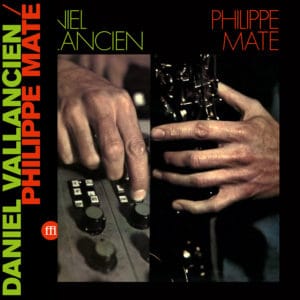
Philippe MATÉ / Daniel VALLANCIEN
s/t
Although discrete, the career of saxophonist Philippe Maté includes nonetheless several indispensable albums: be it with the Acting Trio, Jean Guérin (Tacet) or Jef Gilson (Workshop), his collaborations in a big band or quartet with Lawrence "Butch" Morris, his presence in the Saxophone Quartetand also on the brilliant L'Enfant assassin des mouche by Jean-Claude Vannier.
As for the man in the background, Daniel Vallancien, a sound engineer rarely featuring on the sleeves, the collection Actuel on the BYG label owes much to him (he is at the controls behind Anthony Braxton, Don Cherry, Sonny Sharrock or Steve Lacy), the same goes for Saravah for who he notably recorded Areski, Brigitte Fontaine, Maurice Lemaître or the Cohelmec Ensemble: not bad for starters! What is more, Daniel Vallancien is one of a prestigious group of French recording engineers with open ears and often themselves musicians, even if only occasionally for some, including Bruno Menny, Daniel Deshays or Jean-Marc Foussat, who have all recorded remarkable albums as leaders. Behind this collaboration was the idea ofcreating music which was free, direct and spontaneous, while having also a minimum of advance planning. Music, according to the brief liner notes desirous to "remove itself from long and patient laboratory experiments ". So, there can be found here none of the sophisticated tools associated withelectroacoustic research, but mainly a recording mixer console, which, in the hands of Daniel Vallancien acts directly on the original instrumental sound in real time, modifying and multiplying it while respecting the natural flow. Be it Paul Méfano, Betsy Jolas, Gérard Grisey or Jacques Lejeune, many contemporary composers working in France have, at one time or another, includedthe saxophone in their work. Michel Redolfi, for example, with the GRIM and then the CIRM , experimented with saxophonist André Jaume on a convincing recording (Hardscore). Nothing, however, can compare to the singularity of the dialogue between Philippe Maté and Daniel Vallancien, which they themselves describe as being "serious, sarcastic orhumorous", with, here and there, "disturbing sounds". Words, however, even those used by the protagonists themselves, are insufficient to describe such a sonic object, difficult to identify and, it has to be said, extraordinary.
First ever vinyl reissue
500 copies – Gatefold sleeve – Obi strip
Licensed from Saravah
20,00€
Out of stock

LP
Pierre JODLOWSKI & LES PERCUSSIONS DE STRASBOURG
“Ghostland”
"The Percussions de Strasbourg embark on a journey through the enigmatic universe of Pierre Jodlowski’s ghosts. Ghostland
is a troubling, intimate, uncertain, unstable and obscure territory in which a complex entity travels to the light. The voice of
Katharina Muschiol, the electronic music and the four percussionists merge thanks to a subtle and precise writing. They compose a complex organism of sound
evoking calm, anxiety, euphoria and madness at the same time.The delicacy of this work relies on a daring and masterful performance, with whispers, squeaks,
clatter of metal rods, synchronized gestures, grooves playful drums, pulsed soundtracks and saturated guitars.
Vibrant and full of sensations, this recording perfectly reflects the pleasure that this adventure represents for the Percussions de Strasbourg."
Minh-Tâm Nguyen
Original price was: 18,50€.10,00€Current price is: 10,00€.