
In stock
2 LP
COMPILATION
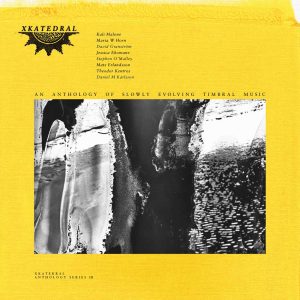
“Xkatedral Anthology Series III (An Anthology Of Slowly Evolving Timbral Music)”
XKatedral Anthology Series III is the third installment in a series of archival releases dedicated to presenting music by composers working within the realm of slowly evolving harmonic and timbral music. The pieces presented here focus on the use of synthetic and acoustic sound as well as algorithmic composition as tools for precise work within the realm of spectral exploration. This double-vinyl set is issued in celebration of the label’s decennalia and contains works from 2014 - 2025. It is released in conjunction with reissues of XKatedral Anthology Series I-II.
My Falling Sinks by Kali Malone is a sparse descending melody for justly tuned organ, cello and acoustic guitar featuring Lucy Railton and Stephen O’Malley. The piece is a compositional sketch in septimal just intonation made on an experimental tuning organ at La Temple de La Tour-de-Peilz while in residency at La Becque in 2021.
Empyrean Flare by Maria W Horn was composed in 2022 for The Dawn Chorus by choreographer Stina Nyberg. This piece uses the Tintinnabuli technique created by Arvo Pärt to animate four supersaw oscillators in slow diatonic arpeggiation, circling around a minor tonic triad, and destabilizing the harmonic framework by means of glissandi
and amplifying the sum of its parts by means of analog tape saturation.
Tessellation by David Granström was composed using generative synthesis methods in the summer of 2017. The musical periodicity and harmonic movement heard within the piece emerges as a result of fixed synthesized tape loops - exploring a space that opens up between antithetical worlds.
To Whoever Shall Inherit the Earth is the first piece of solo music made by Jessica Ekomane and it came together, according to the composer, almost by accident. The work was recorded late one night a decade ago and captures a fleeting, fragile, and unrepeatable moment preserved exactly as it happened.
Smoking Mother by Stephen O’Malley was created for Gisèle Vienne's Der Teich / L'Etang by Robert Walser. It was composed during a residency at the SMEM synthesis archive in Fribourg in 2018 and produced at EMS in August 2020. The piece draws from the works of Zia Mohuiddin Dagar, Krzysztof Penderecki and Popol Vuh while
exploring the roots of minimalism.
Att böja själarna by Mats Erlandsson was composed in 2018 and was included in On Eternity, a collection of four texts and four ten minute cassette loops released in the form of a limited edition box set in 2021 by Irrlicht Förlag. This work features performances by Gaianeh Pilossian and Sara Fors, on violin and voice respectively.
This will be my last piece for organ was composed by Theodor Kentros in 2025 and uses groups of clustered oscillators through resonant feedback to synthesize the fluctuating frequencies heard wandering through physical space when detuning an organ.
Fault Lines was composed by Daniel M Karlsson using generative methods with a deterministic and finite output solidified for this release. This piece features vocal performances by Sara Fors, Ansis Bētiņš and Artūrs Čukurs.
1. Kali Malone - My Falling Sinks 03:50
2. Maria W Horn - Empyrean Flare 15:00
3. David Granström - Tessellation 09:41
4. Jessica Ekomane - To Whoever Shall Inherit The Earth 08:04
5. Stephen O'Malley - Smoking Mother 08:16
6. Mats Erlandsson - Att Böja Själarna 10:12
7. Theodor Kentros - This Will Be My Last Piece For Organ 04:30
8. Daniel M Karlsson - Fault Lines 15:12
36,00€
In stock
2 LP
COMPILATION
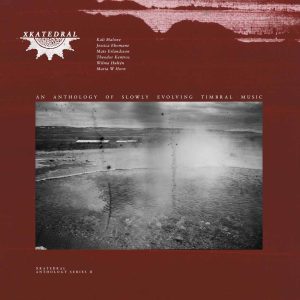
“XKatedral Anthology Series II (An Anthology Of Slowly Evolving Timbral Music)”
XKatedral Anthology II is the second installment in a series of archival releases dedicated to presenting music by composers affiliated with XKatedral working within the realm of slowly evolving harmonic and timbral music. This double-vinyl set contains an array of pieces written from 2018 to 2020 by composers Kali Malone, Jessica Ekomane, Mats Erlandsson, Theodor Kentros, Wilma Hultén and Maria W Horn. This collection of pieces focuses on the use of synthetic sound and algorithmic composition languages as tools for precise work within the realm of spectral exploration. In addition to this, the electronic instrumentation in many of the pieces is augmented by acoustic instruments.
1. Kali Malone - Music for Low Quartet 08:34
2. Jessica Ekomane - First Light 07:44
3. Mats Erlandsson - Hands Melt In The Sun 18:15
4. Theodor Kentros - Rough Draft v.7 06:09
5. Wilma Hultén - Inertia 14:03
6. Maria W Horn - Dies Irae (live) 22:04
36,00€
In stock
2 LP
COMPILATION
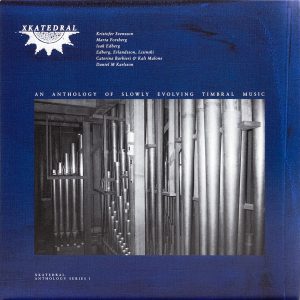
“XKatedral Anthology Series I (An Anthology Of Slowly Evolving Timbral Music)”
XKatedral Anthology I is the first in a series of archival releases dedicated to presenting music by XKatedral affiliated composers working within the realm of slowly evolving harmonic and timbral music. This double-vinyl set contains an array of pieces dating from 2010 - 2020.
Four of the works included here were originally released on cassette early on in the label's history, while the two remaining pieces are presented by the label for the first time.
1. Kristoffer Svensson - Ir Himinn, Groœn 04:09
2. Marta Forsberg - Disquiet (Heart) 17:40
3. Isak Edberg - Lamé 17:26
4. Edberg/Erlandsson/Lisinski - Dissolving Ceremony 07:05
5. Caterina Barbieri & Kali Malone - Glory 15:51
6. Daniel M Karlsson - Shipwrecks 20:00
36,00€
Out of stock

LP
Stephen O’MALLEY
“Spheres Collapser”
XKatedral in collaboration with La Becque Editions are proud to present a new album release from Stephen O’Malley, co-founder of SUNN O))). This record contains two long-form compositions for pipe organ by Stephen O’Malley, which he performs alongside Kali Malone and Frederikke Hoffmeier.
The album was recorded on Les Grandes Orgues (Scherrer (1777), Walker (1867), Kuhn (1995)) at Église Saint-François, Lausanne, Switzerland, on Christmas 2021, initially composed by Stephen within a suite titled Les Sphères (effondrez-les) Phases I-V, for a collaboration with Belgian/Swiss choreographer Cindy Van Acker.
Stephen O’Malley is a guitarist, producer, composer, and visual artist who has conceptualized and participated in numerous drone and experimental music groups for over two decades – SUNN O))), KTL, and Khanate being among his best-known creations. Wildly prolific, O’Malley’s oeuvre is defined by its remarkable breadth, complexity and multidisciplinary interests. It includes collaborations with a wide range of experimental artists, including Scott Walker, Kali Malone, Alvin Lucier, choreographer Gisèle Vienne, the authors Dennis Cooper and Alan Moore, Peter Rehberg, Fujiko Nakaya, Jim Jarmusch, Johan Johansson, experimental music research centers IRCAM, INA-GRM (Paris), EMS (Stockholm) and many others. O’Malley is also a vigorous live performer and has toured around the world since 2000. His live performances feature a reverberating fog of electric guitar minimalism – sorcery that challenges boundaries of space and time.
28,00€
Out of stock
LP
Kali MALONE
“Velocity of Sleep”
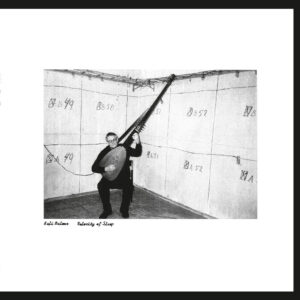
Composed, recorded and produced in Stockholm 2015-2016, ‘Velocity of Sleep’ sees Kali Malone’s work rendered in a septet of strings, gongs, lute, electronics and tape in the vast R1 Reaktorhallen (Sweden’s first nuclear reactor), the electroacoustic studio EMS, and at the Royal College of Music in Stockholm. Her presence is crucial, and liminal, making precise use of tuned sine waves and Studer B67 tape manipulation, while instrumental performance is handled by Peter Söderberg performing on the long-necked Theorbo (a large baroque lute, pictured on the sleeve), Samuel Löfdahl and Oskar Mattsson on Gongs, Vilhelm Bromander on Double Bass, Marta Forsberg on Viola and Adam Grauman on Viola de Gamba - all uniting to produce what feels like a geological time lapse and distillation of European and Indian classical drone musicks.
As far as opening solo statements go, ‘Velocity of Sleep’ is among the most memorable to have emerged this past decade from slow music and experimental classical paradigms. Its languorous yet rigorous consolidation of ideas from across the aeons crosses paths with others before her - the musics of Pauline Oliveros, Phill Niblock, Harley Gaber, Oren Ambarchi all spring to mind - but more importantly helped reset the limits of contemporary music in Malone’s own image. The 3-part, 43 minute work is an ideal example of how staid notions of early and classical music have been jettisoned to instead focus on fundamentals of tone, timbre, tuning, space and temporality with a radical and transfixing effect coolly detached from any directly traditional/sacred meanings.
Peter Söderberg’s justly tuned Theorbo plucks a slowly evolving additive pattern expanded by frippertronic tape delays on the 20 minute title piece, setting a stark tone for a quietly breathtaking resonance of gongs and floating sine waves in ‘1113’ that rest right on the biting point of sublime dissonance, while ‘In Light of Marwa’ pitches into a sort of raga-folk-drone tuned with the fine, durational intensity recalling Harley Gaber’s ‘The Winds Rise In The North’ and earthy cadence of Pauline Oliveros’ vision, yet somehow concentrated, refreshed in a way that’s best felt, and quite impossible to describe.
30,00€
Out of stock
LP
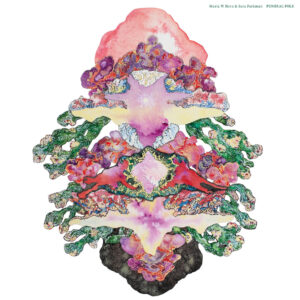
Maria W HORN & Sara PARKMAN
“Funeral Folk”
‘Funeral Folk’ pairs multi instrumentalist composer Maria W. Horn with violinist, singer and composer Sara Parkman on a soundtrack commission for Mattias Lech & Lisen Allard’s dance performance of the same name. Drawing on a shared, formative background playing in the same band as teenagers in their hometown Härnosand, Horn & Parkman naturally and skilfully collapse their worlds of influence, ranging from sacred songs and minimalist spectral music to Finnish black metal and Swedish folk, into epic arrangements for synths, zithers, hurdy gurdy, guitars, mellotrons and lamenting vocals. The results patently play into XKatedral’s love of slowly evolving harmonic and timbral sounds, but also reach to far more climactic appeal than we’ve come to expect from the label, edging on the sort of musical dramaturgy one might better expect from Anna von Hausswolff, or comparable to Okkyung Lee’s ‘Yeo-Nuen’. Stirring stuff, we tell thee.
Flocking around a mutual passion for the sort of progressive music coming from their native north Sweden as teenagers, as well as personal deep dives into their family’s Christian heritage of several generations, Horn & Parkman reassess the meaning of “rites of loss in a de-ritualised and dying civilisation” with a crafty blend of the sacred and profane guided by a heightened emotive intelligence.
Cinematic opener ‘Evighetens Sommar’ or ‘The Summer of Eternity’ establishes a grand sound stage spotlighting hushed vocals and luminous string swells, where ‘Till Margaretha’ follows with sky-clawing Finnish black metal riffs giving way to a keening Karelian vocal lament in staggering fashion. At its core ‘kyrie’ pushes this formula to its most impressively proggy peaks, and the choral vignette ‘Mementomori’ recalls Cucina Povera’s eyrie minimalism, seemingly prepping the way for the final send off ‘Hornalaten’, an unhurried 10 minutes of glistening timbral shifts and soothing drones that feels solemn yet optimistic, and as enchanting as Pauline Oliveros’ drone prayers.
33,00€
Out of stock

LP
Maria W HORN & Mats ERLANDSSON
“Fältinspelningar från Terres de l’Ebre”
New on Kali Malone and Maria W. Horn’s XKatedral label, Eno-esque ambient gems and Fennesz-like lushness inspired by Catalonia’s agroindustrial land/sound-scape.•
Produced by Maria W. Horn, and composer/EMS studio assistant Erlandsson.
300 Copies
In August of 2016 Maria W Horn and Mats Erlandsson traveled to Balada in the Terres de I’Ebre region of Catalonia, Spain, for a two-week residency courtesy of the Eufonics festival in collaboration with EMS.
The geographical characteristics a visitor first encounters in the Terres de I’Ebre delta are defined by the development of industrial agriculture. Endless rice fields stretch through the flat landscape, framed by canals of water to sustain growth. Even the air is saturated with a vague scent of rice. This transmutation of the soil impacts the sonic environment, the buzzing of the irrigation system, the hypnotic constant chirping of crickets, the loud bang from the water pump that echoes through the delta at regular intervals.
Taking the opportunity to collaborate on a project specifically made within the context of the aural environment they found themselves in, and using the resources available to them, the pair decided to make a musical work based entirely on field recorded material transformed through extensive digital editing and processing. Working quickly in the isolation offered by the residency they recorded found material at night and spent the days shaping these recordings into four compositions that move on a dense continuum between drone, noise and generative music all imprinted with the textural characteristics of the immediate surroundings of that time and place.
Through the four compositions the work shows a sonic imprint of an environment shaped by human hands over an almost endless period of time, as heard through the ears of two transient visitors processing their sliver of time in the area as it was unfolding to them.
21,50€