
Out of stock
LP
Daniel MENCHE
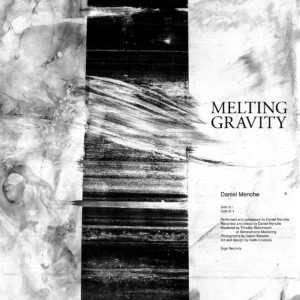
“Melting Gravity”
Daniel Menche follows up his triple CD opus Sleeper with the razor drone constructs of Melting Gravity. Hailing from Portland, Oregon, Menche is an iconic musician with three decades working with intense noise, immersive ambience, and turbulent field recordings. With Melting Gravity, Menche continues to carve his spot as a figurehead in the experimental community.
The title of Melting Gravity refers to an allegory on the human pursuit of transcendence with all of its connotations to weightlessness, ascension, flight, out-of-body experiences, and just getting high. Gravity, on the other hand, becomes that which negates and nullifies those transcendent pursuits. In the context of this particular allegory, gravity is the devil. Music, long a vehicle aimed towards transcendent ideals, becomes the weapon to defeat gravity, to defeat the devil. Daniel Menche wields the weapon of music in composing the mercurial grandeur that is Melting Gravity.
Implementing an elegant arc of acceleration and dissolve, Menche presents a slow-motion tumble of drones from his signature manipulation of FM synthesis, oscillators, and sustained tones from various stringed instruments. The tangles and tendrils of these extended frequencies are bright and liquid, rich in harmonic complexities though mottled with a scrap metal discord. Menche balances these slippery, luminous overtones with a dub-inspired lattice of recursive bass tones. Read as an industrial mantra or as amplified minimalism, Melting Gravity stands as an exemplary work in Menche’s storied catalogue of recordings.
Daniel Menche’s lengthy discography contains over 60 albums, many of which have been published by some of the most esteemed experimental record labels. Over the years he has worked with Editions Mego, Sige, Touch Music, Alien8 Records, Ash International, Utrecht Records, and many others. He has collaborated with Mamiffer, Andrew Liles, KK Null, John Wiese, Aaron Bradford Turner, Joe Preston, Anla Courtis, Zbigniew Karkowski, Kiyoshi Mizutani, and Kevin Drumm. He has performed extensively in North America, Japan, Europe, and Australia.
- Jim Haynes
20,00€
In stock
LP
Jon MUELLER
“Canto”
Jon Mueller is a multi-faceted percussionist, presenting his latest body of work in Canto for gongs, voice, and percussion. In his solo work that spans two decades, Mueller has embarked on a lengthy exploration of the timbres, the dissonance, and the physicality of repetition from his array of percussive instruments. Gongs had long been a part of his repertoire, but here on Canto he addresses their specific sonic attributes in conjunction with extended vocal techniques bolstered through his studies with the legendary NYC minimalists LaMonte Young and Marian Zazeela. In ruminating upon this shift in focus for ‘Canto,’ Mueller explains that “The driving energy of drums is replaced by deep contemplation and wonder, questions, confusion, darkness and ultimately, calm.”
The three tracks to Canto — entitled “Oil,” “Wick,” and “Flame” — have their names taken from a Sufi text, representing parts that create a whole, just as a canto is a part of a longer poem. “Oil” is an expansive piece that builds upon frameworks that build gradual crescendos from his gongs through volume and complexity of frequency. This unfurls into an eerie yet beautifully rendered sound bath of metallic resonance and reverberation girded by slowly paced vocal melodies. “Wick” stems from Mueller’s lessons with Young and Zazeela. While his goal was not to become an Indian classical singer, he adopts those techniques in this vigorous concentration of sustained vocal tones for a piece that is as trenchant as it is meditative. “Flame” reprises the combination of gong overtones that amass out of a deep somatic chant. Canto stands as a bold, expressive album that follows a long line of avant-garde percussionists that include Eddie Prevost, Jason Kahn, Daniel Schmidt, and Christopher Tree’s Spontaneous Sound.
20,00€
Out of stock

2 LP
THALASSA
“Bonds of Prosperity”
Thalassa is the avant-drone project for Aaron Turner (Sumac, Isis, Mamiffer, House Of Low Culture, etc.) and William Fowler Collins. In his many guises, Turner articulates a chimerical aesthetic that intrepidly explores beyond the scope of sludge, hardcore and post-rock. In Collins’ blackened earth drones, he steadfastly engages in the elemental exploration of the New Mexican landscape that often inspire comparisons to the potency of black metal without the need for a single blast beat. It makes a hell of a lot of sense these two would eventually cross paths and collaborate.
The project name Thalassa harkens to ancient Greek mythology of a primordial sea-goddess, later reprised in the early 20th century through an obscure psychoanalytic treatise by Sándor Ferenczi who posited ideas of human sexuality in symbolic return to the sea. For Turner, the project's name was sparked by a blood disorder called Thalassemia, whose root name is that very same Greek goddess. The ocean, blood, rain, sand, the desert, heat, fog -- all of these elemental / environmental forces are at play in the heavily sedimental drones and crumbled noise from Turner and Collins on their debut release, Bonds of Prosperity.
Pressurized torrents of sound build incrementally through layers upon layers of
aggregated grit, soot and flotsam. Given the ecological and mythic references, these tracks suitably take the long-view through a uniquely muscular approach to American minimalism. Thalassa finds itself in very good company with Maeror Tri, Deathprod, Sunn O))) and Lustmord.
2XLP edition of 300 copies, housed in a custom printed 2LP sleeve, pressed on black vinyl only.
Original price was: 25,00€.12,00€Current price is: 12,00€.
In stock

LP
MESA RITUAL
Formed in New Mexico in 2009, Mesa Ritual is the duo of William Fowler Collins and Raven Chacon. In their five year existence they have created a concise, extremely focused, and inimitable body of work consisting of one EP, and this, their first full length album. Considering the rarified nature of their activities, the resultant sounds would suggest a process of patient sonic reductionism, whereby only the most essential elements are allowed to remain in the completed works. These skeletal compositions expose a core that is both vibrant and severe. Much like the environment from which they originated, the sounds conjured by Mesa Ritual on their debut full length are simultaneously alluring and forbidding.
Over the course of the album’s nine tracks a deceivingly spare palette of sounds are implemented: sporadic gasps of crackling circuitry, arid washes of impenetrable static, dilapidated field recordings, and insistent cycles of rhythmic thunder. Through a deft and continual recombination of these elemental pieces, an interwoven series of fevered desert dreams are invoked in the listener - twisting and looming over the vast horizon, and then receding as new facets of the evolving storm supersede. Balancing on the precipice between purgatorial stasis and nightmarish descent, the album evokes the animalistic unease of finding oneself in familiar surroundings which have been uncannily altered beyond recognition. A tense listen though it may be, the album is not without its own form of subtle and serene beauty. In the midst of swirling sandstorms of agitated electronics there beats a steady heart, unwavering in purpose, poised in harmony. Perhaps it is this foundation of a pervasive living spirit veiled within the work that invites repeated visits into the outwardly hostile environments that Mesa Ritual devise.
Original price was: 23,00€.12,00€Current price is: 12,00€.
Out of stock
LP
Daniel MENCHE – William FOWLER COLLINS
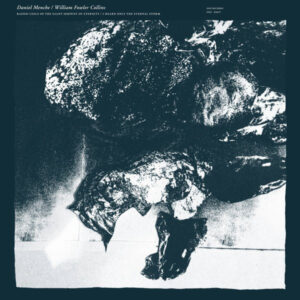
“I traversed the worlds, I ascended into the suns, and soared with the Milky Ways through the wastes of heaven; but there is no God. I descended to the last reaches of the shadows of Being, and I looked into the chasm and cried: ‘Father, where art thou?’ But I heard only the eternal storm ruled by none, and the shimmering rainbow of essence stood without sun to create it, trickling above the abyss.” So declares Christ in the opening section of Jean Paul’s 1796 text “Speech of the Dead Christ”. The text served as inspiration for the music presented on this split album by Daniel Menche and William Fowler Collins, and in the instance of the above quote, also functions as an apt description for it - immense, harrowing, and numinous. Like the procession of images conjured in Jean Paul’s twisting passages, the sounds made by Collins and Menche unfurl in a trail of drifting shadow punctuated by convulsive spasms of light.
Opening the album with a harmonious set of gently spiraling tones, Daniel Menche’s piece “Raised Coils of the Giant Serpent of Eternity” offers only this brief moment of serenity before a headlong dive into a cacophonous abyss of darker dimensions. Suspended in pools of liquid bass, layers of molten brass hover, dissolve and reappear. Pitches rise and fall, intersecting for brief periods of melodic convergence before crumbling again into heaving slabs of rumbling dissonance. Closing out the piece a low and solemn tone emerges from the roar of Menche’s spectral orchestra, seeming less like resolve, than the final flickering breath of a dying star.
Conversely, William Fowler Collins’ offering on the second side remains in a state of subdued tension for much of its duration. Primarily constructed around the emanations of decayed strings, these glimmering filaments seem in perpetual retreat from comfortable stasis or momentous upheaval. Swaying over a backdrop of inky black, disharmonious clusters gradually pile one over the other, pulling apart and recombining, eventually forming a jagged and unsettling crest. From here bilious clouds of humming static overtake the disintegrating strings, appearing long enough to set the stage for the conclusion of the narrative. Much like the opening Menche’s piece on the reverse side, Collins’ gently cascading sheaves of brushed guitar that close out the album serve as a small enclave of comfort in the otherwise lightless caverns through which he and Menche have driven the listener.
20,00€
In stock

LP
Aaron TURNER & Daniel MENCHE
“Nox”
Daniel Menche is a prolific musician whose work in the fields of noise and experimentalism displays both savage tactile expressionism and masterful studio
manipulations. Aaron Turner is an equally prolific artist whose output veers from
violent guitar architectures to textural meditations. Consequently, their collaborative album Nox could have been a brutish exercise in punishing frequencies and aural assaults. Instead, Nox is what Turner describes as “a combo of Daniel s more free-flowing form of impulsive music making and my more contemplative composition.”
Consisting of one lone track over the course of two sides of an LP, Nox uses its allowance of time to patiently wind and unravel around Menche s intuitive and free-associative vocal and drum treatments. Manipulated and wrought to the point of abstraction, this spontaneous underpinning served as the narrative backbone to Turner s orchestral vocal arrangements. Over the course of the year-long development process, the two musicians maintained a continual dialogue on the direction of the album, taking turns adding their accents and embellishments to the composition. Field recordings, found sounds, and auxiliary instrumentation fleshed out the recording until Nox developed into a final ruminative experience.
Menche and Turner had previously worked together on the Mamiffer/Menche collaborative album Crater, though Nox bears closer sonic relations to other endeavors in both artists canons. One can hear vestiges of Menche s more percussion-based albums like Concussions or Turner s more ethereal vocal-based work with Jodis on their most recent offering. And while the tactics and tools used for creating the album are very much of the modern age, the duo conjure the timeless elements of the transcendental hymns of Arvo Pärt or the tonal clusters of György Ligeti through their patient, economical approach. Ultimately, Nox creates a lush, inviting, and deeply dimensional world that belie the cold basements of Portland, OR and Vashon, WA where it was slowly brought to fruition.
LP edition of 400 copies. The LP is housed in a letterpressed jacket designed by Daniel Castrejon with photography by Faith Coloccia. Turner and Menche worked over a period of 2 years to complete the album using voice, field recordings, electronics, guitar, etc. The album was then mixed by Mell Dettmer (Earth, Eyvind Kang, Jessika Kenney, Sunn0))), etc).
manipulations. Aaron Turner is an equally prolific artist whose output veers from
violent guitar architectures to textural meditations. Consequently, their collaborative album Nox could have been a brutish exercise in punishing frequencies and aural assaults. Instead, Nox is what Turner describes as “a combo of Daniel s more free-flowing form of impulsive music making and my more contemplative composition.”
Consisting of one lone track over the course of two sides of an LP, Nox uses its allowance of time to patiently wind and unravel around Menche s intuitive and free-associative vocal and drum treatments. Manipulated and wrought to the point of abstraction, this spontaneous underpinning served as the narrative backbone to Turner s orchestral vocal arrangements. Over the course of the year-long development process, the two musicians maintained a continual dialogue on the direction of the album, taking turns adding their accents and embellishments to the composition. Field recordings, found sounds, and auxiliary instrumentation fleshed out the recording until Nox developed into a final ruminative experience.
Menche and Turner had previously worked together on the Mamiffer/Menche collaborative album Crater, though Nox bears closer sonic relations to other endeavors in both artists canons. One can hear vestiges of Menche s more percussion-based albums like Concussions or Turner s more ethereal vocal-based work with Jodis on their most recent offering. And while the tactics and tools used for creating the album are very much of the modern age, the duo conjure the timeless elements of the transcendental hymns of Arvo Pärt or the tonal clusters of György Ligeti through their patient, economical approach. Ultimately, Nox creates a lush, inviting, and deeply dimensional world that belie the cold basements of Portland, OR and Vashon, WA where it was slowly brought to fruition.
LP edition of 400 copies. The LP is housed in a letterpressed jacket designed by Daniel Castrejon with photography by Faith Coloccia. Turner and Menche worked over a period of 2 years to complete the album using voice, field recordings, electronics, guitar, etc. The album was then mixed by Mell Dettmer (Earth, Eyvind Kang, Jessika Kenney, Sunn0))), etc).
18,00€
Out of stock
2 LP
MAMIFFER – CIRCLE
“Enharmonic intervals (For Paschen organ)”
A fully collaborative effort between Mamiffer and Circle : shininhg heavenly light onto the wan, academic corpse of avant-garde minimalism. “Too often, “collaborations” are little more than different musicians each independently playing their obvious parts. The ego does not retreat; even as every voice gets their say, there is no conversation happening. It’s all a lot of yelling and trying to be heard. It’s a humbling thing then to hear different musicians make conversation seem so effortless and genuine, and to hear them strike such an elegant balance between distinction and disappearance.
I had the privilege of talking with Mamiffer and Locrian about this very thing last year. I didn’t learn much about the technicality of collaborations. I only learned that it takes particular personalities, that is, those fundamentally open to the very possibility of collaboration. The situation - the recording studio, the equipment, and even the talent - only determines so much. It really is, instead, a posture of openness, an “ethic of conversation,” that clears the way for making something truly effective, collaboratively.
What I then mean to say - with absolutely shameless, uncritical praise and admiration - is that it’s no surprise to me (at all) that Mamiffer and Circle were able to make this work, together. Below is only one stunning example of this extraordinary collaboration. And believe me when I say that you should look forward to hearing the others as well.” (Max Power, tinymixtapes.com)
I had the privilege of talking with Mamiffer and Locrian about this very thing last year. I didn’t learn much about the technicality of collaborations. I only learned that it takes particular personalities, that is, those fundamentally open to the very possibility of collaboration. The situation - the recording studio, the equipment, and even the talent - only determines so much. It really is, instead, a posture of openness, an “ethic of conversation,” that clears the way for making something truly effective, collaboratively.
What I then mean to say - with absolutely shameless, uncritical praise and admiration - is that it’s no surprise to me (at all) that Mamiffer and Circle were able to make this work, together. Below is only one stunning example of this extraordinary collaboration. And believe me when I say that you should look forward to hearing the others as well.” (Max Power, tinymixtapes.com)
12,00€
Out of stock
2 LP
MAMIFFER
“Mare descendrii”
A Sige Records repress of Mamiffer’s second full length Mare Decendrii.
Artwork is different from the original pressing. Edition of 600.
Credits : Recorded from September 2009 to September 2010 at: Studio Litho, Aleph Studio, and London Bridge in Washington State. Produced by Randall Dunn. Co-produced by Mamiffer. Engineered by Randall Dunn. Assistant engineers: Mell Dettmer and Shawn Simmons. Mixed at London Bridge Studio by Randall Dunn. Mixing assistant: Mell Dettmer. Mastered by Mell Dettmer.
Tape samples recorded by Faith Coloccia 2008-2009. String arrangements by Eyvind Kang. Piano tuned by Hak Bo Lee. Lyrics by Faith Coloccia and Aaron Turner. The bonus track Dead Settlers was recorded by Faith Coloccia and Aaron Turner in WA. 2008-2010. Mixed by Aaron Turner. Mastered by James Plotkin. Tape samples recorded by Faith Coloccia in Chicago Il. 2008.
For this recording Mamiffer is Faith Coloccia: piano, vocals, bass synthesizer, prepared piano, organ, auxiliary percussion and tape samples. Aaron Turner: guitar, vocals, effects. Additional performances by Don McGreevy: drums, tubular bells, and auxiliary percussion. Brian Cook: bass. Eyvind Kang: viola, violin, cello and overtones. Timb Harris: viola, and violin. Moriah Neils: double bass. Additional vocals by Mika Rättö, Jussi Lehtisalo, Parvaneh Daneshvar, Jessika Kenney, Sera Timms, and Joe Preston. Additional auxiliary percussion by Aaron Harris, Travis Rommereim, and Randall Dunn. Photos 39/40 and 20/40, extract of the series : "”0 Portraits - 2003-2008”. Dolls and photography by Gisèle Vienne. Ash paintings, forest photography and design by Faith Coloccia. Design assistance: Aaron Turner.
Artwork is different from the original pressing. Edition of 600.
Credits : Recorded from September 2009 to September 2010 at: Studio Litho, Aleph Studio, and London Bridge in Washington State. Produced by Randall Dunn. Co-produced by Mamiffer. Engineered by Randall Dunn. Assistant engineers: Mell Dettmer and Shawn Simmons. Mixed at London Bridge Studio by Randall Dunn. Mixing assistant: Mell Dettmer. Mastered by Mell Dettmer.
Tape samples recorded by Faith Coloccia 2008-2009. String arrangements by Eyvind Kang. Piano tuned by Hak Bo Lee. Lyrics by Faith Coloccia and Aaron Turner. The bonus track Dead Settlers was recorded by Faith Coloccia and Aaron Turner in WA. 2008-2010. Mixed by Aaron Turner. Mastered by James Plotkin. Tape samples recorded by Faith Coloccia in Chicago Il. 2008.
For this recording Mamiffer is Faith Coloccia: piano, vocals, bass synthesizer, prepared piano, organ, auxiliary percussion and tape samples. Aaron Turner: guitar, vocals, effects. Additional performances by Don McGreevy: drums, tubular bells, and auxiliary percussion. Brian Cook: bass. Eyvind Kang: viola, violin, cello and overtones. Timb Harris: viola, and violin. Moriah Neils: double bass. Additional vocals by Mika Rättö, Jussi Lehtisalo, Parvaneh Daneshvar, Jessika Kenney, Sera Timms, and Joe Preston. Additional auxiliary percussion by Aaron Harris, Travis Rommereim, and Randall Dunn. Photos 39/40 and 20/40, extract of the series : "”0 Portraits - 2003-2008”. Dolls and photography by Gisèle Vienne. Ash paintings, forest photography and design by Faith Coloccia. Design assistance: Aaron Turner.
12,00€
Out of stock
2 LP
Daniel MENCHE
“Vilke”
Vilké: of Lithuanian origin, a word for the female wolf. An avid and voracious hiker, Menche found great inspiration in the beautiful lament of howling wolves during his overnight expeditions; and ultimately chose these sounds as the core sonic elements for Vilké. By layering and distending wolves voices, a choir of howls was constructed - a massive sound wall colliding with layers of poly-rhythmic drums, abstracted guitar and piano.
“(Menche) eschews classification as a noise artist, and while many of his techniques suggest similarities to musicians who work within that realm, he works within specific structures, with a meticulous sense of the relationships between sounds and the overall development of a piece”- Dusted
“(Menche’s) honed style thrives on subtleties, crescendos, sublimation, and locomotive transformation. One can easily become immersed in his web of carefully sculpted sound hip-gnosis.” - Tiny Mix Tapes
“...proof of Menche’s uncanny talent for mutating common sounds into tracks that are dizzyingly unworldly. A tour of his universe is unlike any other and well worth the time and attention invested in attentive listening.” - brainwashed.com
“(Menche) eschews classification as a noise artist, and while many of his techniques suggest similarities to musicians who work within that realm, he works within specific structures, with a meticulous sense of the relationships between sounds and the overall development of a piece”- Dusted
“(Menche’s) honed style thrives on subtleties, crescendos, sublimation, and locomotive transformation. One can easily become immersed in his web of carefully sculpted sound hip-gnosis.” - Tiny Mix Tapes
“...proof of Menche’s uncanny talent for mutating common sounds into tracks that are dizzyingly unworldly. A tour of his universe is unlike any other and well worth the time and attention invested in attentive listening.” - brainwashed.com
24,00€
Out of stock
3 CD
Daniel MENCHE
“Sleeper”
Daniel Menche is best known for his assemblages of visceral, industrial-
strength noise. In such head-rinsing recordings as Vilké (2013), Deluge (2003), and Fields of Skin (1997), Menche’s compositional directives instigate and exacerbate the physiological properties of anxiety -- increased blood pressure, blurred vision, claustrophobia, panic, disorientation, etc. In the hands of a talented composer such as Menche, noise can be demonstrative, cathartic and even communal. But after three decades of intense relentlessness, Menche posed the internal question: “Why the hell do I gravitate to compositions that stresses people out?” In re-evaluating his own compositional strategies and philosophical stances, Menche worked out the ideas through sound. Out of that research came the makings an ambient record that he could fall asleep to. These recordings seek to amplify the re-imagined traces of light and dark across the inner eyelid of the dreamer caught in that crepuscular moment between wake and sleep.
To peg this album as merely an ambient record is to do Sleeper a gross disservice. This a Menche ambient record. Feckless new age drivel, this is not. While seeking a graceful tranquility and placid states of mind, Menche’s compositional tools remain the sonic equivalent of a chainsaw. Rough edges and bold gestures are steadfast reminders that Menche is at the helm. In Sleeper, Menche plunges into the harmonic dissonance and glassine minimalism found in the historical works of La Monte Young and Charlemagne Palestine. Never one to be static, Menche drapes his ephemerally half-melodic loops and unfurled sonic tapestries onto a distant, iron-clad thump as a rhythmic spine. The ghostly frequencies that flare out of from his drones almost always evolve into sharp and blinding coronas of sound, embruing the album with an unnerving tension.
An opus at a third of the length, Menche’s Sleeper is a monumental album of colossal driftwork clocking in well over three hours.
3 CD edition of 500 copies, housed in a custom printed tri-gatefold stumptown printing CD jacket.
18,00€