
In stock
LP
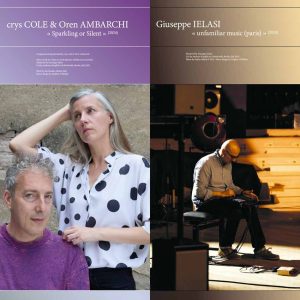
Crys COLE & Oren AMBARCHI / Giuseppe IELASI
“Sparkling or Silent / unfamiliar music (paris)”
Sparkling or Silent, by the duo composed of crys cole and Oren Ambarchi, is a moment apart in their respective artistic approaches, taking a step aside and marking a point of fixation around an electroacoustic method which, while always latent in both of their works, here asserts itself as a central compositional modality. However, the electroacoustic approach is not called upon here for its formal reasons, or even less as an aesthetic line to follow. On the contrary, it is seen as a writing tool, open to all possible sonic possibilities, a tool that allows the artist to draw, within the sound itself, an intertwined space where reminiscences, impressions and sensations weave a narrative on the edge of the imagination and the moments experienced together, a narrative in which a complex and sensitive layer of sound is embedded, blurring the boundaries between artistic project, intimate journey and shared dreams.
—
Derived from a live performance, unfamiliar music (paris) reveals the essence of the obsessions and sonic universe of Giuseppe Ielasi, a musician whose discretion is matched only by his talent and boundless dedication to musical creation over almost 30 years. unfamiliar music (paris) is a remarkable manifestation of Ielasi’s approach, an approach in which delicacy, sometimes nostalgia, and emotions know how, with discretion, to infuse a sound universe built around polyphony and reminiscence, around textures and motifs that intertwine, combine and drive each other with grace and inspiration.
François J. Bonnet
24,00€
In stock

LP
Jana IRMERT – 7038634357
“Portals – Rope”
Jana IRMERT « Portals »
Produced entirely from sounds recorded in the Amazon rainforest in Brazil and Colombia, Portals evokes the hidden world of sounds that lie beyond our perception. Whether concealed in ultra-sonic frequency registers or in the depths of the aquatic medium, these sounds bear witness to an unsuspected and teeming animal activity. Insects, frogs, bats and freshwater dolphins move about, hiding from our eyes and ears. Revealing this palette of sounds, in particular through transposition, and placing it back in the realm of the audible, Jana Irmert invites and guides us on a fascinating exploration of an unsuspected, speculative and non-human world of sound, which she exposes and recomposes in a way that is both respectful and personal, accompanying this teeming and fascinating sound material in a musical gesture of great clarity. Portals is an attempt to access the evocative power of an Amazonian forest on the brink of catastrophe, through a decentring of the listening experience delicately composed by Jana Irmert.
7038634357 « Rope »
With uncommon mastery and precision, Rope unfolds in a suspended time that seems nonetheless ominous. As its title suggests, Rope explores the formal figure of the rope, as an interweaving of synthetic and natural fibres that hold and amalgamate, held together by the forces of tension and friction. The rope itself, as Neo Gibson explains, is knotted at regular intervals along its entire length, so that you can hang on to it. Rope unfolds slowly, evolving from the threshold of the perceptible towards denser, more ballasted electronic textures, but always on the brink of an upheaval to come. Then a melodic motif appears, seeming to carry within it an impossible consolation. In this respect, Rope balances strikingly between formal elegance, sonic gravity and an emotional charge that is almost uncontainable.
25,00€
In stock

CD
Stephen O’MALLEY
“But remember what you have had”
With But remember what you have had, Stephen O’Malley continues and expands his musical approach by transposing it to multiphonic electroacoustic writing and acousmatic listening. Drawing not only on his extensive experience as a composer and live instrumentalist, but also on the countless studio production and mixing sessions he has taken part in the course of his many projects (in solo, with SUNN O))) or KTL, to name but a few), Stephen O’Malley’s work on this new piece is ambitious, engaging in an inspired research that delves into the deep intricacies between polyphony, intonation and timbrality, enhanced by melodic motifs. To do this, O’Malley summons up his own very personal sound universe, constellated with amplified textures, instrumental sustained tones and raw energy, in order to diffract them into wavefronts, waves and blows that weave a complex, rich and fascinating matter. But remember what you have had stands out as an important work in Stephen O’Malley’s repertoire: it brings together the multiplicity of his musical approach in an exemplary way, while laying the foundations and promises for the future of an already extraordinary journey.
Composed by Stephen O’Malley / Mixed & arranged at GRM studios, Paris, 2022-2024 / Commissioned by INA grm
Electric guitars performed by Stephen O’Malley / Recorded at Applehead Studio, Woodstock by Randall Dunn, September 2022
Winds performed by Hans Teuber (bfl, fl, bcl, cl, tpt) & Stephen Moore (tbn) / Recorded at Studio Litho, Seattle by Floyd Reitsma, September 2022 / Arrangement assistance & conduction by Kali Malone
Premix at La Fugitive, Paris with François-Xavier Gilles & Tristan Mazire, February 2023 / Final stereo mix at GRM studios, Paris with Emmanuel Richier, May & October 2024
Mastered by Giuseppe Ielasi, October 2024 / Cut by Andreas Kauffelt at Schnittstelle, October 2024
17,00€
In stock
LP
Stephen O’MALLEY
“But remember what you have had”
With But remember what you have had, Stephen O’Malley continues and expands his musical approach by transposing it to multiphonic electroacoustic writing and acousmatic listening. Drawing not only on his extensive experience as a composer and live instrumentalist, but also on the countless studio production and mixing sessions he has taken part in the course of his many projects (in solo, with SUNN O))) or KTL, to name but a few), Stephen O’Malley’s work on this new piece is ambitious, engaging in an inspired research that delves into the deep intricacies between polyphony, intonation and timbrality, enhanced by melodic motifs. To do this, O’Malley summons up his own very personal sound universe, constellated with amplified textures, instrumental sustained tones and raw energy, in order to diffract them into wavefronts, waves and blows that weave a complex, rich and fascinating matter. But remember what you have had stands out as an important work in Stephen O’Malley’s repertoire: it brings together the multiplicity of his musical approach in an exemplary way, while laying the foundations and promises for the future of an already extraordinary journey.
Composed by Stephen O’Malley / Mixed & arranged at GRM studios, Paris, 2022-2024 / Commissioned by INA grm
Electric guitars performed by Stephen O’Malley / Recorded at Applehead Studio, Woodstock by Randall Dunn, September 2022
Winds performed by Hans Teuber (bfl, fl, bcl, cl, tpt) & Stephen Moore (tbn) / Recorded at Studio Litho, Seattle by Floyd Reitsma, September 2022 / Arrangement assistance & conduction by Kali Malone
Premix at La Fugitive, Paris with François-Xavier Gilles & Tristan Mazire, February 2023 / Final stereo mix at GRM studios, Paris with Emmanuel Richier, May & October 2024
Mastered by Giuseppe Ielasi, October 2024 / Cut by Andreas Kauffelt at Schnittstelle, October 2024
24,50€
In stock

CD
Jim O’ROURKE
“Shutting Down Here”
Shutting Down Here
2019 / 35’13
Recorded at INA GRM and Steamroom
Piano: Eiko Ishibashi // Violin, viola: Atsuko Hatano // Trumpet: Eivind Lonning
Cut by Andreas Kauffelt at Schnittstelle, Berlin, February 2020
Photo by Eiko Ishibashi // Sleeve design by Stephen O’Malley
Special thanks to Francois Bonnet and Jean Schwarz for bookending 30 years
Due to the wide dynamic levels, please adjust your volume accordingly
Shutting Down Here is a special work. Symbolically, it covers a period of thirty years, between two visits by Jim O'Rourke to the GRM, the first, as a young man fascinated by the institution and his repertoire, the second, as an accomplished musician, influential and imbued with an aura of mystery. Shutting Down Here is a piece shaped like an universe, a heterogeneous world in which collides the multiple musical facets of Jim O'Rourke: instrumental writing, field recordings, electronic textures and cybernetic becomings, dynamic spaces, harmonic spaces, silent spans . This variety of approach, strangely, does not in any way weaken the coherence of the whole and this is the talent of Jim O'Rourke, a talent, properly speaking, of composition, where all the sound elements compete and participate to stakes that exceed them and of a common destiny, that is to say of an apparition.
Released in association with Editions Mego.
Coordination GRM: François Bonnet, Jules Négrier
Executive Production: Peter Rehberg
17,00€
In stock
LP
Jim O’ROURKE
“Shutting Down Here”
Shutting Down Here
2019 / 35’13
Recorded at INA GRM and Steamroom
Piano: Eiko Ishibashi // Violin, viola: Atsuko Hatano // Trumpet: Eivind Lonning
Cut by Andreas Kauffelt at Schnittstelle, Berlin, February 2020
Photo by Eiko Ishibashi // Sleeve design by Stephen O’Malley
Special thanks to Francois Bonnet and Jean Schwarz for bookending 30 years
Due to the wide dynamic levels, please adjust your volume accordingly
Shutting Down Here is a special work. Symbolically, it covers a period of thirty years, between two visits by Jim O'Rourke to the GRM, the first, as a young man fascinated by the institution and his repertoire, the second, as an accomplished musician, influential and imbued with an aura of mystery. Shutting Down Here is a piece shaped like an universe, a heterogeneous world in which collides the multiple musical facets of Jim O'Rourke: instrumental writing, field recordings, electronic textures and cybernetic becomings, dynamic spaces, harmonic spaces, silent spans . This variety of approach, strangely, does not in any way weaken the coherence of the whole and this is the talent of Jim O'Rourke, a talent, properly speaking, of composition, where all the sound elements compete and participate to stakes that exceed them and of a common destiny, that is to say of an apparition.
Released in association with Editions Mego.
Coordination GRM: François Bonnet, Jules Négrier
Executive Production: Peter Rehberg
24,00€
In stock

LP
Beatrice DILLON – Hideki UMEZAWA
“Basho – Still Forms”
The title of this work by Beatrice Dillon is taken from the notion of ‘basho’, developed by Kitarō Nishida, Japanese philosopher and father of the Kyoto school. Kitaro’s ‘basho’ (場所) refers to a fundamental ‘place’ or ‘field’ where things exist and interact. Not just a physical location, but a more abstract space where all experiences, thoughts, and phenomena are interconnected. In Nishida’s philosophy, ‘basho’ is a dynamic, living ground where subject and object, self and world, are not separate but mutually interrelated. Inspired by this, Beatrice Dillon develops a music of a complex nature, that never ceases to constitute itself as pure presentation, constantly re-exposed, reactivating at every moment both the object of attention and the listener who aims at it. Borrowing both its sounds (which have no real origin or internal space) and its idioms from electronic music, Dillon's Basho is a diversion, a rearrangement that places us, through elements that are familiar but suddenly alien, back into a field of pure listening.
—
Still Forms, by Japanese composer Hideki Umezawa, draws its sound material from the exploration of Baschet sound structures, instruments developed by the brothers Bernard and François Baschet in the 1950s that have since been highly prized by the world of contemporary musical creation. These structures were presented at the 1970 Osaka World’s Fair, and some remained in Japan. Through various recording sessions, in Japan but also in France, Hideki Umezawa re-explores the fascinating sonic potential of these atypical instruments to include them in a highly mastered composition where sounds of acoustic origin and electronic textures respond to each other, as in the distorted reflection of the resonators of the Baschet structures. Still Forms is thus a tribute to, and a journey through time through, the incredible power of inspiration and invention of these sound structures, but also a sharpened proposal of contemporary electroacoustic composition that knows how to renew itself without denying its origins.
24,00€
In stock

LP
Michelle Helene MACKENZIE & Stefan MAIER – Olivia BLOCK
“Orchid Mantis – Breach”
Orchid Mantis, by Michelle Helene Mackenzie and Stefan Maier, is a work that draws its inspiration from the history of the Sanzhi Pod City, in northern Taiwan. Sanzhi Pod City was built from 1978 onwards, made up of buildings constructed from assemblages of ‘pods’ inspired by the futuro houses of Finnish architect Matti Suuronen. The project was abandoned in 1980, following a number of accidents during construction and persistent rumours that the site was haunted. However, this wasteland of a city has allowed insects to proliferate, in particular five species of orchid mantis. It is this strange environment, made up of utopian buildings, proliferating insects and vegetation reclaiming the site, that serves as the imaginary space for Michelle Helene Mackenzie and Stefan Maier’s music, a music of carefully designed pace and progression, drawing, through resonance and stridulation, subtle sonic materials that guide and accompany us into multiple worlds with admirable ease and grace.
—
Breach, by American composer Olivia Block, engages in a dialogue between field recordings and synthesised sounds, creating a vibrant plea for wild spaces that face an ever-growing threat to their survival from human activities. The work is based on recordings collected in the San Ignacio lagoon in the Mexican part of Southern California. This lagoon is known as a breeding ground for eastern Pacific grey whales. With the help of precise electronics, the music unfolds like a drift, depicting the subjective soundscape of whales caught up in the noise of the Anthropocene. The composer uses otoacoustic emissions in particular, representing the sound saturation caused by humans in the habitat of these large marine mammals. Going beyond a merely descriptive dimension, Olivia Block manages to transcend her subject to offer a fascinating musical form that engages the listener in a constantly renewed way.
24,00€
In stock

LP
François J. BONNET – Sarah DAVACHI
“Banshee – Basse Brevis”
François J. Bonnet – Banshee
Banshee is an ear directed towards the edges of the old world, where these infinite fines terrae cut and fractalize into coasts, harbours, fjords, peninsulas and archipelagos. Drawing its raw material from recordings made in the Inner Hebrides, Banshee tightly weaves a fabric where the sonic avatars of fauna, flora and climate merge with the human presence, its tools and its culture. Thus, a small boat cleaving through a loch becomes the voice of the mountains and wilderness, and the howling of the wind on the moors becomes the lament of a Banshee, harbinger of death, messenger of the Other World.
Sarah Davachi – Basse Brevis
Co-commissioned by Radio France and INA grm, Basse Brevis by Canadian composer Sarah Davachi was premiered at the Présences 2024 festival, which was dedicated to Steve Reich. Drawing on her own minimalist approach, Sarah Davachi explores, with extreme care, the weavings and complex relationships between the timbral, spatial and durational components of music. Using developments that can be appreciated over time, the composer manages to create music that is extremely precise, subtle and lively. But what is striking, and particularly evident in Basse Brevis, is that such an approach, both abstract and restrained, is nonetheless at times utterly poignant. The work combines moments of formal exploration with moments of pure emotion in a perfectly mastered fashion, creating a gentle tension as it swings between two modes of listening that navigate indecisively within both instrumental and concrete approaches, tracing, in parallel, a diagonal of sound that unfolds around perception, sensation and feeling.
24,00€
In stock

LP
Flora YIN WONG – Sébastien ROUX
“Trigram for Earth / 50 Frequency and Amplitude Modulated Sine Waves Describing a Landscape”
Flora YIN WONG 'Trigram for Earth'
Trigram for Earth, by Flora Yin Wong, is inspired by traditional eight-sided Pakua mirrors and the trigrams inscribed on each of their edges. The function of the mirrors is to show the nature of reality as being composed of mutually opposing forces and modulate them. Here, energies seem to be manipulated to guide and direct our listening, lost in a maze of sound, diffracted to the point of merging with the artist's own listening, through her memories, her obsessions, the fragments she carries within her. Flora Yin Wong invites us to embark on a multi-faceted investigation of sound, a journey through the meanders of liberated sonic forces, an auscultation of her own listening and a portal, at last, ajar to a fragmented and forever mysterious inner world.
—
Sébastien ROUX '50 frequency and amplitude modulated sine waves describing a landscape'
In his work '50 frequency and amplitude modulated sine waves describing a landscape,' Sébastien Roux applies his approach to algorithmic composition to the observation of the natural world, bringing the sound of the sea and the song of birds into the electronic domain, transmuting them into each other through a slow process of gradual modulation. Exploring the abstract space of pure sounds between two naturalistic tableaux, Sébastien Roux offers us a fascinating meditation on the world of synthesis, revealing, with an economy of means and great formal elegance, the magic of sonic simulacrum and the strange beauty of the artificial, in a gesture that is ultimately as poetic as it is musical.
— François J. Bonnet, 2024
25,00€
Out of stock

LP
Laurel HALO / Jessica EKOMANE
“Octavia / Manifolds”
Laurel Halo: Octavia
Octavia, a piece for piano and electronics, explores the relationship between melodic motifs and textures in a singular way, intermittent moments of melody, harmony and sound materials connecting and disconnecting, to indicate a series of nets or webs, swaying in and out of one another. These sonic nets gently float, spin and merge, and the effect is one of gently floating over an abyss. The work is inspired by the “spiderweb city” of the same name in Italo Calvino’s Invisible Cities: “Below there is nothing for hundreds of feet: a few clouds glide past; further down you can glimpse the chasm’s bed....Suspended over the abyss, the life of Octavia’s inhabitants is less uncertain than in other cities. They know the net will last only so long.”
Jessica Ekomane: Manifolds
Entirely computer-generated, Manifolds is a work that explores the multiple possibilities of polyphonic writing, extending it to the “multiphonic” universe where sources and timbres diffract themselves in the listening space. The different voices of the composition no longer follow the traditional parallel trajectories of musical dialogue, but find themselves propelled as if into a particle accelerator, a “collider” freed from all formal rhetoric to reach a state of liberation of energies that is truly confounding. It is then that, in the multi-layered universe of sonic electrons, as if against its own will, a “chant” of overwhelming humanity is revealed.
—François J. Bonnet, 2023
23,00€
In stock

LP
Félicia ATKINSON / Richard CHARTIER
“Ni envers ni endroit … / Recurrence.Expansion”
Félicia Atkinson: »Ni envers ni endroit que cette roche brûlante (Pour Georgia O’Keeffe)« (2021)
Félicia Atkinson’s Ni envers ni endroit que cette roche brûlante (Pour Georgia O’Keeffe) is approached as a meditation, not as meditative music, but as a reflection on the art of creation: how to inhabit one’s creation, how to convey it, domesticate it and live with it. Drawing inspiration from the artist Georgia O’ Keeffe, both in her work as a painter and in the houses in which she lived in New Mexico, and even in the landscapes that surround them, Félicia Atkinson has composed a piece that evokes and celebrates, in a poetic and holistic way, the mystery of art, the somnambulic oscillation that accompanies the act of creating. Blending fragmentary voices, islands of piano, electronic textures and patterns, and field recordings, Félicia Atkinson’s music is sincere and inspired, a meditation, then, but also a lesson we sometimes forget: being an artist is not an activity, even less a profession, it’s a singular way of approaching the world and, in so doing, densifying it.
Richard Chartier: »Recurrence.Expansion« (2020)
Richard Chartier’s music takes up residence at the frontiers of the audible, on the edge where sound diffracts into an inter-dimensionality where sounds, space, listening and silence recombine in an arborescence of becomings that present themselves to us and then disappear. The space-time in which Richard Chartier’s music unfolds is a stretched space-time, barely emerging in the world of sound. The delicacy, precision and accuracy of the composition Recurrence. Expansion lies precisely in this dialogue between a shape that is exposed and developed in an inspired and masterful way, and the sonic biotope in which this shape develops. It is from such an encounter that the singularity of Richard Chartier’s music emerges, music of attentive listening, but also sensitive, inhabited music, a music of discreet metamorphosis.
25,00€
Out of stock

LP
Dafne VICENTE-SANDOVAL / Lars Petter HAGEN
“Minos Circuit / Transfiguration 4”
DAFNE VICENTE-SANDOVAL - MINOS CIRCUIT (2021)
Minos Circuit is the resonance of a double exploration, that of an instrument, the bassoon - an instrument dear to Dafne Vicente-Sandoval - and that of a listening, of a gaze, almost. The first exploration deconstructs the instrument, tearing it apart, reducing it to an archipelago of sound bodies stimulated by an electro-acoustic device that generates feedback and infiltrates each part of the bassoon, in order to carry out a methodical, systematic examination. The second exploration is the inner one of attention and listening, the one that measures, at each moment, the necessity or not of an intervention in the very act of the musical work, of this subtle balance that is established between composition and observation, between action and contemplation.
LARS PETTER HAGEN - TRANSFIGURATION 4 (2018)
Both a “meditation on musical ruins” and “a study of the material of Richard Strauss’s Metamorphoses”, Transfiguration 4 works on the musical fragment as an expressive and poetic possibility that can be deployed below or beyond simple musical syntax, a syntax that is still too often equated with music itself. What Lars Petter Hagen highlights in this remarkable work is that the power of music lies at its fringes, that is, at the edge of its own disappearance. Transfiguration 4 floats in a particularly moving way in these troubled lands, where nothing is ever resolved, and where everything, however, is suspended, like a stream of blurred memories that memory would summon to form an intuition. A musical intuition.
21,00€
Out of stock

LP
Eve ABOULKHEIR / Lasse MARHAUG
“22/12/2017 Guilin Synthetic Daydream / How to Avoid Ants”
EVE ABOULKHEIR - 22/12/2017 GUILIN SYNTHETIC DAYDREAM (2021)
22/12/2017 Guilin Synthetic Daydream is a perceptual trap. Inspired by an experience of intense perceptive disorientation while crossing a market in China, Eve Aboulkheir reinstantiates, in the field of sounds, the swirling and anamorphic universe of thwarted perceptions, surrounding multitudes and shifted sensations. She thus constructs a dreamlike and artificial universe, suspended and hyperactive, which is both an electronic vortex sucking us in and a mechanical ballet developing its arabesques around us, caught and fascinated by these volutes of sound that fracture like a kaleidoscope in which our eyes-ears are immersed. 22/12/2017 Guilin Synthetic Daydream approaches the musical form in the most direct way possible, i.e. through its effects and its empire on our sensorium.
LASSE MARHAUG - HOW TO AVOID ANTS (2020)
Using concrète techniques to collect, transform and assemble sounds of various origins (sounds of tree branches, leaves, but also guitars or synthesizers), Lasse Marhaug elaborates a dense and subterranean work, which unfolds through the multiple dimensions induced by the great diversity of its sound material. There is a labyrinthine feeling in this work, a feeling that is better understood when the inspiration for the title of the piece How to avoid ants is revealed, a very practical and then poetic undertaking, that of avoiding the anthills lining the path to the forest camp in the kindergarten to which his little girl, who was then frightened of insects, was going. It is such an activity of circumvention, diversion and byways that Lasse Marhaug uses to create an exploratory and evasive music.
21,00€
Out of stock

LP
Kali MALONE
“Living Torch”
2023 repress.
Living Torch, through its unique structural form and harmonic material, is a bold continuation of Kali Malone’s demanding and exciting body of work, while opening new perspectives and increasing the emotional potential of the music tenfold. As such, Living Torch is a major new piece by the composer and adds a significant milestone to an already fascinating repertoire.
Departing from the pipe organ that Malone’s music is most notable for, Living Torch features a complex electroacoustic ensemble. Leafing through recordings from conventional instruments like the trombone and bass clarinet to more experimental machines like the boîte à bourdon, passing through sinewave generators and Éliane Radigue’s ARP 2500 synthesizer. Living Torch weaves its own history, its own genealogy, and that of its author. It extends her robust structural approach to a liberated palette of timbre.
Living Torch was initially commissioned by GRM for its legendary loudspeaker orchestra, the Acousmonium, and premiered in its complete multichannel form at the Grand Auditorium of Radio France in a concert entirely dedicated to the artist.
Composed at GRM studios in Paris between 2020-2021, Living Torch is a work of great intensity, an oeuvre-monde that is singularly placed at the crossroads of instrumental writing and electroacoustic composition. Living Torch proceeds from multiple lineages, including early modern music, American minimalism, and musique concrète. It’s a work as much turned towards exploring justly tuned harmony and canonic structures as towards the polyphony of unique timbres, the scaling of dynamic range, and the revelation of sound qualities.
GRM (Groupe de Recherches Musicales), the pioneering institution of electroacoustic, acousmatic, and musique concrète, has been a unique laboratory for sonorous research since 1958. Witnessing the extreme vitality of the music championed by GRM, the Portraits GRM record series extends and expands this momentum with Kali Malone’s Living Torch.
The French label-partner Shelter Press is proud to continue the collaboration with GRM, which Peter Rehberg of Editions MEGO set the foundation for in 2012.
Composed & Produced by Kali Malone at INA GRM 2020-2021
Trombone & Bass Clarinet recorded at EMS Elektronmusikstudion 2020
Pre-mastered by Emmanuel Richier at INA GRM
Mastered by Stephan Mathieu at Schwebung Mastering
Cut by Andreas Kauffelt at Schnittstelle, Berlin.
Photograph by Estelle Hanania
Painting by Ross Caliendo
Sleeve design by Stephen O’Malley
Trombone: Mats Äleklint
Bass Clarinet: Isak Hedtjärn
ARP 2500, Modular Synthesis, Pura Data & Boîte à Bourdons: Kali Malone
21,50€
In stock

LP
Peter REHBERG
“at GRM”
Shelter Press and Ina grm are pleased and moved to present two previously unreleased recordings of Peter Rehberg, two live performances given at the GRM which, each in their own way, vividly illustrate the extent of his sonic palette.
On 22 July 2021, Peter Rehberg passed away, leaving a great emptiness in his wake. Many initiatives have already celebrated or will soon celebrate his memory and the titanic work he put at the service of so many artists - a whole musical community, in fact - through Editions Mego. INA grm, Shelter Press and Stephen O’Malley, who are continuing some of the collaborative Editions Mego sub-labels (Recollection GRM, Portraits GRM and Ideologic Organ), wanted to pay tribute more specifically to the musician Peter Rehberg, and to his immense talent.
Peter Rehberg, as an artist, has collaborated with the GRM on numerous occasions, both with Stephen O’Malley (as KTL) and solo. This release features two concerts given for the GRM, each time as part of the Présences électronique festival. The first concert, given on 15 March 2009 at the Maison de la Radio in Paris, marked the first collaboration between Peter Rehberg and the GRM and the beginning of a long and fruitful friendship. The second concert took place on 6 March 2016. Between these two concerts, 7 years have passed, 7 years in which the ties between Peter Rehberg and the GRM have been strengthened, 7 years in which Peter Rehberg’s music has flourished. What is striking in these two concerts is how Peter Rehberg’s unique musical sensitivity and ‘grammar’ can be heard beyond the instruments. For while the first concert is pure laptop music, the second is extended to the field of modular synthesis. However, in both concerts, the elements that are so personal to Peter Rehberg’s music are present and combine in a layering of sonic abrasions, raw sensations and a sensitivity that is as much about formal awareness as it is about the invocation of overwhelming emotions, even though a little hidden behind a radicality that is always a bit provocative. Peter Rehberg offers us a “portrait music”, a music that gives some clues about the personality of its author and whose absence continues to deepen an inconsolable sadness.
Live performances by Peter Rehberg at le Centquatre-Paris for INA grm’s Présences électronique festival, recorded on March 15, 2009, and March 6, 2016.
Mastered by Giuseppe Ielasi
Cut by Andreas Kauffelt at Schnittstelle, Berlin
Photo by Magdalena Blaszczuk
Sleeve design by Stephen O’Malley
25,00€
Out of stock
CD
Kali MALONE
“Living Torch”
Living Torch, through its unique structural form and harmonic material, is a bold continuation of Kali Malone’s demanding and exciting body of work, while opening new perspectives and increasing the emotional potential of the music tenfold. As such, Living Torch is a major new piece by the composer and adds a significant milestone to an already fascinating repertoire.
Departing from the pipe organ that Malone’s music is most notable for, Living Torch features a complex electroacoustic ensemble. Leafing through recordings from conventional instruments like the trombone and bass clarinet to more experimental machines like the boîte à bourdon, passing through sinewave generators and Éliane Radigue’s ARP 2500 synthesizer. Living Torch weaves its own history, its own genealogy, and that of its author. It extends her robust structural approach to a liberated palette of timbre.
Living Torch was initially commissioned by GRM for its legendary loudspeaker orchestra, the Acousmonium, and premiered in its complete multichannel form at the Grand Auditorium of Radio France in a concert entirely dedicated to the artist.
Composed at GRM studios in Paris between 2020-2021, Living Torch is a work of great intensity, an oeuvre-monde that is singularly placed at the crossroads of instrumental writing and electroacoustic composition. Living Torch proceeds from multiple lineages, including early modern music, American minimalism, and musique concrète. It’s a work as much turned towards exploring justly tuned harmony and canonic structures as towards the polyphony of unique timbres, the scaling of dynamic range, and the revelation of sound qualities.
GRM (Groupe de Recherches Musicales), the pioneering institution of electroacoustic, acousmatic, and musique concrète, has been a unique laboratory for sonorous research since 1958. Witnessing the extreme vitality of the music championed by GRM, the Portraits GRM record series extends and expands this momentum with Kali Malone’s Living Torch.
The French label-partner Shelter Press is proud to continue the collaboration with GRM, which Peter Rehberg of Editions MEGO set the foundation for in 2012.
Composed & Produced by Kali Malone at INA GRM 2020-2021
Trombone & Bass Clarinet recorded at EMS Elektronmusikstudion 2020
Pre-mastered by Emmanuel Richier at INA GRM
Mastered by Stephan Mathieu at Schwebung Mastering
Cut by Andreas Kauffelt at Schnittstelle, Berlin.
Photograph by Estelle Hanania
Painting by Ross Caliendo
Sleeve design by Stephen O’Malley
Trombone: Mats Äleklint
Bass Clarinet: Isak Hedtjärn
ARP 2500, Modular Synthesis, Pura Data & Boîte à Bourdons: Kali Malone
15,50€
Out of stock

LP
HECKER / Okkyung LEE
“Statistique Synthétique / Teum (the Silvery Slit)”
A split album as part of the GRM Portraits series with two electroacoustic pieces by Florian Hecker (computer-generated multiphonic sounds and resynthesized recordings of localized textures) and Okkyung Lee (an acousmatic piece written for computer-generated sounds, pre-recorded materials and cello that was developed for the Acousmonium sound diffusion system during a residence at Ina GRM, Paris, in January 2019).
Statistique Synthétique draws as much from the history of computer sound synthesis as from its latest developments. But well beyond developing simply as a proof of concept, this piece aims to transcend the abstract status of synthetic sound objects and lead them to a properly hallucinatory state, that is to say to a meeting point where the object and perception dissolve into each other, in a sort of transcendental field. Beyond, also, hylomorphism, to reach the world of matter-form fusions, where perception knows how to see “shoulders of hills”, as Cézanne wrote.
Teum (the Silvery Slit) is, as the title suggests, an overture, an opening to the game of multiplications, fragmentations, duplications. But it is also the opening understood as the void that blossoms between two borders, a break from which escapes a double tension, both the pulling force of these two edges which move apart and the opposite force of reconciliation, of compression. Okkyung Lee invites us to a truly telluric moment, a rare moment of expression where tectonic movements and shear stresses become music. If the earthquakes were, as we thought in the 18th century, due to underground thunderstorms, there is no doubt that this piece of music, both celestial and continental, could have been their audible manifestation.
In his sound installations and live performances, Florian Hecker (born 1975 in Augsburg, lives and works in Vienna) deals with specific compositional developments of post-war modernity, electro-acoustic music, and other, non-musical disciplines. He dramatizes space, time and self-perception in his sonic works by isolating specific auditory events in their singularity, thus stretching the boundaries of their materialization. Their objectual autonomy is exposed while simultaneously evoking sensations, memories, and associations in an immersive intensity.
Okkyung Lee (born 1975 in Daejeon, South Korea) is a cellist, composer, and improviser who moves freely between of artistic disciples and contingencies. Since moving to New York in 2000 she has worked in disparate contexts as a solo artist and collaborator with creators in a wide range of disciplines. A native of South Korea, Okkyung Lee has taken a broad array of inspirations—including noise, improvisation, jazz, western classical, and the traditional and popular music of her homeland—and used them to forge a highly distinctive approach. Her curiosity and a determined sense of exploration guide the work she has made in disparate contexts.
Okkyung Lee has appeared on more than 30 albums and has collaborated with Arca, David Behrman, Chris Corsano, Jacques Demierre, Mark Fell, Ellen Fullman, Douglas Gordon, Jenny Hval, Vijay Iyer, Christian Marclay, Ikue Mori, Phill Niblock, Bill Orcutt, Marina Rosenfeld, John Zorn, among others.
25,00€
Out of stock

LP
Lucy RAILTON / Max EILBACHER
“Forma / Metabolist Meter”
Lucy Railton - Forma - 2019 / 23’19
Forma, for multichannel tape and live cello
Commissioned by INA GRM and first performed on the Acousmonium at INA GRM's Multiphonies Concert Series, Maison de la Radio, Paris on June 1st 2019.
Cello recorded live in concert, performed by Lucy Railton. Serge Synthesiser recorded at GRM Studios in April 2019.
Organ recorded in Skálholt Cathedral, Iceland, by Alex Bonney, performed by Kit Downes in 2017.
All other materials recorded, mixed and created by Lucy Railton at GRM Studios and in her Berlin studio between November 2018 and May 2019.
Mix by Lucy Railton / Premaster by Emmanuel Richier (GRM)
-
Forma by Lucy Railton, is a work that burrows deep inside. It disorientates and teases, without malice. Its beauty lies in gentle projections, which, though subtle, leave deep impressions, like the wings of a nocturnal moth reflecting dark light. Its path, too, is unpredictable, but such disorientation is not a reflection of chaos. Instead, a mysterious intention appears through an imperious unfolding - its logic escapes us, but nevertheless captivates us. It is the story of a becoming of forms, as well as of their fading away and their appearance as a disappearance .
----------
Max Eilbacher - Metabolist Meter (Foster, Cottin, Caetani and a Fly) - 2019 / 22’29
Created and recorded November 2018-March 2019 in Baltimore, Maryland.
Fly recording made September 2018 in Carrières-sous-Poissy, France.
Made for the Présences électronique festival 2019 in Paris, France.
Mixed from 8 channel to stereo August 2019.
Metabolist Meter (Foster, Cottin, Caetani and a Fly), by Max Eilbacher is a teeming piece, a matrix where textures and structures merge together, where the polyrhythmic instances become timbre, where the formal abstraction of the harmonic volutes coagulates around a vibrating form that is actualized in the dramatic reality of a dying fly. And this formal mastery is not disembodied in Max Eilbacher’s work and the kaleidoscopic forms of the sound spectra that he has deployed know how to resonate in the sensations and experiences of each one.
------
These two pieces have this in common, but each with their own agenda, that they evolve with grace and inspiration in the vast domain of the sound world and it is a great pride for us to present them in this new collection.
25,00€