
In stock

2 LP
Luc FERRARI – Ensemble LABORINTUS
“…et après”
PLANAM presents "...et après" a suite created by Ensemble Laborintus highlighting their collaboration with Luc Ferrari and well underlining the creative heights reached by the composer during the last years of his career.
Laborintus, so named in homage to Luciano Berio, was an ensemble born in 1993 and dissolved in 2014, formed by Hélène Breschand (harp), César Carcopino (percussions), Sylvain Kassap (clarinets), Franck Masquelier (flutes) and Anaïs Moreau (cello). The main vocation of the ensemble was to give voice to the music of today by working in close collaboration with living and active composers, confronting current technologies, as well as practicing improvisation and musical theater. Laborintus developed a special relationship with composers, with Luc Ferrari in particular. Each creation was the occasion for an in-depth encounter.
For Laborintus the music of Luc Ferrari was always a bearer of joy, a carnal joy - a joy of sound, and a joy of playing. There is a balance between the concrete character of the sounds that builds a poetic topology, and the virtuosity of the score, which allows a pleasurable physical involvement in the heart of sound. This music, and the state of being beyond music itself, has ever since been with the ensemble.
Bristling with stunning dances of acoustic and electronic sound, "...et après" - collecting a full two LPs worth of material - presents the final unreleased work that Ensemble Laborintus created in collaboration with Ferrari, including "Bonjour, comment ça va?", two realizations of "Tautologos III" featuring the voice of Brunhild Ferrari and a new version of Ferrai's work "À la recherche du rythme perdu", created under the supervision of Brunhild Ferrari for harp and percussion; as well as an homage to the composer, composed by Sylvain Kassap titled "Arezzo" (after the name of the city where Luc died, who that day was to join Laborintus to record and together play "Archives sauvées des eaux") and Hélène Breschand "L", for flute, clarinet, cello, harp, percussion & fixed sounds. Both "Arezzo" and "L" were composed using sound archives by Luc Ferrari. This double LP also includes as a 'bonus' the realization of Ferrari's "À la recherche du rythme perdu", recorded live by Hélène Breschand and eRikm in 2019.
The selection of tracks and the title of the album "...et après" were chosen in the spirit of a continuation with the legacy of Luc Ferrari: a balance between heritage, transmission, and continuity, transformation over time.
Like Russian dolls that fit together Luc encouraged encounters and bonds are still forged today, through his music.
Privately produced by Laborintus and issued by PLANAM, this double LP is limited to 500 copies of which only 250 are made available for distribution.
34,00€
In stock

LP
Donald McPHERSON
“Some Songs”
Alga Marghen present a reissue of Donald McPherson's Some Songs LP, self-released in 1994 in an edition of 20 lathe-cut. As Stefan Neville, coordinator for this edition, suggests: "... the first time I heard anything about Donald McPherson was when my friend David Muir told me excitedly about this guitarist from Ravensbourne who could play really beautifully properly but also just as wonderfully wrongly. I first heard him playing a rare live performance in Dunedin in about 1997. It remains one of the most heavily self-deprecating sets I've ever seen. Abandoning songs halfway through, Donald couldn't contain his belief that his efforts were worthless and that he hadn't practiced as much as we were idiots for listening. He made a good show of appearing not to care but the quality of the few pieces of music he did play showed a personality and idiosyncratic natural ability that could only come from the most meaningful places. And he was totally right... we were idiots tolerating any old shit, just as he was an idiot for being so ridiculously good. Donald is most well-known for the free range guitar instrumentals of his Bramble CD (Metonymic, 2001) and the Vinegar & Rum (WEAVIL 012CD/LP, 2006) collaboration with Tetuzi Akiyama, but it's his 1994 album Some Songs that his friends and fans hold in the highest regard. It sparkles with beauty, wit, and wonder and it crumbles under its own self-sabotaging cynicism. Lyrical flowing folk melodies with playful irritations and grafted on textures, bare-boned hyper-sensitive pop songs, and scrambled spontaneous sketches. Donald always sounds to me like he is resisting his talents as they are too embarrassing, but at the same time embracing the chance to express everything he is feeling no matter how awkward or humiliating it may be. It seems like such a crippling difficult perspective to create from but Some Songs always sounds playful, honest, humble and hopeful to me!" Includes extra tracks taken from Decap (1995) and The Trees (1996) 7" lathe editions. Edition of 200.
Original price was: 23,50€.12,00€Current price is: 12,00€.
In stock
LP
LITTLE SKULL
“A Light In The Window Will Guide Us Safely Home”
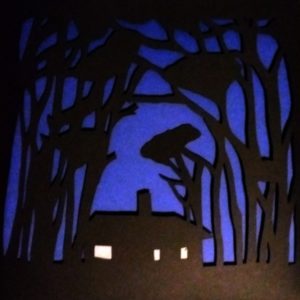
A Light In The Window Will Guide Us Safely Home, the new and unique LP by Little Skull, is an album defined by places, journeys between them, and the traces we leave: Warbly guitars and a town hall in rural Waikato; Wheezing melodicas and a train through Tongariro; Tinny autoharps and a bus stop on the Canterbury coast; Scratching violins and mattresses on the floor in flats in Dunedin and Wellington; Squalling saws and the detritus of a life abandoned and rediscovered in Waitati -- These all jostle to be heard over the murk and cassette hiss whether they deserve to be or not. Insignificant instrumentation congregates on insignificant locations, leaving behind ghosts in a place of their own. We each choose our own light to follow in the hope it is the right one. Handmade paper-cut, fold-out sleeves; micro-edition of 200.
23,50€
In stock
LP
The FUTURIANS
“Programmed”
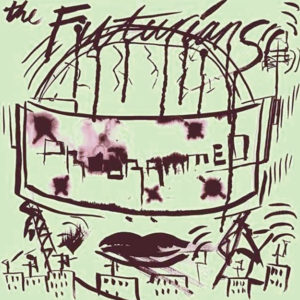
Matt Middleton (Crude / The Aesthetics / Dirtlove): The Futurians are a band that have soul. Their music, a pulsating, minimalist, primitivist, machinistic monster of a thing is at once fiction and fanstasy, at once politics and hyper-reality. Theirs is an approach synthesizing elements of no-wave, new-wave, synth-rock, drone rock, doom rock, kraut-rock, Dunedin dirge, robot rock, riot grrllism, and calculator punk.
Brad Rose: Clayton Noone and his posse of Duckling Monster, ISO12, Rocko Mandroid, and Krauss have enough energy to light a small town for a year. Have enough energy to light a small town for a year.
LP in full color sleeve issued in an edition of 200 copies.
19,50€
In stock

LP
CJA
“Sido Not Dead”
As reported by Campbell Kneale (Birchville Cat Motel / Our Love Will Destroy The World / C-Psi-P) : “I narrowly avoided an English-second-language tete-a-tete in Belgium once when I refused to believe in the face of all evidence that Sunn O)))’s newly released “Flight of the Behemoth” was not CJA. I was wrong, but whatever… I was already ascending Lucifers path to the stars not garbed in chic grim-robes but a pilling homespun jersey that stunk of wet dog. I confess and repent… for me, all ‘this kinda music’ was an exercise in deftly crafted slovenliness and anonymous surface texture, but in spending time with a tape simply labeled “Sido Not Dead” I was struck dumb with the burning religious fervor of real people who had truly forgotten to give a fuck and at that very moment unto me was bestowed a mighty vision of two-bar heaters, worn cream carpet, mooching about in slippers with cups of budget herbal tea. A long winter weekend that passed too close to a tape recorder and whose glacial momentum had accidentally combed the little magnetic thingies on the cassette into recognizable geometric shapes. This was my (unwashed) fork in the road: facile, nihilistic, too lazy to make it to the letterbox, yet enlightened, enlivened, ascended, eternal…”
blangblangblang
GRONGGRONG
blangblangblang
GRONGGRONG… Fellow pilgrims and travellers to furthest inner outposts…herein lies your scripture. Edition limited to 200 copies in silkscreened sleeve.
GRONGGRONG
blangblangblang
GRONGGRONG… Fellow pilgrims and travellers to furthest inner outposts…herein lies your scripture. Edition limited to 200 copies in silkscreened sleeve.
Original price was: 19,50€.10,00€Current price is: 10,00€.
In stock

LP
WITCYST
“Screuma – Chilli Song”
Since the early 1990’s Witcyst (Michael Veet) has been the stunning big secret diamond of the New Zealand noise underground. A short circuiting monolith on top of the rubbish heap of NZ art and sound. This LP is made of two pieces originally issued on cassettes in 1995.
1. “Screuma”. A guitar is being fed through a washing machine. Its not a normal guitar mind you. It’s a giant home made one that’s been made from old medicine bottles and beard hair. The washing machine is on full spin and it has pine cones in it. Michael mumbles a running commentary. It goes on and on. All outputs are fed back into the inputs.
2. “Chilli Song”. A Witcyst rock song stretched into a spitting blur of strumming and singing. Streaks of hiss and saturation swamp and dissolve the riff. Someone is frying old meat and Michael has a lot to say about it. It goes on and on. All outputs are fed back into the inputs.
Witcyst instructions for completing yourself the sleeve artwork: “if the vinal comes with unprinted blank card covers rub them a bit on rough concrete, cut out the center holes like a 12” sleeve, but not perfect circle… like rough chop chop. hack or lay a cover on wood, slab with a big metal pipe end, slam down off center like cutting with a cookie cutter?!
and tear the centers out. that would be goodly!”.
Witcyst lives and works in a concrete floor shed in Whangarei, in the far north of New Zealand. His releases on his own labels Extemporaneous and LifeSpace run into the thousands. Each item hand made from insect casings, old X-rays, beer cans and elbow grease. Exquisite drawings, obsessional collage, unreadable calligraphy and photocopying onto tinfoil. His music is always a surprise and wrestles every potential sound out of endless mutations of endless new ideas. Every variation is layered, wrung out and exploded. It is the freest of all the free noise’s. A complete drooling feast for the eyes and ears.
Witcyst makes everyone else seem like a baby with a coloring-in book and one crayon. Edition of 300 copies in diy sleeve.
19,00€
Out of stock
LP
Twig HARPER
“New Lost Knowns”
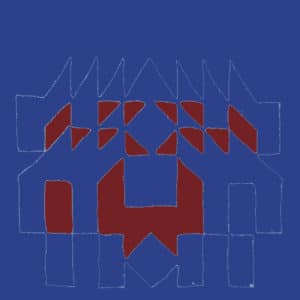
Edition limited to 200 copies. In the beginning of what exactly was this beginning that has remained one of the mysteries ever since? In this beginning the year might or might not be 2011 and the whole practice could still be in-process now (though we firmly reject the meaning of the meaning as an open forma s we consider it more a time-binding). It is doubtful if this sonic process would have ever evolved beyond the animal stage suspended as it is in a fragile balance between sounding familiar to the nervous system and unfamiliar and alien. This process is wholly dependant upon the integrity of the system and its necessary environment… an extermination program created by working multiple channels, reducing mixes, removing sections, adding segments, layering inversions under continual growths and constant changes, until we can no longer recognize the original source or process itself. A very limited unit of sound and image biologically activated to act as communicable dizziness existing in the past present and future when listening to it. Let’s turn it on. LP record and silkscreened sleeve are the access, your playback new “reality”. Edition of 200 copies which will turn your eyes and ears inside out, upward, backwards and in all directions.
23,00€
In stock
LP
TEEN-X-RAY
“Spirits Dogroll”
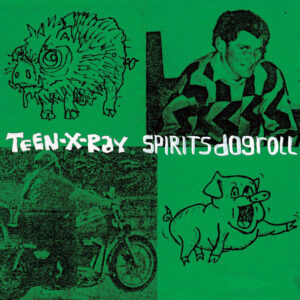
Edition limited to 300 copies.
A dogroll is a cheap giant sausage of bad meat to feed your pets. It’s a magic wand and it is a pizzle.
Teen-X-Ray came from Hamilton, NZ, which is known for agricultural innovation, frosts, fog and Taniwha in the Waikato river. Live cows with windows permanently inserted into their bodies for research live on the edge of town.
As Stefan ‘Smetal’ Neville recalls: “Glen Frenzy asked me to join his new ‘rock n roll’ band Teen-X-Ray at a ska concert at the Hillcrest Tavern in Hamilton in 1993. He had probably already recorded most of the first cassette ‘The Ballad Of Vince Neil’ using the karaoke sound on sound function of his flat-mates stereo. Then & now I would do anything Glen asked of me so I’ve been in X-Ray ever since”.
Glen also recruited Dusk, his girlfriend’s German Shepard who howled when she heard sirens. She would bite and claw at Casio keyboards. She didn’t share her dogroll. Teen-X-Ray recorded their music on cassette decks, performed on top of kitchen tables and released many tapes on the Plop, M60 and Stabbies And The Rocket labels.
Glen and Dusk got a reel-to-reel tape machine, moved to Upper Hutt and could make noise long into the night. Dusk got into Neil Young and killing mice while Glen got into home brewing beer and computers. Stefan Neville moved to Dunedin but Upper Hutt became his favorite holiday destination and each visit would result in new albums. Upper Hutt is known for its pig hunting and for producing NZ’s first Hip Hop group.
Spirits Dogroll was compiled from recordings from 1994-1996. Teen-X-Ray is still active today.
LP in full color sleeve issued in an edition of 300 copies.
19,50€
In stock
LP
PUMICE
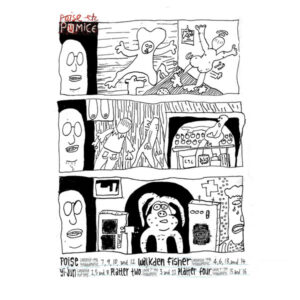
“Poise etc”
A collection of Pumice recordings from 1993-99 when teenagers Sugar Jon Arcus and Stefan Neville learned about music by doing it. The album covers the earliest days of the band recording on ghetto blasters with untuneable guitars at home in Whatawhata and Hamilton, NZ. There are a couple of recordings from their first public performance with drummer Ugly Dog Davies where their friends yelled at them relentlessly. There is material from the years living in Dunedin, NZ with cassette 4 track machines. Living cheaply in a cheap city with pet dogs and all the time in the world. Finally the album includes music from the move back north to Hamilton and Auckland. Material that was released in microscopic editions as lathe cut 7 inches and cassettes and the last times Jon participated in Pumice activities. The LP features trio, duo and solo recordings by both Jon and Stefan.
The basic multi-directional creative impulse that Pumice is known for today is there from the beginning. One chord pop songs, crumbling folk music and smeared organ sound sculptures. Small speakers shitting themselves with distortion and tape saturation. Acoustic guitars twanging and Stefan and Jon clearly learning to write songs of real quality. This music making manages to be bold, reckless and stupid, as well as delicate, sad and instinctive. Pumice has always done whatever the fuck it wants to.
Edition of 300 copies in silkscreened sleeve.
19,00€
In stock
LP
GOL – Mik QUANTIUS – Dave NUSS
“Bruxelles”
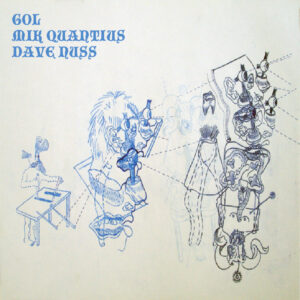
Drinking Belgian beer in a moisty cellar after an exhausting night might be the best situation to jump on the instruments that surround you and gig over and over again until you barely find the way to gather your legs together and improve the tricky exercise of wasted walking. This is what seems to have happened that frozen night of September 19th, 2009 when Dave Nuss (No Neck Blues Band, Sabbath Assembly) wrung from his Amolvacy concert and accompanied by mate Mik Quantius (Embryo) accepted GOL’s perverse invitation to pursue the darkness of Brussels abusing of the aforementioned liquid. Warped and deep bass lines support the disturbed vocalisms and spontaneous words of Mister Quantius shaped by a shamanistic percussive Nuss while the crispy electronics and whatsoever instruments by the french GOL combo reach out for a "blues" extravaganza that says it all with lyrics such as "I have sex on Christmas" or “Tomorrow maybe not”. Gollaboration No.5, recorded at 2 am by Yann Leguay. LP cover and insert with drawings by Mattia Denisse giving a hint of this twisted and skittish psychedelic must have. One-time pressing edition limited to 300 copies.
19,00€
In stock
LP
PAPIRO
“Teopatia”
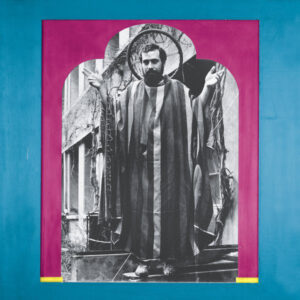
The subtitle of this album describes it as “Messa in scena arcaica per strumenti elettronici e voci ingannevoli” - a play of words which could be translated as “Mass in an archaic scene (or archaic enactment) for electronic instruments and deceptive voices”. The italian graphic designer and musician Marco Papiro deliberately plays with different forms of religious music, and loosely oscillates between the spiritual and the illusory world, starting on the cover where we can see a self-portrait of his father disguised as a saint with a steering wheel in place of the halo. As for the voices, they are deceptive in a double sense... Not only because they seem to promise eternal bliss, but also because they are completely artificial, and have been masterfully created - like everything here - from scratch with an array of aged modular synthesizers. It’s the thin line between the human warmth and the eeriness of its simulation that makes up the fascination of the music on “Teopatia”, which by the way is the term used to describe an indirect divine contact. Though this record might be too odd to become a religious classic, it might very well help future generations understand the turmoil of an early 21st-century youth converting to synthesizers after growing up with catholicism. First pressing limited to 300 copies of which only the half are available for distribution outside Switzerland.
19,00€
Out of stock
LP
GOL – TAZARTES
“Alpes”
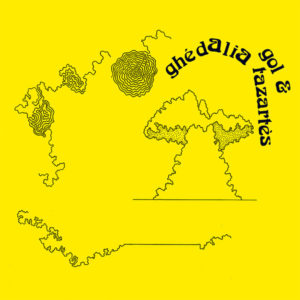
The sixth Gollaberration features a rather odd encounter indeed! It all happened when matchless vocalist Ghedalia Tazartes challenged GOL dada-style quartet. Ghedalia threw in the game his pan-africanasian singing techniques blending gypsy, jewish and trans-continental flavor. GOL exceeded on Electric Mandoline, Jew’s Harps, Percussions, Janotron, Flutes, Electric Guitar, Bass Guitar, Electronic Garage and Voice. Together with Ghedalia they developed into what became a "bal musette" for mentally disabled. Reaching at some points the sides of rock that doesn’t roll, this sonic attack jumps from topic to topic as a ritualistic anthology of unknown "ritournelles". Such a decadence was hardly contained in the neutral environment of the Swiss Cultural Center in Paris where the recording took place on Feb 22nd and 23rd, 2011. Tired liver resonances accurately rendered by the acid yellow cover created by Dennis Tyfus of Ultra Eczema. A mountain peaks journey below the very heart of no-where Europe to be consumed gently without skis on. One-time pressing edition limited to 400 copies.
20,00€
In stock
LP
THEE IDEAL GUS
“99”
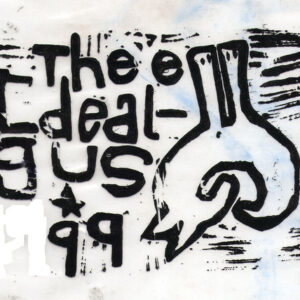
Thee Ideal Gus began in Hamilton, New Zealand in the early 90’s and sprung from the same gene pool and time as Armpit, Gfrenzy and Pumice. Its participants include Sugar Jon Arcus, Clayton Noone, Indira Neville, Kaatarama “Motty” Morehu, Stefan Neville, Witcyst, Dan “Eemonk” Powell and Rachel Garbott but membership has never been settled or defined. The band have released numerous cassettes and lathe cut records on cult labels such as Plop, Root Don Lonie For Cash, Extemporaneous and Stabbies And The Rocket Recordings.
Thee Ideal Gus love double barrelled year numbers so during the year 1999 daily recordings were conducted in Whangarei and Wellsford in the far north of New Zealand, and Dunedin in the far south. Diaries were kept, artwork was assembled and tapes were posted up and down the country. The resulting material was released in an edition of 20 lathe cut 2 LP’s as “1999” by Stabbies And The Rocket Recordings.
This “99” LP is a selection of material compiled from that ridiculous obscurity by Clayton Noone & Stefan Neville. The music Thee Ideal Gus made that year documented the days as they happened. It charted weather patterns, prophesized the future and celebrated team sports. Eddie Murphy and Yoko Ono are held in equal high regard. Nude drunk partying and the New Zealand general election of 1999 are all there in this record where a rusted clothes line is played alongside a primary school xylophone, sampled techno records and ukulele through a heavy metal pedal. It is mundane and marvelous.
Edition of 200 copies in very elaborate packaging, including prints on acetate, xerox inserts and several hand-drawn original artworks.
19,00€
In stock
LP
ARMPIT
“Leisure & The Elderly”
Edition limited to 300 copies.
As reported by Stefan Neville…
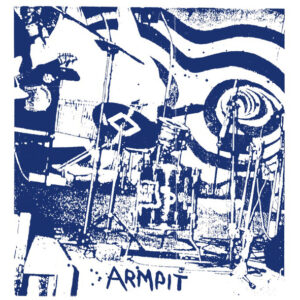
Clayton “CJA” Noone and Jon “Sugar Jon” Arcus are some of my oldest and dearest friends. I’ve been listening to their band Armpit pouring out infinite sweat and toe jams for 20+ years and I still can’t work out what Armpit even is. They are the wrongest band I’ve ever heard.
We were all part of the same gang in early 1990s Hamilton, New Zealand. Armpit would always happen in rooms next door. They would keep me awake with the eternal strumming of bad guitars through bad equipment, bottles falling over, people falling over, things catching fire and always lots of giggling. I saw them play at a party once where they were too wasted to plug in their guitar pedals. They wrestled with them giggling for about ten minutes and then gave up. They didn’t make a sound but it’s one of the greatest concerts I’ve ever seen.
Their recordings are always confusing. They display their deepest awful humanity and their sweet sweet heart’s all in the same mouthful. Scorched hateful noise, incompetent absurdity, smoochy crooning folk songs with poignant words & brutal sausage fingered editing to highlight the horror and hilarity.
“Leisure & The Elderly“ was recorded in Dunedin in the mid 1990’s. Jon was doing a Nursing foundation course and learnt to simulate giving a skinhead a sponge bath. A classmate gave him some of her tortured poetry so Armpit blended it with a Nursing textbook and disappeared into the room next door to record the album in one go ping ponging recordings with two tapedecks.
It was originally released on cassette in an edition of just 3 copies.
Edition limited to 300 copies in silkscreened sleeve.
19,50€
In stock
LP
WITCYST
“Soibiast Anti-Culler”
Edition limited to 300 copies
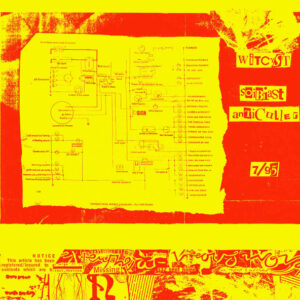
Recorded in 1995 by the winterless north of New Zealand’s Witcyst. Another monolithic skid mark serving of crackers plucked from the man’s vast lifetime archive of sound making and beard.
Witcyst makes his music with oceans of constant daily mutation. Machines get used upside down and back to front and inside out. Layers of string, tin foil and expired medicine are saved up to dazzle the eye. Parcels in the post come and go full of nostril hair and pamphlets and wool. What would that sound like through a funnel and a heavy metal pedal? Is the room shrinking? One knock for yes. Two for no.
This audio is severely distressed and swollen. It is particularly buried and murky and howling here. Are they voices or organs? Meat or musical instruments? Is that a drum solo or decades of tape degradation? Are the hums musical or malfunction? It starts to sound like it was recorded inside your brain and has always been there. I wonder if it means us any harm? And then it starts to sound like a basket full of wise puppies.
“Soibiast Anti-Culler” is one of the most relevant works among at least a thousand albums Witcyst has originally released on cassettes and CDR’s on his own Extemporaneous and Lifespace labels since the early 1990s.
Edition limited to 300 copies in silkscreened sleeve.
19,50€