
In stock
CD
Burkhard SCHLOTHAUER
“harmonies and structures”
« Nine – for John Cage » (2010) by Zeirkratzer with Reinhold Friedl (inside piano), Frank Gratkowski (bass clarinet), Hilary Jeffery (trombone), Hild Sofie Tafjord (horn), Burkhard Schlothauer (violin), Anton Lukoszevieze (cello), Ullrich Philipp (double bass), Marc Weiser (electric guitar), Christian Lillinger (percussion).
The well-known Zagreb music biennale, which has been a hotspot for contemporary music for more than 30 years, asked Reinhold Friedl, musical director of Zeitkratzer, to perform a program of late ensemble works by John Cage in 2010. Unfortunately, however, there are only a few works that could be performed with the full cast of Zeitkratzer. So i suggested that i would rewrite the non-existent number piece nine for Zeitkratzer. In my master thesis, i had thoroughly studied John Cage's number pieces, their compositional style - in particular seven, one of the first works in this series - and had already recorded and produced this composition in 2002 (EWR 0604).
« yo tampoco lo entiendo » (2019) with Burkhard Schlothauer (viola, sine-waves).
For the dance piece « Bewegte Bauhausbilder » at Theater Gera 2019.
« structures indépendantes » (2007) with Antoine Beuger (flute), Gudula Rosa (tenor recorder), Burkhard Schlothauer (viola), Thomas Stiegler (viola), Jürg Frey (clarinet), Eva-Maria Houben (indian harmonium), Christoph Nicolaus (stone harp), Tobias Liebezeit (timpani).
Delicately spotted tones of two identical instruments (flutes, violas) in symmetrical intervals meet two different sound surfaces - on the one hand unisons with more or less beatings (violas, flutes) of about 5 seconds each and on the other hand 3 minute long sound blocks of clarinet and harmonium. The distribution of the action spaces of the duos is independent of each other: while the meeting of the tones is organized completely geometrically, we experience it as somehow coincidental. In addition, there are blocks of time in which the tympani sometimes glissandize very slowly and thus irritate the sound surfaces above in a subtle way. The stone harp contributes very beautiful, clearly microtonally defined tones.
9,00€
Out of stock
2 CD
Eva-Maria HOUBEN
“ensemble works”
CD 1: Echo Fantasy I, IV & V
CD 2: Gesang XI, Unter Anderen
Performed by Ordinary Affects: Morgan Evans-Weiler (violin), Laura Cetilia (cello), J.p.a. Falzone (vibraphone/piano), Luke Martin (guitar) with Eva-Maria Houben (organ).
10,00€
In stock

CD
Hans-Jürg MEIER
“colours de la rose . presso il passo di cristallina . diaphanés”
Colours de la rose (2001) for flute, oboe, saxophone. A work in nine parts contrasting the music by Guillaume de Machaut.
Presso il passo di cristallina (1993) for 2 recorders. "the piece was preceded by the real experience of surprising silence just before crossing the Passo di Cristallina" (Hans Jürg Meier)
Diaphanés (durchscheinend), 2015, for three baroque transverse flutes and percussion. Music to Santo Stefano in Rotondo in Rome, the musical sensation while entering the room and its architectonical athmosphere.
In Hans-Jürg Meier's music, translations from architecture have become increasingly meaningful.
On the one hand, in both art forms, the power of imagination is of fundamental importance.
On the other, both work with holistic formal inventions that unfold in time or/and in space.
Endeavouring to make physically tangible the sensual qualities of the musical material (tones, intervals, texture), his compositions are committed to exploring the interaction of nature, form and beauty.
Original price was: 9,00€.5,00€Current price is: 5,00€.
In stock
CD
Antoine BEUGER
“… of being numerous”
“... of being numerous” for us opened up a space in which to affirm this tension, this challenge of being (singular and) numerous. In the name of this practice we left the subject of the preposition open to allow numerous possibilities to resonate: the challenge, the joy, the danger, the fragility, the grace, the condition, the difficulty, the meaning, the reality, the roots, the boun- daries, the promise, ..., ..., ... of being numerous.
Performing “... of being numerous” we would try to be as detached, as much by ourselves, as possible. we would all be involved in the same kind of things: playing a “phrase” (some “phrases”) with some mostly longish, quiet sounds; articulate a slow, but regular pulse with 2 little stones; reading some words, or syllables or letters from a poem one brought or knew by heart (just to oneself); humming a melody, so quietly, that maybe only oneself would hear it; making a very soft, continuous, spectrally complex frictional sound (paper on paper, stone on stone, paper on wood, finger on skin, ...); moving dry leaves from one bowl to another, trying to make no sounds; etc.; or just being silent, listening inward rather than outward.
Colectivo maDam: David Area (synthesizer, voice and objects), Joan Espasa (bass clarinet, voice and stones), Tomás Gris (melodica, voice and objects), Rubén (sinewaves, voice and objects), Víctor (singing bowls, voice and objects), Guillermo Torres (flugelhorn, voice and stones)
Guest: Antoine Beuger (flute, voice and objects)
9,00€
Out of stock
In stock
In stock
In stock
CD
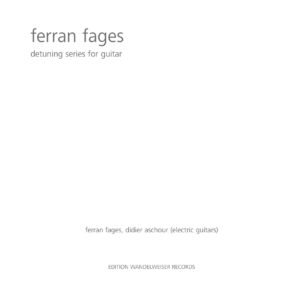
Ferran FAGES
“Detuning series for guitar”
Performers: Ferran Fages, Didier Aschour (electric guitars).
9,00€
In stock
Out of stock
CD
Eva-Maria HOUBEN
“Orgelbuch”
14 five-minute pieces from Eva-Maria Houben’s “Organ Book”. Eva-Maria Houben (organ).
10,50€
Out of stock

CD
NONO – FREY
Back in stock with new cover.
Performers: Joanna Becker, Clemens Merkel, violin. “Ohne Titel (Zwei Violinen)” is emblematic for much of Jürg Frey‘s work, because here, as elsewhere, the idea of two runs very deep. A piece begins with something - some group of similar sounds, or some manner of performance; and then, without warning, reason, or justification, simply changes to something else. These are moments in which all lies open, where the imminent need to decide threatens to become almost a kind of panic. “In Ohne Titel (Zwei Violinen)” two means not just two moments in time (i.e., before and after), but two persons. Throughout most of the piece the players play the same part, exactly the same notes. And here there is an interesting principle: the more similar the musicians actually sound, the more one senses their separation. This implies that, in this work, two is most visible at the border of one, where an infinite proximity reveals a fundamental difference.How strange and interesting that this kind of music would be ‚paired‘ with Nono‘s duo "Hay que caminar" sognando ! Every thing in this piece seems to move from one extreme to the other: by leaps or sudden contrasts. In each case the physical limit of the instrument is approached in way that suggests that the music would continue, beyond the realm of the physical and audible. With the emphasis on boundaries, we are strongly directed towards a metaphorical kind of space, enclosed not with walls but with windows, which allow us a view to the horizon. And still, this music is a song. But this song either speaks with gestures of great intensity or hardly at all. There is just the slightest echo of melody: Verdi‘s ‚scala enigmatica‘, itself an echo of melody. In this piece we hear song as pure longing, reaching for something that will forever remain just out of our grasp.”
Performers: Joanna Becker, Clemens Merkel, violin. “Ohne Titel (Zwei Violinen)” is emblematic for much of Jürg Frey‘s work, because here, as elsewhere, the idea of two runs very deep. A piece begins with something - some group of similar sounds, or some manner of performance; and then, without warning, reason, or justification, simply changes to something else. These are moments in which all lies open, where the imminent need to decide threatens to become almost a kind of panic. “In Ohne Titel (Zwei Violinen)” two means not just two moments in time (i.e., before and after), but two persons. Throughout most of the piece the players play the same part, exactly the same notes. And here there is an interesting principle: the more similar the musicians actually sound, the more one senses their separation. This implies that, in this work, two is most visible at the border of one, where an infinite proximity reveals a fundamental difference.How strange and interesting that this kind of music would be ‚paired‘ with Nono‘s duo "Hay que caminar" sognando ! Every thing in this piece seems to move from one extreme to the other: by leaps or sudden contrasts. In each case the physical limit of the instrument is approached in way that suggests that the music would continue, beyond the realm of the physical and audible. With the emphasis on boundaries, we are strongly directed towards a metaphorical kind of space, enclosed not with walls but with windows, which allow us a view to the horizon. And still, this music is a song. But this song either speaks with gestures of great intensity or hardly at all. There is just the slightest echo of melody: Verdi‘s ‚scala enigmatica‘, itself an echo of melody. In this piece we hear song as pure longing, reaching for something that will forever remain just out of our grasp.”
10,50€
Out of stock
CD
Michael PISARO
“Hearing metal 1”
Performer: Greg Stuart (tam-tam). “The 60-inch ("Mikrophonie") tam-tam is a large piece of metal, a proto-sculpture. Brancusi might have altered it: rounding and tapering the edges, making an oval instead of a circle, polishing the surface into smooth gold. The tam-tam is also a vast sound landscape-an instrument that makes noise at the slightest provocation. A resonance is created just in the act of walking past the instrument or breathing on it ... that is, if your ear (or a microphone) is close enough to hear it. Wherever it is touched with a bow or a hand, it responds with chaotic, unpredictable complexity, never producing the same sound twice.I have attempted to work within the givens of this landscape, to allow some of its implicit contours to reveal themselves-by collecting sounds, giving them a duration, putting them into a clear structure, and cutting a path through them with pure tones. Sleeping Muse is something like a four-part chorale of bowed sounds, with a melody made up of long sine tones buried in the sounds. The Endless Column is a collection of sixty extremely light, close recorded strikes, randomly ordered, but with a rising scale of sine tones mixed in, more or less within the central frequency range of the tam-tam (from 50 to 671 hz). Sculpture for the Blind arranges eight layers of bowed sounds (which are then released) along a pattern of lengthening durations and combined with a sine tone trio, again woven into the sounds of the tam-tam. Hearing Metal 1 is the product of close collaboration between composer and performer. The piece evolved as Greg made test recordings based on my suggestions and then sent them to me. As it happened we feel we fell into its world, in order to move it slightly towards our own.” Michael Pisaro
10,50€
Out of stock
CD
Michael PISARO
“Harmony series 11-16”
Composer Michael Pisaro. Performer: Johnny Chang (violin), James Orsher (harmonium), Kathryn Pisaro (oboe-english horn), Michael Pisaro (guitar-sine tones), Marc Sabat (violin), Mark So (piano), Greg Stuart (percussion). “Any tone, any tuning. The world of Michael Pisaro’s Harmony Series revolves around the process of translation. In this collection of thirty-four pieces (nine of which are presented here) the composer translates a wide variety of poems into text scores. The first step is to literally trace each poem, as if one were making a stencil. A five-line poem might become a five-minute piece through this procedure. This kind of action is direct and purposely simple and it will provide a stable space from which each piece will develop. Call this architecture.
In the second step the composer seeks out the internal forces of the text. For example, a text suggesting proliferation is read as a shift from a barely to a clearly audible, multi-faceted sound. As the poem is already in motion, the composer seeks to harness energy rather than block flow. Evocative readings are eschewed in favor of direct transmutation. Asymptotes are drawn to the poem, resulting is an extremely fine mist of possibilities for the performers to tune (and detune) in performance. Call this material.
A piece is set in motion when the mist is sprayed - always lightly - through the stencil (think pathway, pinprick, or filter). This action creates a dynamic situation. As performers our ears focus as a version begins to take shape - it is unmistakable when this happens. A small flutter appears in the fabric of the piece. We notice sounds that cannot be traced back to any of the individual performers. Drawn in by the fluttering, one starts to know (or sense) what sounds are correct to play, even when there are no explicit rules for how they are to be chosen. The piece is thinking. Call this the point of contact. To the performers the distance between score and realization will often seem impossibly large. To travel this distance is the defining experience of this music. Along the way, each realization establishes its own kind of weather system wherein complex relationships are created not only between (and within) the sounds but also the performers. On the other side of the stencil we are in unknown world - sun-distant, alive - immersed in a gently spinning mixture of tone, noise and silence, the radio having been tuned to a previously unheard channel. Call this harmony.” Greg Stuart
In the second step the composer seeks out the internal forces of the text. For example, a text suggesting proliferation is read as a shift from a barely to a clearly audible, multi-faceted sound. As the poem is already in motion, the composer seeks to harness energy rather than block flow. Evocative readings are eschewed in favor of direct transmutation. Asymptotes are drawn to the poem, resulting is an extremely fine mist of possibilities for the performers to tune (and detune) in performance. Call this material.
A piece is set in motion when the mist is sprayed - always lightly - through the stencil (think pathway, pinprick, or filter). This action creates a dynamic situation. As performers our ears focus as a version begins to take shape - it is unmistakable when this happens. A small flutter appears in the fabric of the piece. We notice sounds that cannot be traced back to any of the individual performers. Drawn in by the fluttering, one starts to know (or sense) what sounds are correct to play, even when there are no explicit rules for how they are to be chosen. The piece is thinking. Call this the point of contact. To the performers the distance between score and realization will often seem impossibly large. To travel this distance is the defining experience of this music. Along the way, each realization establishes its own kind of weather system wherein complex relationships are created not only between (and within) the sounds but also the performers. On the other side of the stencil we are in unknown world - sun-distant, alive - immersed in a gently spinning mixture of tone, noise and silence, the radio having been tuned to a previously unheard channel. Call this harmony.” Greg Stuart
14,00€
Out of stock
CD
Michael PISARO
“Mind is moving I”
Composer : Michael Pisaro. Performer : Michael Pisaro, guitar.
“Many pieces created today are written for specific places or opportunities (whether for the concert hall or a special performance), and then fulfill the function intended for them in that place. However, in a piece like mind is moving (I) the prevailing impression is that the piece itself must first create the site where it can sound. It seems that there is not simply a container into which the music is fit. The piece does not create a site by, so to say, standing its ground and asserting itself: its presence is much more subtle. The extremely delicate contact with the guitar strings (mostly harmonics, encompassing a wide range, up to the17th partial) corresponds to a temporal organization which just as delicately places these sounds in the expanse of time. The site thus created is not a self-contained place through which time flows in a definite direction. Here at times an astounding sensation is felt, where time passes perpendicular to the music, or where time may come and go from all directions. Thus the site which comes into being is without walls, and along with this comes a permeability which leaves room for individual thought and for other tones. For that reason, in this music other things quite simply turn up: like the occasional whistling or soft scraping of the strings; not effects, but pure matters of course. Perhaps there is here the faintest reminiscence of the image of a folk singer, who whistles along with his guitar playing, and uses the noises to clarify the rhythm. But above all, these are sounds which in their lack of tension leave nothing behind but the memory that they were there at all. In this piece, expanse and openness, rather astoundingly, go along with precision, which is concealed within the compositional craftsmanship and finds its most beautiful counterpart in the precise locating of the harmonics on the fret board of the guitar. Both of these qualities can only succeed when work and play are without arbitrariness. Thereupon, within the listener, silence and listening meet, allowing a sense of expanse and openness to develop. So the piece gently unfolds, and creates, all by itself, over the course of its long resounding, its own site: a place where it can live.” Jürg Frey
10,50€
Out of stock
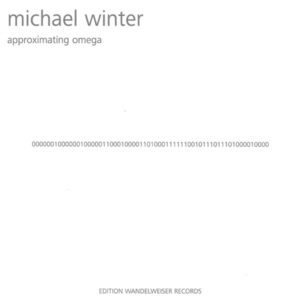
CD
Michael WINTER
“Approximating omega”
approximating omega
text adapted from gregory chaitin's 1994 book the limits of mathematics
muirgen éléonore gourgues (reading), judith hamann (violoncello), with samples contributed by tomás cabado, raven chacon, yiannis christofides, alan courtis, john eagle, carmina escobar, bryan eubanks, jacqueline george, tom johnson, david kant, aj kluth, ulrich krieger, juan sebastián lach lau, ingrid lee, john lely, todd lerew, heather lockie, scott mclaughlin, ezequiel menalled, ian mikyska, pablo riera, dean rosenthal, karen santana, james saunders, marcus schmickler, elliot simpson, mark so, laura steenberge, adrian tenney, philip thomas, samuel vriezen, lucie vítková, manfred werder, byron westbrook, michael winter and melike yersiz
arranged by aidan reynolds and michael winter
for gregory chaitin
michael winter (piano)
a realization of a subset of ‘omega’ (or chaitin’s constant): a maximally complex, incomputable number defined
as the halting probability for some universal, prefix-free turing machine. the subset of omega used for this realization
(given by the bit string on the cover) is presented in the 2002 article by cristian calude et al. entitled computing a glimpse of randomness.
10,00€
In stock
In stock
CD
Eva-Maria HOUBEN
“aus den fliegenden blättern eines fahrenden waldhornisten”
“aus den fliegenden blättern eines fahrenden waldhornisten” (2013) ( “from the flying leaves of a traveling horn player”) for horn in F. Wilfried Krüger, horn.
10,50€
In stock
Out of stock

CD
Christian WOLFF
“Stones”
The score of “Stones” consists of just a few lines of text:
Make sounds with stones, draw sounds out of stones, using a number of sizes and kinds (and colours); for the most part discretely; sometimes in rapid sequences. For the most part striking stones wfth stones, but also stones on other surfaces (inside the open head of a drum, for instance) or other than struck (bowed, for instance, or amplified). Do not break anything. Christian Wolff, STONES, (from: Prose ColIection, 1968-74)
While these instructions contain an abundance of possibilities, they also exclude many things. The score describes a condition under which things may happen, not a process in which things develop.
Seven composers participated in the present realization by the Wandelweiser Komponisten Ensemble: Antoine Beuger, Jürg Frey, Chico Mello, Michael Pisaro, Burkhard Schlothauer, Kunsu Shim und Thomas Stiegler.
For this performance, each prepared, independently of the others, between 10 and 20 events.The solutions, though compatible with the score, were unique. Michael Pisaro, for example, made drawings on stones, producing very gentle sounds. Burkhard Schlothauer sometimes drew a large stone across the floor. Jürg Frey decided, that a single sound might well last long time. Thus, 27 minutes of quietly rubbing two very uneven limestones, is considered as one event. Thomas Stiegler used a violin and violin bow as the surface upon which all of his events took place. Kunsu Shim began performing his nearly inaudible, subtle sounds only after about 55 minutes had elapsed.
While playing this CD you may forget, after a while, that it is playing. All of a sudden you might hear a little stone, sometime, somewhere. After an initial ,,What is that?", you’ll suddenly realize: ,,Oh yes, it’s the CD!".
10,00€
In stock
CD
Cem GÜNEY
“Five compositions”
Antoine Beuger (flute), Germaine Sijstermans (clarinet), Tobias Liebezeit (percussion), Burkhard Schlothauer (violin), Lydia Haurenherm (viola), Marcus Kaiser (violoncello).
Cem Güney was born in Turkey in 1973. Influenced by jazz music, he learned to play the trumpet and later attended the College of San Mateo’s Music Department in San Mateo, California. During the years of playing trumpet, his interaction with music has mostly been with experimental forms of expression. This interaction influenced him to compose electronic music. Currently, he’s also been writing scores for contemporary music.
10,50€
In stock
CD
Burkhard SCHLOTHAUER
“PianoMusic”
Composer: Burkhard Schlothauer. Performers : Jongah Yoon, piano; Reinhold Friedl, Michael Iber, Yungkyung Lee, piano. “As a result of the fascination the unmuted decay of the piano sound held for me, the fading string vibration became the focus of "ab tasten". In each sound of this piece at least one tone fades away unmuted. I also decided to take a given fact (the different fading times: the higher a tone, the shorter it sounds) to form the basis of the music’s temporal organisation. The respective unmuted string determines the overall duration of the sound and as a result, the timing of the composed "muting activities". Having each sound followed by a pause of possibly equal weight is a formal concept I have used in many of my compositions since1995. Each sound stands alone, is a "piece" of music in its own right, an autonomous "image", an individual, that may be perceived in its entire appearance from sounding to dying away. The order of the sounds may be chosen by the musicians themselves. In "ab tasten" I discovered my interest for the moment the sound falls silent, dies away. I noticed, that at some point it is not longer possible to asses whether the strings are still vibrating audibly, or whether it is only the image of the sound which is still in the mind. A sound has a beginning, an existence and an end. These parts, though, cannot be clearly divided: we cannot really say where the beginning is, where beginning turns into continuity, where continuity becomes an ending, where the end is. In "three pianos drumming" from 1999, which I wrote for PianoInsideOut (Reinhold Friedl, Michael Iber, Yunkyung Lee), on the other hand, the piano is used only as a percussion instrument. In three of the Steinway D grand pianos of Sender Freies Berlin the same bass string was taped with adhesive tape, strongly and lastingly muting the string. By this treatment the hammer beating of the piano becomes clearly audible. The piano is treated as what it is in terms of its sound production: as a "hammering machine". Hearing recordings of still existing hunter and gatherer cultures, I kept hearing rhythms which were pure pulse. These musics - no matter from which region of the earth - refrain from any conscious accentuation or division of rhythmic units. To me, this seemed to be an archetype of rhythm, some sort of nucleus to every rhythmic music, in which the hypnotic power of these first man made time forms makes itself felt. In "three pianos drumming" the performers determine a set of parameters (dynamics, tempo, pitch) within a given range and stick to these for the entire piece. Each part has its own sequence of beats and pauses, allowing for the emergence of very subtle spaces and microrhythms between the pianos. What fascinates me about this piece (and also its successor, "drumming for one to many percussionists"), is that it remains the same piece, regardless of whether it is played pianissimo or forte, no matter which tempo between 30 and 120 b.p.m is used. or what order of pages the players select. Different versions take on very different "expressive qualities". To me, it seemed very important for my development to have composed a piece which allows for a strong expressive power, without me as a composer having provided it with expression.” Burkhard Schlothauer
10,50€
In stock
CD
Antoine BEUGER
“Silent harmonies in discrete continuity”
Program: Antoine Beuger: silent harmonies in discrete continuity (fifth music for marcia hafif), series I. Performer: Electronic Music.
“Silence is not an acoustical phenomenon
silent harmonies: three-minute sounds, stationary, quiet, pure waves
each sound has eight frequencies, each from a different octave range
there is silence where depth disappears and expanse emerges: on the surface
in discrete continuity: one soud goes, another one comes and on it goes, step by step, continuously
still waters are said to run deep,
but in reality it is the imperturbability of their surface
that impresses us.
for marcia hafif:
american painter of monochrome paintings
and a quiet person’s silence hides nothing deep -
it hides nothing at all.”
10,50€
Out of stock
CD
André O. MÖLLER
“Musik für orgel und ein(n) tonsetzer(in) …2003…”
Eva-Maria Houben, organ. “What do you do, if you work with just intonation and wish to write a piece for organ? you have to deal with the relation between equally tempered and over or undertonal (just) intonation. 2001 i had several opportunities to make a study of some wonderful instruments. This eventually put me on the path towards this composition. In this piece only those frequencies of the organ sound that have close to whole-numbered ratios (+/- 6 cents) to a fundamental (in this case C’ at about 32 Hz). Because the frequencies are never perfectly tuned - a result of the organ’s tempered tuning - more or less strong beatings and frictions emerge, that rhythmically and timbrally shape the inner life of the sounds. A realisation of this piece strongly depends on the disposition of the instrument and the performance space. The version at hand corresponds approximately to the first performance by Eva-Maria Houben at St. Suitbertus church, Dortmund october 3, 2003. For this cd I tried to record the organ in such a way that the playback, instead of reproducing the church environment, projects the instrument into the listener’s space.” André O. Möller
10,50€
Out of stock
CD
André O. MÖLLER with Hans Eberhard MALDFELD
“In memory of James Tenney”
“I never met james tenney personally.
in 2004, the year of his 70th birthday, tenney was invited to cologne by WDR to honor him. the man held a charming speech and showed an excerpt of his early electronic piece Collage
1 “blue suede”, based upon elvis presley’s version of carl perkins’ song blue suede shoes.
afterwards we heard a beautiful performance of forms I - IV, four pieces for amplified ensemble, each of them dedicated to one of his teachers.
before and since then i listened to a lot of tenney’s music, met and worked with quite a few students and colleagues of his.
therefore, it almost felt like a personal loss, when tenney died in 2006.
the man’s spirit, though, is still around!
2006 i met double bass player hans eberhard maldfeld, when he was invited by antoine beuger to introduce the tromba marina to me and some other composers.
the tromba marina is a single stringed instrument played with a bow.
in addition to the open string one can play harmonics up to the 20th partial and maybe even higher.
the unusual construction of the bridge makes it possible to create sounds reminiscent of the sound of the trumpet or other brass instruments.
since 2003 hans eberhard maldfeld is committed to a renaissance of the instrument.
his explorative drive and his sheer dedication to sound and performance allow the instrument to reveal hitherto unknown qualities.
this dedication, which also led us to collaborate on a double bass piece, i find so compelling and inspiring.” andré o. möller, 2015
14,00€
In stock
3 CD
Manfred WERDER
“2003”
Erik Carlson (violin), Stephanie Richards (trumpet), D. Edward Davis (electronics).
“Stück 20031”
three instruments sharing the same pitch.
three performers determine a common pitch.
the duration of the performance is not determined. the performers do not use a watch.
two of the performers play the pitch, lasting three to seven seconds, once during the duration of the performance.
for itself. simple.
“Stück 20032”
one performer
the performer determines a sound.
the duration of the performance is not determ
ined. the performer does not use a watch.
the performer plays the sound lasting three to seven seconds twice during the duration of the performance.
for itself. simple.
“Stück 20033”
two instruments sharing the same pitch.
two performers determine a common pitch.
the duration of the performance is not determined. the performers do not use a watch.
the pitch lasting three to seven seconds sounds twice during the duration of the performance.
for itself. simple
10,00€
In stock
2 CD mp3
John CAGE
“Empty words”
Four parts. Four times 2 hours and 30 minutes in mp3.
Sylvia Alexandra Schimag (speaking voice).
“begins by omitting sentences,
has only phrases, words, syllables and letters.
The second part omits the phrases,
has only words, syllables and letters.
The third part omits the words,
has only syllables and letters. And the last part ...
has nothing but letters and sounds.”
“A mix of words, syllables, and letters obtained by subjecting the Journal of Henry David Thoreau to a series of I Ching chance operations.
What was interesting to me was making English less understandable.
Because when it’s understandable, well, people control one another,
and poetry disappears.
A transition from language to music.
It’s bewildering at first, but it’s extremely pleasurable as time goes on. And that’s what I’m up to.”
10,50€
Out of stock
2 CD
Michael PISARO
“Transparent city (volumes 3 and 4)”
“Field recordings, electronic sounds. Field recordings made in greater Los Angeles from October, 2006 to February, 2007. Each recording is an unedited ten-minute take from a single location. Sine tones and mixing completed in Michael Pisaro’s home studio in Santa Clarita, California. Each ten-minute piece is followed by two minutes of silence. Recordings were mastered with home stereo playback in mind. In general, it is best to set the volume control on your system to a normal level (that is, the level at which most of your other music is played) and to let it remain in that position. Volume levels of the pieces vary intentionally over the course of the series.”
10,00€
In stock
2 CD
Maria de ALVEAR
“besando el tiempo”
“Besando el tiempo” for flute solo (1995). Antoine Beuger (flute).
'besando el tiempo' is a piece that was composed in 1995 in the space of four days. It was written in an automatic script that Maria de Alvear uses for many of her pieces. The work was originally composed for the flautist Caren Levine, who also gave it its first performance in Salzau in 1995. 'besando el tiempo' has now been performed several times worldwide by different interpreters.
When Maria de Alvear heard the performance by Antoine Beuger, she asked him to give her a recording for herself.
Maria de Alvear: “For me, Antoine Beuger's interpretation is the most exact reading there is of my piece. It embodies perfect introversion on the part of the interpreter. The interpreter hears music as “the first beholder of the composer”, and that is the way the piece is played here.”
Antoine Beuger: “When I start playing this piece, I embark on a journey into my inmost being and encounter myself. I never know beforehand what it will be like, how it will continue; I am on my way, on my travels … that is the adventure of this piece. You have to expose yourself to this encounter without any protection or reservations, in complete innocence. And that is also what can be heard.”
10,50€
In stock
2 CD
John CAGE
“One 9”
Program: John Cage : One9
Performer: Edwin Alexander Buchholz, Accordion
“sounds brushed into existence as in oriental calligraphy" (Cage)
the sounds in one9 are single tones and chords, up to six part harmonies.
how do sounds come into existence, how do they gain focus, how do they resolve, how do they merge into one another, how can one quietly and attentively, in all modesty, follow their unfolding?
these are the questions that guided edwin alexander buchholz in his interpretation of the piece.
over the years he played one9 time and again - for himself and in concerts. gradually solutions manifested themselves which he never, at first, would have considered.
it is not simply the case, that this music, which was originally written for shô, the japanese mouth organ from gagaku music, may also be played on accordion.
much as the immemorial shô, originated about 4000 years ago, and the modern accordion are related, they are not interchangeable. one9 has been written specifically for shô and first has to find its way to the accordion, in order to become real accordion music.
the accordion is a wind instrument, but also a keyboard instrument, it has stops, its colours are eminently rich and its two sound sources, as long as they are sounding, are always moving: away from each other, towards each other.
for edwin alexander buchholz one9, in the course of time, grew into a music, that integrated all of this, a music entirely for his instrument: the accordion.
traditionally the sound of the shô is connected to the heavens’ gleam. I have no trouble hearing this quality here, in the sound of the accordion.” antoine beuger
17,00€
Out of stock
2 CD
Johan LINDVALL
“Solo – ensemble”
Composer : Johan Lindvall. Performers : Vilde Sandve Alnæs (violin), Kristine Tjøgersen (clarinet), Jan Martin Gismervik (percussion), Henrik Munkeby Nørstebø (trombone), Ina Sagstuen (voice), Fredrik Rasten (guitar), Johan Lindvall (piano).
10,50€
Out of stock
2 CD
Hermann MEIER
“Works for piano 1949 – 1987”
“in this edition we hear for the first time the complete solo piano works from between 1949 and 1987 of the swiss avant-garde composer hermann meier.
before the time of the three movement sonata meier composed several dodecaphonic works some of which were cyclic. these were not considered for this CD,
since the sonata contains structurally a replica of all that meier wrote before. the sonata coincides with the first serial sketches and visions,
together with integral thinking using rows and is as such for meier’s eminent work from the 50s onward, both retrospectively as well as anticipatory, of great importance.
the piano piece hmv* 37 from 1956 exists only as a pencil sketch. why the composer wrote no definitive version is not known.” dominik blum, october 2017
10,00€
Out of stock
2 CD
Eva-Maria HOUBEN
“Works for double bass”
Archipelagos (2006). Nachtstück (2007). Hans Eberhard Maldfeld, double bass.
17,00€