
In stock

CD
Lucio CAPECE & Werner DAFELDECKER
“Iteration”
Two improvisations from an astonishing Munich performance in May 2019 by the Berlin-based duo of Lucio Capece & Werner Dafeldecker.
Lucio Capece - bass clarinet, slide saxophone, room acoustics & mini-speakers
Werner Dafeldecker - double bass
12,00€
In stock

CD
Kraig GRADY
“Monument of diamonds”
Epic 45-minute microtonal composition by Kraig Grady, using a 17-tone scale, the Meta-Slendro tuning, created by Erv Wilson. Composed in 2020. The instruments were specially built or adapted for the unusual tuning system.
Kris Tiner - trumpets
Subhraag Singh - saxophones
Emmett Kim Narushima - trombones
Terumi Narushima - organ
Kraig Grady, composition
12,00€
In stock

CD
Clara de ASIS & Mara WINTER
“Repetition of the same dream”
Five works for flute, percussion & electronics, recorded during Covid-19 lockdown in a church in Basel, Switzerland, March 2020.
Commissioned by Another Timbre
Mara Winter - flute
Clara de Asis - bowed objects, percussion & electronics
12,00€
In stock

CD
Ernstalbrecht STIEBLER
“Für Biliana”
Four chamber works for strings by Ernstalbrecht Stiebler, three of which are relatively recent, the other an early string trio dating from 1963.
Biliana Voutchkova (violin),
with Michael Rauter (cello) and Nurit Stark (viola)
Artwork by Bruno Duplant.
12,00€
In stock

CD
Magnus GRANBERG & SKOGEN
“Let pass my weary guiltless ghost”
Superb hour-long composition by Magnus Granberg for his Swedish-based ensemble Skogen.
Magnus Granberg (composition & prepared piano) with Skogen:
Anna Lindal (violin), Rhodri Davies (harp), Toshimaru Nakamura (no-input mixing board), Petter Wastberg (electronics), Ko Ishikawa (sho), Leo Svensson Sander (cello), Simon Allen (vibraphone, amplified strings), Henrik Olsson (objects), Erik Carlsson (percussion).
12,00€
Out of stock

CD
Emmanuel HOLTERBACH & BLUTWURST
“Ricercar nell’ombra”
A collaboration between composer Emmanuel Holterbach and the Italian ensemble 'Blutwurst', developed during a residency at Tempo Reale in Florence in 2018. A 46-minute work.
Cristina Abati (viola), Marco Baldini (trumpet), Maurizio Constantini (double bass), Daniela Fantechi (accordion), Michele Lanzini (cello), Edoardo Ricci (bass clarinet), Luisa Santacesaria (harmonium)
12,00€
Out of stock

5 CD box
Morton FELDMAN
“Piano”
5-CD box set presenting virtually all of Morton Feldman'smusic for solo piano. Performed by Philip Thomas, who also writes a 52-page booklet that is included in the box.
Artwork by David Ainley
Philip Thomas, piano
40,00€
In stock

CD
Magnus GRANBERG & SKOGEN
“Nun, es wird nicht weit mehr gehn”
Label notes : "A really beautiful new release from Skogen, taking a song from Winterreise as its starting point, but transformed in Magnus Granberg's usual magical way into a shifting, shimmering ocean of sounds."
Anna Lindal & Angharad Davies, violin, Leo Svensson Sander, cello, Erik Carlsson, percussion, John Eriksson, vibraphone, Henrik Olsson, percussion, objects, Petter Wästberg, contact microphones, mixing board, d'incise, electronics, objects, Magnus Granberg, prepared piano.
12,50€
Out of stock

CD
Julius EASTMAN
“Femenine”
Label notes :
"Apartment House give new life to Julius Eastman's irrepressible ensemble piece from 1974. Unbounded energy and clarity of sound. Unmissable."
12,00€
In stock

CD
Angharad DAVIES / Rie NAKAJIMA / Alice PURTON
“Dethick”
Label notes :
"Dethick" – another church, another country, and another unique collaboration. Angharad Davies combines with Japanese sound artist Rie Nakajima and the virtuoso cellist from Distractfold ensemble, Alice Purton, in a series of explorations in the small church in the Derbyshire village of Dethick. The trio improvised, then developed and refined ten short pieces across two days, producing music which is as good as improvisation gets.
12,50€
In stock

CD
Klaus LANG & GOLDEN FUR
“Beissel”
Label notes :
Beissel – a collaboration between Austrian composer Klaus Lang and the ensemble Golden Fur (James Rushford, Judith Hamann & Samuel Dunscombe). Together they developed a piece in the abbey at Sankt Lambrecht in Austria, using music by the eighteenth century religious composer Johann Beissel, who developed a compositional system which he claimed to have received from angels, and which has been described as a very early precursor of serialism. The result is an extraordinary piece of music: fragility blown through with tumultuous waves of sound.
Klaus Lang - church organ
Samuel Dunscombe - clarinets
Judith Hamann - cello
James Rushford - viola & harmonium
12,50€
In stock

CD
Morgan EVANS-WEILER and Michael PISARO
“Lines and tracings”
Two wonderful works for ensemble by two of the most interesting US composers. Michael Pisaro's remarkable ' Helligkeit, die Tiefe hatte, nicht keine Fläche', followed by Morgan Evans-Weiler's exquisite 'lines and tracings'. (Another Timbre)
12,50€
In stock

CD
Mark R TAYLOR
“Aftermaths”
Works for solo piano by Mark R Taylor, beautifully played by Teodora Stepančić. First CD release by a remarkable but neglected English composer, featuring works dating between 1979 and 2018. (Another Timbre)
12,50€
In stock

CD
Ferran FAGES
“Un lloc entre dos records”
Extended solo work for guitar and sinewaves, composed and performed by the brilliant Catalan musician Ferran Fages. (Another Timbre)
12,00€
Out of stock

2 CD
Ryoko AKAMA
“Places and pages”
A 2 CD with realisations of short text scores, actualised by Ryoko Akama, Cristián Alvear, d’incise, Cyril Bondi, Stefan Thut and Christian Müller.
“I had been inspired by short text works like ‘Water Yam’ by George Brecht, ‘grapefruits’ by Yoko Ono, and some other pieces by Alison Knowles or James Tenney. I am also interested in the haiku and the poetry tradition of Japan as well.
The threshold between the defined and undefined in minimalistic word and sound composition fascinates me. I enjoy witnessing the process whereby a score transforms into a different medium, especially when the instructions are open-ended.
I did a series of scores called tada no score between 2013-14 in which I wrote short scores in hidden places in busy towns or in a natural landscape. These weren’t explicitly made for performance purposes, but were more like marking my musical thoughts in relation to passing time. The next year, 2015, I was invited to Chile to play a concert with Cristian Alvear. I had an idea to compile a notebook with many short texts, this time deliberately intended for performance. I gradually accumulated a number of short scores that would relate to ‘place’, ‘space’, ‘time’ or ‘location’, and assembled them into pages of the notebook.” (R. Akama)
“I had been inspired by short text works like ‘Water Yam’ by George Brecht, ‘grapefruits’ by Yoko Ono, and some other pieces by Alison Knowles or James Tenney. I am also interested in the haiku and the poetry tradition of Japan as well.
The threshold between the defined and undefined in minimalistic word and sound composition fascinates me. I enjoy witnessing the process whereby a score transforms into a different medium, especially when the instructions are open-ended.
I did a series of scores called tada no score between 2013-14 in which I wrote short scores in hidden places in busy towns or in a natural landscape. These weren’t explicitly made for performance purposes, but were more like marking my musical thoughts in relation to passing time. The next year, 2015, I was invited to Chile to play a concert with Cristian Alvear. I had an idea to compile a notebook with many short texts, this time deliberately intended for performance. I gradually accumulated a number of short scores that would relate to ‘place’, ‘space’, ‘time’ or ‘location’, and assembled them into pages of the notebook.” (R. Akama)
Original price was: 23,00€.12,00€Current price is: 12,00€.
Out of stock

CD
Cassandra MILLER
“Just So”
Finally the second batch of CDs in the highly-acclaimed Canadian Composers Series is here.
“Just So” (2008/18). “5 Warblework” (2011). “About Bach” (2015). “Leaving” (2011) by Quatuor Bozzini with Clemens Merkel & Alissa Cheung (violins), Stephanie Bozzini (viola), Isabelle Bozzini (cello).
Another disc of extraordinary music by Cassandra Miller, this one containing four string quartets superbly played by Quatuor Bozzini.
11,50€
In stock

CD
Cassandra MILLER
“O Zomer!”
Finally the second batch of CDs in the highly-acclaimed Canadian Composers Series is here.
“O Zomer!” (2007) by Apartment House “Philip the Wanderer” (2012) by Philip Thomas (piano) & Clemens Merkel (whistling). “For Mira” (2012) by Mira Benjamin (violin). “Duet for Cello and Orchestra” (2015) by Charles Curtis (cello), BBC Scottish Symphony Orchestra, conducor Ilan Volkov.
Two ensemble works and two solo pieces by Christian Wolff's favourite contemporary composer, who is blazing a very personal trail through the experimental music world. Brilliant performances by Apartment House, Mira Benjamin, Philip Thomas, and Charles Curtis with the BBC Scottish Symphony Orchestra, conducted by Ilan Volkov.
11,50€
In stock

CD
Alex JANG
“Momentary encounters”
Finally the second batch of CDs in the highly-acclaimed Canadian Composers Series is here.
“Momentary encounters(5)” (2015) by Heather Roche (clarinet). “Any three players” (2016) by John Lely (melodica) Simon Limbrick (vibraphone) Anton Lukoszevieze (cello). “A grey, bent interior horizon” (2016) by Cristian Alvear (guitar) “Distributed tourism” (2014/17) by Mira Benjamin (violin), Simon Limbrick (vibraphone), Heather Roche (clarinet), Nancy Ruffer (flute), Anton Lukoszevieze (cello). Four fine, delicate works by the young, Victoria-based composer, performed by Apartment House, with solo pieces by Heather Roche on clarinet and Cristiàn Alvear on guitar.
“Momentary encounters(5)” (2015) by Heather Roche (clarinet). “Any three players” (2016) by John Lely (melodica) Simon Limbrick (vibraphone) Anton Lukoszevieze (cello). “A grey, bent interior horizon” (2016) by Cristian Alvear (guitar) “Distributed tourism” (2014/17) by Mira Benjamin (violin), Simon Limbrick (vibraphone), Heather Roche (clarinet), Nancy Ruffer (flute), Anton Lukoszevieze (cello). Four fine, delicate works by the young, Victoria-based composer, performed by Apartment House, with solo pieces by Heather Roche on clarinet and Cristiàn Alvear on guitar.
11,50€
In stock

CD
Linda CATLIN SMITH
“Wanderer”
Finally the second batch of CDs in the highly-acclaimed Canadian Composers Series is here.
“Morning Glory” (2007). “Music for John Cage” (1990). “Stare at the River” (2010). “Knotted Silk” (1999). “Sarabande” (2010). “Velvet” (2007). “Wanderer” (2009). “Light and Water” (2010). Played by Apartment House: Philip Thomas (piano), Anton Lukoszevieze (cello), Mira Benjamin (violin), Heather Roche (clarinet), Nancy Ruffer (flute), James Opstad (double bass), Chloe Abbott (trumpet), Simon Limbrick (percussion), George Barton (percussion), Mark Knoop (piano), Jack Sheen (conductor).
Linda’s double CD Drifter, which opened the Canadian Composers Series, was described by Kate Molleson in The Guardian as “beautiful, poised and thoughtful”. The same words apply equally to Wanderer, which completes the Canadian series with eight chamber pieces realised by the ever-excellent Apartment House.
11,50€
Out of stock

CD
Cyril BONDI / Pierre-Yves MARTEL / Christoph SCHILLER
“tse”
Cyril Bondi (harmonium), Pierre-Yves Martel (viola da gamba) & Christoph Schiller (spinet).Five pieces by a new trio, who improvise but on a pre-agreed sequence of pitches, allowing a much greater use and exploration of pitch and melody than is usual in improvisation. Beautiful and thoughtful music. “I find that music requires a kind of implicit order, though this can consist of the barest rules imaginable. You need something to contain and channel the chaos of creation.” (Pierre-Yves Martel)
12,50€
Out of stock

2 CD
John CAGE
“Two2”
Landmark recording of Cage’s late work for two pianos, played by Mark Knoop and Philip Thomas. Uniquely for Cage’s number pieces, Two2 (1989) doesn’t use time brackets, so duration is open and left to the musicians’ ‘inner clock’. Previous recordings have lasted between 35 and 74 minutes, but this new version stretches across two CDs and lasts 128 minutes, revealing new depths and sonorities in the music. From two excellent early reviews: “This version is more intimate than a concert hall experience and also somehow larger than life, combining the potency of poetic invocation with the all-encompassing narrative arc of the finest stories. It will be some time before I have the pleasure of encountering either Cage or this piece to such revelatory effect.” Marc Medwin“128 minutes of pure, thought-compelling, perception-enhancing, down to earth bliss. Can’t ask for more. A major achievement.” Brian Olewnick
23,00€
In stock

CD
Magnus GRANBERG
“Es schwindelt mir, es brennt mein Eingeweide”
Hot on the heels of his wonderful piece on the Early to Late CD released earlier this year, a new hour-long work for an ensemble of six musicians by Swedish composer Magnus Granberg. Recorded in Geneva in September 2017 and played by Anna Lindal (baroque violin), d’incise (vibraphone & electronics), Cyril Bondi (percussion), Anna-Kaisa Meklin (viola da gamba), Christoph Schiller (spinet) and Magnus Granberg (prepared piano).The piece borrows material from a song by Schubert, but transforms it into Granberg’s typically taut and focused soundworld: “The expressiveness of the song has been subdued or silenced, and has become something which takes place somewhere beneath the surface of the music.” (Magnus Granberg)
12,50€
Out of stock

2 CD
Bruno DUPLANT
“Chamber and Field Works 2015 – 2017”
Performed by The Suidobashi Chamber Ensemble - a Tokyo-based group for new music with Wakana Ikeda, flute & harmonica, Yoko Ikeda, violin & viola, Masahiko Okura, clarinets, Taku Sugimoto, guitar & mandolin, Aya Naito, bassoon & voice, Hikaru Yamada, electronics - and by Taku Sugimoto (guitar).
22,00€
In stock

CD
Magnus GRANBERG / Jürg FREY
“Early to Late”
Performed by Ensemble Grizzana, Jürg Frey (clarinet), Magnus Granberg (celesta, harmonica & stones), Angharad Davies & Mira Benjamin (violins), Anton Lukoszevieze (cello), Dominic Lash (double bass), John Lely (electronics, harmonica & stones), Richard Craig (flute & electronics), Philip Thomas (piano), Simon Allen (dulcimer & glass harp), Dimitra Lazaridou-Chatzigoga (zither & electronics).Recorded at Huddersfield University, November 2017.
13,00€
Out of stock

CD
Taku SUGIMOTO
“h”
Cristián Alvear & Taku Sugimoto (guitars). Recorded live in concert at Ftarri, Tokyo, November 2017.
13,00€
In stock

CD
Clara DE ASIS
“Do Nothing”
Electroacoustic and minimal studio composition for guitar and percussion performed by Clara de Asis. Six beautiful solo pieces developed over the course of 2017. “It’s the way I work now. To me, one of the differences between improvisation and composition is how I think about and experience time. Meaning the time within the piece itself, but also the time of my life in which I develop the piece, and how I live through that time. I believe that, as with any other activity, music is very much related to the moment, the stage of one’s life, where it is produced – be it either in a perceptibly evident or in a subtle way. There is a correspondence between one’s life and way of living and the music one makes. And when I’m developing a piece, during the process of composing it and making it, which can last months, weeks, or days, I learn things about myself; there’s a feedback between the developing piece and my own life. And that feedback leads me to make choices. Choices that set up a frame regarding a situation that goes beyond the present time. In that sense, I do find improvisation limiting as a means of music-making, because improvised music is formally circumscribed by one instant.”
12,50€
In stock

CD
AP’STROPHE
“Corgroc”
“Ferran Fages: Acoustic guitar. Dimitra Lazaridou-Chatzigoga: zither. ap’strophe is the duo of Ferran Fages and Dimitra Lazaridou Chatzigoga. They began working together in 2006, when Ferran Fages recorded “Cançons per a un lent retard”, where Dimitra Lazaridou Chatzigoga collaborated in the track Paraula clau, which they composed and interpreted together. After recording the album they realized the impossibility of re-interpreting this piece, which is based on the detuning(s) of the guitar, but they decided to continue working together and started to search for a common sonoric space. The result of this survey gave shape to their present collaboration, which consists of a duo of acoustic guitar and zither. With their music they investigate the perception of the distinctive timbre of the guitar and the zither alongside the differences and similarities of their string instruments. Their approximation combines the acoustic with the electronic in the sense that they employ frequencies produced by their acoustic notes together with sounds produced by electronic means. Their first album ‘objects sense objectes’ has been released in Etude Records in May 2009”. “Barcelona-based Ferran Fages is known both for his lyrical acoustic guitar playing (on solo discs such as Cancons a per un Lent Retard and Al Voltant d’un Para/’lel) and for hard-edged electronics (with groups such as Cremaster and Octante). His work in ap’strophe is an intriguing combination of these two sides of his music: there is plenty of resonant acoustic playing, but this is set against both the zither of Athens-based Dimitra Lazaridou Chatzigoga, and both players’ sometimes harsh electronic extensions of their instruments’ timbres.”
Original price was: 12,00€.5,00€Current price is: 5,00€.
In stock

CD
INSUB META ORCHESTRA
“13 & 27”
Co-ordinated and composed by Cyril Bondi & d’incise.
Alexis Degrenier (hurdy-gurdy), Anna-Kaisa Meklin (viola da gamba), Angelika Sheridan (flutes), Antoine Läng (voice), Anouck Genthon (violin), Bertrand Gauguet (saxophone), Brice Catherin (cello), Bruno Crochet (laptop) - Christophe Berthet (saxophone), Cyril Bondi (harmonium, bass drum), d’incise (laptop), Daniel Tyrrell (acoustic guitar), Dorothea Schürch (voice, singing saw), Eric Ruffing (analogue synthesizer), Gerald Perera (electric double bass), Hans Koch (clarinet), Heike Fiedler (voice), Ivan Verda (electric guitar), Jamasp Jhabvala (violin), Luc Müller (floor-tom, melodica), Maxime Hänsenberger (bowl, harmonium), Raphaël Ortis (laptop), Regula Gerber (double bass), Rodolphe Loubatière (bowl, cymbal), Sébastien Branche (saxophone), Sandra Weiss (bassoon), Steve Buchanan (saxophone), Thierry Simonot (laptop), Violeta Motta (flutes), Vinz Vonlanthen (electric guitar), Wanda Obertova (voice), Yann Leguay (electronics).
“For the ‘13 unissons’, we split the orchestra in 13 subgroups (2-3 musicians) playing just one note as a unison. Every group can play as much as they want but never have more than 3-4 groups playing together. The silence is used as a moment of breath, giving a certain articulation between the musical moments. The main idea is to create different structures and associations between the groups.
‘27 times’ was a difficult piece to record because the structure is quite complex even if the result seems quiet and peaceful. For years our main goal with the orchestra was to convince everybody to feel the ensemble as a whole and not as a collection of individuals. For this piece we ask them exactly the opposite. We started with the idea that each musician had to choose his or her ‘most unique, personal sound’. But obviously, as this is so subjective, we had to find a way to have some coherence.
During this 30 minute piece, each musician has to play 27 times. The orchestra is divided into 4 groups (percussions, strings, winds and electronics), playing at 3 moments. In each moment, the musicians has to play 3 times a sequence of 3 times. Which is at the end 3x3x3, so 27 times, but always the same sound.” Cyril Bondi
Alexis Degrenier (hurdy-gurdy), Anna-Kaisa Meklin (viola da gamba), Angelika Sheridan (flutes), Antoine Läng (voice), Anouck Genthon (violin), Bertrand Gauguet (saxophone), Brice Catherin (cello), Bruno Crochet (laptop) - Christophe Berthet (saxophone), Cyril Bondi (harmonium, bass drum), d’incise (laptop), Daniel Tyrrell (acoustic guitar), Dorothea Schürch (voice, singing saw), Eric Ruffing (analogue synthesizer), Gerald Perera (electric double bass), Hans Koch (clarinet), Heike Fiedler (voice), Ivan Verda (electric guitar), Jamasp Jhabvala (violin), Luc Müller (floor-tom, melodica), Maxime Hänsenberger (bowl, harmonium), Raphaël Ortis (laptop), Regula Gerber (double bass), Rodolphe Loubatière (bowl, cymbal), Sébastien Branche (saxophone), Sandra Weiss (bassoon), Steve Buchanan (saxophone), Thierry Simonot (laptop), Violeta Motta (flutes), Vinz Vonlanthen (electric guitar), Wanda Obertova (voice), Yann Leguay (electronics).
“For the ‘13 unissons’, we split the orchestra in 13 subgroups (2-3 musicians) playing just one note as a unison. Every group can play as much as they want but never have more than 3-4 groups playing together. The silence is used as a moment of breath, giving a certain articulation between the musical moments. The main idea is to create different structures and associations between the groups.
‘27 times’ was a difficult piece to record because the structure is quite complex even if the result seems quiet and peaceful. For years our main goal with the orchestra was to convince everybody to feel the ensemble as a whole and not as a collection of individuals. For this piece we ask them exactly the opposite. We started with the idea that each musician had to choose his or her ‘most unique, personal sound’. But obviously, as this is so subjective, we had to find a way to have some coherence.
During this 30 minute piece, each musician has to play 27 times. The orchestra is divided into 4 groups (percussions, strings, winds and electronics), playing at 3 moments. In each moment, the musicians has to play 3 times a sequence of 3 times. Which is at the end 3x3x3, so 27 times, but always the same sound.” Cyril Bondi
13,00€
Out of stock

CD
DAVIES-PATTERSON-TOOP
“Wunderkammern”
“David Toop laptop, steel guitar, flutes, percussive devices. Rhodri Davies harp, ebows, electronics, preparations. Lee Patterson amplified devices, field recordings. Recorded by Dave Hunt at Dave Hunt Studio, London, 24 July 2006. Magnificent, tight studio recordings from 2006 by a trio of UK improvisers of different generations, coming together to create a rich and strange soundworld of whispered, scraped and quietly haunting reverberations.” label info
11,00€
In stock
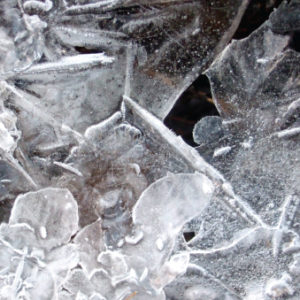
CD
Tiziana BERTONCINI-Thomas LEHN
“Horsky park”
“Tiziana Bertoncini (violin) and Thomas Lehn (analogue synthesiser). Recorded in Milan, Italy in july 2006. Recorded in Heidelberg, Germany in november 2010. Galaverna was recorded on November 11th, 2010 at Festival Pulsi, Triennale Bovisa, Milano, Italy. Moss agate was recorded on July 30th, 2006 at art ort Festival, Heidelberg, Germany.Recorded, mixed and mastered by Thomas Lehn and Tiziana Bertoncini.” label info
14,00€
Out of stock
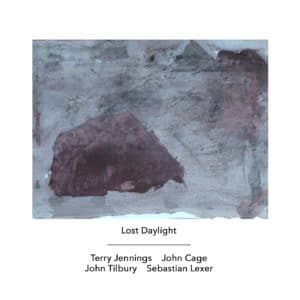
CD
Terry JENNINGS-John CAGE
“Lost daylight”
“The compositions on ‘Lost Daylight’ (at10) by John Cage and the almost-forgotten American Fluxus composer Terry Jennings date from between 1958 and 1966. Yet in the hands of John Tilbury and Sebastian Lexer they sound astonishingly modern. Jennings’ solo pieces couldn’t be more conventional in using only pure keyboard notes, but they could hardly be more radical in the way in which the notes are reduced, isolated and surrounded with silences. As Michael Pisaro’s sleevenotes say, “It is music of simplicity and great mystery. There are bar lines, but nothing feels counted: things happen in moments not measures… The sounds drift, suspended in a dense medium of some kind. The shape of a piece emerges gradually, like the hills appearing as the marine layer burns off. Each piece feels like a small event extended in time.” The score for John Cage’s ‘Electronic Music for Piano’ is nothing more than a few sketchy suggestions for ways in which David Tudor might combine Cage’s ‘Music for Piano’ with the use of electronics. On ‘Lost Daylight’ Sebastian Lexer has transformed John Tilbury’s performance with an alchemical array of electronic techniques, using - as Cage had suggested - star charts and other random processes to determine the editing of the 40 minute interpretation. The result is the first recording of the piece that really sounds like ‘electronic music for piano’ rather than piano music subjected to a minor electronic treatment.”
12,00€
In stock
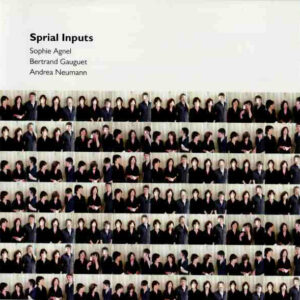
CD
Sophie AGNEL-Bertrand GAUGUET-Andrea NEUMANN
“Spiral inputs”
Sophie Agnel (piano), Bertrand Gauguet (alto and soprano saxophones) and Andrea Neumann (piano frame & electronics). Recorded in Mulhouse, february 2010 and Le Garric, june 2008. Mixed on 23rd and 24th September 2010 at GMEA studio, Albi (81). With the support of GMEA, National Centre for Musci Creation, Albi. The recordings took place during a first residency in June, 2008 at GMEA, National Centre for Music Creation, Albi and during a second residency in February, 2010 at Meteo Festival, Mulhouse. label info
14,00€