
In stock
CD
Thomas TILLY
“Birds measuring space”
As a counterpoint to discourses about sound in nature, french sound artist Thomas Tilly continues his research on the use of noise by non humans. Following the noise walls of Codex Amphibia, Birds measuring space focuses on the strange rituals operating by the mysterious Guacharos de Cuevas, and its interpretation by humans and technology.
Thomas Tilly (FR) is a sound artist and composer of experimental music. His work is based on field experiments using microphones, loudspeakers, and acoustic analysis instruments. Developing a unique approach to phonography, influenced by biology, anthropology, and sound measurement, his creations, broadcasts, and installations open up a field of listening that extends beyond the naturalist paradigm.
13,50€
In stock

CD
Thomas TILLY
“Codex amphibia (Phonotaxis)”
A new interpretation of the explosive frog breeding phenomenon.
Recorded, composed and mixed between 2016 and 2020 in French Guiana and France by Thomas Tilly, this pieces are part of a both scientific and artistic collaborative project conducted with herpetologist Antoine Fouquet, research associate at French National Center for Scienctific Research Cnrs. These compositions follow Codex amphibia (an interpretation of the explosive breeding), released in 2018 on Glistening Examples.
Thomas Tilly is a musician using the microphone and speaker as the main instruments of creation.
16,00€
Out of stock
CD
Thomas TILLY
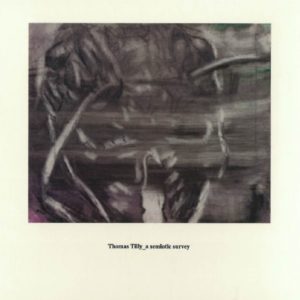
“A Semiotic Survey”
Limited to 200 copies. Field recordings made by Thomas Tilly at Saül and on the Rorota road, French Guiana, May 2015. Composed using field recordings, electronic sounds and microphones dysfunctions, from 2015 to 2018 by Thomas Tilly.
10,50€
Out of stock

LP
Thomas TILLY
“Le Cébron – Statics and sowers”
French sound artist Thomas Tilly uses unique field recordings as material for compositions. This LP presents two pieces: Le Cébron is based on recordings done on a frozen lake. Statics and sowers uses recordings from beehives as well as feedback from a mixing board. Edition limited to 300 copies on transparent 180g Vinyl. Drawings by Jean-Luc Guionnet. Mastered by Giuseppe Ielasi. Cut by Flo Kaufmann.
12,00€
In stock

2 LP + CD
Thomas TILLY
“Script geometry”
“Approaching the forest as if were a city, a construct, an ensemble of strata and vertical heights where signals answer, contrast and ignore each other. Variations occur, fullness and emptiness are created according to the weather and the peak and off-preak hours. This density that language can't define presents a challenge for the ear, and from this density surfaces, from time to time, certain analogies to a modern sound environment. Cultural leads fraw our experience of these natural acoustic phenomenin towards the domain of technology : “it sounds like... it's like…”.
The timbres ? The sound structures ? There exists something in a tropical forest that sounds like and plays within the realms of electronics, music and electronics noise ; something characteristic of an era long before the birth of biotopes that form this forest and create this sound. Script geometry comes from this idea and the desire to work with density, in an attempt to extract forms that characterize these analogies. Taking these sounds out of their context and rearranging them as we would patch cables on a synthesizer ; weaving these strata and vertica heights into a different pattern by using the signals from the forest as if they were synthetic sounds : dissecting this spectrum and looking for something that can only be revealed through listening, this is the essence of the project”. Thomas Tilly - Winter 2012
“In March 2013, I traveled to the Nourages scientific research station in French Guiana. Situated in the heart of a tropical rainforest, this station welcomes international scientific research progams dealing with tropical forests and their biodiversity. For the 30 days and nights of my stay, i listened to and captured the sound environment with an emphasis on animal communications : those wich are perceptible to the huan ear, but also the inaudible spectrum. The result is a collection of compositions and phonography characteristic of the zone.
No electronic treatement has been added to these recordings other than a low cut filter and a light EQ mix.
Script Geometry was conducted as an artist-in-residency programme at the Confort Moderne, Jazz à Potiers, the Lieu Multiple and the Nouragues Station in French Guiana between February and June 2013. A series of concerts, conférences, broadcasts and a creative workshop took place in accompaniment to the project”.
2 LP mastered by James Plotkin. CD mastered by Thomas Tilly. Cut by Rashad Becker at Dubplates and Mastering, Berlin.
The timbres ? The sound structures ? There exists something in a tropical forest that sounds like and plays within the realms of electronics, music and electronics noise ; something characteristic of an era long before the birth of biotopes that form this forest and create this sound. Script geometry comes from this idea and the desire to work with density, in an attempt to extract forms that characterize these analogies. Taking these sounds out of their context and rearranging them as we would patch cables on a synthesizer ; weaving these strata and vertica heights into a different pattern by using the signals from the forest as if they were synthetic sounds : dissecting this spectrum and looking for something that can only be revealed through listening, this is the essence of the project”. Thomas Tilly - Winter 2012
“In March 2013, I traveled to the Nourages scientific research station in French Guiana. Situated in the heart of a tropical rainforest, this station welcomes international scientific research progams dealing with tropical forests and their biodiversity. For the 30 days and nights of my stay, i listened to and captured the sound environment with an emphasis on animal communications : those wich are perceptible to the huan ear, but also the inaudible spectrum. The result is a collection of compositions and phonography characteristic of the zone.
No electronic treatement has been added to these recordings other than a low cut filter and a light EQ mix.
Script Geometry was conducted as an artist-in-residency programme at the Confort Moderne, Jazz à Potiers, the Lieu Multiple and the Nouragues Station in French Guiana between February and June 2013. A series of concerts, conférences, broadcasts and a creative workshop took place in accompaniment to the project”.
2 LP mastered by James Plotkin. CD mastered by Thomas Tilly. Cut by Rashad Becker at Dubplates and Mastering, Berlin.
23,00€
Out of stock

CD
Thomas TILLY
“Codex Amphibia (an interpretation of the explosive breeding phenomenon)”
Professionnaly duplicated CDR.
Field recordings realized by Thomas Tilly, December 2016 Guiana. This project comes from a research field session realized with Antoine Fouquet, Research associate at The French National Center for Scientific Research; “Ecology, environment and interactions in Amazonian systems Lab” (LEEISA); and the “Evolution and Biological diversity Lab”.
Comprised from unprocessed raw field recordings and interspersed sinewave structures by Thomas Tilly, 2017.
13,00€
In stock
CD
Thomas TILLY
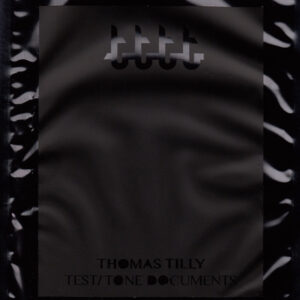
“Test – Tone documents”
Test/Tone - Installation for plans, recordings and speakers. La Cartonnerie/Palais du Tau, Reims (France), 2007.
“Through the filters constituted by a building's walls and the complex electrical network composing its nervous system, sound appears as a residual matter of the building's activities, eroded by the architecture. The geographical situation of these aucoustical phenomena is representative of this activity’s nature.Test/Tone is a listening space, created through a study of the building that hostes La Cartonnerie, dedicated to amplified music and composed by two concert halls, several studios, technical premises and a reception area. The space is defined by ten loudspeakers wich broadcast a work exclusively composed of sound recordings made in the building. These recordings (vibrations, magnetic fields and sounds from influx of visitors or employees working) put foreward some almost inaudible resonant images of the building. The loudspeakers’ placing inside the device has been determined while picking up sounds by a cartographical work making the place's most important zones of intense sound flows appear.A work of urban phonography, Test/Tone is both a retranscription on a reduced scale of a place’s geography and an enlargement of it's sound environment.” Thomas Tilly, 2007.
14,00€