
In stock
CD
Terry FOX
“Labyrinth of the inner ear”
About Terry Fox: Labyrinth of the inner ear
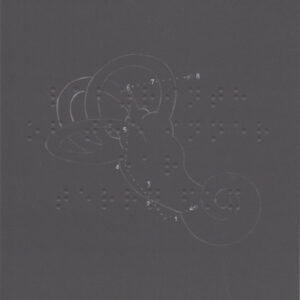
For the exhibition “Sonambiente", I will produce a new audio work for compact disc. The title of this work will be “Labyrinth of the inner ear" and it will be recorded in Berlin on the 14th and 15th of April, 2006. The compact disc will be produced directly after the recording process and presented, during Sonambiente, in a room of the former Polish Embassy.
This will be a kind of “drone" work consisting of the repetitive tapping of a sightless person (the artist, Siegfried Saerberg) navigating his way through an urban environment and finally returning to the place where the walk began. The sound of the cane, either tapping or sweeping back and forth, would be a constant in this composition. It would cease only when Siegfried stops walking for some reason, for
example: an interesting acoustical space, a ride in a public transport, etc.
Location interpretations could be ascertained by the sounds surrounding the steady central position of the cane; an alley, a busy shopping district, the relative quietness of a back street a park, and so forth. This walk would, itself, finally return to its place of origin.
Terry Fox, Köln 2006
About Terry Fox
Terry Fox (b. 1943 Seattle – d. 2008 Cologne) was one of the leading pioneers of American Body Art and Conceptual art. He became famous in the Seventies with performances in which he used his own body as a medium for exploring often extreme physical and psychological experiences. In numerous installations, actions and street events he directed a heightened attention to everyday phenomena and aspects of social interactions. Fox researched both unknown and little regarded aspects of energy in substances, and the transformative qualities of materials. And from the 1980s on, language, as both substance and meaning, would play an increasingly important role in his space related works and objects.
With his lifelong, innovative exploration of sound and space, Terry Fox is also one of the seminal figures in contemporary Sound Art. He became known worldwide in the 1970s for performances with meters-long piano wires stretched in rooms, often fastened from one wall to an opposite wall. With his understanding of sound as a sculptural material, he has created an impressive body of work located between Visual art and Acoustic Sound art. In his later years quiet sounds at the limit of audibility and silence became more and more prominent.
The ephemeral, the invisible, time, space, the body, words, letters, sound -throughout his entire work Terry Fox used the elemental forms of human existence to explore the possibilities of sculpture and extend its limits..
Fold out embossed DVD sleeve with liner notes and photographs documenting the piece
15,00€
Out of stock

2 LP
Terry FOX
“552 Steps Through 11 Pairs of Strings”
When Terry Fox went from San Francisco to Europe in 1972, he discovered the great pavement labyrinth at Chartres Cathedral. It consists of 11 concentric rings with 552 steps and 34 turns leading into the center. The discovery of the labyrinth became a revelation to him. He saw it as a metaphor for his own life, the numbers of rings and turns corresponding to cycles of health and sickness he had undergone. Thus he decided to base all of his works until 1978 on the labyrinth. These include two major sound works, one of which – “The Labyrinth Scored for the Purrs of 11 Cats” – was later released on cassette and LP, while the other has remained unreleased so far.
“552 Steps Through 11 Pairs of Strings” was a performance made in Fox’s loft in San Francisco on August 14, 1976, starting at 10 pm and lasting 4 1/2 hours. He stretched 11 pairs of piano wires of 11 different thicknesses across the floor, attached them to turnbuckles at each end which he hooked to eye-screws into the wooden floor. Each pair of wires passed over a wooden bridge at both ends. He played this instrument with a soft mallet in one hand and a score in the other. The score was a 34-foot string tied with 552 knots. Each knot represented a step in the labyrinth with the 34 turns indicated by either a piece of wire in a knot (a move to the next longer pair of wires) or a rubber band around a knot (a move to the next shorter pair). The audience was in the dark loft of the floor below.
“We were all mesmerized by the beauty of the piece and lost in its grace. Around midnight a light rain began to fall outside the windows completing the piece’s perfection. He played for another two hours or so. It also happened to be my birthday. It was the best birthday I ever had.” (from the liner notes by Alan Scarritt)
This 2 LP includes four selections from the performance. A gatefold sleeve reproduces the score, a photograph and a drawing of the instrument, and the invitation card to the performance. Texts by Terry Fox and Alan Scarritt. Edition of 300.
“552 Steps Through 11 Pairs of Strings” was a performance made in Fox’s loft in San Francisco on August 14, 1976, starting at 10 pm and lasting 4 1/2 hours. He stretched 11 pairs of piano wires of 11 different thicknesses across the floor, attached them to turnbuckles at each end which he hooked to eye-screws into the wooden floor. Each pair of wires passed over a wooden bridge at both ends. He played this instrument with a soft mallet in one hand and a score in the other. The score was a 34-foot string tied with 552 knots. Each knot represented a step in the labyrinth with the 34 turns indicated by either a piece of wire in a knot (a move to the next longer pair of wires) or a rubber band around a knot (a move to the next shorter pair). The audience was in the dark loft of the floor below.
“We were all mesmerized by the beauty of the piece and lost in its grace. Around midnight a light rain began to fall outside the windows completing the piece’s perfection. He played for another two hours or so. It also happened to be my birthday. It was the best birthday I ever had.” (from the liner notes by Alan Scarritt)
This 2 LP includes four selections from the performance. A gatefold sleeve reproduces the score, a photograph and a drawing of the instrument, and the invitation card to the performance. Texts by Terry Fox and Alan Scarritt. Edition of 300.
32,00€