
In stock

2 LP
Steve REICH
“Drumming”
Steve Reich’s Drumming is regarded as one of the most important musical works of the last century. Distilled through his studies of African percussion in Ghana during 1970 and Balinese gamelan music, Reich revolutionized our understanding of polyrhythms, sculpting a new sonic territory to illuminate the radical potential of Minimalism.
Divided into four sections, performed without pause, Drumming is written for eight small tuned drums, three marimbas, three glockenspiels, piccolo and voice. The singers recite melodic patterns that mimic the sounds of the instruments, gradually rising to the surface and then fading out. The overall effect can be transfixing – pulling listeners into the rhythm and possessing a raw immediacy, directness and energy.
The premier performances of Drumming took place in December 1971 in New York City – first at The Museum of Modern Art, then at Brooklyn Academy of Music and finally at Town Hall where this recording was made – and featured the composer along with a cast of longtime collaborators including Art Murphy, Steve Chambers, Russ Hartenberger, James Preiss, Jon Gibson, Joan La Barbara, Judy Sherman, Jay Clayton, Ben Harms, Gary Burke, Frank Maefsky and James Ogden.
Originally released in 1972 by gallerist John Gibson in a small private edition, Drumming represents the culmination of Reich’s investigation into rhythmic phase relationships and its early realization captures a remarkably organic feel, especially compared to the more widely known version on Deutsche Grammophon from 1974.
This first-time vinyl reissue and first-time CD release has been carefully remastered from the original master tapes.
29,00€
Out of stock
2 CD
Steve REICH
“Drumming”
Steve Reich’s Drumming is regarded as one of the most important musical works of the last century. Distilled through his studies of African percussion in Ghana during 1970 and Balinese gamelan music, Reich revolutionized our understanding of polyrhythms, sculpting a new sonic territory to illuminate the radical potential of Minimalism.
Divided into four sections, performed without pause, Drumming is written for eight small tuned drums, three marimbas, three glockenspiels, piccolo and voice. The singers recite melodic patterns that mimic the sounds of the instruments, gradually rising to the surface and then fading out. The overall effect can be transfixing – pulling listeners into the rhythm and possessing a raw immediacy, directness and energy.
The premier performances of Drumming took place in December 1971 in New York City – first at The Museum of Modern Art, then at Brooklyn Academy of Music and finally at Town Hall where this recording was made – and featured the composer along with a cast of longtime collaborators including Art Murphy, Steve Chambers, Russ Hartenberger, James Preiss, Jon Gibson, Joan La Barbara, Judy Sherman, Jay Clayton, Ben Harms, Gary Burke, Frank Maefsky and James Ogden.
Originally released in 1972 by gallerist John Gibson in a small private edition, Drumming represents the culmination of Reich’s investigation into rhythmic phase relationships and its early realization captures a remarkably organic feel, especially compared to the more widely known version on Deutsche Grammophon from 1974.
This first-time vinyl reissue and first-time CD release has been carefully remastered from the original master tapes.
20,00€
Out of stock

LP
Steve REICH
“Four Organs / Phase Patterns”
2017 repress.
“Steve Reich remains one of the most important figures in 20th century music. Though he studied at the prestigious arts institutions Julliard and Mills College, by the mid- 1960s Reich set about dismantling the very orthodoxy that he had been trained in. Forming a new musical language based on repetitive processes, Reich became established as part of the so-called 'Big Four' of New York minimalists (along with La Monte Young, Terry Riley and Philip Glass). Reich's influence can easily be seen today in both the classical world and contemporary pop music. 'Four Organs' is the ultimate minimalist composition. Performed by Reich, Glass, Art Murphy and Steve Chambers, four identical Farfisa organs strike a single chord and gradually lengthen each note to produce polyrhythms between the players. Anchored by Jon Gibson's stoicallysteady pulse on maracas, the piece deconstructs its opening burst to a sustained mass of sound -- stretching the tones to create (in Reich's words) 'slow-motion music.' Inspired by Reich's early training on drums, 'Phase Patterns' treats the keyboards like tuned percussion instruments: a basic rhythm pattern is played in unison and almost imperceptibly increases tempo to move out-of-sync. Each progressive cycle emphasizes unique figures that are not generated by an individual alone, but rather emerge from the communal expression of the group. Originally released on Shandar in 1971, Four Organs / Phase Patterns is one of most highly regarded avant-garde recordings in the past 45 years. This first-time vinyl reissue features cover photography by artist Michael Snow and is recommended for fans of Neu!, Glenn Branca and Tim Hecker.”
20,00€
Out of stock

2 LP
Steve REICH
“WTC 9-11”
Vinyl version. WTC 9/11 on one side A and Different Trains on sides C and D. 180g, limited and numbered 500 copies + postal card.
Performed by Quatuor Tana.
Steve Reich composed WTC 9/11 in 2010 in homage to the victims of the attack on the World Trade Center, September 11th, 2001. First performed on March 19, 2011 at Duke University in North Carolina by the Kronos Quartet, WTC 9/11 would be played for the first time in New York, at Carnegie Hall, in late April of the same year.
WTC 9/11 is written for a string quartet playing live, on which are juxtaposed pre-recorded voices and two string quartets. With a playing time of 16 minutes, the work is in three movements played without a break: “9/11”, “2010” and “WTC”.
The first movement, “9/11”, is moving, disturbing and even stressful. Deliberately bruitist, it begins and develops to the haunting rhythm of the alarm of a telephone left off the hook: an F played on the violin with the superimposed archive voices of the NORAD (North American Aerospace Defense Command) air traffic controllers and the FDNY (Fire Department City of New York).
The second movement, entitled “2010”, uses interviews of memories from 2001. In it, we hear Steve Reich’s neighbors, an officer of the FDNY and the first ambulance driver to arrive at the scene.
In the third movement, Steve Reich takes inspiration from his friend the composer David Lang, creator in 2003 of World To Come, “WTC” being the common acronym of both their works. Steve Reich’s is concerned with metaphysical and spiritual preoccupations. Brought up in the Jewish faith, he knows that it imposes the ritual of presence around the body to accompany the deceased from the time of death to burial, thus accompanying the soul, which floats above the body until inhumation. It was impossible for the composer to ignore the fact that after the 9-11 attacks, the problem of identifying the bodies lasted seven months...
In 2011, for the release of WTC 9/11, the cover photo showing the Twin Towers at the moment of the attack created such a shock and controversy that it was replaced by another visual showing a cloud of smoke.
Steve Reich, who was a neighbor of the World Trade Center for 25 years, wrote on his label’s website: “I believed… that a piece of music with documentary material from an event would best be matched with a documentary photograph of that event”.
Serge Thomassian, the producer of the Megadisc Classics label - whose offices, four blocks from the Twin Towers, were destroyed during the 2001 attack - now proposes an unambiguous cover photo of the World Trade Center being struck by the plane.
DIFFERENT TRAINS
The idea for this work comes from Steve Reich’s childhood. He was a year old when his parents separated, his mother going to live in Los Angeles, his father staying in New York. Thus, accompanied by his nanny, the young Steve was going to make frequent trips between the East and West Coasts. Those pleasant train trips, taking four days, doubtless did not prevent him from knowing that, between 1939 and 1942, European Jewish children his age were getting into very different trains…
This is what would result in Different Trains (1988), a 27-minute work laid out in three movements: “America-Before the War”, “Europe-During the War” and “After the War”. The composition uses and superimposes conversations on tape and the instruments of the string quartet. The retrieval of numerous sonorities of daily life, voices like announcements, recorded sounds of trains from the 1930s and ‘40s make up the musical material of Different Trains. To his composition he adds recorded interviews of witnesses from his childhood: his nanny, Virginia Mitchell, who evokes their train trips; Lawrence Davis, an employee of the New York-Los Angeles railroad line, who relates his life; and finally, testimony collected from Rachella, Paul and Rachel, Holocaust survivors.
Different Trains opened new directions and new perspectives for Steve Reich. Although he brings together four string quartets, one playing live, the three others being added to the pre-recorded tape, it is above all the taped voices that make for the work’s originality. The spoken language thus becomes a full-fledged musical material, and after Different Trains, this technique would lead to The Cave, composed in 1990, Three Tales (2002) then WTC 9/11 (2010)…
Steve Reich, born October 3, 1936, is one of the most important and influential composers of today’s music, his impact on his contemporaries being considerable. Since the Minimalism of his beginnings, he has remained faithful to repetitive writing (patterns), even though his latest creations have become more harmonic and thereby richer and more delightful, tinged with the fantastic.
Performed by Quatuor Tana.
Steve Reich composed WTC 9/11 in 2010 in homage to the victims of the attack on the World Trade Center, September 11th, 2001. First performed on March 19, 2011 at Duke University in North Carolina by the Kronos Quartet, WTC 9/11 would be played for the first time in New York, at Carnegie Hall, in late April of the same year.
WTC 9/11 is written for a string quartet playing live, on which are juxtaposed pre-recorded voices and two string quartets. With a playing time of 16 minutes, the work is in three movements played without a break: “9/11”, “2010” and “WTC”.
The first movement, “9/11”, is moving, disturbing and even stressful. Deliberately bruitist, it begins and develops to the haunting rhythm of the alarm of a telephone left off the hook: an F played on the violin with the superimposed archive voices of the NORAD (North American Aerospace Defense Command) air traffic controllers and the FDNY (Fire Department City of New York).
The second movement, entitled “2010”, uses interviews of memories from 2001. In it, we hear Steve Reich’s neighbors, an officer of the FDNY and the first ambulance driver to arrive at the scene.
In the third movement, Steve Reich takes inspiration from his friend the composer David Lang, creator in 2003 of World To Come, “WTC” being the common acronym of both their works. Steve Reich’s is concerned with metaphysical and spiritual preoccupations. Brought up in the Jewish faith, he knows that it imposes the ritual of presence around the body to accompany the deceased from the time of death to burial, thus accompanying the soul, which floats above the body until inhumation. It was impossible for the composer to ignore the fact that after the 9-11 attacks, the problem of identifying the bodies lasted seven months...
In 2011, for the release of WTC 9/11, the cover photo showing the Twin Towers at the moment of the attack created such a shock and controversy that it was replaced by another visual showing a cloud of smoke.
Steve Reich, who was a neighbor of the World Trade Center for 25 years, wrote on his label’s website: “I believed… that a piece of music with documentary material from an event would best be matched with a documentary photograph of that event”.
Serge Thomassian, the producer of the Megadisc Classics label - whose offices, four blocks from the Twin Towers, were destroyed during the 2001 attack - now proposes an unambiguous cover photo of the World Trade Center being struck by the plane.
DIFFERENT TRAINS
The idea for this work comes from Steve Reich’s childhood. He was a year old when his parents separated, his mother going to live in Los Angeles, his father staying in New York. Thus, accompanied by his nanny, the young Steve was going to make frequent trips between the East and West Coasts. Those pleasant train trips, taking four days, doubtless did not prevent him from knowing that, between 1939 and 1942, European Jewish children his age were getting into very different trains…
This is what would result in Different Trains (1988), a 27-minute work laid out in three movements: “America-Before the War”, “Europe-During the War” and “After the War”. The composition uses and superimposes conversations on tape and the instruments of the string quartet. The retrieval of numerous sonorities of daily life, voices like announcements, recorded sounds of trains from the 1930s and ‘40s make up the musical material of Different Trains. To his composition he adds recorded interviews of witnesses from his childhood: his nanny, Virginia Mitchell, who evokes their train trips; Lawrence Davis, an employee of the New York-Los Angeles railroad line, who relates his life; and finally, testimony collected from Rachella, Paul and Rachel, Holocaust survivors.
Different Trains opened new directions and new perspectives for Steve Reich. Although he brings together four string quartets, one playing live, the three others being added to the pre-recorded tape, it is above all the taped voices that make for the work’s originality. The spoken language thus becomes a full-fledged musical material, and after Different Trains, this technique would lead to The Cave, composed in 1990, Three Tales (2002) then WTC 9/11 (2010)…
Steve Reich, born October 3, 1936, is one of the most important and influential composers of today’s music, his impact on his contemporaries being considerable. Since the Minimalism of his beginnings, he has remained faithful to repetitive writing (patterns), even though his latest creations have become more harmonic and thereby richer and more delightful, tinged with the fantastic.
40,00€
In stock
CD
Steve REICH
“WTC 9-11”
32 pages & Notes in English ans French.
Performed by Quatuor Tana.
Steve Reich composed WTC 9/11 in 2010 in homage to the victims of the attack on the World Trade Center, September 11th, 2001. First performed on March 19, 2011 at Duke University in North Carolina by the Kronos Quartet, WTC 9/11 would be played for the first time in New York, at Carnegie Hall, in late April of the same year.
WTC 9/11 is written for a string quartet playing live, on which are juxtaposed pre-recorded voices and two string quartets. With a playing time of 16 minutes, the work is in three movements played without a break: “9/11”, “2010” and “WTC”.
The first movement, “9/11”, is moving, disturbing and even stressful. Deliberately bruitist, it begins and develops to the haunting rhythm of the alarm of a telephone left off the hook: an F played on the violin with the superimposed archive voices of the NORAD (North American Aerospace Defense Command) air traffic controllers and the FDNY (Fire Department City of New York).
The second movement, entitled “2010”, uses interviews of memories from 2001. In it, we hear Steve Reich’s neighbors, an officer of the FDNY and the first ambulance driver to arrive at the scene.
In the third movement, Steve Reich takes inspiration from his friend the composer David Lang, creator in 2003 of World To Come, “WTC” being the common acronym of both their works. Steve Reich’s is concerned with metaphysical and spiritual preoccupations. Brought up in the Jewish faith, he knows that it imposes the ritual of presence around the body to accompany the deceased from the time of death to burial, thus accompanying the soul, which floats above the body until inhumation. It was impossible for the composer to ignore the fact that after the 9-11 attacks, the problem of identifying the bodies lasted seven months...
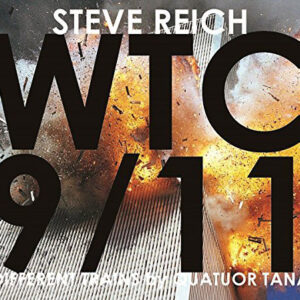
In 2011, for the release of WTC 9/11, the cover photo showing the Twin Towers at the moment of the attack created such a shock and controversy that it was replaced by another visual showing a cloud of smoke.
Steve Reich, who was a neighbor of the World Trade Center for 25 years, wrote on his label’s website: “I believed… that a piece of music with documentary material from an event would best be matched with a documentary photograph of that event”.
Serge Thomassian, the producer of the Megadisc Classics label - whose offices, four blocks from the Twin Towers, were destroyed during the 2001 attack - now proposes an unambiguous cover photo of the World Trade Center being struck by the plane.
DIFFERENT TRAINS
The idea for this work comes from Steve Reich’s childhood. He was a year old when his parents separated, his mother going to live in Los Angeles, his father staying in New York. Thus, accompanied by his nanny, the young Steve was going to make frequent trips between the East and West Coasts. Those pleasant train trips, taking four days, doubtless did not prevent him from knowing that, between 1939 and 1942, European Jewish children his age were getting into very different trains…
This is what would result in Different Trains (1988), a 27-minute work laid out in three movements: “America-Before the War”, “Europe-During the War” and “After the War”. The composition uses and superimposes conversations on tape and the instruments of the string quartet. The retrieval of numerous sonorities of daily life, voices like announcements, recorded sounds of trains from the 1930s and ‘40s make up the musical material of Different Trains. To his composition he adds recorded interviews of witnesses from his childhood: his nanny, Virginia Mitchell, who evokes their train trips; Lawrence Davis, an employee of the New York-Los Angeles railroad line, who relates his life; and finally, testimony collected from Rachella, Paul and Rachel, Holocaust survivors.
Different Trains opened new directions and new perspectives for Steve Reich. Although he brings together four string quartets, one playing live, the three others being added to the pre-recorded tape, it is above all the taped voices that make for the work’s originality. The spoken language thus becomes a full-fledged musical material, and after Different Trains, this technique would lead to The Cave, composed in 1990, Three Tales (2002) then WTC 9/11 (2010)…
Steve Reich, born October 3, 1936, is one of the most important and influential composers of today’s music, his impact on his contemporaries being considerable. Since the Minimalism of his beginnings, he has remained faithful to repetitive writing (patterns), even though his latest creations have become more harmonic and thereby richer and more delightful, tinged with the fantastic.
20,00€