
In stock

CD
Sébastien ROUX
“Musiques d’ordinateur”
Musiques d’ordinateur rassemble des pièces écrites entre 2011 et 2020. Les pistes de ce CD sont les résultats plus ou moins prévisibles de programmes plus...
12,00€
In stock
CD
Sébastien ROUX
“Inevitable music #5”
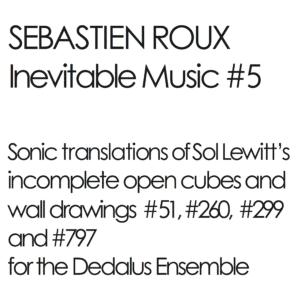
Inevitable music is a collection of pieces based on the work of American artist Sol Lewitt, initiated by Sébastien Roux in 2012. Each piece is a sonic translation of a wall drawing using the instructions given by Lewitt for the realization of the drawing, or the drawing itself, as partition. This fifth installment is the first to propose instrumental compositions for guitar, bassoon, clarinet, trumpet, violin, cello, viola and voice. The pieces were composed in 2016 during a residency at the Villa Medici for and with the experimental contemporary music ensemble Dedalus.
Sébastien Roux (born 1977) writes electronic music, and presents it in diverse formats, from CD’s and records, to public listening sessions, sound installations, sound walks, and radio pieces. He experiments with listening conditions, with the concept of soundscape, and with composition using formal constraints. In 2011 he began to develop an approach focused on principles of translation, analyzing the structures of pre-existing art works (visual, musical, literary) and transposing them into musical scores for new works. This process has led to the creation of Quatuor (2011, released on Brocoli records) and Nouvelle (2012). The most recent development out of this process of translation is Inevitable Music, a long-term examination and development of a methodology for applying the rules and means of the wall drawings of Sol Lewitt to sonic ends. Along with his solo works Roux maintains significant collaborations with writers (Célia Houdart), designers (Olivier Vadrot), choregraphers (DD Dorvillier, Sylvain Prunenec and Rémy Héritier). He worked at Ircam, Paris as a musical assistant to Georges Aperghis, Bruno Mantovani and Gérard Pesson, and was a musical assistant to Morton Subtonick, for “Parades and Changes, replays” by Anne Collod/Anna Halprin. He is a Rome Prize Winner and was in residence at the French Academy in Rome for 2015 – 2016.
12,50€
Out of stock
CD
Sébastien ROUX
“Quatuor”
Sébastien Roux’s new album is an ambitious work of musique concrète. Like the title track of his previous album More Songs, Quatuor is based on Beethoven's 10th string quartet.
The sonic material of the piece is culled from arrangements of the original score by Mathieu Bonilla, for flute, clarinet, cello, French horn, and percussion. Quatuor follows the same structure as the original string quartet, classic and solid, but the sound is profoundly original, in turns woody, rubbed, creaking, jerky or enveloping.
Quatuor will without a doubt become a milestone in the canon of electroacoustic music.
Sébastien Roux (born 1977) writes electronic music, and presents it in diverse formats, from CD’s and records, to public listening sessions, sound installations, sound walks, and radio pieces. In 2011 he began to develop an approach focused on principles of translation, analyzing the structures of pre-existing art works (visual, musical, literary) and transposing them into into scores for new works (radiophonic or electro-acoustic taped music). This process has led to the creation of Quatuor (2011) an electroacoustic work based on Beethoven’s 10th String quartet, commissioned by Groupe de Recherches Musicales and Nouvelle (2012) a radio work, based on Flaubert's short story The Legend of Saint Julien L’Hospitalier, commissioned by the Westdeutscher Rundfunk. The most recent development out of this process of “translation” is Inevitable Music which has involved an exhaustive research on the wall drawings of Sol Lewitt, and a long-term examination and development of a methodology for applying the rules and means of these works to sonic ends. He has written music for dance and theater, for choreographers Lionel Hoche, Sylvain Prunenec, and DD Dorvillier, and theater director Annie Dorsen.
The sonic material of the piece is culled from arrangements of the original score by Mathieu Bonilla, for flute, clarinet, cello, French horn, and percussion. Quatuor follows the same structure as the original string quartet, classic and solid, but the sound is profoundly original, in turns woody, rubbed, creaking, jerky or enveloping.
Quatuor will without a doubt become a milestone in the canon of electroacoustic music.
Sébastien Roux (born 1977) writes electronic music, and presents it in diverse formats, from CD’s and records, to public listening sessions, sound installations, sound walks, and radio pieces. In 2011 he began to develop an approach focused on principles of translation, analyzing the structures of pre-existing art works (visual, musical, literary) and transposing them into into scores for new works (radiophonic or electro-acoustic taped music). This process has led to the creation of Quatuor (2011) an electroacoustic work based on Beethoven’s 10th String quartet, commissioned by Groupe de Recherches Musicales and Nouvelle (2012) a radio work, based on Flaubert's short story The Legend of Saint Julien L’Hospitalier, commissioned by the Westdeutscher Rundfunk. The most recent development out of this process of “translation” is Inevitable Music which has involved an exhaustive research on the wall drawings of Sol Lewitt, and a long-term examination and development of a methodology for applying the rules and means of these works to sonic ends. He has written music for dance and theater, for choreographers Lionel Hoche, Sylvain Prunenec, and DD Dorvillier, and theater director Annie Dorsen.
15,00€
Out of stock
CD
Sébastien ROUX
“More songs”
More Songs is the fourth solo album by Sébastien Roux, and a sequel to Songs, released on Taylor Deupree’s 12k label. It consists in three electroacoustic compositions which use an ensemble of acoustic instruments (strings, clarinet, horn, percussion, flute) recordings as source material. It starts with the short Créancier de secondes, a musique concrète rereading of the eponymous work by French composer Gérard Pesson. For More Songs, Roux asked fellow composer Mathieu Bonilla to transcribe seven fragments of Beethoven’s 10th string quartet, which are used as sound content within the piece as well as drawing from their structure to build the piece. Obliques is a revised version of a live piece written for cellist Séverine Ballon.
15,00€