
In stock

LP
PUCE MOMENT
“Epic Ellipses”
Puce Moment is part of the French contemporary music scene. Their music is climatic, often inhabited by a strong emotional power. A procession of harmonic structures organized in a ritual way, sometimes close to trance. It can be written or improvised, vocal or instrumental. The electronic and electroacoustic arrangements summon new spaces and abstract landscapes, which can go from the purest sound to the rawest distortions. Vast, slower, deeper -- distant echoes of half-faded things -- and when you are lost, voices appear. Voices whose only reference would be the timeless SeeFeel. Nicolas Devos and Pénélope Michel are visual and sound artists, one trained at the Beaux-Arts and the Fresnoy studio national des arts contemporains and the other a classically trained cellist, singer, and multi-instrumentalist. They created Puce Moment, envisaged as a sound research laboratory open to experimentation, to multi-disciplinary encounters and to decompartmentalization. Their work is akin to a fictional ethnology expressed through protean projects and mutant visual, sound and musical creations. Epic Ellipses is their fourth album. They have composed the original soundtracks of more than a dozen dance performance, fiction or documentary films, virtual reality in variable formats (Christian Rizzo, Mylène Benoit, Vania Vaneau, Benjamin Nuel, Laurent Pernot, Carolina Gonçalves). Or in the form of film-concerts including David Lynch's cult film Eraserhead with which they have toured intensively since 2012 in France and Europe, and since 2019 Koyaanisqatsi, the cult experimental documentary by Godfrey Reggio.
16,00€
Out of stock
LP
PUCE MOMENT
“O.R.G.”
On January 27, 2019, as part of the VIVnAT LA DANSE festival of Le Vivat d'Armentières, the duo Puce Moment proposed the first diffusion of their scores written for the mechanical organs of the Café des Orgues d'Herzeele.
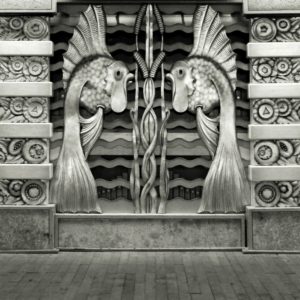
The Café des Orgues is a mythical place. It's a small bistrot that pays no mine, in a town of just over a thousand inhabitants on the road to Dunkirk. We can't imagine that the back room hides the most singular dance floor in the corner if not much further. Three great mechanical organs of the famous Belgian brand Mortier are recessed on three of the four walls surrounding the floor. Every Sunday, the room is open to the public made of faithful zealous who never miss a weekend except for a hip operation, young people driven by curiosity as much as the simple desire to eat a carbonade-fries while drinking a Flemish beer, but also large families and lovers of all kinds of folk music.
What a sumptuous idea then to have thought and proposed the creation of an unpublished work played on these organs to make the crowd dance that day. The challenge was rto create a composition that is danceable, where the rhythms lead to the loss of landmarks and where is heard to the micro-details of the sounds of this gigantic sound machine, with grains and textures always more organic.
A series of rough, repetitive and heady pieces that take on a particularly strong dimension to be played on these limonary organs. As if a Comeladian orchestra was playing some Steve Reich in a deterritorialized fest-noz in the Flanders for clubbers fans of German Kraut-electronic music.
16,00€