
In stock

LP
Michèle BOKANOWSKI
“Cirque”
The Circus is a place of lights and colors, but also of shadows, even darkness. Admittedly, it delights children and makes adults laugh. But you only need one rainy autumn evening near a circus tent and the smell of fodder to think of the sadness of the clowns, the endless training of the animals and the freaks who are hidden in some caravan... cinema, the essence of the circus – movement, light, danger and burlesque – will have been admirably rendered in Notes on the circus by Jonas Mekas (1966), one of the inventors of the filmed diary. With Cirque, Michèle Bokanowski does similar work, entirely dedicated to spinning, in the musical field.
She distinguished herself in particular in the composition of musique concrète, among others Tabou and Trois chambres d'inquiétudes, after having studied with Pierre Schaeffer and Éliane Radigue. The latter, great lady of drone and minimalism, fell under the spell of Cirque and wrote the booklet for the piece as a poem.
The piece, divided into five movements, is based on the handling and editing of recordings captured within one or more circuses (this is not specified and is of no importance) between 1988 and 1993. The initial allegro reveals the gallop of a horse joined gradually by other images. The idea of the circular space of the circus tent is immediatly and magnificently rendered and will be constantly recalled by an insistent use of the loop technique. Children's laughter, applause and drum rolls are thus sheared, repeated before being brutally interrupted. Accordion interludes and the distortion of sounds create a dreamlike atmosphere. This beautiful nightmare reminds us, to quote Éliane Radigue, the “Magic of childhood still living in the heart of man even beyond its abrupt end. »
Words by Alexandre Galand, from the book “Field Recording – L’usage sonore du monde en 100 albums” (ed. Le mot et le reste, 2012)
Major member of the french musique concrète scene, Michèle Bokanowski was born on August 9, 1943 in Cannes, FR, to a musician mother and a writer father.
She now lives and works in Paris.
Music lover since adolescence, it was relatively late, at the age of 22, that Michèle Bokanowski decided to study composition. Reading In Search of a Concrete Music by Pierre Schaeffer was decisive. After classical training on harmony, she met Michel Puig, a student of René Leibowitz, who taught her writing and analysis based on the Treatise of Schönberg. In September 1970 she began a two-year internship in the ORTF Research Department under the direction of Pierre Schaeffer. She takes part in the same time in a research group on sound synthesis, studies musical computing at the Faculty of Vincennes and electronic music with Éliane Radigue.
Her main works are intended for concert: Pour un pianiste, Trois chambres d’inquiétude, Tabou, Phone Variations, Cirque, L’étoile Absinthe, Chant d’Ombre, Enfance, Rhapsodia, Cadence, Elsewhere. She has also composed for theater (with Catherine Dasté), dance (with choreographers Hideyuki Yano, Marceline Lartigue, Bernardo Montet) and cinema: music for the short films of Patrick Bokanowski and his two feature films L'Ange ( 1982) and A Solar Dream (2016).
23,00€
In stock
2 CD
Michèle BOKANOWSKI
“Musique de courts métrages, Music of Patrick Bokanowski’s short films”
*2023 repress*
This double CD edition collects, for the first time, all the original music composed by Michele Bokanowski for the short films of her husband, Patrick Bokanowski.
Covering a time spectrum of almost 50 years, from "La Femme Qui Se Poudre" dated 1972 to "Vers Syracuse" of 2019.
Michele Bokanowski's sounds are visionary, sometimes disturbing and grotesque, sometimes ecstatic.
Some compositions are suites of grim musique concrete, an obscure ambient perhaps like never heard before, others are liquid abstractions of "expanded" music where it is easy to lose the ordinary awareness of one's senses, and find oneself experimenting with new ways of approaching listening as in the best tradition of experimental music .
The work of Michele Bokanowski and Patrick Bokanowski is essential for all avant-garde and visionary art lovers.
La Femme Qui Se Poudre (1972) 15:28
Déjeuner Du Matin (1974) 12:03
La Plage (1991) 12:12
Au Bord Du Lac (1993) 05:11
Flammes (1998) 03:35
Le Canard à L’orange (2002) 07:37
Battements Solaires (2008) 17:43
L’envol (2016) 07:26
L’indomptable (2017) 03:48
Vers Syracuse (2019) 05:40
18,00€
Out of stock

4 CD box
Michèle BOKANOWSKI
“Musiques de concert”
This 4 CD box edition collects all concert musics by Michèle Bokanowski, a composer of electroacoustic music living in Paris, France.
Passionate about music from childhood, it wasn’t until later, at the age of 22, after reading À la recherche d’une musique concrète by Pierre Schaeffer, that she decided to study composition. After classical training in harmony, she met Michel Puig, a pupil of René Leibowitz, who taught her writing and analysis upon Schönberg Theory. In 1970, she began a two-year internship at the Research Department of the ORTF under the direction of Pierre Schaeffer. Between 1973 and 1975, she took part in a research group on sound synthesis, studied computer music at the University of Vincennes as well as electronic music with Éliane Radigue. She mainly composes for concert and for cinema (music for Patrick Bokanowski’s short films and for his feature films L’Ange and Un Rêve solaire). She has also composed for television, theatre and dance.
In her music, often infused with a mysterious atmosphere, she uses evocative and poetic concrete sounds, with a mastery of looping and feedback techniques and with an art of cinematic editing.
“Why musique concrète is so attractive to me, as opposed to written music… To write music implies that an idea or a thought is at the origins of the composition and that the final thing is the sound rendering of this thought. The sound is at the end of the line, in other words. Musique concrète is the exact reverse of this process: you start from sounds… sounds that will perhaps lead you to a constructive thought. Here, it’s the material that induces the thought, or the writing. The possibilities of finding or inventing new sounds and, therefore, new forms are tremendous, infinite… Moreover you can use chance to a much greater extent.”
(Excerpt of an interview with Michael Karman for Asymmetry Music Magazine 2007)
CD1 :
Pour un pianiste (1974)
Trois chambres d’inquiétude (1976)
Tabou (1984)
CD2 :
Phone variations (1988)
Cirque (1994)
CD3 :
L’étoile absinthe (2000)
Chant d’ombre (2004)
Enfance (2011)
CD4 :
Rhapsodia (2018)
Cadence (2019)*
Elsewhere (2020)*
* unreleased
Mastering by Giuseppe Ielasi.
35,00€
Out of stock
LP
Michèle BOKANOWSKI
“Rhapsodia / Battements solaires”
*** Repressed ***
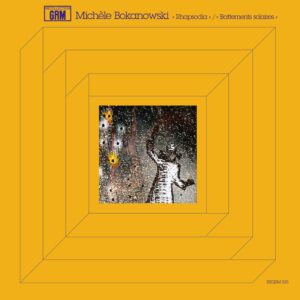
Michèle Bokanowski's art is one of densities, much like the density of a given colour, a given depth. Her sound textures are, indeed, profound, both in the space occupied by their frequencies and the sharp temporal trail they leave behind. Here lies the composer's immense talent that finds the right development for each sound, letting it blossom before altering it, adapting the musical structure to let the sounds “be”, even if it sometimes means returning to the most basic form, such as a loop. This is a sign of great honesty and artistic sensitivity; able to stand back and let the music become music. It is the most radical, the most accurate gesture of composition. The two pieces on this record, dissociated in time, both in their approach and destination, nevertheless reflect, each in its own way, Michèle Bokanowski's highly singular and insightful musical intuition. - François Bonnet, Paris, 2020
20,00€
Out of stock

LP singled side
Michèle BOKANOWSKI
“La plage”
Remained unpublished until today, this composition is made as soundtrack for the short film "La Plage" (1992) created by the experimental filmmaker Patrick Bokanowski (husband of Michèle Bokanowski).
"La Plage" is probably the less "concrete" composition made by Michèle Bokanowski. It is pure liquid abstraction in sounds. It is one of those rare compositions really out of time and space.
As expressed by Pip Chodorov, editor of 4 DVDs that contain all the films directed by Patrick Bokanowski, we can feel the works created by Michèle Bokanowski and Patrick Bokanowski are a sort of "spiritual search for the overrunning of perception, and thereby oneself. Searches into abstraction in the real, mysterious blanks that recover the daily".
Limited edition of 300 copies. Unconventional 4 different cover artwork (75 copies each) on embossed cardboard (2 colours version : Lavanda and Tabacco), one credit sheet inside. All on high quality recycled paper.
16,00€
In stock

maxi CD
Michèle BOKANOWSKI
“Pour un pianiste”
“Pour un pianiste” (1973-1974). Piano and prepared piano : Gérard Frémy. Electroacoustic music edited and mixed in the composer‘s studio (Paris) and GMEB studios (Bourges). Sound recording : GRM studio, ORTF. Sound engineer : N’Guyen Van Tuong. First performance :May 28th,1974, Bourges, Maison de la Culture,4th International Festival of Experimental Music. Mastering 2005 :Lionel Risler. Thanks to Roger Cochini.
“This work was commissioned by Gérard Frémy. I wrote the different themes, the patterns and rythmic cells first. Gérard Frémy played them on piano as well as on prepared piano. These recordings gave me the necessary material to create the magnetic tape. All the sounds are issued from the piano with the exception of the opening clavicord clusters. I wrote another version of this work that is for concerts only. In this instance a piano partition is played live along with the magnetic tape. Pour un Pianiste is dedicated to Gérard Frémy.”
8,00€
Out of stock

CD
Michèle BOKANOWSKI
s/t
“After “L’Ange” in 2003 and “Pour un Pianiste” in 2005, TraceLabel continues to explore the music of Michèle Bokanowski. This new release contains three pieces that were composed between 1975 and 1988. The first two works have already been the object of a discographic edition, however, the last piece “Phone Variations” has remained unpublished until today. Here you will find all the elements that are the mark of Michèle Bokanowski’s work: concrete sounds, obsessional mechanisms, the consideration of space, the underlining of the medium by a scriptwriting of the edit cuts, the primacy of expressiveness… In “Trois Chambres d’Inquiétude” (1975-1976), the minimalist sound materials (a child laughing, toys, women’s breath and voices, various looped sounds of machinery), serve a diffuse narrative dimension.The reference to the title of a series of etchings by the Danish artist, Lars Bo, confirms this illustrative lead. "Tabou" (1983-1984), on the other hand, reveals a more direct musicality, space and energy are opened out and developed with subtlety and skill. This piece, used by several choreographers (such as Hideyuki Yano in 1985 and Marceline Lartigue in 1993) introduced Michèle Bokanowski to the dance world. Lastly, with “Phone Variations” (1986-1988), the vocal messages and the music borrowed from telephone answering machines significantly expand the composer’s sound material and, in a sort of “found footage” approach, shed light upon the domestic and intimate dimension of these messages by staging them in the public musical space. The entire CD gives to the notion of “musique sur support” (music fixed on a medium) all it’s meaning. In fact, Michèle Bokanowski’s music brings into play an analogical and magnetic tape aesthetic, reminding us of the existence of electroacoustic music despite the hegemonic reign of digitalization and computers.”
13,00€
Out of stock

CD
Michèle BOKANOWSKI
“L’ange”
Original Music for the 1982 film “L’Ange” by Patrick Bokanowski. Composed in 1976-79. Coming from a family of musicians (professionals on her mother’s side, amateurs on her father’s side), she read, at the age of 22, À la recherche d’une musique concrète (In Search of a Concrete Music) by Pierre Schaeffer and decided to study composition. After a classical education in harmony, she met Michel Puig, a student of René Leibowitz, who taught her composition and analysis according to Schönbergian Principles. In September 1970, she began a two-year course at the Research Department of the ORTF under the direction of Pierre Schaeffer. At the same time, she participated in a sound synthesis research group, studied computer music at the Faculté de Vincennes as well as electronic music with Éliane Radigue. Between 1972 and 1984, she composed essentially for the concert - Korè, Pour un pianiste, Trois chambres d’inquiétude, Tabou - and for film - music for the short films by Patrick Bokanowski as well as his feature film L’Ange. Since 1985, she has composed for television, for theatre - with Catherine Dasté - and for dance, with choreographers Hideyuki Yano, Marceline Lartigue and Bernardo Montet.
13,00€