
Out of stock
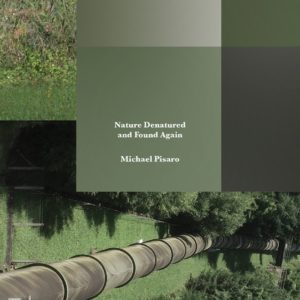
5 CD box
Michael PISARO
“Nature Denatured and Found Again”
Musicians:
Antoine Beuger (flute)
Jürg Frey (clarinet)
Marcus Kaiser (cello)
Radu Malfatti (trombone)
André Möller (electric guitar)
Kathryn Gleasman Pisaro (oboe/english horn)
Composition, field recording, sine tones, noise, mixing, mastering by Michael Pisaro
The piece is derived from field recordings made along the Grosse Mühl River, Neufelden, Austria, from 2011 to 2015 (during the flussaufwärts project created by Joachim Eckl, Marcus Kaiser and Michael Pisaro). Alongside the recordings of the river as it flows down from Neufelden to the Danube, are performances by Antoine Beuger, Jürg Frey, Marcus Kaiser, Radu Malfatti, André Möller, and Kathryn Pisaro. Pisaro has been working on the piece since 2011 and we are very happy to have it finally see the light of day.
The five discs come in an oversized box with cover art by Marcus Kaiser and Yuko Zama. The box set also includes a 24-page full-color booklet containing additional photos by Joachim Eckl, Marcus Kaiser, Emmanuelle Waeckerle, and Michael Pisaro, and liner notes by Michael Pisaro and Joachim Eckl.
65,00€
Out of stock
CD
Michael PISARO
“a mist is a collection of points”
Phillip Bush, piano; Greg Stuart, percussion; Michael Pisaro, sine tones.
Michael Pisaro (b. 1961) is a member of the Wandelweiser collective, an international organization of musicians which he has defined as “a particular group of people who have been committed, over the long term, to sharing their work and working together.” Its members have shared an interest in John Cage and experimental music, and extended durations, indeterminacy, and silence have featured in many works they have made; but Pisaro is quick to point out that the members of the collective have a far from uniform aesthetic stance. Pisaro’s work over the past decade bears little surface resemblance to the pieces made by other members of the collective apart from a commitment to experimental music and to deeply collaborative processes. Many of the recent trajectories of his work intersect in A mist is a collection of points (2014).
“A mist is a collection of points”, while a grid is an organized collection of points. There is the unspoken tension in this work between regular and aperiodic, solid and vague, artificial and organic, order and sprawl. This interplay takes place from one section to the next, and also in the interactions between the parts: between the pianist (Phillip Bush), the percussionist (Greg Stuart), and the sine tones (by Michael Pisaro). It affects the melody and the resonance, the timing and the coordination between parts. The intermingling of shadow pitches and extended resonances creates effects that are at least as vivid as any articulation.
Gradual change is a feature of the entire work, on the most local scale (measure by measure) and on the macro scale as well. Timing, resonance, melody, register, and dynamics are all intertwined in these slow transformations. “The work is essentially about the morphology and topography of this resonance.” This recording, like the piece itself, best reveals itself when it is “let loose in an environment,” played on speakers rather than headphones, in order to continue to develop its shape.
15,00€
Out of stock
CD
Michael PISARO
“Closed categories in cartesian worlds”
We are very happy to announce the release of GW 010, a 72-minute CD version of Closed Categories in Cartesian Worlds, for crotales and sine tones (composed by Michael Pisaro, performed by Greg Stuart, mastered by Michael Pisaro and Joe Panzner). Those interested in more info and sound examples can look below. The disc also comes with extensive notes and a reproduction of a page of the score.
From the notes: “This record consists of four crotales, each bowed for 16 minutes. Against each crotale I have placed sine tones, one after another, for four minutes each (four for each crotale note). The score gives 10 possibilities for each crotale (over the two octave range of the instrument there are 250 possibilities). Greg selected four instruments, and then sent me the recordings. I took some time to select and scale the volume of the sine tones, work with the stereo balance and mix each crotale/tone combination in a slightly different way.
What emerges from the vast possible selection is four connected pieces, working their way up in range, each having a distinct profile, structured perhaps with a distant echo of a four movement symphony.”
From the notes: “This record consists of four crotales, each bowed for 16 minutes. Against each crotale I have placed sine tones, one after another, for four minutes each (four for each crotale note). The score gives 10 possibilities for each crotale (over the two octave range of the instrument there are 250 possibilities). Greg selected four instruments, and then sent me the recordings. I took some time to select and scale the volume of the sine tones, work with the stereo balance and mix each crotale/tone combination in a slightly different way.
What emerges from the vast possible selection is four connected pieces, working their way up in range, each having a distinct profile, structured perhaps with a distant echo of a four movement symphony.”
14,00€
In stock
CD
Michael PISARO
“Fields have ears (6)”
“A 56-minute piece for guitar and electronics. It has had a long composition history, starting from a solo for classical guitar and sine tones (premiered in Munich in July of 2010). It was subsequently performed in Seattle (August, 2010), A Coruña, Galicia (May, 2011) and New York (September, 2011). For each performance a new version was created, incorporating recordings from the previous locations (including parts of previous performances), and other sounds that I began to associate with the history of the piece: turntables, radios, records, field recordings, earlier pieces of mine, etc. The process reached its endpoint in December of 2011 (with me recording all the parts on electric guitar). What started as a fairly simple piece is now a densely layered object, that carries its history on its back like a tortoise shell.”
16,00€
In stock
CD
Michael PISARO
“Étant Donnés”
Étant donnés [2015-2017] is a six-track disc based almost entirely on samples (from Curtis Mayfield to John Carpenter !!!).
15,00€
Out of stock

CD
Michael PISARO
“Hearing metal 1”
Performer: Greg Stuart (tam-tam). “The 60-inch ("Mikrophonie") tam-tam is a large piece of metal, a proto-sculpture. Brancusi might have altered it: rounding and tapering the edges, making an oval instead of a circle, polishing the surface into smooth gold. The tam-tam is also a vast sound landscape-an instrument that makes noise at the slightest provocation. A resonance is created just in the act of walking past the instrument or breathing on it ... that is, if your ear (or a microphone) is close enough to hear it. Wherever it is touched with a bow or a hand, it responds with chaotic, unpredictable complexity, never producing the same sound twice.I have attempted to work within the givens of this landscape, to allow some of its implicit contours to reveal themselves-by collecting sounds, giving them a duration, putting them into a clear structure, and cutting a path through them with pure tones. Sleeping Muse is something like a four-part chorale of bowed sounds, with a melody made up of long sine tones buried in the sounds. The Endless Column is a collection of sixty extremely light, close recorded strikes, randomly ordered, but with a rising scale of sine tones mixed in, more or less within the central frequency range of the tam-tam (from 50 to 671 hz). Sculpture for the Blind arranges eight layers of bowed sounds (which are then released) along a pattern of lengthening durations and combined with a sine tone trio, again woven into the sounds of the tam-tam. Hearing Metal 1 is the product of close collaboration between composer and performer. The piece evolved as Greg made test recordings based on my suggestions and then sent them to me. As it happened we feel we fell into its world, in order to move it slightly towards our own.” Michael Pisaro
10,50€
Out of stock
CD
Michael PISARO
“Harmony series 11-16”
Composer Michael Pisaro. Performer: Johnny Chang (violin), James Orsher (harmonium), Kathryn Pisaro (oboe-english horn), Michael Pisaro (guitar-sine tones), Marc Sabat (violin), Mark So (piano), Greg Stuart (percussion). “Any tone, any tuning. The world of Michael Pisaro’s Harmony Series revolves around the process of translation. In this collection of thirty-four pieces (nine of which are presented here) the composer translates a wide variety of poems into text scores. The first step is to literally trace each poem, as if one were making a stencil. A five-line poem might become a five-minute piece through this procedure. This kind of action is direct and purposely simple and it will provide a stable space from which each piece will develop. Call this architecture.
In the second step the composer seeks out the internal forces of the text. For example, a text suggesting proliferation is read as a shift from a barely to a clearly audible, multi-faceted sound. As the poem is already in motion, the composer seeks to harness energy rather than block flow. Evocative readings are eschewed in favor of direct transmutation. Asymptotes are drawn to the poem, resulting is an extremely fine mist of possibilities for the performers to tune (and detune) in performance. Call this material.
A piece is set in motion when the mist is sprayed - always lightly - through the stencil (think pathway, pinprick, or filter). This action creates a dynamic situation. As performers our ears focus as a version begins to take shape - it is unmistakable when this happens. A small flutter appears in the fabric of the piece. We notice sounds that cannot be traced back to any of the individual performers. Drawn in by the fluttering, one starts to know (or sense) what sounds are correct to play, even when there are no explicit rules for how they are to be chosen. The piece is thinking. Call this the point of contact. To the performers the distance between score and realization will often seem impossibly large. To travel this distance is the defining experience of this music. Along the way, each realization establishes its own kind of weather system wherein complex relationships are created not only between (and within) the sounds but also the performers. On the other side of the stencil we are in unknown world - sun-distant, alive - immersed in a gently spinning mixture of tone, noise and silence, the radio having been tuned to a previously unheard channel. Call this harmony.” Greg Stuart
In the second step the composer seeks out the internal forces of the text. For example, a text suggesting proliferation is read as a shift from a barely to a clearly audible, multi-faceted sound. As the poem is already in motion, the composer seeks to harness energy rather than block flow. Evocative readings are eschewed in favor of direct transmutation. Asymptotes are drawn to the poem, resulting is an extremely fine mist of possibilities for the performers to tune (and detune) in performance. Call this material.
A piece is set in motion when the mist is sprayed - always lightly - through the stencil (think pathway, pinprick, or filter). This action creates a dynamic situation. As performers our ears focus as a version begins to take shape - it is unmistakable when this happens. A small flutter appears in the fabric of the piece. We notice sounds that cannot be traced back to any of the individual performers. Drawn in by the fluttering, one starts to know (or sense) what sounds are correct to play, even when there are no explicit rules for how they are to be chosen. The piece is thinking. Call this the point of contact. To the performers the distance between score and realization will often seem impossibly large. To travel this distance is the defining experience of this music. Along the way, each realization establishes its own kind of weather system wherein complex relationships are created not only between (and within) the sounds but also the performers. On the other side of the stencil we are in unknown world - sun-distant, alive - immersed in a gently spinning mixture of tone, noise and silence, the radio having been tuned to a previously unheard channel. Call this harmony.” Greg Stuart
14,00€
Out of stock
CD
Michael PISARO
“Mind is moving I”
Composer : Michael Pisaro. Performer : Michael Pisaro, guitar.
“Many pieces created today are written for specific places or opportunities (whether for the concert hall or a special performance), and then fulfill the function intended for them in that place. However, in a piece like mind is moving (I) the prevailing impression is that the piece itself must first create the site where it can sound. It seems that there is not simply a container into which the music is fit. The piece does not create a site by, so to say, standing its ground and asserting itself: its presence is much more subtle. The extremely delicate contact with the guitar strings (mostly harmonics, encompassing a wide range, up to the17th partial) corresponds to a temporal organization which just as delicately places these sounds in the expanse of time. The site thus created is not a self-contained place through which time flows in a definite direction. Here at times an astounding sensation is felt, where time passes perpendicular to the music, or where time may come and go from all directions. Thus the site which comes into being is without walls, and along with this comes a permeability which leaves room for individual thought and for other tones. For that reason, in this music other things quite simply turn up: like the occasional whistling or soft scraping of the strings; not effects, but pure matters of course. Perhaps there is here the faintest reminiscence of the image of a folk singer, who whistles along with his guitar playing, and uses the noises to clarify the rhythm. But above all, these are sounds which in their lack of tension leave nothing behind but the memory that they were there at all. In this piece, expanse and openness, rather astoundingly, go along with precision, which is concealed within the compositional craftsmanship and finds its most beautiful counterpart in the precise locating of the harmonics on the fret board of the guitar. Both of these qualities can only succeed when work and play are without arbitrariness. Thereupon, within the listener, silence and listening meet, allowing a sense of expanse and openness to develop. So the piece gently unfolds, and creates, all by itself, over the course of its long resounding, its own site: a place where it can live.” Jürg Frey
10,50€
Out of stock
3 CD
Michael PISARO
“Continuum Unbound”
Michael Pisaro’s Continuum Unbound is a three CD box set, featuring three individual as well as linked CD-length pieces, each 72 minutes long.
“Kingsnake Grey” is a field recording of sundown in the Congaree National Park in South Carolina. The beautiful and erratic sonic transformation that occurred over the 72 minutes was the model for the other two pieces.
“Congaree Nomads” takes as its basis 24 three-minute recordings Greg Stuart and I made in the park, along Cedar Creek and the Kingsnake, the Weston Lake and the River trails. It is a “nomadic” series that moves very gradually from the Creek to the Congaree River. Instrumental “fogs” (harmonies made by Pisaro and Stuart) overlay the field recordings.
“Anabasis” is a composition in 72 parts for five musicians, loosely based on four kinds of materials: Sand, Wind, Tone and Wave. The musicians featured on this recording (in addition to Pisaro and Stuart) are Patrick Farmer, Joe Panzner and Toshiya Tsunoda.
Continuum Unbound, as the title implies, attempts to hear how the apparent continuum of the sounding world is actually a series of states that are as fragile and discontinuous as they are solid and connected. (Discrete continuity is one of the ways we have of understanding contingency.)
The three discs come in an oversized box with a gorgeous cover collage by Greg Stuart, which also includes a 12 page full color booklet including additional photos and liner notes by Pisaro.
50,00€
Out of stock
2 CD
Michael PISARO
“Transparent city (volumes 3 and 4)”
“Field recordings, electronic sounds. Field recordings made in greater Los Angeles from October, 2006 to February, 2007. Each recording is an unedited ten-minute take from a single location. Sine tones and mixing completed in Michael Pisaro’s home studio in Santa Clarita, California. Each ten-minute piece is followed by two minutes of silence. Recordings were mastered with home stereo playback in mind. In general, it is best to set the volume control on your system to a normal level (that is, the level at which most of your other music is played) and to let it remain in that position. Volume levels of the pieces vary intentionally over the course of the series.”
10,00€