SEARCH
What are you looking for?
  • Account
  • Contact
  • Shipping
Facebook
  • Home
  • Shop
  • Sales
  • Infos
0 0

View Wishlist Add all to cart

0 0,00€ 0

No products in the cart.

Return To Shop
Shopping cart (0)
Subtotal: 0,00€

View cartCheckout

0 0
0 My Wishlist

View Wishlist Add all to cart

0 0,00€ 0
0 Shopping Cart

No products in the cart.

Return To Shop
Shopping cart (0)
Subtotal: 0,00€

View cartCheckout

  • Home
  • Shop
  • Sales
  • Infos
  • My Account
Facebook
Home Shop

Knud VIKTOR

Return to previous page
Grid
List
Show

Out of stock

7"

Knud VIKTOR
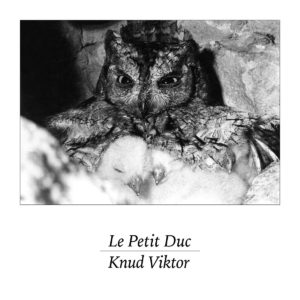
“Le Petit Duc”

Le Petit Duc' [The Little Scops Owl] is a sound work by Danish artist Knud Viktor, made between 1978 and 1983. Viktor was classically trained as a painter at The Royal Danish Academy of Fine Arts in the 1950’s. In 1961 he moved to France to live and work, but was overwhelmed by the sounds of the wildlife in Provence, and instead of painting began listening to and recording his surroundings. With these recordings, he composed what he called sound images – images sonores – and throughout the rest of his career, sound was his main medium.
12,50€
Read more

In stock

LP

Knud VIKTOR
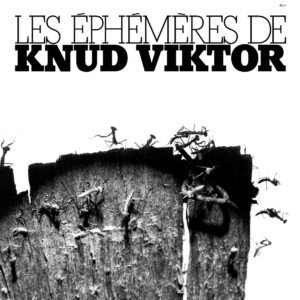
“Les Éphémères”

The lost masterpiece Les Éphémères by the self labeled ‘sound painter’ Knud Viktor (1924-2013) now sees its first ever release by Institute for Danish Sound Archaeology – 40 years after it was conceived. Viktor’s pioneering work – his Images Sonores – are composed of field recordings of insects, animals and his surroundings. His only earlier releases, the much sought-after Images and Ambiances from 1972, were re-issued by Institute for Danish Sound Archaeology in 2017 to great critical acclaim. A finished master tape and even a complete cover layout for Les Éphémères was found in Viktor’s archives after he passed away in 2013. The phenomenal piece was originally commissioned by the French radio station France Musique in 1977. The twenty short ‘sound images’ of Les Éphémères were originally broadcast as vignettes in-between other radio programs. Working with Allo la Terre, the association in charge of the estate of Knud Viktor, we at Institute for Danish Sound Archaeology are thrilled to finally be able to release this central and evocative work. From the middle of the 1970’s Viktor began composing almost exclusively for four channels. He invented his own intuitive quadraphonic mixer – the Tetramix – to realise his spatial visions for his Image VI – The Lubéron Symphony, and from then on worked with quadraphonic sound, thus making the release of his works difficult. Les Éphémères is close in time and also holds close ties to The Lubéron Symphony, which Viktor considered his magnum opus. Perhaps most strikingly is the shift in the way he uses the recordings of insects, birds and animals in both The Lubéron Symphony and Les Éphémères: Often untreated and clearly recognizable, the field recordings leave the inherent melody and rhythm of the animal sounds to sing for themselves, layering recordings to create simple and elegant sound images. In two of the twenty pieces Viktor’s own voice blends with the animals, as he recites two poems. One about the singing vineyard populated by musical crickets, the other painting an autumn picture with wine bubbling in the barrels as we hear the wine flies humming.
22,00€
Add to cart

In stock

2 LP

Knud VIKTOR
“Ambiances – Images”

*** New edition. Available before end january *** Re-issue of rare releases by Danish sound artist Knud Viktor. The Institute for Danish Sound Archaeology is re-issuing the Danish sound artist Knud Viktor’s only two releases. Ambiances and Images – both released in 1972 – are longtime sought-after rare collector’s items. These are now re-issued as a 2 LP from the original master tapes with liner notes by poet and sound artist Morten Søndergaard. Overlooked and unheard Danish sound art Knud Viktor (1924-2013) graduated from The Royal Danish Academy of Fine Arts in Copenhagen as a painter. In the 1960’s he moved to the Luberon valley in southern France to paint the Provençal light and nature. However, Viktor left the painting and gradually moved towards filming and recording the sounds of nature. He used the field recordings as raw material for a series of abstract electronic compositions, which also served as soundtracks for his filmworks. A selection of these compositions were released in 1972 on the two records Images and Ambiances on the French label L’Oiseau Musicien. The records came in very limited editions, and therefore Knud Viktor’s works have remained largely unknown. With the re-issue of these records The Institute for Danish Sound Archaeology wishes to revitalize Knud Viktor and his contribution to the history of sound art. The small sounds of nature Knud Viktor is recognized as an important figure in the field of sound art in France and he is regarded as a pioneer within field recording and acoustic ecology. During the 1970’s he turned his house in Provence into one large mixing desk with a myriad of homebuilt microphones and cables spiralling into the surrounding landscape. From here he would carefully record the sounds of snoring rabbits in their holes, the rhythmic songs of cicadas in the night – even termites gnawing through an old cupboard in the bedroom As the Danish poet Morten Søndergaard writes in the essay A Sonic Seismograph, which accompanies the release: “Light became sound. The most fascinating aspect of Knud Viktor’s world is perhaps that there is a universal coalescence of all things: of artistic expressions and natural science, of painting, sculpture and installation. A paintbrush becomes a microphone. Music becomes sound.” By re-issuing Ambiances and Images, The Institute for Danish Sound Archaeology hopes to contribute to a revitalization of Knud Viktor’s important work, and that more listeners will engage and lend the deserved attention to these works. The Institute for Danish Sound Archaeology is an independent association with the overall purpose of uncovering and releasing historical Danish electronic music and sound art.
29,00€
Add to cart


Catalogue


  • BACK IN STOCK
  • SALES

New arrivals :

In stock

4 CD

Cornelius CARDEW
“The Great Learning”

All seven Paragraphs of Cardew's The Great Learning by the Scratch Orchestra Strasbourg under Didier Aschour, an orchestra born from an open call and two years of shared practice: 4CD box with a 116-page booklet. 4CD box with a 116-page booklet. Shiiin's thirteenth release is a complete recording of Cornelius Cardew's The Great Learning, the seven Paragraphs written between 1968 and 1971 on the opening of the Ta Hio (Daxue, "the Great Learning"), the Confucian treatise on self-cultivation and the harmonious ordering of collective life, in Ezra Pound's translation. Mixing voices, instruments, objects and actions through graphic and verbal notation, the score prescribes relationships between the performers more than sounds, and shares out among them the responsibility for the form. The work is inseparable from the Scratch Orchestra, which Cardew founded in London in 1969 with Michael Parsons and Howard Skempton. The Scratch Orchestra Strasbourg grew out of an open call launched by the Musica festival in spring 2023, with no condition of level or background: amateurs and professionals, the self-taught and people with no previous practice. First gathered in September 2023, the group worked regularly under Didier Aschour, with members of the Dedalus ensemble and Strasbourg musicians versed in improvisation, graphic scores and open protocols passing on tools rather than imposing a reading. The aim was neither to reproduce a traditional orchestra nor to rebuild Cardew's, but to put his principle back into play: turning a diversity of skills into a shared resource. On 15 September 2024 the orchestra performed all seven Paragraphs in the Saint-Paul church in Strasbourg, a concert of nearly seven hours that opened the music programme of the 42nd Musica festival, in dialogue with Mode d'emploi, the exhibition of instruction-based works at the city's museum of modern and contemporary art. The group went on working on other pieces and came back to The Great Learning for this recording, made in the same church from 27 to 29 November 2025. What it fixes is an interpretation shaped by more than two years of common practice, not a line-up assembled for a single date, which brings it close to Cardew's own idea of the orchestra as a lasting space of practice, learning and collective change. Alongside Aschour play Lou Renaud-Bailly, Jeanne Barbieri, Stéphane Clor, Yannick Guédon, Jean-Philippe Gross and Thierry Madiot, with Jérémy Marchal on the church organ, the Pelicanto choir directed by Mathilde Mertz and the De-ci De-là choir directed by Cédric Dosch. Paragraphs 1 to 3 fill the first disc and Paragraph 4 the second; Paragraph 5 alone runs over an hour and a quarter on the third, and the fourth holds Paragraphs 6 and 7. The booklet opens with a text by Stéphane Roth and gathers two essays. Dean Inkster's, written for the 2009 Cardew exhibition at CAC Brétigny, places the work within the composer's aesthetic and political path and shows how the dispersal of the voices opens onto a shared freedom of listening rather than a fusion of the collective. Matthieu Saladin's, first published in Revue & Corrigée in 2020, examines the devices of each Paragraph as so many attempts to contain the relations of domination that form again within any group.
49,00€
Add to cart

In stock

2LP

Eliane RADIGUE
“Occam XIII, Occam River XI, Occam V”

Occam Ocean is a series of acoustic compositions made for and with individual instrumentalists by the late French composer Éliane Radigue. Extending the interactive process pioneered in Naldjorlak (2005–2009), Occam Ocean employs a scoreless method of composing in dialogue with each performer. Dating back to 2011, the series has proliferated almost organically, growing out of a musical and social dynamic of combinatoriality and multiplication to a catalog of more than eighty discrete compositions. This body of work stands as one of the most extraordinary late-career outpourings in recent music history. The Occam series was catalyzed in part by a visit to the Natural History Museum in Los Angeles, where Radigue encountered a depiction of the electromagnetic spectrum—from radio signals to gamma rays—which impressed upon her the minuscule range of human hearing relative to the seemingly unlimited compass of universal wavelength and frequency. The Occam compositions seem to address this vertiginous confrontation with the infinite; each individual composition elaborates a radically reduced technique or sound process, frequently working outward from only a handful of fundamental tones, to expose the flickering, idiosyncratic spectral behavior of the instrument. The reference to William of Ockham indicates a principled commitment to parsimony; paradoxically, the reduction in material content makes possible an incommensurate richness in perceived acoustical detail. Notable in the Occam series is the inextricable identification of the composition with the performer for whom, and with whom, it was made. The particular sounds and techniques of each individual performer are thus indelibly stamped in the composition; the piece composes the playing of that musician, as much as the musician plays the composition. The time-honored division of labor between performer and composer is thus suspended and reconfigured, proposing a model for new music composition that has not yet been fully theorized or understood. Occam XIII, Occam River XI (presented here in two distinct readings, which reveal subtle variations in instrumental response), and Occam V feature two longtime collaborators of Radigue in solo and duo formations. Charles Curtis, the first instrumentalist for whom Radigue wrote an acoustic composition (Naldjorlak), performs on cello, while Dafne Vicente-Sandoval—whose parallel investigations into her instrument’s complex sounding properties led her to collaborate with Radigue—performs on bassoon. The works were recorded at Temple Saint-Théodule, La Tour-de-Peilz, Switzerland, during a 2024 residency at La Becque, a setting previously explored by the musicians for its distinctive acoustic properties.
45,00€
Add to cart

Out of stock

CD

Eliane RADIGUE
“Occam XIII, Occam River XI, Occam V”

Occam Ocean is a series of acoustic compositions made for and with individual instrumentalists by the late French composer Éliane Radigue. Extending the interactive process pioneered in Naldjorlak (2005–2009), Occam Ocean employs a scoreless method of composing in dialogue with each performer. Dating back to 2011, the series has proliferated almost organically, growing out of a musical and social dynamic of combinatoriality and multiplication to a catalog of more than eighty discrete compositions. This body of work stands as one of the most extraordinary late-career outpourings in recent music history. The Occam series was catalyzed in part by a visit to the Natural History Museum in Los Angeles, where Radigue encountered a depiction of the electromagnetic spectrum—from radio signals to gamma rays—which impressed upon her the minuscule range of human hearing relative to the seemingly unlimited compass of universal wavelength and frequency. The Occam compositions seem to address this vertiginous confrontation with the infinite; each individual composition elaborates a radically reduced technique or sound process, frequently working outward from only a handful of fundamental tones, to expose the flickering, idiosyncratic spectral behavior of the instrument. The reference to William of Ockham indicates a principled commitment to parsimony; paradoxically, the reduction in material content makes possible an incommensurate richness in perceived acoustical detail. Notable in the Occam series is the inextricable identification of the composition with the performer for whom, and with whom, it was made. The particular sounds and techniques of each individual performer are thus indelibly stamped in the composition; the piece composes the playing of that musician, as much as the musician plays the composition. The time-honored division of labor between performer and composer is thus suspended and reconfigured, proposing a model for new music composition that has not yet been fully theorized or understood. Occam XIII, Occam River XI (presented here in two distinct readings, which reveal subtle variations in instrumental response), and Occam V feature two longtime collaborators of Radigue in solo and duo formations. Charles Curtis, the first instrumentalist for whom Radigue wrote an acoustic composition (Naldjorlak), performs on cello, while Dafne Vicente-Sandoval—whose parallel investigations into her instrument’s complex sounding properties led her to collaborate with Radigue—performs on bassoon. The works were recorded at Temple Saint-Théodule, La Tour-de-Peilz, Switzerland, during a 2024 residency at La Becque, a setting previously explored by the musicians for its distinctive acoustic properties.
23,00€
Read more

In stock

CD

David GRANSTRÖM
“Echoes of Impermanence”

Echoes of Impermanence sees David Granström’s previously established strict hermetic minimalist musical topography undergo a major shift with the introduction of the electric guitar, which instigates a breaking of the sealed crystal walls of the composer’s previous work within music of long duration and precise digital synthesis, bringing forth a riff-laden spirit previously lingering below the surface. The album was recorded at the world-renowned Elektronmusikstudion EMS as well as in the composer’s own studio with the help of Mats Erlandsson and features a guest appearance by long-time collaborator and XKatedral co-founder Maria W Horn performing on the Hurdy-Gurdy on the title track. David Granström is a composer and musician from Umeå in the northern part of Sweden. His hometown is a stronghold of extreme musical expression and consequently Granström grew up playing guitar in a metal band and started to compose music within that context which eventually evolved into solo projects, having access to studio facilities adjacent to the rehearsal space. Granström initially found his personal musical voice within the context of electroacoustic composition utilizing his advanced programming ability to manifest a sound and formal structure governed by algorithmic processes. The resulting musical work is characterized by harmonic simplicity and spatiotextural complexity, employing sounds of synthetic and acoustic origin in combination with strict digital synthesis techniques.
17,00€
Add to cart

In stock

CD

William BASINSKI
“Passing the Cup of Sorrows”

In the realm of past-life regression hypnotherapy, there is a concept known as “Life Between Lives,” wherein a sacred exchange of energy occurs between two souls in the spirt world, helping a spirit fully understand and forgive a being who hurt them in a past life. This exchange – called “passing the cup of sorrows” – became the unexpected inspiration for William Basinski’s first new album in six years. While sinking deeper into the daily abyss of our collective negativity bias, William Basinski stumbled upon a video describing the spiritual hypnotherapy exercise known as “passing the cup of sorrows.” Fixed on the glow of a screen that projected mounting anxiety and cynicism at a seemingly interminable pace, Basinski found the testimonials of this fascinating therapeutic practice to be profoundly moving. He sat at his piano, translating the transformation of those traumatic memories of past lives into cathartic tears of the present day. Channeling the quiet curiosity and asymmetrical patterns of pioneering 20th Century composer, Morton Feldman, Passing the Cup of Sorrows is a single 40-minute piece that employs a solitary piano and subtle electronics to truly haunting effect. It recalls fragments of traumatic memories and projects them as fractals in a slow-moving soft focus that’s as eerie as it is enlightened.
15,50€
Add to cart

In stock

LP

Oren AMBARCHI
“Cooked”

With Cooked, Oren Ambarchi takes his adventurous sonic universe into gloriously unpredictable territory. Bringing together an extraordinary cast of international collaborators, including Eiko Ishibashi, Jim O’Rourke, Joe Talia and members of his Ghosted trio, the album unfolds across two expansive, side-long compositions. Blending hypnotic grooves, shimmering guitars, intricate electronics, jazz-inflected rhythms and surreal sonic detours, Cooked moves effortlessly between delicate atmospheres and exuberant experimentation. Meticulously constructed yet remarkably spontaneous, it reveals Ambarchi at his most playful, inventive and delightfully unpredictable. A dazzling journey through the outer limits of contemporary experimental music. Oren Ambarchi - Guitars and whatnot Hidden Tableau: Johan Berthling - Double bass Eiko Ishibashi - Piano Jim O'Rourke - Synth Konrad Sprenger - Voice synthesis, electronics & production Joe Talia - Drums Sleight of Hand: Johan Berthling - Double Bass Will Guthrie - Gamelan & drums Isak Hedtjärn - Whistling Michiko Ogawa - Shō Marcus Pal - Synthetic Sound Fredrik Rasten - Guitars James Rushford - Celeste, piano & portative organ Andreas Werliin - Drums
30,00€
Add to cart

CORTICALART

Mail-order and distribution of experimental music (electroacoustic, improvised music, sound-art, noise, sound poetry), past or present, along with some books, magazines and DVDs.

NEWSLETTER

INFORMATIONS

  • Contact
  • My Account
  • Shipping

CORTICALART / Ass. META
44, rue Camille Sauvageau
33800 Bordeaux
France

© Corticalart 2026    • Terms Of Use    • Legal Notice    • Privacy Policy

• CGV    • Mentions légales    • Politique de confidentialité