
In stock
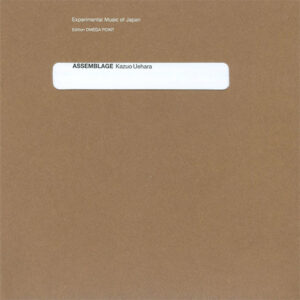
CD
Kazuo UEHARA
“Assemblage”
Experimental Music of Japan vol.8. “Music Collage Re-Mix version” (1989-2010), “Pont de l’Alma de Paris” (1998), “OTO Mandala 2” (2009), “Sound Work 1” (1983), “Forest of Gombe” (2005), “Assemblage 2004” (2004), “Meteora version 1.0” (2007). Assemblage is a word from domain of modern art. This is the one of the technique of expression of art. The word means mixture originally. I decide the assemblage as a concept of this CD. The collage by Picasso is similar example. Dadaism is also similar example. I try to express new direction of music by using assemblage technique. Profile of artist : Kazuo Uehara was born in Osaka in 1949. He studied composition in Tokyo and in New York. He is an Professor of Music at the Osaka University of Arts. He gives courses on composition, experimental music and also multi-media performance at the university. His music has been performed in France, Germany, U.S.A., and other countries. He also performed his interactive live music and multi-media pieces at major festivals in Sweden, Bulgalia, Russia, France, Poland, Brasil, China, Korea and other countries. He is the prize winner of Bourge International Electro-acoustic Music competition. In 1990, he was awarded the grant from the New York State Council on the Arts. He had been producing the International Festival for Contemporary Music in Japan from1980s.
17,00€
Out of stock

CD
Kazuo UEHARA
“Early works” – Obscure Tape Music of Japan vol.16
“Seoul” (1982). This piece was composed using the recorded sounds as raw material. It was to reassemble the “historical” soundscape of the Korea’s capital city, Seoul, in the early 1980s. During this time, despite the political chaos and the tension in the city under the Korean military government, I felt the lively energy in its people’s life. The raw material comprised of wide range of different sounds includes the street cries in the downtown, cheerful voices of children in Namsang area, noise of arterial streets, and conversations of the students at the Seoul National University. “Music for Contemporary Dance - dedicate to Takao Kusuno” (1975). In 1970s, the art space “Jean-Jean“ in Shibuya served as a popular venue for experimental music, theatre, dance and others. In this movement, I did collaboration works with Takao Kusuno who performed as the artist and dance director. This piece for the dance was composed in collaboration with Kusuno to explore new approaches for dance. The work has two consecutive parts with the subtitles “Crows Habit” and “I am a Clown”. It was not merely a contemporary dance, nor Butoh, but it indicated the contemporary room for the dance scene of the time. “Science Technology Expo ’85 - Music for Cell Universe” (1985). The piece was specially composed for the Health and Sports Pavilion “Cell Universe“ at the International Exposition, Tsukuba, Japan, 1985. The space was comprised of twenty-seven-multiscreen film and stereophonic space. The uniquely designed space controller, the system for moving sound image, made it possible to control the electronic acoustic sound image to create virtual 3D space. “Homage to Xenakis” (1983). This piece was composed at a UPIC workshop held in Tokyo in 1980s where the composer Iannis Xenakis made remarks on each presented work. The musical composition tool, UPIC, was created by Xenakis. This unique sound synthesis system allows the user to create music by drawing lines on the board. Xenakis originally envisaged this tool to be used for pedagogical purpose. Other than musicians, the workshop drew participants from children to adults from the public. - from liner note by artist.
18,00€
Out of stock
CD
Kazuo UEHARA
“Event’ 73” – Obscure Tape Music of Japan vol.15
“From 1972 to 1973, I was based in New York for my creative activities and live performances. New York at this time was in its golden age of experimental music. Towards the end of my stay, I held a live performance entitled Event ’73 to sum up my creative works in New York. The venue for the performance was The Kitchen of the Mercer Arts Center that provided spaces for innovative and emerging artists. This CD consists of a mixture of sounds that were created at a studio prior to the live performance and the sounds recorded live at the performance. I used the Buckla Synthesizer for electronic sound and also for transformation of the sound. The work has four different segments: 1) Diffusion 2) Condensation 3) Chaos 4) Revolution. Each segment’s meanings and sounds itself doesn’t necessarily correlate to each other. Yet, the images that are evoked by each word express the chaotic world of the day.“”
17,50€