
In stock

LP
Kali MALONE
“Burning Song”
With Burning Song, Kali Malone unveils her first album of new solo compositions since All Life Long (2024), embracing a more intuitive and direct approach to her distinctive exploration of microtonal harmony.
Recorded in Leipzig’s historic Thomaskirche, where J.S. Bach spent the final decades of his life, the album brings together Malone on organ, Lucy Railton on cello and Stephen O’Malley on bowed acoustic guitar. Slowly unfolding chords and subtle harmonic shifts create a deeply immersive sound world, moving between ambiguity and radiance, melancholy and quiet transcendence.
Moving away from the strict structures of her earlier work, Malone allows emotion and intuition to guide the music’s gradual transformations. A meditation on change, continuity and renewal, Burning Song reveals a new sense of freedom, where sound becomes a space for tenderness, reflection and possibility.
29,50€
In stock
CD
Kali MALONE
“Burning Song”
With Burning Song, Kali Malone unveils her first album of new solo compositions since All Life Long (2024), embracing a more intuitive and direct approach to her distinctive exploration of microtonal harmony.
Recorded in Leipzig’s historic Thomaskirche, where J.S. Bach spent the final decades of his life, the album brings together Malone on organ, Lucy Railton on cello and Stephen O’Malley on bowed acoustic guitar. Slowly unfolding chords and subtle harmonic shifts create a deeply immersive sound world, moving between ambiguity and radiance, melancholy and quiet transcendence.
Moving away from the strict structures of her earlier work, Malone allows emotion and intuition to guide the music’s gradual transformations. A meditation on change, continuity and renewal, Burning Song reveals a new sense of freedom, where sound becomes a space for tenderness, reflection and possibility.
18,50€
In stock

2 LP
Kali MALONE
“The Sacrificial Code (2025 edition)”
Kali Malone’s landmark album The Sacrificial Code emerged from a momentous confluence of dedication and inspiration. In 2019, Malone was finishing a master's thesis in electroacoustic composition at The Royal College of Music in Stockholm, having spent several years studying how sound and space interact, both academically and as a part of Sweden’s underground music community. An apprenticeship with the organ tuner Jan Börjeson opened up the instrument’s history as a laboratory for the development of various tuning systems, resonating with her interest in the sublime, uncanny soundworlds that exist beyond equal temperament. Countless hours were spent imagining new ways to conceptualize archaic compositional forms like canons, embracing their limitations as a way to peel away dramatic flourishes so only a stark core remains. A vision of music began to crystalize that was instilled with koan-like dualities of restraint and spectacle, stasis and variation, intimacy and grandeur.
Six years after its initial release, Ideologic Organ has reissued The Sacrificial Code, adorned with striking archival organ photography by Malone and including a new arrangement of the titular composition recorded in 2023 on the 16th-century meantone organ at Malmö Konstmuseum. The album remains one of the defining works of 21st-century minimalism, singular in its approach and impact. Its legacy has been defined by the revelatory experiences of those who encountered it, passed from listener to listener by word of mouth. The intensely personal experience of taking in these sounds, sitting with them for over an hour, absorbing each chordal shift in countless repetitions and finding oneself within them, became the driver of its slow cultural saturation. As she began regularly performing these pieces in churches and concert halls around the world, their impact deepened.
To produce the reissue, Malone went so far as to return to the copy machine at the legendary EMS studios in Stockholm to lay out the typography, revisiting the physical spaces in which it was created and remaining faithful to its DIY roots. The album’s first three pieces - “Spectacle of Ritual,” “Sacrificial Code,” and “Rose Wreath Crown (for CW)” - were captured voice by voice, each in single takes, on the Mats Arvidsson organ in Kirnberger III temperament as a part of her thesis. They were realized in isolation, and were originally presented as electroacoustic works on multi-channel speaker arrays in acousmoniums, speaker domes, and an abandoned iron mine. “Sacer Profanare,” “Litanic Cloth Wrung,” and “Fifth Worship II” were all recorded within two-hours of borrowed studio time on the Woehl organ at Studio Acusticum in Piteå; their patient and deliberate nature cutting through the hasty timeline of their capture. With each, Malone was developing and deploying self-taught close micing techniques to reproduce the most granular, air-filled sound of the instrument, bringing the listener into its stoically heaving guts.
The effect of all this careful work is a sense of time dilation, the physicality of the sound itself - the thunderous rolls of bass, the pitched hiss of the flue, the quivering dance of air molecules animated by dissonance - drawing attention away from the clock. Each piece cycles through purposefully constructed chord progressions, the repetition creating moments that can feel anthemic or mournful depending on the harmonic resonance and duration of the piece. These reiterations become so steady and expected that at the end of “Fifth Worship II,” when Malone switches off the organ mid-stream and the harmonics wither and fall, it feels like the ground slips away from under us. Repetition becomes the magnetic force shaping and stabilizing space and time.
Recurrence has also been a hallmark of Malone’s work on a larger scale, as evidenced by the third, new iteration of “Sacrificial Code” included on this reissue. She frequently returns to compositions, including multiple versions across various releases (“Fifth Worship” was originally heard on Organ Dirges 2016-2017, an experimental precursor to The Sacrificial Code), and they often change as they are performed over successive years and on different organs. Recorded five years after the two versions originally included on the album, “Sacrificial Code III” is absent the sense of sorrowful gravity heard in the previous versions, replaced by a sense of relative tranquility and performed in a higher register - an expressive shift that naturally occurred through years of repeated live performances. As The Sacrificial Code resurfaces, it retains its power but feels rejuvenated in this new context, inevitably changed by the years between then and now. Like any highly personal work, how those changes manifest depend on the listener, how they meet the sounds, and how those years have changed them in return.
–Jonathan Williger, February 2025
37,00€
In stock
CD
Kali MALONE
“The Sacrificial Code (2025 edition)”
Kali Malone’s landmark album The Sacrificial Code emerged from a momentous confluence of dedication and inspiration. In 2019, Malone was finishing a master's thesis in electroacoustic composition at The Royal College of Music in Stockholm, having spent several years studying how sound and space interact, both academically and as a part of Sweden’s underground music community. An apprenticeship with the organ tuner Jan Börjeson opened up the instrument’s history as a laboratory for the development of various tuning systems, resonating with her interest in the sublime, uncanny soundworlds that exist beyond equal temperament. Countless hours were spent imagining new ways to conceptualize archaic compositional forms like canons, embracing their limitations as a way to peel away dramatic flourishes so only a stark core remains. A vision of music began to crystalize that was instilled with koan-like dualities of restraint and spectacle, stasis and variation, intimacy and grandeur.
Six years after its initial release, Ideologic Organ has reissued The Sacrificial Code, adorned with striking archival organ photography by Malone and including a new arrangement of the titular composition recorded in 2023 on the 16th-century meantone organ at Malmö Konstmuseum. The album remains one of the defining works of 21st-century minimalism, singular in its approach and impact. Its legacy has been defined by the revelatory experiences of those who encountered it, passed from listener to listener by word of mouth. The intensely personal experience of taking in these sounds, sitting with them for over an hour, absorbing each chordal shift in countless repetitions and finding oneself within them, became the driver of its slow cultural saturation. As she began regularly performing these pieces in churches and concert halls around the world, their impact deepened.
To produce the reissue, Malone went so far as to return to the copy machine at the legendary EMS studios in Stockholm to lay out the typography, revisiting the physical spaces in which it was created and remaining faithful to its DIY roots. The album’s first three pieces - “Spectacle of Ritual,” “Sacrificial Code,” and “Rose Wreath Crown (for CW)” - were captured voice by voice, each in single takes, on the Mats Arvidsson organ in Kirnberger III temperament as a part of her thesis. They were realized in isolation, and were originally presented as electroacoustic works on multi-channel speaker arrays in acousmoniums, speaker domes, and an abandoned iron mine. “Sacer Profanare,” “Litanic Cloth Wrung,” and “Fifth Worship II” were all recorded within two-hours of borrowed studio time on the Woehl organ at Studio Acusticum in Piteå; their patient and deliberate nature cutting through the hasty timeline of their capture. With each, Malone was developing and deploying self-taught close micing techniques to reproduce the most granular, air-filled sound of the instrument, bringing the listener into its stoically heaving guts.
The effect of all this careful work is a sense of time dilation, the physicality of the sound itself - the thunderous rolls of bass, the pitched hiss of the flue, the quivering dance of air molecules animated by dissonance - drawing attention away from the clock. Each piece cycles through purposefully constructed chord progressions, the repetition creating moments that can feel anthemic or mournful depending on the harmonic resonance and duration of the piece. These reiterations become so steady and expected that at the end of “Fifth Worship II,” when Malone switches off the organ mid-stream and the harmonics wither and fall, it feels like the ground slips away from under us. Repetition becomes the magnetic force shaping and stabilizing space and time.
Recurrence has also been a hallmark of Malone’s work on a larger scale, as evidenced by the third, new iteration of “Sacrificial Code” included on this reissue. She frequently returns to compositions, including multiple versions across various releases (“Fifth Worship” was originally heard on Organ Dirges 2016-2017, an experimental precursor to The Sacrificial Code), and they often change as they are performed over successive years and on different organs. Recorded five years after the two versions originally included on the album, “Sacrificial Code III” is absent the sense of sorrowful gravity heard in the previous versions, replaced by a sense of relative tranquility and performed in a higher register - an expressive shift that naturally occurred through years of repeated live performances. As The Sacrificial Code resurfaces, it retains its power but feels rejuvenated in this new context, inevitably changed by the years between then and now. Like any highly personal work, how those changes manifest depend on the listener, how they meet the sounds, and how those years have changed them in return.
–Jonathan Williger, February 2025
17,50€
Out of stock

LP
Kali MALONE
“Living Torch”
2023 repress.
Living Torch, through its unique structural form and harmonic material, is a bold continuation of Kali Malone’s demanding and exciting body of work, while opening new perspectives and increasing the emotional potential of the music tenfold. As such, Living Torch is a major new piece by the composer and adds a significant milestone to an already fascinating repertoire.
Departing from the pipe organ that Malone’s music is most notable for, Living Torch features a complex electroacoustic ensemble. Leafing through recordings from conventional instruments like the trombone and bass clarinet to more experimental machines like the boîte à bourdon, passing through sinewave generators and Éliane Radigue’s ARP 2500 synthesizer. Living Torch weaves its own history, its own genealogy, and that of its author. It extends her robust structural approach to a liberated palette of timbre.
Living Torch was initially commissioned by GRM for its legendary loudspeaker orchestra, the Acousmonium, and premiered in its complete multichannel form at the Grand Auditorium of Radio France in a concert entirely dedicated to the artist.
Composed at GRM studios in Paris between 2020-2021, Living Torch is a work of great intensity, an oeuvre-monde that is singularly placed at the crossroads of instrumental writing and electroacoustic composition. Living Torch proceeds from multiple lineages, including early modern music, American minimalism, and musique concrète. It’s a work as much turned towards exploring justly tuned harmony and canonic structures as towards the polyphony of unique timbres, the scaling of dynamic range, and the revelation of sound qualities.
GRM (Groupe de Recherches Musicales), the pioneering institution of electroacoustic, acousmatic, and musique concrète, has been a unique laboratory for sonorous research since 1958. Witnessing the extreme vitality of the music championed by GRM, the Portraits GRM record series extends and expands this momentum with Kali Malone’s Living Torch.
The French label-partner Shelter Press is proud to continue the collaboration with GRM, which Peter Rehberg of Editions MEGO set the foundation for in 2012.
Composed & Produced by Kali Malone at INA GRM 2020-2021
Trombone & Bass Clarinet recorded at EMS Elektronmusikstudion 2020
Pre-mastered by Emmanuel Richier at INA GRM
Mastered by Stephan Mathieu at Schwebung Mastering
Cut by Andreas Kauffelt at Schnittstelle, Berlin.
Photograph by Estelle Hanania
Painting by Ross Caliendo
Sleeve design by Stephen O’Malley
Trombone: Mats Äleklint
Bass Clarinet: Isak Hedtjärn
ARP 2500, Modular Synthesis, Pura Data & Boîte à Bourdons: Kali Malone
21,50€
Out of stock
LP
Kali MALONE
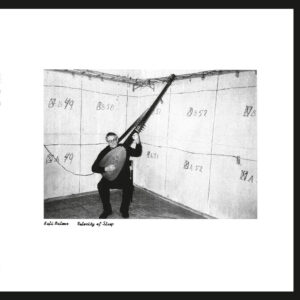
“Velocity of Sleep”
Composed, recorded and produced in Stockholm 2015-2016, ‘Velocity of Sleep’ sees Kali Malone’s work rendered in a septet of strings, gongs, lute, electronics and tape in the vast R1 Reaktorhallen (Sweden’s first nuclear reactor), the electroacoustic studio EMS, and at the Royal College of Music in Stockholm. Her presence is crucial, and liminal, making precise use of tuned sine waves and Studer B67 tape manipulation, while instrumental performance is handled by Peter Söderberg performing on the long-necked Theorbo (a large baroque lute, pictured on the sleeve), Samuel Löfdahl and Oskar Mattsson on Gongs, Vilhelm Bromander on Double Bass, Marta Forsberg on Viola and Adam Grauman on Viola de Gamba - all uniting to produce what feels like a geological time lapse and distillation of European and Indian classical drone musicks.
As far as opening solo statements go, ‘Velocity of Sleep’ is among the most memorable to have emerged this past decade from slow music and experimental classical paradigms. Its languorous yet rigorous consolidation of ideas from across the aeons crosses paths with others before her - the musics of Pauline Oliveros, Phill Niblock, Harley Gaber, Oren Ambarchi all spring to mind - but more importantly helped reset the limits of contemporary music in Malone’s own image. The 3-part, 43 minute work is an ideal example of how staid notions of early and classical music have been jettisoned to instead focus on fundamentals of tone, timbre, tuning, space and temporality with a radical and transfixing effect coolly detached from any directly traditional/sacred meanings.
Peter Söderberg’s justly tuned Theorbo plucks a slowly evolving additive pattern expanded by frippertronic tape delays on the 20 minute title piece, setting a stark tone for a quietly breathtaking resonance of gongs and floating sine waves in ‘1113’ that rest right on the biting point of sublime dissonance, while ‘In Light of Marwa’ pitches into a sort of raga-folk-drone tuned with the fine, durational intensity recalling Harley Gaber’s ‘The Winds Rise In The North’ and earthy cadence of Pauline Oliveros’ vision, yet somehow concentrated, refreshed in a way that’s best felt, and quite impossible to describe.
30,00€
Out of stock
CD
Kali MALONE
“Living Torch”
Living Torch, through its unique structural form and harmonic material, is a bold continuation of Kali Malone’s demanding and exciting body of work, while opening new perspectives and increasing the emotional potential of the music tenfold. As such, Living Torch is a major new piece by the composer and adds a significant milestone to an already fascinating repertoire.
Departing from the pipe organ that Malone’s music is most notable for, Living Torch features a complex electroacoustic ensemble. Leafing through recordings from conventional instruments like the trombone and bass clarinet to more experimental machines like the boîte à bourdon, passing through sinewave generators and Éliane Radigue’s ARP 2500 synthesizer. Living Torch weaves its own history, its own genealogy, and that of its author. It extends her robust structural approach to a liberated palette of timbre.
Living Torch was initially commissioned by GRM for its legendary loudspeaker orchestra, the Acousmonium, and premiered in its complete multichannel form at the Grand Auditorium of Radio France in a concert entirely dedicated to the artist.
Composed at GRM studios in Paris between 2020-2021, Living Torch is a work of great intensity, an oeuvre-monde that is singularly placed at the crossroads of instrumental writing and electroacoustic composition. Living Torch proceeds from multiple lineages, including early modern music, American minimalism, and musique concrète. It’s a work as much turned towards exploring justly tuned harmony and canonic structures as towards the polyphony of unique timbres, the scaling of dynamic range, and the revelation of sound qualities.
GRM (Groupe de Recherches Musicales), the pioneering institution of electroacoustic, acousmatic, and musique concrète, has been a unique laboratory for sonorous research since 1958. Witnessing the extreme vitality of the music championed by GRM, the Portraits GRM record series extends and expands this momentum with Kali Malone’s Living Torch.
The French label-partner Shelter Press is proud to continue the collaboration with GRM, which Peter Rehberg of Editions MEGO set the foundation for in 2012.
Composed & Produced by Kali Malone at INA GRM 2020-2021
Trombone & Bass Clarinet recorded at EMS Elektronmusikstudion 2020
Pre-mastered by Emmanuel Richier at INA GRM
Mastered by Stephan Mathieu at Schwebung Mastering
Cut by Andreas Kauffelt at Schnittstelle, Berlin.
Photograph by Estelle Hanania
Painting by Ross Caliendo
Sleeve design by Stephen O’Malley
Trombone: Mats Äleklint
Bass Clarinet: Isak Hedtjärn
ARP 2500, Modular Synthesis, Pura Data & Boîte à Bourdons: Kali Malone
15,50€
Out of stock

3 CD
Kali MALONE
“The Sacrificial Code”
*** Repress ***
Kali Malone presents a quietly subversive new album featuring almost two hours of concentrated, creeping organ pieces governed by a strict acoustic and compositional code. It’s a major new work with ultimately profound emotional resonance.
‘The Sacrificial Code’ takes a more detailed approach to ideas first sketched out on last year’s ‘Organ Dirges’, which featured canon exercises spontaneously captured without much prior technical planning. By contrast, the recording of ‘The Sacrificial Code’ involved the more careful micing up of several organs in such a way as to eliminate acoustic impurities as far as possible - essentially removing the large hall reverb so inextricably linked to the instrument. The pieces were then performed free of gestural adornments and without expressive impulse - an approach that flows against the grain of the prevailing musical hegemony, where sound is so often manipulated, and composition often steeped in self indulgence. The question posed; can this strict methodology still speak to the listener in meaningful terms?
The answer is both obvious and entirely surprising; with its slow, purified and seemingly austere qualities ‘The Sacrificial Code’ guides us through an almost trance-inducing process where we become vulnerable receptors for every slight movement, where every miniature shift in sound becomes magnified through stillness.
As such, it’s a uniquely satisfying exercise in transcendence through self restraint - a stunning realisation of ideas borne out of academic and conceptual rigour which gradually reveals startling personal dimensions. It has a perception-altering quality that encourages self exploration free of signposts and without a preordained endpoint - the antithesis to the language of colourless musical platitudes weíve become so accustomed to.
25,00€
Out of stock
2 LP
Kali MALONE
“The Sacrificial Code”
Kali Malone presents a quietly subversive new album featuring almost two hours of concentrated, creeping organ pieces governed by a strict acoustic and compositional code. It’s a major new work with ultimately profound emotional resonance.
‘The Sacrificial Code’ takes a more detailed approach to ideas first sketched out on last year’s ‘Organ Dirges’, which featured canon exercises spontaneously captured without much prior technical planning. By contrast, the recording of ‘The Sacrificial Code’ involved the more careful micing up of several organs in such a way as to eliminate acoustic impurities as far as possible – essentially removing the large hall reverb so inextricably linked to the instrument. The pieces were then performed free of gestural adornments and without expressive impulse – an approach that flows against the grain of the prevailing musical hegemony, where sound is so often manipulated, and composition often steeped in self indulgence. The question posed; can this strict methodology still speak to the listener in meaningful terms?
The answer is both obvious and entirely surprising; with its slow, purified and seemingly austere qualities ‘The Sacrificial Code’ guides us through an almost trance-inducing process where we become vulnerable receptors for every slight movement, where every miniature shift in sound becomes magnified through stillness.
As such, it’s a uniquely satisfying exercise in transcendence through self restraint – a stunning realisation of ideas borne out of academic and conceptual rigour which gradually reveals startling personal dimensions. It has a perception-altering quality that encourages self exploration free of signposts and without a preordained endpoint – the antithesis to the language of colourless musical platitudes weíve become so accustomed to.
Limited 2LP repress.
34,50€