
In stock

LP
Horacio VAGGIONE
“Schall / Rechant”
A discreet but essential figure in the field of musical creation, Horacio Vaggione has been crafting an ambitious, precise and highly significant body of work for over the last fifty years, coupled with a demanding research activity. This disc offers four purely electroacoustic pieces which illustrate, each in their own way, this singular and fascinating grammar developed by Horacio Vaggione, a complex but fertile grammar which establishes a very special relationship between structure and texture, between matter and formula, to create a fascinating musical space, made up of polyphonies and metamorphoses. (François Bonnet, Paris, 2022)
--
«Schall» (1994), 07’30
Schall exclusively uses piano sounds sampled and processed with various digital techniques. The sound palette focuses on several shapes of various sizes which reiterate, altered to varying degrees, throughout the process. The granular paradigm is clearly assumed here, as is also that of the interactions between various temporal scales. Basically, there is a concern for the articulation of micro-events. The piece essentially plays with low-intensity frames, composed of various planes and punctuated by stronger objects, in a kind of polyphonic dialogue between proximity and distance. (H. V.)
«Rechant» (1995), 15’51
Initially, a few brief sounds of instrumental origin — percussions, flutes, strings. Processed by means of various digital techniques, projected on various temporal scales, analyzed and re-synthesized, worked in their parts (in their saliences), articulated in their edges as well as in their interactions, these sounds show, as Bachelard would say, «pluralism under identity». I thus tried to compose morphologies by targeting properties contained in the material and by projecting them on temporal perspectives of all sizes. The title, an allusion to the old polyphonic technique, refers to the iterative content of these morphologies as well as to the modalities of their interweaving. (H. V.)
«24 Variations» (2001), 09’50
The word «variations» applies here to the morphological transformations of the material, as well as to the various contexts in which these transformations appear. The result can be heard as a continuous interaction between sound particles of different sizes, composed of several layers, reflecting a preoccupation with detailed articulation spanning different time scales. (H. V.)
«Gymel» (2002), 09’25
In Gymel I tried to compose a space-trajectory using layered sounds, produced by morphological operations (splits, clusterings) that spread out from location to location in variously dense objects. The space was treated through phase-decorrelation, a technique which I use extensively, both to create spaces and to locate sounds and movements within a polyphonic (stratified) context. (H. V.)
26,00€
Out of stock
LP
Horacio VAGGIONE
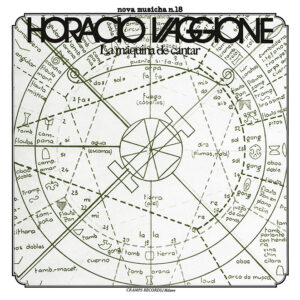
“La Maquina de Cantar”
At long last, after remaining out of print for decades, the Milan based imprint, Dialogo, dives into the legendary catalog of Cramps, bringing forth the first ever vinyl reissue of Horacio Vaggione’s LP, "La Maquina de Cantar", issued as the 18th instalment of the label’s Nova Musicha series in 1978 and among the most important examples of Latin American experimental music from the 1970s. Engrossing and creatively riveting, heard more than 40 years on its rippling electronic tones recast the terms of minimal music and shatter the historic perceptions of these sounds.
Edition of 300 LP on black vinyl. Audiophile pressing, including printed inner. Perfect replica of the original packaging and newly remastered for optimal sound.
Horacio Vaggione was born in Cordoba (Argentina) in 1943. He co-founded, in 1965, the Centro de Música Experimental de la Universidad de Cordoba, Argentina.
In 1966, he was awarded a Fullbright scholarship that allowed him to travel through the USA, where he visited several electronic music studios (Columbia, Illinois, California) and met John Cage. From 1969 to 1972, while living in Madrid, he belonged to a “live” electronic music group with Eduardo Polonio and Luis de Pablo. He was also in charge of the ALEA group’s electronic music studio.
In 1973, he visited the Far East. In 1974/75 he toured in the USA and Europe, more precisely with E. Wiener and the Kevan Cleary and Dance Company, while he was working in various electronic music studios (New York, Oakland, Montreal and Paris).
La Maquina de Cantar was produced in 1971, using the IBM 7090 computer owned by the data processing centre of the University of Madrid. Sound synthesis was carried out by a team under the technical advice of Florentino Briones, director of the centre.
The complete system is a “hybrid”, as it is made up of digital and analogue operations. To begin, the composer writes his “score” in musical notation and then transcribes it into decimal numerical notation. This numerical notation is then transcribed into the machine’s language, in the form of punch cards; in this way, the computer receives all the data that it has to process and translate into sound. At the same time, the POPOVA program, which supports all the operations, is also launched. The sound is produced in the central unit of the IBM 7090, via high-speed magnetisation changes. So, the sound values will be expressed in the form of the number of magnetisation changes (bits). Once the sound and its envelope have been generated through this digital process, the next step is to send this information to an analogue section, consisting of a series of filters, a VCO (voltage-controlled oscillator), and an echo chamber.
Contrastingly, Ending is a work for live electronic keyboards. In this version, three Minimoog synthesisers (played by the composer) and a Yamaha organ (played by E. Wiener) were used. The work is dedicated to Robert Ashley.
26,00€
Out of stock

CD
Horacio VAGGIONE
“Points critiques”
Argentinian composer living and working in Paris since 1978. Horacio Vaggione was an incredible user of tape machine. Even if he’s working now with digital tools, you can remember it. Five pieces working on ideas of acoustic transformations. “Points critiques” (2011), “Arenas” (2007), “Nodal” (1997), “Ash” (1991), “Phases” (2001).
15,00€
Out of stock
CD
Horacio VAGGIONE
“Fluides”
“Mécanique des fluides” (2014-15). “PianoHertz” (2012). “Consort for Convolved Violins” (2011). “Préludes suspendus III” (2009, 10). “Fractal C” (1983-84).
Horacio Vaggione has been integrating computers to his approach to composition since the 1970s. His body of work includes electroacoustic pieces, mixed pieces, and instrumental music.
Born in 1943 in Argentina, Vaggione has been residing in France since 1978. He studied piano with Ornella Ballestreri and composition at Universidad Nacional de Córdoba (Argentina, 1959-62) and in Buenos Aires (Argentina) with Juan Carlos Paz. He holds a PhD in musicology from Université Paris 8 (France, 1983), where he worked under Daniel Charles.
Horacio Vaggione cofounded the Universidad Nacional de Córdoba’s Centro de música experimental (CME) in 1965. A year later, on a Fulbright fellowship, he was introduced to the computer as a music tool by Lejaren Hiller and Herbert Brün at University of Illinois (Urbana, Illinois, USA). In 1969-73, he joined Luis de Pablo in the electroacoustic music studio Alea in Madrid (Spain), after which he worked in various French studios — GRM, IRCAM, IMEB — and in several European and North-American universities. He was artist-in-residence in Berlin (Germany) in 1987-88 on a fellowship from DAAD.
Horacio Vaggione won awards in numerous international competitions, including NewComp (Cambridge, Massachusetts, USA, 1983); the ICMA Award (1992), the Euphonie d’or (Bourges, France, 1996), the Ton Bruynèl Award (The Netherlands, 2010), and the Giga-Hertz-Preis 2012 (Karlsruhe, Germany).
Starting in 1989, Horacio Vaggione worked at the Music Department of Université Paris 8 (France) as a professor, PhD research director, and director of the Centre de recherche informatique et création musicale (CICM). He became Professor Emeritus in 2012.
Horacio Vaggione has been integrating computers to his approach to composition since the 1970s. His body of work includes electroacoustic pieces, mixed pieces, and instrumental music.
Born in 1943 in Argentina, Vaggione has been residing in France since 1978. He studied piano with Ornella Ballestreri and composition at Universidad Nacional de Córdoba (Argentina, 1959-62) and in Buenos Aires (Argentina) with Juan Carlos Paz. He holds a PhD in musicology from Université Paris 8 (France, 1983), where he worked under Daniel Charles.
Horacio Vaggione cofounded the Universidad Nacional de Córdoba’s Centro de música experimental (CME) in 1965. A year later, on a Fulbright fellowship, he was introduced to the computer as a music tool by Lejaren Hiller and Herbert Brün at University of Illinois (Urbana, Illinois, USA). In 1969-73, he joined Luis de Pablo in the electroacoustic music studio Alea in Madrid (Spain), after which he worked in various French studios — GRM, IRCAM, IMEB — and in several European and North-American universities. He was artist-in-residence in Berlin (Germany) in 1987-88 on a fellowship from DAAD.
Horacio Vaggione won awards in numerous international competitions, including NewComp (Cambridge, Massachusetts, USA, 1983); the ICMA Award (1992), the Euphonie d’or (Bourges, France, 1996), the Ton Bruynèl Award (The Netherlands, 2010), and the Giga-Hertz-Preis 2012 (Karlsruhe, Germany).
Starting in 1989, Horacio Vaggione worked at the Music Department of Université Paris 8 (France) as a professor, PhD research director, and director of the Centre de recherche informatique et création musicale (CICM). He became Professor Emeritus in 2012.
13,00€