
In stock

DVD audio
Gilles GOBEIL
“Trilogie d’ondes”
Works for ondes martenot and tape. DVD audio. DVD vidéo. DVD rom.
“Voix blanche” (1988-89), “Là où vont les nuages...” (1990-91), “La perle et l’oubli” (1999-2002). All works were recorded and mixed in 2004-05.
About this Trilogy by Suzanne Binet-Audet. Gilles Gobeil’s body of work to date has been characterized by a rupture or break æsthetics, in which large-scale musical gestures are developed and brought to their acme before being immediately crushed into silence. It is a musical way of being, of breathing, a natural mark, a style, immediately identifiable and thus much more than a habit. The Trilogie d’ondes is testimony to this approach, so deeply rooted in the composer’s musical thought. The ondes Martenot’s electronic timbre and acoustic resonance are perfectly suited to the musical fabric of the electroacoustic tape part, turning it into a rich and complex mixed work. In places the instrument melds almost perfectly with the tape, while in others the ondes stand out from the sonic material, due either to the expressive quality of some melodic interventions or the contrast between the ethereal quality of the timbre and the colorful complexity of the tape sounds. In this case, Gilles Gobeil has chosen to rely mostly on the musician’s expressive accuracy in addition to virtuosity. Among the various contributions from the ondes, two themes stand out and underpin the entire structure: the “wrench theme,” which is always tightly woven into the tape and manifests itself through a long rising glissando, and the “cell theme” - or “soul theme” -, a cell consisting of four neighboring, distempered notes.
“Voix blanche” (1988-89)
The wrench theme, with its slow dramatic build-up, appears at the very beginning of this movement. Halfway through, the soul theme emerges, very legato. Following its long unfolding, it will be reintroduced in a form that is more spelled-out than linear, a form which will become definitive in the other two parts of the trilogy. Inhabited by a subtle form of poetry, this is the most lyrical movement of the cycle.
“Là où vont les nuages…” (1990-91)
This movement features a different technique. The ondes are almost always used as a trigger for prerecorded sound elements that are juxtaposed with the ondist’s playing. Through the ondes’ various interventions, the aforementioned themes are transformed into something more closely related to a sense of traveling. This movement is full of vitality and playfulness; at times, sound masses are built and taken down at vertiginous speed.
“La perle et l’oubli” (1999-2002)
Inspired by an apocryphal initiatory text from the second century, this piece consists of twelve sequences, six of which are variations on the “soul theme” cell played by the ondes. In this movement, the ondes play the part of the soul in its journey of incarnation. The final coda brings back the wrench and soul themes. The latter, modified one last time, closes the work in the bass register; its missing fourth note seems to irradiate from the dark aura of the last note played.
Suzanne Binet-Audet, iii-2005 [English translation: François Couture
“Voix blanche” (1988-89), “Là où vont les nuages...” (1990-91), “La perle et l’oubli” (1999-2002). All works were recorded and mixed in 2004-05.
About this Trilogy by Suzanne Binet-Audet. Gilles Gobeil’s body of work to date has been characterized by a rupture or break æsthetics, in which large-scale musical gestures are developed and brought to their acme before being immediately crushed into silence. It is a musical way of being, of breathing, a natural mark, a style, immediately identifiable and thus much more than a habit. The Trilogie d’ondes is testimony to this approach, so deeply rooted in the composer’s musical thought. The ondes Martenot’s electronic timbre and acoustic resonance are perfectly suited to the musical fabric of the electroacoustic tape part, turning it into a rich and complex mixed work. In places the instrument melds almost perfectly with the tape, while in others the ondes stand out from the sonic material, due either to the expressive quality of some melodic interventions or the contrast between the ethereal quality of the timbre and the colorful complexity of the tape sounds. In this case, Gilles Gobeil has chosen to rely mostly on the musician’s expressive accuracy in addition to virtuosity. Among the various contributions from the ondes, two themes stand out and underpin the entire structure: the “wrench theme,” which is always tightly woven into the tape and manifests itself through a long rising glissando, and the “cell theme” - or “soul theme” -, a cell consisting of four neighboring, distempered notes.
“Voix blanche” (1988-89)
The wrench theme, with its slow dramatic build-up, appears at the very beginning of this movement. Halfway through, the soul theme emerges, very legato. Following its long unfolding, it will be reintroduced in a form that is more spelled-out than linear, a form which will become definitive in the other two parts of the trilogy. Inhabited by a subtle form of poetry, this is the most lyrical movement of the cycle.
“Là où vont les nuages…” (1990-91)
This movement features a different technique. The ondes are almost always used as a trigger for prerecorded sound elements that are juxtaposed with the ondist’s playing. Through the ondes’ various interventions, the aforementioned themes are transformed into something more closely related to a sense of traveling. This movement is full of vitality and playfulness; at times, sound masses are built and taken down at vertiginous speed.
“La perle et l’oubli” (1999-2002)
Inspired by an apocryphal initiatory text from the second century, this piece consists of twelve sequences, six of which are variations on the “soul theme” cell played by the ondes. In this movement, the ondes play the part of the soul in its journey of incarnation. The final coda brings back the wrench and soul themes. The latter, modified one last time, closes the work in the bass register; its missing fourth note seems to irradiate from the dark aura of the last note played.
Suzanne Binet-Audet, iii-2005 [English translation: François Couture
13,00€
Out of stock
CD
Gilles GOBEIL
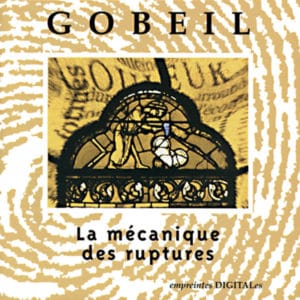
“La mécanique des ruptures”
Le vertige inconnu (The Mysterious Vertigo) was produced in 1993 at the studios of the Groupe de musique expérimentale de Bourges (GMEB, France). It premiered in June 1993 at the 23rd Bourges International Electroacoustic Music Festival (France). Le vertige inconnu received the 1994 Stockholm Electronic Arts Award (Sweden) and was selected for the 1994 World Music Days (Stockholm, Sweden) and the 1994 International Computer Music Conference (ICMC’94) in Danmark. The piece was commissioned by the GMEB, with the assistance of the Canada Council [for the Arts].[v-94] Since, Le vertige inconnu was awarded the prize of international competition Stockholm Electronic Arts Award (Sweden, 1994) and the 2nd prize of the international competition Prix Ars Electronica (Linz, Austria, 1995).
12,00€
In stock
CD
Gilles GOBEIL
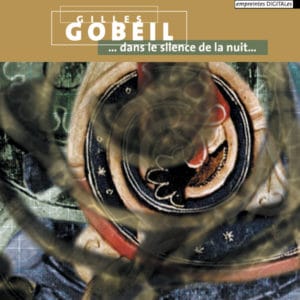
“… dans le silence de la nuit…”
“Derrière la porte la plus éloignée…” (1998), “Projet Proust” (1995-2001), “Point de passage” (1997), “Nuit cendre” (1995).
“… one of the most talented and sensitive jugglers of sounds we’ve heard” (Sonoloco Record Reviews, Sweden). “Since its release, Gilles Gobeil’s new disc, … dans le silence de la nuit…, attracts a lot of praises and attention. Dark and fascinating, his sonic universe routs bias and produces extraordinary sonic depth. Inspired by both readings (Proust, HG Wells, Verne) and travels (Venice), Gobeil’s compositions leaves the listener breathless with its moving images and secret atmospheres. 50 minutes expressly remastered for this edition, illustrated by Luc Beauchemin.”
“… one of the most talented and sensitive jugglers of sounds we’ve heard” (Sonoloco Record Reviews, Sweden). “Since its release, Gilles Gobeil’s new disc, … dans le silence de la nuit…, attracts a lot of praises and attention. Dark and fascinating, his sonic universe routs bias and produces extraordinary sonic depth. Inspired by both readings (Proust, HG Wells, Verne) and travels (Venice), Gobeil’s compositions leaves the listener breathless with its moving images and secret atmospheres. 50 minutes expressly remastered for this edition, illustrated by Luc Beauchemin.”
13,00€
Out of stock
CD
Gilles GOBEIL
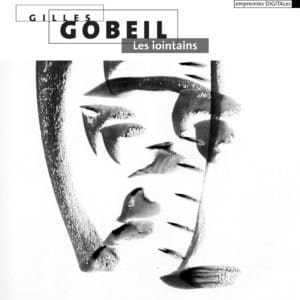
“Les lointains”
“Les lointains noirs et rouges” (2008-09), “Castalie” (2008), “Bol-Hydre” (2011), “Sibylle” (2010), “Golem” (2013), “Des temps oubliés” (2012).
Gilles Gobeil has completed a master’s degree in composition at Université de Montréal, after studying writing techniques. He has been focusing his work on acousmatic and mixed music since 1985. His works fall close to what is called ‘cinema for the ear.’ Many of his pieces have been inspired by literary works and attempt to let us ‘see’ through sound.
Gilles Gobeil has won over 20 national and international awards including the Ars Electronica (Austria, 1995, 2005), Black & White (Portugal, 2009), Bourges (France, 1988, ’89, ’99, 2009), British Design & Art Direction (UK, 2002), Brock University (Canada, 1985), Canadian Music Council (1985), Ciber@rt (Spain, 1999), CICEM (Monaco, 2014), CIMESP (Brazil, 1997, ’99, 2001), Destellos (Argentina, 2011, ’12), Luigi Russolo (Italy, 1987, ’88, ’89), Métamorphoses (Belgium, 2000, ’02), Newcomp (USA, 1987), SDE Canada (1984), SOCAN (Canada, 1993), and Stockholm Electronic Arts Award (Sweden, 1994, ’97) competitions. His DVD-Audio Trilogie d’ondes has won the Conseil québécois de la musique (CQM)’s Prix Opus for Best Album in 2004-05; his CD Le contrat was nominated in the same category in 2003-04.
Gobeil has received commissions from Codes d’accès (Montréal), DAAD (Berlin, Germany), empreintes DIGITALes (Montréal), Groupe de musique expérimentale de Bourges (GMEB, France), Groupe de recherches musicales (GRM, France), Musiques & Recherches (Belgium), Réseaux des arts médiatiques (Montréal), Société Radio-Canada, Totem contemporain (Montréal), Zentrum für Kunst und Medientechnologie (ZKM, Germany), from Folkmar Hein, Uli Aumüller, Camille Mutel, and Oscar Wiggli, and from performers Suzanne Binet-Audet, René Lussier, Arturo Parra, and Rick Sacks.
He has been composer-in-residence in Banff (Canada, 1993, ’95), Bourges (France, 1991), EMS (Sweden, 2013), GRM (France, 1993, 2012), Franz Liszt Academy (Weimar, Germany, 2010), Miso Music Portugal (2012), Musiques & Recherches (Belgium, 2012), PANaroma (Brazil, 2014), and ZKM (Germany, 2005, ’06, ’07, ’09, ’10, ’12, ’13), and guest composer at DAAD (Germany, 2008).
Gilles Gobeil is a member of the Canadian Electroacoustic Community (CEC), and co-founder of Réseaux, an organization devoted to producing media arts events.
Gilles Gobeil has completed a master’s degree in composition at Université de Montréal, after studying writing techniques. He has been focusing his work on acousmatic and mixed music since 1985. His works fall close to what is called ‘cinema for the ear.’ Many of his pieces have been inspired by literary works and attempt to let us ‘see’ through sound.
Gilles Gobeil has won over 20 national and international awards including the Ars Electronica (Austria, 1995, 2005), Black & White (Portugal, 2009), Bourges (France, 1988, ’89, ’99, 2009), British Design & Art Direction (UK, 2002), Brock University (Canada, 1985), Canadian Music Council (1985), Ciber@rt (Spain, 1999), CICEM (Monaco, 2014), CIMESP (Brazil, 1997, ’99, 2001), Destellos (Argentina, 2011, ’12), Luigi Russolo (Italy, 1987, ’88, ’89), Métamorphoses (Belgium, 2000, ’02), Newcomp (USA, 1987), SDE Canada (1984), SOCAN (Canada, 1993), and Stockholm Electronic Arts Award (Sweden, 1994, ’97) competitions. His DVD-Audio Trilogie d’ondes has won the Conseil québécois de la musique (CQM)’s Prix Opus for Best Album in 2004-05; his CD Le contrat was nominated in the same category in 2003-04.
Gobeil has received commissions from Codes d’accès (Montréal), DAAD (Berlin, Germany), empreintes DIGITALes (Montréal), Groupe de musique expérimentale de Bourges (GMEB, France), Groupe de recherches musicales (GRM, France), Musiques & Recherches (Belgium), Réseaux des arts médiatiques (Montréal), Société Radio-Canada, Totem contemporain (Montréal), Zentrum für Kunst und Medientechnologie (ZKM, Germany), from Folkmar Hein, Uli Aumüller, Camille Mutel, and Oscar Wiggli, and from performers Suzanne Binet-Audet, René Lussier, Arturo Parra, and Rick Sacks.
He has been composer-in-residence in Banff (Canada, 1993, ’95), Bourges (France, 1991), EMS (Sweden, 2013), GRM (France, 1993, 2012), Franz Liszt Academy (Weimar, Germany, 2010), Miso Music Portugal (2012), Musiques & Recherches (Belgium, 2012), PANaroma (Brazil, 2014), and ZKM (Germany, 2005, ’06, ’07, ’09, ’10, ’12, ’13), and guest composer at DAAD (Germany, 2008).
Gilles Gobeil is a member of the Canadian Electroacoustic Community (CEC), and co-founder of Réseaux, an organization devoted to producing media arts events.
13,00€