
In stock
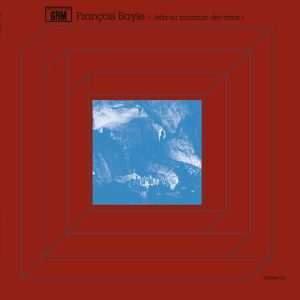
LP
François BAYLE
“Jeita ou murmure des eaux”
A major work in François Bayle’s repertoire, Jeîta ou murmure des eaux provides a journey and an immersion into a world of unleashed energies, with the Jeîta cave serving both as a backdrop and a particle accelerator. Here, the cave indeed stands for the concrete source of the composer’s inspiration as much as the mind space where metamorphoses occur. By combining such figurative spaces and immaterial sound projections, François Bayle evokes another subject, an inhabitant of the multiple and symbolic cave: the listening subject, who always reveals himself, implicitly, at the heart of François Bayle’s musical concerns and the path he has always defended: the acousmatic approach.
28,00€
In stock

CD
François BAYLE
“Le Projet Ouïr”
Digipack CD including a 24-page booklet in French and English
INA grm is pleased to present Le Projet « Ouïr » by François Bayle, a 62’ minute piece composed between 2015 and 2019, published for the first time on CD digipak.
The French language can hear (entendre), listen (écouter), grasp (comprendre). “Comprendre” aims too far. What is grasped has already been digested by the mind, away from the ear. “Entendre” is poorly distinguished from it—mainly because of “entendement”, which is virtually the same as “raison” (reason). That leaves us with “écouter”: the only one amongst the three that exclusively refers to the ear. Whoever listens stretches out his or her ear and expects to hear something and understand its ins and outs. However, this is still too nice, too urban. The idea is to break out of these customary dimensions and enter more difficult and risky territories. This is the “Ouïr” Project (Le Projet « Ouïr »). This archaic verb, which is now obsolete and that we can’t conjugate properly anymore, invites us to exercise a proto-listening, awkward, uncomfortable and unsure of its aims—yet with the promise of new horizons.
- Regis Renouard Larivière
21,00€
In stock

LP
François BAYLE
“Electrucs !”
Never before released.
On the occasion of the 80th anniversary of the GRM, the composer François Bayle introduces us to some of his unpublished archives : “Electrucs !” (1974) composed on a 1970’s Synthi AKS synthesizer like an imaginary soundtrack.
“Foliphonie” (1974) inspired by “La Grande Polyphonie”. “Marpège” (1995) dedicated to Bernard Parmegiani. Also includes “Cinq dessins en rosace” (1973).
Born in 1932 in Tamatave (Madagascar) where he lived for 14 years, François Bayle is a major figure of electro acoustic music and member of the historic Pierre Schaeffer’s “Groupe de Recherches Musicales” (GRM) joined in Paris in 1958. In 1975, the GRM was integrated with the new Institut national de l’audiovisuel (INA) with Bayle as its head, which post he held until 1997, he brought a valuable contribution to the opening of musical research in these original innovative institutions. Ever since his first productions (“L’expérience acoustique” 1971) François Bayle has developed through a great variety of “formats” and designed the Acousmonium a sound diffusion system used originally by the GRM.
He also originated the record series Collection Ina-Grm, organizes concerts and supports the development of technologically advanced musical instruments (Syter, Grm tools...).
After leaving GRM in 1997, he founded his own electronic music studio and record label Magison.
22,00€

15 CD
François BAYLE
“50 ans d’acousmatique”
“François Bayle’s itinerary spans over five decades through which music was able to renovate its material through a sensible use of technology. The terms of Musique Concrète, Electroacoustics or Acousmatics, as conveniently proposed by François Bayle, ultimately explore a similar artistic approach: a creative and
expressive work on recorded sound. This last half-century saw many major technical mutations and François Bayle - in the fertile context of the Grm - seized the right opportunities, often initiating them through his function as director, so as to renovate and update creativity to serve what he called the Light Speed Sound. The fifty opuses in this box set are all markers or beacons illuminating this musical adventure firmly placed under the sign of modernity. Listening through them with a curious and active ear is also a way of witnessing how utopia can occur; how yesterday’s strange sounds are now fully part of our audible landscape.” Christian Zanési.
“Trois rêves d’oiseau” (1963, 1971). “Espaces inhabitables” (1967). “Jeîta, ou Murmure des eaux” (1970 - new version 2012). “L’expérience acoustique” (1969 - 1972). “Purgatoire d’après la Divine Comédie de Dante” (1972). “Vibrations composées” (1973). “Grande polyphonie” (1974). “Camera oscura” (1976). “Les Couleurs de la nuit” (1982 - new version 2012). “Erosphère” with “Tremblement de terre très doux” (1978), “La Fin du bruit” (1979-80 - new version 2009), “Eros” (1979-80), “Toupie dans le ciel” (1979-80 - new version 2009). “Son - Vitesse - Lumière” with “Grandeur nature” (1980), “Paysage, personnage, nuage” (1980), “Voyage au centre de la tête” (1981), “Le Sommeil d’Euclide” (1983), “Lumière ralentie” (1983). “Motion-Émotion” (1985). “Théâtre d’Ombres” (1988). “Fabulæ” with “Fabula” (1990), “Onoma” (1990), “Nota” (1991), “Sonora” (1992). “Mimaméta” (1989). “La main vide” (1994-95) with “Bâton de pluie”, “La Fleur future”, “Inventions”. “Morceaux de ciels” (1996). “Arc, pour Gérard Grisey” (unedited) (1999). “La forme du temps est un cercle” with “Concrescence” (2001), “Si loin, si proche…” (1998 - 2001 - new version 2012), “Tempi” (1999-2000), “Allures” (1999-2000), “Cercles” (2000-2001). “La forme de l’esprit est un papillon” (2002-04) with ”Ombrages et trouées” (2004 - new version 2012), “Couleurs inventées” (2003). “Univers nerveux - in memoriam K. Stockhausen” (unedited) (2005-2007). “L’oreille étonnée - in memoriam O. Messiaen” (unedited) (2006-2012). “Rien n’est réel” (unedited) (2009-2010) with “… sensations” (2010) et “… perceptions” (2009). “Déplacements” (unedited) (2011-12) with “Horizontal-vertical” (2012) et “Spiral” (2011).
70,00€
In stock

Out of stock

LP
François BAYLE
“Tremblements…”
“Tremblement de terre très doux” (1978).
The familiar generates the strange. These rolls, these hums, these sudden rushes; this song, these peaceful circlings; these sudden outbursts, these returns to quiescence – what do they remind us of?
This piece’s trajectory could also be a representation of the dramatic unfolding of a day - of a life - from sunrise (climate 1) to night-time (landscape 4) via restless encounters, transitions (1 to 3) that announce the drama climaxing in landscape 3, before reaching its denouement in climate 4… A whole concrete ‘story’.
The subterranean properties inherent to listening gently shift our ideas…
François Bayle
First performance: 19 March 1979 – Grand Auditorium of Radio-France,
Ina-GRM’s Cycle Acousmatique. .
“Toupie dans le ciel” (1979)
A wave is swaying on two minors thirds. This constantly uniform yet constantly varied swaying revolves in a swarm of sharp designs that blink on and off in a layer of growing density and mobility. Distance, speed, pressure, density, temperature, colour, intensity, are the “themes” of the 27 short interconnected cells flowing together though this seemingly unified movement. Occasionally, a breach in the texture reveals skyes dotted with little comets. In the centre, a slow
gliding picks up the distant harmonics of a basic chord. Toward the end, this gliding returns with a fiery burst.
Fine lines and whirs are generated from the song of a spinning antique top.
To end on a lighter note the title Toupie dans le ciel – Spinning Top in the Sky reminds us of Lucy in the Sky with Diamonds by The Beatles as well as Lucy, the oldest Australopithecine (3 million years), our African grandmother in the Erosphere…The overall title Erosphere alludes to the desire inherent to the listening experience, and to the very primitive cues that sustain the auditory attention and are the basis of all musical pleasure.
François Bayle
First performance: 21 January 1980 – Grand Auditorium of Radio-France,
Ina-GRM’s Cycle Acousmatique.
The familiar generates the strange. These rolls, these hums, these sudden rushes; this song, these peaceful circlings; these sudden outbursts, these returns to quiescence – what do they remind us of?
This piece’s trajectory could also be a representation of the dramatic unfolding of a day - of a life - from sunrise (climate 1) to night-time (landscape 4) via restless encounters, transitions (1 to 3) that announce the drama climaxing in landscape 3, before reaching its denouement in climate 4… A whole concrete ‘story’.
The subterranean properties inherent to listening gently shift our ideas…
François Bayle
First performance: 19 March 1979 – Grand Auditorium of Radio-France,
Ina-GRM’s Cycle Acousmatique. .
“Toupie dans le ciel” (1979)
A wave is swaying on two minors thirds. This constantly uniform yet constantly varied swaying revolves in a swarm of sharp designs that blink on and off in a layer of growing density and mobility. Distance, speed, pressure, density, temperature, colour, intensity, are the “themes” of the 27 short interconnected cells flowing together though this seemingly unified movement. Occasionally, a breach in the texture reveals skyes dotted with little comets. In the centre, a slow
gliding picks up the distant harmonics of a basic chord. Toward the end, this gliding returns with a fiery burst.
Fine lines and whirs are generated from the song of a spinning antique top.
To end on a lighter note the title Toupie dans le ciel – Spinning Top in the Sky reminds us of Lucy in the Sky with Diamonds by The Beatles as well as Lucy, the oldest Australopithecine (3 million years), our African grandmother in the Erosphere…The overall title Erosphere alludes to the desire inherent to the listening experience, and to the very primitive cues that sustain the auditory attention and are the basis of all musical pleasure.
François Bayle
First performance: 21 January 1980 – Grand Auditorium of Radio-France,
Ina-GRM’s Cycle Acousmatique.
15,50€
Out of stock

CD
François BAYLE
Vol. 4 “Fabulæ”
Vol. 4 of the series. A series of works from 1990-92. "A polyphony of impacts, a broad, sparkling, iridescent fabric, such as are often to be found in Bayle’s works."
15,00€