
Out of stock
LP
David TUDOR
“Microphone”
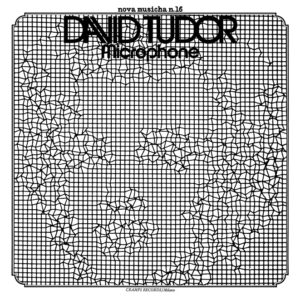
At long last, after decades out of print, the Milan based imprint, Dialogo, dives into the legendary catalog of Cramps, bringing forth the first ever vinyl reissue of David Tudor’s legendary LP, "Microphone", part of an ongoing initiative dedicated to bring the imprint’s seminal output back into the light. Still mind-blowing nearly half a century after it was first released, now complete with a new English translation of the album’s original liner notes, this is just about as exciting as reissues come and not to be missed.
Edition of 300 LP on black vinyl. Audiophile pressing, including printed inner. Perfect replica of the original packaging and newly remastered for optimal sound.
The only source of Microphone’s sound is the modulation of a microphone feedback produced in a distant echo chamber. The incidence and duration of the sounds are produced by the action of extremely close (narrow band) peak/notch filters (used in both modes), inserted into the lead signal. Each of the 9 versions is performed by the composer and simultaneously recorded on four tracks. Then the four tracks are spliced onto two, using a pan-matrix. The final product is a library of 9 stereo tapes, each about 32 min. long, which can be used in any combination, for live performances or for electronic installations. In these performances the tapes are played and stopped at any point, rewound and played again, altered in amplitude and/or equalisation, rotated on any given channel, etc., at will, for any period of time.
A live performance of Microphone (for instance without tapes) can be achieved by employing (a minimum of 4) performers using duplication systems, each one with 2 speakers.
This 1973 instantiation of Microphone covers a work originally conceived for the Pepsi Pavilion of Expo ‘70, in Osaka, Japan. Conceptually, the original work derives from discoveries made through the composer’s collaboration in the design of the Pavilion’s acoustic system. Sound diffusion was achieved through the use of 37 loudspeakers placed in a rhomboid grid system covering 3/4 of the sphere.
The loudspeakers could be “temporalised” at the entrance and exit of sounds, at variable speeds, following predetermined spatial models. The composer experimented with highly directional microphones, randomly pointed in space and amplified at the feedback level. The resulting signals were controlled in incidence and duration solely by the action of the loudspeaker’s temporaliser. Modulators, with variable features, designed and incorporated into the sound system by Gordon Mumma, were placed in the lead signals in order to vary the musical content of the feedback signals.
These experiments, although carried out through a compositional process, were not recorded in the Pavilion, due to the presence of “ambient noise” created by the multiple electrical fields. However, since the “tuned space” concept is now involved in Tudor’s compositional processes, the work could be recovered using variable bandpass filters (but capable of accommodating or excluding a cycle), and “q” variables, such as “tuning” elements, instead of operative loudspeakers. The used filters are manufactured by Ling Electronics, California.
The original tapes for Microphone were recorded in May 1973, at the Mills College Centre for Contemporary Music, using funds from their multi-track recording research project.
The recordings were conducted by Robert Sheff, with assistance from John Bischoff.
The two versions of Microphone featured in this recording were made with the assistance of the ZBS Foundation, Fort Edward, New York. Such grants were possible thanks to the public funds from the New York State Council of the Arts.
26,00€
In stock
CD
David TUDOR
“Three works for live electronics”
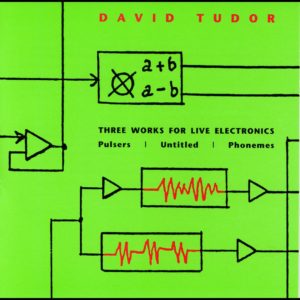
David Tudor, electronics; with Takehisa Kosugi, electronic violin and vocals; produced and recorded by David Tudor, Nicolas Collins, and John D.S. Adams. Originally released on LP in 1984 and rereleased in September 1996, just following Tudor’s death on August 13, with the addition of Phonemes. “Pulsers explores the world of rhythms created electronically by analog, rather than digital, circuitry. With analog circuitry, the time-base common to the rhythms can be varied in many different ways by a performer, and can eventually become unstable. Untitled is a part of a series of works composed in the 1970s that were developed through experiments in generating electronic sound without the use of oscillators, tone generators, or recorded natural sound materials. Composed in 1972, it was designed for simultaneous performance with John Cage’s vocalization of his Mesotics re Merce Cunningham. The work was revived in 1982, and performed with improvised vocals by Takehisa Kosugi. Phonemes was commissioned by the Merce Cunningham Dance Company for Cunningham’s dance Channels/Inserts, a work made both as a "filmdance" and for the stage. Phonemes employs two discrete processes which provide input source material for an array of sound modifying electronics, thus creating a multitude of outputs.”
14,00€
Out of stock
CD
David TUDOR
“Microphone”
“Originally released on LP in 1973 as number 16 in the Nova Musicha series. Recorded at Center for Contemporary Music, Mills College, Oakland, California. Includes 12-page booklet with photographs, score and liner notes in Italian.”
13,00€
Out of stock

7 CD
David TUDOR
“The art of David Tudor (1963-1992)”
David Tudor’s (1926-1996) identity morphed seamlessly from interpreter of mainly acoustic music to composer-performer of predominately electronic music over a period of about ten years, from the mid-1950s to the mid-1960s. This set of seven CDs, the first truly comprehensive survey of Tudor’s work as a composer, goes beyond any previous attempt to document that process of transformation. It captures his touch and sensitivity and offers an expansive, previously unavailable view onto more than three decades of Tudor’s astonishingly original work as an electronic musician. It neatly describes the arc of his career, from his first composition, Bandoneon ! (A Combine), through the fully-realized works of his long collaboration with the Merce Cunningham Dance Company. Six works that were issued in excerpted form in Music for Merce (1952-2009) are issued here complete. Other highlights include the live soundscapes for the Pepsi Pavilion at the 1970 Osaka World Expo, the marvelous simultaneous performance with John Cage of Mesostics Re Merce Cunningham/Untitled, and two extended binaural recordings of Rainforest IV with Composers Inside Electronics, the best recorded documents of this signature work. While Cage has finally more or less received his due, Tudor’s own accomplishments have been somewhat overshadowed and are ripe for a proper re-evaluation. It is our hope that the release of this set will prompt a thorough reconsideration of his seminal achievements.
David Tudor : Anima Pepsi, Bandoneon ! (A Combine), Neural Network Plus, Pepscillator, Pepsibird, Phonemes, Rainforest IV [Berlin, 1980], Rainforest IV [Stockholm, 1980], Virtual Focus, Weatherings, Webwork
John Cage / David Tudor [simultaneous performance]: Mesostics re Merce Cunningham / Untitled.
John Cage : Variations II.
Christian Wolff : For 1, 2, or 3 People.
David Tudor, Takehisa Kosugi, live electronics. John Cage, voice. Composers Inside Electronics : John Driscoll, Phil Edelstein, Ralph Jones, Martin Kalve, David Tudor, Bill Viola, live electronics.
David Tudor : Anima Pepsi, Bandoneon ! (A Combine), Neural Network Plus, Pepscillator, Pepsibird, Phonemes, Rainforest IV [Berlin, 1980], Rainforest IV [Stockholm, 1980], Virtual Focus, Weatherings, Webwork
John Cage / David Tudor [simultaneous performance]: Mesostics re Merce Cunningham / Untitled.
John Cage : Variations II.
Christian Wolff : For 1, 2, or 3 People.
David Tudor, Takehisa Kosugi, live electronics. John Cage, voice. Composers Inside Electronics : John Driscoll, Phil Edelstein, Ralph Jones, Martin Kalve, David Tudor, Bill Viola, live electronics.
90,00€
In stock

2 CD
David TUDOR
“Music for piano”
2-CD set with recordings by the legendary 20th century avan-tgarde pianist. “With compositions by Sylvano Bussotti, John Cage, Morton Feldman, Christian Wolff. David Tudor, pianist - a profession, a vocation, a life. From 1950 until around 1965, David Tudor was the epitome of the pianist who could simply play anything. In fact, David Tudor was no longer a name, but an indication for instrumentation as dozens of pieces were written “for David Tudor”. As early as 1960, after having conquered all of the challenges posed by serial piano music, Tudor began to differentiate between composers who filled him with life and those who left him cold - the focus of his repertory became crystallized. The main criterion for his choices were shaped by the part he would play as interpreter in the composition. He distinguished carefully between having a free choice among prefabricated parts - generally called aleatoric, as for example, Stockhausen’s Klavierstück XI (dedicated, as his Klavierstücke V-VIII, to Tudor) - and indeterminate actions. In the first case, they have a tendency to “put me to sleep”, whereby pieces that are less limiting led him to say, “I feel that I’m alive in every part of my consciousness”. The program of these CDs portrays these distinctions.”CD1 : John Cage : “Music for Piano 27...” 1955 (DR 1958) (John Cage- David Tudor), “Music for Piano 22, 21, 26, 36” 1955 (NDR 1956) (David Tudor), “Music for Piano 27, 21, 32, 36” 1955 (RB 1959) (David Tudor), “Variations I” 1958 (DR 1958) (John Cage-David Tudor), “Winter Music” 1957 (WDR 1957) (John Cage-David Tudor). Christian Wolff : “Duo for Pianists I” 1957, Version 1 (RB 1960) (John Cage, David Tudor), “Duo for Pianists I” 1957, Version 2 (RB 1960) (John Cage, David Tudor), Sylvano Bussotti : “Piano Piece for David Tudor III” 1959 (RB 1959) (David Tudor). Morton Feldman: “Piece for Four Pianos” 1957 (Columbia 1959) (David Tudor, Russell Sherman, Edwin Hymovitz, Morton Feldman). CD 2 : John Cage : “Varitations II” 1961 (Sony Music 1967) (David Tudor), “Music for Piano 27, 21, 32, 35, 36” 1955 (HR 1959) (David Tudor), “Music for Piano 21, 22, 26, 29, 34, 36” 1955 (WDR 1959) (David Tudor). Christian Wolff : “Duo for Pianists I” 1957, Version 2 (DR 1963) (John Cage, David Tudor), David Tudor “O-Ton” (DR 1963).
24,00€
In stock
2 CD
David TUDOR
“Neural synthesis N° 6-9”
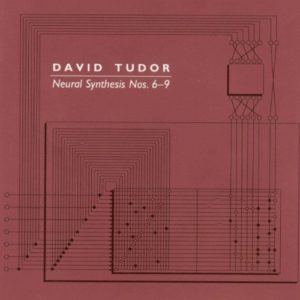
Performed by David Tudor; produced and recorded by David Tudor and John D.S. Adams. Binaural and stereo mixes on 2 CDs. This recording combines the art of music, the engineering of electronics, and the inspiration of biology. In it, David Tudor orchestrates electronic sound in ways analogous to our biological bodies’ orchestration of consciousness. The performance originates from a neural-network synthesizer conceived and built especially for Tudor. He surrounds this synthesizer with his own unique collection of electronic devices, and in the recording on this CD made for headphone playback, he uses a new binaural technique for translating sound into out-of-head localizations in which sound seems to originate from specific, changing points within a space around the listener.
23,50€
Out of stock

CD
David TUDOR
“Rainforest”
“Sounds electronically derived from the resonant characteristics of physical materials. First version (1968), a sound-score for Merce Cunningham’s dance work of the same name, established a means of sound transformations without the use of electronic modulation: the source sounds, when transmitted through the physical materials, will be modified by the resonant nodes of those materials. Fourth version (1973): A collaborative environmental work, spatially mixing the live sounds of suspended sculptures and found objects, with their transformed reflections in an audio system.
"In the first version, I made objects which I could travel with. The object were so small, however, that they didn’t have any sounding presence in the space, so I then amplified the outputs with the use of contact microphones. Then for the second version, I wanted to have a different kind of input... because for the first I had used oscillators that made animal and bird-like sounds. In the second version I wanted to use a vocal input to the system, the natural resonance of the object and its subsequent amplification. Its a kind of mechanical filter. The third version had to deal with the ability to have any input go to any transducer. I made that system for a simultaneous performance with John Cage (Mureau). It was one of those pieces that changes all the time so I needed to have a sort of continuous thing, so I used tape sources, but having the ability to mix them or separate them into different output channels. So the next step was "Rainforest IV"... the object was to make the sculptures sound in the space themselves. Part of that process is that you are actually creating a an environment. The contact mikes on the objects pickup the resonant frequencies which one hears when very close to the object, and then are amplified through a loudspeaker as an enhancement." (this transcription is partially edited from the original)”. David Tudor, form interview by John Fullemann 10/12/85
17,50€