
In stock

LP
David BEHRMAN
“ViewFinder / Hide & Seek”
Black Truffle is thrilled to announce ViewFinder / Hide & Seek, a new release from acclaimed American experimental composer David Behrman, presenting recordings made in collaboration with Jon Gibson and Werner Durand between 1989 and 2020. Last heard from on Black Truffle as part of the collaborative art song/live electronics madness of She’s More Wild, these recordings find Behrman continuing the pioneering work in interactive electronics that have established him as one of the major living experimental composers.
Side A presents excerpts from two live realisations of Unforeseen Events (1989), the fourth in a series of pieces focussing on the interactions between instrumental performers and responsive software. Like the classic earlier works in the series, On the Other Ocean (1977), Interspecies Smalltalk (1984) and Leapday Night (1986), Unforeseen Events is an “unfinished composition” in which a computer system listens for and responds to specific pitch cues from an instrumentalist. Performed by the composer on electronics and Werner Durand on soprano saxophone in Berlin in 1989, the first realisation immediately ushers the listener into an environment of long soprano notes, lush, sustained synth harmonies, randomised percussive interjections and distantly burbling arpeggiated patterns.
The 1999 realisation recorded in New York with Jon Gibson on soprano shows how much room for the instrumentalist to affect the course of the music exists in Behrman’s interactive pieces, in which, as he notes, ‘performers have options rather than instructions’. Beginning in a roughly similar area to the version with Durand, this later recording eventually becomes substantially more active, as polyrhythmically layered arpeggios and percussive patterns respond to fast chromatic lines and dynamic phrases from the saxophone, moving Gibson in turn to respond with cycling figures and moments of extended technique that touch on the soprano languages pioneered by players like Steve Lacy and Evan Parker. Yet even at its most active, the lack of conventional forward movement in the music allows it to retain what Behrman’s friend Jacques Bekaert called its ‘fragile tranquillity’, as episodes of activity appear only as momentary disruptions of an underlying calm.
On the B side, we are treated to a new collaborative work from Behrman and Werner Durand, building on the 2002 installation work ViewFinder, in which a camera detecting physical motion triggered changes to electronic sound. The piece presented here is a long-distance studio construction, recorded by Behrman in the Hudson Valley and Durand in Berlin, offering up an expansive duet between Behrman’s lush, gliding synth tones and the alien, untempered tones of Durand’s invented and adapted wind instruments. Presented in a stunning gatefold sleeve with art from Terri Hanlon, archival photographs and new liner notes from Behrman and Durand,ViewFinder / Hide & Seek is an essential release showcasing the continuing vitality of a legendary figure in experimental music.
20,00€
Out of stock
LP
David BEHRMAN
“On the Other Ocean”
Lovely Music present a reissue of David Behrman's On the Other Ocean, originally issued as one of Lovely Music's first six releases in 1978. This newly-mastered LP is a must-have for Behrman aficionados or a perfect introduction to his work.
"I've been engaged for many years in an exploration of ways to make music and intermedia installations in which software and electronic devices interact with human performers. I've wanted to make works that have personalities, which remain distinct and recognizable, yet are open to surprising changes that can come about when they are performed or exhibited." --David Behrman
"Remarkable achievements on a purely technological level. Behrman's carefully programmed Kim-I system listens to tones played by the live performers, instantly analyzes the situation, and responds by playing back electronic tones of its own. This is undoubtedly the first time that humans and electronic sound equipment have communicated with one another with high degrees of spontaneity and intelligence on both ends of the wire. But the music that results is perhaps even more remarkable. Subtle, sustained, serene, sophisticated, super." --Tom Johnson, The Village Voice, Dec. 18, 1978
Recorded at the Center for Contemporary Music, Mills College, Oakland, California, Sept. 18, 1977, and at the Electronic Music Studio, State University of New York at Albany, June 9, 1977. Personnel: On the Other Ocean: David Behrman - electronics; Maggi Payne - flute; Arthur Stidfole - bassoon Figure in a Clearing: David Behrman - electronics; David Gibson - cello. 180 gram vinyl, Stoughton Old Style sleeve.
22,50€
Out of stock

LP
David BEHRMAN
“Music With Memory”
alga marghen proudly introduce you to “Music With Memory”, a new record LP by David Behrman focused on his 70s work with new small, inexpensive devices then known as “microcomputers” equipped with “memory” to be used in live performances and installations.
Side A presents “Interspecies Smalltalk” with Takehisa Kosugi (Violin) and David Behrman (Electronics). A wild intertwine of two worlds of resonance, structure and tonal which is decades ahead of its time. Commissioned by John Cage and Merce Cunningham as music for the 1984 Cunningham Company dance titled “Pictures”, it was made to be performed by Takehisa Kosugi playing violin in his uniquely personal style.
Side B includes “Circling Six”, an earlier version of a more extended piece titled “Leapday Night”. “Circling Six” had six looping synthesizer phrases which could be played along with by the acoustic instrumentalist, on this recording by Werner Durand on saxophone.
“Interspecies Smalltalk” and “Circling Six” were pieces for instrumental performers and a small computer-controlled music system that Behrman assembled during the 1980s. The electronic gear consisted of pitch sensors (“ears” with which it listened to the performing musicians), various music synthesizers (some homemade), a video display and a personal computer. The pieces were made with computer programs governing interaction between performers and the electronics. The software created situations rather than set pieces. The performers had options rather than instructions, and the exploration of each situation as it unfolded was up to them.
Also on side B a short track titled “All Thumbs” for two electrified mbiras (African instruments of ancient origin also known as thumb pianos, kalimbas or zanzas). This piece grew out of a collaborative sound and video installation that George Lewis and David Behrman made for the opening of the Paris science museum La Villette in the spring of 1986. The metal tines of the mbiras were linked to sensors and to a computer music system. In this concert version, played together with Fast Forward, the piece was in several sections. All the sounds in “All Thumbs” were electronically generated.
Edition of 400 copies with liner notes by David Behrman and photos by the performances as well as original programs of the Music With Memory Festival.
Side A presents “Interspecies Smalltalk” with Takehisa Kosugi (Violin) and David Behrman (Electronics). A wild intertwine of two worlds of resonance, structure and tonal which is decades ahead of its time. Commissioned by John Cage and Merce Cunningham as music for the 1984 Cunningham Company dance titled “Pictures”, it was made to be performed by Takehisa Kosugi playing violin in his uniquely personal style.
Side B includes “Circling Six”, an earlier version of a more extended piece titled “Leapday Night”. “Circling Six” had six looping synthesizer phrases which could be played along with by the acoustic instrumentalist, on this recording by Werner Durand on saxophone.
“Interspecies Smalltalk” and “Circling Six” were pieces for instrumental performers and a small computer-controlled music system that Behrman assembled during the 1980s. The electronic gear consisted of pitch sensors (“ears” with which it listened to the performing musicians), various music synthesizers (some homemade), a video display and a personal computer. The pieces were made with computer programs governing interaction between performers and the electronics. The software created situations rather than set pieces. The performers had options rather than instructions, and the exploration of each situation as it unfolded was up to them.
Also on side B a short track titled “All Thumbs” for two electrified mbiras (African instruments of ancient origin also known as thumb pianos, kalimbas or zanzas). This piece grew out of a collaborative sound and video installation that George Lewis and David Behrman made for the opening of the Paris science museum La Villette in the spring of 1986. The metal tines of the mbiras were linked to sensors and to a computer music system. In this concert version, played together with Fast Forward, the piece was in several sections. All the sounds in “All Thumbs” were electronically generated.
Edition of 400 copies with liner notes by David Behrman and photos by the performances as well as original programs of the Music With Memory Festival.
19,00€
In stock
CD
David BEHRMAN
“Leapday night”
David Behrman, electronics; Takehisa Kosugi, violin; Ben Neill and Rhys Chatham, trumpets...A series of three pieces/suites; ’Leapday Night’, ’A Traveler’s Dream Journal’, and ’Interspecies Smalltalk’ involving Rhys Chatham/Ben Neill (on trumpet/mutantrumpet), Fluxus mainstay Takeisha Kosugi (violin), and Behrman himself on electronics. Behrman creates thickly layered liquid sounds utilizing this complex computer music system which absorbs, actually hears, the sounds of instrumentalists, then plays off their improvisations with its own synthesized reactions. The system consists of pitch sensors ("ears" with which it listens to the performing musicians), various music synthesizers (some homemade), a computer graphics color video display and a personal computer. "Heavy period-synth float with bare accompaniment, thankfully just-pre DX-7."
15,00€
In stock
CD
David BEHRMAN
“On the other ocean”
David Behrman, electronics, Kim-1 microcomputer; Maggi Payne, flute; Arthur Stidfole, bassoon; David Gibson, cello. Recording engineers: "Blue" Gene Tyranny and Richard Lainhart. Originally released by Lovely Music on LP in 1978; reissued on CD in 1996.
“On the Other Ocean is an improvisation by Maggi Payne and Arthur Stidfole centered around six pitches which, when they are played, activate electronic pitch-sensing circuits connected to the "interrupt" line and input ports of a microcomputer, Kim-1. The microcomputer can sense the order and timing in which the six pitches are played and can react by sending harmony-changing messages to two handmade music synthesizers. The relationship between the two musicians and the computer is an interactive one, with the computer changing the electronically-produced harmonies in response to what the musicians play, and the musicians influenced in their improvising by what the computer does.
Figure in a Clearing, made a few months before On the Other Ocean, was the first piece of Behrman’s to use a computer for music. For Figure, the Kim-1 ran a program which varied the time intervals between chord changes. The time intervals were modelled on the motion of a satellite in falling elliptical orbit about a planet. David Gibson’s only "score" was a list of 6 pitches to be used in performance, and a request that he not speed up when the computer-controlled rhythm did. The timbral richness and concentrated eloquence of his playing sprang from his own sources.
Charming booklet notes by David Behrman.”
12,00€
Out of stock
CD
David BEHRMAN
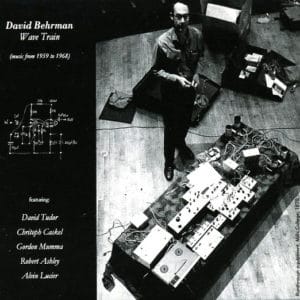
“Wave train”
New remastered CD edition of David Behrman “Wave Train” CD, featuring Sonic Arts Union. A digipak CD with David Behrman experimental music from 1959 to 1968. “The CD starts with the short piece called “Canons” a product of a 3 weeks stage in Darmstadt (summer 1959) featuring David Tudor on piano and Christoph Caskel playing percussions. ’Ricercar’ is a prepared piano piece made in 1961 and has the flexible form of the kind favoured by European composers in the early 1960s, but also reflecting the work of Cowell and Cage. “Wave Train” (1966) marked the moment when something radical happened, in which established techniques were thrown away. A powerful feedback piece live performed with Gordon Mumma. “Players with Circuits” (1966) is an exploration of raw materials, here a combination of live electronics and amplified acoustic sound. “Sounds for a Film by Bob Watts” for outdoor environment recording and homemade synthesizer, was recorded at Stony Point, the artists’ cooperative which John Cage, David Tudor, Sari Dienes and other friends had established. The last piece, “Runthrough” was made for performance by members of the sonic Arts Union: Alvin Lucier, Gordon Mumma, Robert Ashley and, of course, David Behrman; two of them working the dials and switches of homemade synthesizers, and two others distributing sound in space with homemade photocell mixers; Time Records released a different version of this piece in 1969. All others are previously unreleased. The edition includes a 12 page booklet”.
15,00€