
In stock

CD
Alvin LUCIER
“One Arm Bandits”
2023 release
"One Arm Bandits is an hour-long piece in four parts, scored for four cellists. The cellists play only open strings, thus using only their right arms, never fingering the strings with the left hand. Recorded in Alvin Lucier's dining room, this work features cellists Tyler J. Borden, Laura Cetilia, Charles Curtis and Judith Hamann. Lucier oversaw and produced the recording, and approved the final takes. One Arm Bandits was an important project for Alvin Lucier. The idea for the piece goes back to conversations we first had in 2007 about the relationship between bow direction changes and shifts in phase. In the summer of 2015 we worked these ideas out in long sessions with Judith Hamann and T. J. Borden in New York, and the resulting piece received its first performances in Graz and Zürich in 2016. Alvin thought of One Arm Bandits as a radical statement, I think primarily in view of the severe reduction in material -- even in the context of his music -- and the physical restraint required in performance. The unusually long duration attests to Alvin's recognition that an expansion of scale was required in order to magnify acoustical details of such subtlety. In November 2021 Alvin saw proofs for the CD artwork. He passed away at the age of 90 on December 1, before he could see the album in its final form. Work with Alvin was always joyful, stimulating, and surprising. We dedicate this recording to the continuing spirit of this remarkable musician and friend." --Charles Curtis
15,50€
In stock

LP
Alvin LUCIER
“Works for the Ever Present Orchestra Vol. II”
Works for the Ever Present Orchestra Vol. II continues Black Truffle’s documentation of the late work of legendary American experimental composer Alvin Lucier, who sadly passed away in 2021 at the age of 90. Like the first volume of the series, the two works recorded here were written for The Ever Present Orchestra, an ensemble founded in Zürich in 2016 to perform Lucier’s work exclusively. At the core of the music Lucier wrote for the ensemble is the electric guitar, an instrument he began to explore in 2013. Played with e-bows, in these works electric lap steel guitars take on roles akin to the slow sweep pure wave oscillators heard in many of Lucier’s works since the early 1980s. This strikingly elegant pair of compositions would serve as an ideal introduction to Lucier’s late music for a listener as yet unfamiliar with its graceful exploration of beating patterns and other acoustic phenomenon.
The two pieces have quite different characters, exemplifying Lucier’s ability to harvest a remarkable range of musical results from closely related compositional procedures and concerns. In Arrigoni Bridge (2019), Lucier uses a technique familiar from earlier works such as Still Lives (1995), where sine waves traced the shapes of household objects. Here, three lap steel electric guitars (played by Oren Ambarchi, Bernhard Rietbrock, and Jan Thoben) follow the form of the Arrigoni Bridge that connects Middletown and Portland, Connecticut. The bridge’s two enormous steel arcs become slowly sweeping pitches, alongside which alto saxophone (Joan Jordi Oliver Arcos), violin (Rebecca Thies) and cello (Lucy Railton) sustain long tones, creating a variety of audible beating patterns depending on their distance from or proximity to the guitars. With its stately pacing, warm middle register tones, and rich timbral variety in the sustaining instruments, Arrigoni Bridge is a beautiful example of compositional reduction producing immersive results. Flips (2020), on the other hand, is more austere. Scored for two lap steel electric guitars (Rietbock and Thoben), double bass (Ross Wightman) and glockenspiel (Trevor Saint), the two acoustic instruments played with bows, the piece zooms in on the range of a major second (two semitones). The two guitars sweep in opposite directions within the range, crossing every four minutes; the double bass and glockenspiel sustain long tones, producing beats of different speeds determined by their distance from the guitar tones. This limitation of the tonal range means the music is often dissonant and forces the phenomenon of audible beating to the surface, resulting in a paradoxical music composed entirely of long tones yet alive with pulsating rhythm. Exemplifying Lucier’s ability to uncover near-infinite complexity within seemingly simple materials, Works for the Ever Present Orchestra Vol. II is a fitting tribute to one of the major figures of the experimental music tradition and a testament to the continuing power of his work.
25,00€
In stock
LP
Alvin LUCIER
“Bird And Person Dyning”
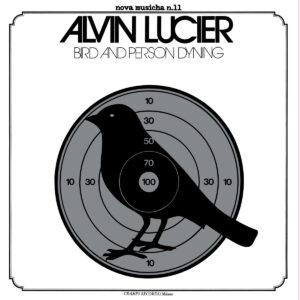
At long last, after decades out of print, joining their growing Cramps Records Reissue Series, Dialogo brings us the long-awaited vinyl reissue of Alvin Lucier's "Bird and Person Dyning", the composer's first solo LP. As legendary as they come, and easily among the most important and groundbreaking efforts in experimental music ever recorded, this is Lucier at his most visionary. Issued in a limited edition of 300 copies of black vinyl, with fully remastered audio, housed in a sleeve that beautifully reproduces the original design, complete with brand new English translations of the original liner notes, it doesn't get better than this.
26,00€
In stock

2 LP
Alvin LUCIER
“Works for the Ever Present Orchestra”
Black Truffle's documentation of the prolific recent work of legendary American composer Alvin Lucier continues with Works for the Ever Present Orchestra. This is a very special release for the composer, as it presents pieces written for the thirteen-member Ever Present Orchestra, formed in 2016 exclusively to perform Lucier's works. At the heart of the ensemble are four electric guitars, an instrument Lucier began composing for in 2013 with Criss-Cross (recorded by two core members of the Ever Present Orchestra, Oren Ambarchi and Stephen O'Malley, for whom it was composed, on Black Truffle 033). Through the use of e-bows, the guitars take on a role akin to the slow sweep pure wave oscillators heard in many of Lucier's works since the early 1980s, but with added harmonic richness. Like much of Lucier's instrumental music, the pieces recorded here focus on acoustic phenomena, especially beating patterns, produced by the interference between closely tuned pitches. The work presented here is some of the richest and most inviting that Lucier has composed. Though all of the pieces clearly belong to the same continuing exploration of the behaviour of sound in physical space and make use of related compositional devices, each takes on a strikingly different character. Titled Arc, for the full ensemble of four guitars, four saxophones, four violins, piano and bowed glockenspiel inhabits a world of sliding, uneasy tones, punctuated by a single piano note. Where Double Helix, for four guitars, rests on a pillow of warm, low hum, EPO-5, for two guitars, saxophone, violin, and glockenspiel possess a limpid, crystalline quality. Accompanying the four new compositions are two adaptations of existing pieces for radically different instrumentation, demonstrating Lucier's excitement about the new possibilities suggested by this dedicated ensemble. Works for the Ever Present Orchestra is an essential document of the current state of Lucier's continuing exploration, as well as offering a seductive entry-point for anyone who might yet be unacquainted with his singular body of work.
Presented in a deluxe gatefold sleeve with cover artwork and liner notes from Alvin Lucier. Includes a download code featuring hi-res versions of the LP material. The download code also includes the bonus Adaptions for the Ever Present Orchestra featuring two pieces ("Two Circles" and "Braid") that are not included on the LP version. Mastered by Rashad Becker. Design by Lasse Marhaug.
26,00€
Out of stock
2 CD
Alvin LUCIER
“Works for the Ever Present Orchestra”
Black Truffle's documentation of the prolific recent work of legendary American composer Alvin Lucier continues with Works for the Ever Present Orchestra. This is a very special release for the composer, as it presents pieces written for the thirteen-member Ever Present Orchestra, formed in 2016 exclusively to perform Lucier's works. At the heart of the ensemble are four electric guitars, an instrument Lucier began composing for in 2013 with Criss-Cross (recorded by two core members of the Ever Present Orchestra, Oren Ambarchi and Stephen O'Malley, for whom it was composed, on Black Truffle 033). Through the use of e-bows, the guitars take on a role akin to the slow sweep pure wave oscillators heard in many of Lucier's works since the early 1980s, but with added harmonic richness. Like much of Lucier's instrumental music, the pieces recorded here focus on acoustic phenomena, especially beating patterns, produced by the interference between closely tuned pitches. The work presented here is some of the richest and most inviting that Lucier has composed. Though all of the pieces clearly belong to the same continuing exploration of the behaviour of sound in physical space and make use of related compositional devices, each takes on a strikingly different character. Titled Arc, for the full ensemble of four guitars, four saxophones, four violins, piano and bowed glockenspiel inhabits a world of sliding, uneasy tones, punctuated by a single piano note. Where Double Helix, for four guitars, rests on a pillow of warm, low hum, EPO-5, for two guitars, saxophone, violin, and glockenspiel possess a limpid, crystalline quality. Accompanying the four new compositions are two adaptations of existing pieces for radically different instrumentation, demonstrating Lucier's excitement about the new possibilities suggested by this dedicated ensemble. Works for the Ever Present Orchestra is an essential document of the current state of Lucier's continuing exploration, as well as offering a seductive entry-point for anyone who might yet be unacquainted with his singular body of work.
Presented in a deluxe gatefold sleeve with cover artwork and liner notes from Alvin Lucier. Includes a download code featuring hi-res versions of the LP material. The download code also includes the bonus Adaptions for the Ever Present Orchestra featuring two pieces ("Two Circles" and "Braid") that are not included on the LP version. Mastered by Rashad Becker. Design by Lasse Marhaug.
16,00€
In stock
LP
Alvin LUCIER
“Criss Cross / Hanover”
*** Repress ***
Black Truffle is honoured to present the premier recordings of two recent works by legendary American experimental composer Alvin Lucier. A friend and contemporary of pioneers like Robert Ashley, David Behrman, Gordon Mumma, and Christian Wolff, Lucier has been crafting elegant explorations of the behavior of sound in physical space since the 1960s. Lucier is perhaps best known for I Am Sitting in a Room (1970), in which he repeatedly re-recorded his own speaking voice being played back into a room until the room’s resonant frequencies entirely obscure the spoken text. Beginning in the early 1970s, he has written a remarkable catalogue of instrumental works that focus on phenomena produced by the interference between closely tuned pitches, such as audible beating, often using pure electronic tones produced by oscillators in combination with single instruments.
Demonstrating the restless creative drive of an artist now in his 80s, the two recent works presented here both feature the electric guitar, an instrument Lucier has just recently begun to explore. In Criss-Cross, Lucier’s first composition for electric guitars, two guitarists using e-bows sweep slowly up and down a single semitone, beginning at opposite ends of the pitch range. The piece is a model of simplicity, exemplifying Lucier’s desire not to ‘compose’ in the conventional sense, but rather to eliminate everything that ‘distracts from the acoustical unfolding of the idea’. In this immaculately controlled performance of Criss-Cross by Oren Ambarchi and Stephen O’Malley, (for whom the piece was written in 2013), a seemingly simple idea creates a rich array of sonic effects – not simply beating patterns, which gradually slow down as the two tones reach unison and accelerate as they move further apart, but also the remarkable phenomenon of sound waves spinning in elliptical patterns through space between the two guitar amps.
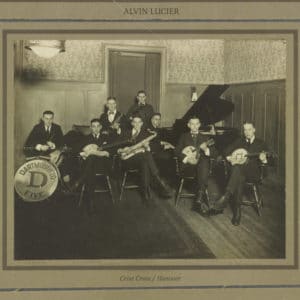
In the comparatively lush Hanover, Lucier draws inspiration from the beautiful photograph that provides the LP with its cover, an image of the Dartmouth Jazz Band taken in 1918 featuring Lucier’s father on violin. Using the instrumentation present in the photograph, Lucier creates an unearthly sound world of sliding tones from violin, alto and tenor saxophones, piano, vibraphone (bowed) and three electric guitars (which take the place of the banjos present in the photograph). Waves of slow glissandi create thick, complex beating patterns, gently punctuated by repeated single notes from the piano. The result is a piece that, like much of Lucier’s instrumental music, is simultaneously both unperturbably calm and constantly in motion.
Stunning LP design by Stephen O’Malley including an inner sleeve with a portrait of Alvin Lucier by Kris Serafin.
“Criss-Cross” recorded at Studios Ina GRM, Paris by Francois Bonnet and mixed by Alvin Lucier. “Hanover” recorded in Zurich and mixed by Alvin Lucier.
Mastered and cut by Rashad Becker at D&M Berlin.
20,50€
Out of stock

LP
Alvin LUCIER
“Vespers”
Vespers (1969) and Chambers (1968), the two works featured on this LP, witness Lucier rethinking the material and conceptual possibilities of music at every turn. First released as Lucier's contribution to the Sonic Arts Union's lone LP, Electronic Sound, in 1972, Vespers is a work generated by two equal actors —the performers and the space that they occupy. Conceived following a chance encounter with hand-held echolocation technology —the Sondol™, a pulse oscillator that emits short, sharp pulses at variable repetition speeds, producing echoes from the reflecting walls of a space to register relative location and orientation— it stands as one of the first works in history within which the decisions made during the performance are solely based on acoustics, allowing sound to be equally the content and structural determiner.
Written as a poetic "prose score", for the realization of Vespers, each performer is equipped with a Sondol™ and asked to move blindfolded within a defined space, moving from one point to the next using only echolocation, taking what Lucier describes as "sound photographs" that reveal discrete details of the given area. As the recording unfolds, the aptitude of this image becomes increasingly clear. While an aesthetic relationship to the movement of musical minimalism, embarked upon by a number of his peers, has often presented itself within Lucier's work, of all of them this is arguably most present within Vespers. Despite the radical leap it presented within the history of the sonic arts, Vespers was not the first of Lucier's works that began to specifically address the relation between sound, perception, and space. Notably Chambers, composed the year before in 1968 and embedded with the wry humor which lingers below much of the composer's output, explored the theme on a brilliantly miniature scale.
As a total work, Chambers contends with the relationship between the knowing and understanding of what we hear, our perception of the source of a sound, and its relation to space. When viewed in the immediate context of Vespers, as it is here, it presents as an unexpected inversion of what was to come. While it plays on the relation of sight and the sonic actor, here what is seen and unseen takes on a dynamically different role. Equally, there is not one space to perceive, but many. For the realization of Chambers, battery-operated radios, tape recorders, and various kinds of electric toys are hidden in paper bags, shoes, kettles, a suitcase, and other small resonant spaces, which not only limit the perception of these object to their sounds alone, but take on the role of acoustic actors on the sounds within, each space becoming as individual and distinct as the object it contains. Taking it one step further, rather than being static, these "chambers" are carried by performers into larger ones —those in which the work is performed— further altering the sounds which occupy them, drawing the ear, once again, to the action of that which contains a body of sound.
Vespers is released by Blume in an edition of 300 copies on 160gr audiophile coloured (dark blue) vinyl, housed in the label's traditional monochrome package coming with a newly designed obi-strip/insert with an introduction by Robert Ashley, liner-notes by Bradford Bailey and Gaia Martino, and also including a printed inner sleeve housing a Nagaoka anti-static record sleeve, plus an all-new transparent colour-matching outer plastic sleeve. Photography by Mary Lucier.
21,00€
In stock
2 CD
Alvin LUCIER
“String noise”
Continuing Black Truffle's series of releases documenting the recent work of legendary American experimental composer Alvin Lucier, String Noise presents three major works for violin solo and duo composed between 2004 and 2019. Lucier has developed his compositions in close collaboration with many instrumentalists over the years; the three works presented here are performed by the violinists for whom they were originally written, Conrad Harris and Pauline Kim Harris, who together make up the innovative violin duo String Noise, and have premiered works by a plethora of major figures in contemporary music. The long-form compositions presented here continue Lucier's life-long exploration of acoustic phenomena, drawing on aspects of some of his most well-known compositions and extending them into new instrumentation. Tapper (2004) extends the experiments with echolocation – gathering information about an environment by listening to the echoes of sounds produced within it – that Lucier began with his classic 1969 work Vespers, where performers explore a space equipped with hand-held pulse oscillators. Here, the same principle is put into practice for solo violin, the body of which the performer taps repeatedly with the butt end of the bow while moving around the performance space. The result is a subtly shifting web of echoes and resonances produced by the reflection of the sharp tap off the surfaces of the room (in this case, the Drawing Center in New York). In Love Song (2016), two violinists are connected by a long wire stretched between the bridges of their instruments, causing the sounds played on one violin to also be heard through the other. As the two violinists play long tones using only the open E string, they move in a circular motion around the performance space, thus changing the tension of the wire, which creates a remarkable array of variations in pitch and timbre ranging from ghostly wavering pitches reminiscent of a singing saw to near-electronic tones. In Halo (2019), one or more violinists walk slowly through the performance space in a zig-zag pattern while sustaining long tones. As in Tapper, the consistent sound production reveals the sonic properties of the environment. As the title of the piece suggests, the outcome is a shimmering halo of sound produced by the reflection of the violin's extended tones off the walls and ceiling of the performance space (in this case, Alvin's home).
2CD release presented in a deluxe 4-panel digipak with liner notes by Alvin Lucier, live images and artist bios. Sleeve design by Lasse Marhaug. Mastered by Tom Hamilton.
14,50€
In stock

CD
Alvin LUCIER
“Orpheus Variations”
Orpheus Variations is a new composition by Alvin Lucier for solo cello and seven wind instruments. It is based on a particular sonority from the first movement of Igor Stravinsky's ballet score, Orpheus; a sonority that has haunted Lucier for decades.
Orpheus Variations is one of eight large-scale compositions made expressly for Charles Curtis by Alvin Lucier in the last 15 years. This performance was conducted by Petr Kotik, with Charles Curtis playing solo cello alongside members of the SEM Ensemble.
"Lucier speaks first of a sonority, and only then of a chord. He discusses the chord, its notes and their disposition, but what haunts him is a "particular sonority." A sonority is the product of physical action on physical materials: the instruments, the registers in which they are activated, the breath of the musicians, the waveforms thus produced, their merging and interfering, and finally the moment and place of these actions. An energy field, certain to vanish completely once the musicians put down their instruments. However concrete and real the actions and materials, the sonority they produce is a phantom."
14,00€
In stock

CD
Alvin LUCIER
“Ricochet lady”
The recently composed "Ricochet Lady" (2016) is the only work for solo acoustic glockenspiel by the American experimental composer Alvin Lucier. Following in the manner of his pieces "I Am Sitting In A Room" and "Vespers", "Ricochet Lady" embodies Lucier's approach toward sound's individual function and mobility within space. This CD defines this approach through four realizations recorded in four dissimilar spaces, ranging from the standard to extraordinary: a university rehearsal hall with walls of drywall and glass, a chapel made of oak and stone, an empty forge and foundry warehouse for steel railway wheels, and a 36-meter tall dilapidated cement grain elevator. Never one to shy away from convention, Lucier intensifies each performance by instructing that the glockenspiel be placed against a wall or other reflective surface where the soloist systematically traverses the entire range of the instrument in rapid, repetitive patterns, actively disseminating the glockenspiel's sustain, clicks, and interferences throughout the space. In doing so, the glockenspiel maps the unique acoustical characters of each space as each space helps to compose the piece. Created in close collaboration with Trevor Saint, a rare (if not the only) specialist of experimental music for glockenspiel, Lucier has further enhanced the sophistication of this re-imagined instrument while maintaining his devotion to letting spaces speak. Presented in a stunning digipak with liner notes by Alvin Lucier and Trevor Saint. Design by Lasse Marhaug. Mixed and mastered by Matt Sargent at Bard College, Annandale-on-Hudson, New York. (For an optimal listening experience it is recommended that these recordings be played at high volume).
14,00€
Out of stock

CD
Alvin LUCIER
“Broken line”
“Carbon Copies” (1989) for recordings “of any indoor or outdoor environment” and instrument.
“Risonanza” (1982) for resonant objects and optional electronics.
“Music for Pure Waves, Bass Drums and Acoustic Pendulums” (1980).
“Broken Line” (2006) for flute, piano & vibraphone written for Trio Nexus.
Performed by Trio Nexus (Erik Drescher, Sebastian Berweck, Martin Lorenz).
Alvin Lucier (b.1931) is the great American poet of acoustic phenomena. He has a keen sensitivity to the way objects vibrate, the way sound waves travel to our ears, and to the way our brain processes those vibrations. Trio Nexus is a Berlin based ensemble specializing in New Music.
Carbon Copies seeks the recreation on musical instruments of sounds recorded in the environment. Here, the musicians prepare the piece by making their own 15-minute recordings “of any indoor or outdoor environment.” These are then played back simultaneously. The musicians then mimick the environment which they hear on their instruments; then the recording is faded out and they continue to play via looping, or by anticipating, delaying, truncating or elongating the sounds at will.
Risonanza takes the central idea to find an object that can be excited by sound such that it responds with a sound of its own, as though becoming, in the composer’s words, a “non-breathing player,” a fourth member of the ensemble.
Music for Pure Waves, Bass Drums and Acoustic Pendulum has the concept that electronic sounds - what Lucier calls a “slow sweep oscillator” which makes a slow, continuous glissando movement - excite the skins of four large bass drums, causing them to vibrate and to set in motion extremely light pendulums suspended in front of them. As the bass drums begin to vibrate under excitation from the oscillator, the pendulums begin to swing, as if by magic, more or less actively, gently striking the drumhead in a regular rhythm.
Broken Line, written for Trio Nexus, is about as close as Lucier has ever come to writing chamber music in the traditional sense. The piece consists of a series of flute glissandi spanning the intervals of a semitone, major second and minor third respectively. Vibraphone and piano play long tones during the glissandi, creating either unisons, octaves, or fifths and twelfths against the flute lines. Because the flute tone is continuously in motion this has the effect of creating beats - audible “wah wah” patterns in the sound. These gentle rhythmic fluctuations - which appear of their own accord without the performers needing to do anything - are like the flickering of a candle in the wind.
Liner notes by Bob Gilmore.
16,50€
Out of stock

CD
Alvin LUCIER
“Orchestral works”
“Diamonds for 1, 2, or 3 orchestras” [for three orchestras] (1999), “Slices” [for cello and orchestra] (2007), “Exploration of the house” (2005).
Janá ek Philharmonic Orchestra, Christian Arming, Petr Kotik, and Zsolt Nagy,
conductors; Charles Curtis, cello solo, with members of the San Diego
Symphony.
For nearly fifty years the work of Alvin Lucier (b. 1931) has marked off a space unlike any other in American music. By now a hero to three generations of experimentalists, Lucier continues to make work at a brisk pace, finding new, surprising and radical approaches to the same artistic concerns. His subject is the human as listener, and his music can be understood as a detailed, exhaustive investigation into the complexities of the act of listening. The results are often uncanny, but the approach is through the familiar and the ordinary; and the production is invariably of rare composerly discipline and exactness of execution. The three works presented on this album set forth three perspectives on the orchestra, monument of the European concert tradition. In each work we hear unmistakable echoes of the familiar iconography of the orchestra, associations with the past that are the bearers of complex meanings. Yet in a kind of tandem reality, sound itself pushes forward, bringing us back to the present, to our immediate presence as listeners, and to meanings independent of association. The world construed as what is known, as a set of received notions, is gently put in question; another world, the one we live in moment to moment, is briefly illuminated.
Janá ek Philharmonic Orchestra, Christian Arming, Petr Kotik, and Zsolt Nagy,
conductors; Charles Curtis, cello solo, with members of the San Diego
Symphony.
For nearly fifty years the work of Alvin Lucier (b. 1931) has marked off a space unlike any other in American music. By now a hero to three generations of experimentalists, Lucier continues to make work at a brisk pace, finding new, surprising and radical approaches to the same artistic concerns. His subject is the human as listener, and his music can be understood as a detailed, exhaustive investigation into the complexities of the act of listening. The results are often uncanny, but the approach is through the familiar and the ordinary; and the production is invariably of rare composerly discipline and exactness of execution. The three works presented on this album set forth three perspectives on the orchestra, monument of the European concert tradition. In each work we hear unmistakable echoes of the familiar iconography of the orchestra, associations with the past that are the bearers of complex meanings. Yet in a kind of tandem reality, sound itself pushes forward, bringing us back to the present, to our immediate presence as listeners, and to meanings independent of association. The world construed as what is known, as a set of received notions, is gently put in question; another world, the one we live in moment to moment, is briefly illuminated.
14,00€
Out of stock
CD
Alvin LUCIER
“Vespers and other early works”
Alvin Lucier (b. 1931) is best known for his pioneering work in the mid-sixties in the exploration of sonic environments, particularly sounds that we would never perceive under ordinary circumstances. Vespers and Other Early Works restores to the catalog several of his key works from that time. In ’Vespers’ (1969) performers with Sondols (sonar-dolphin), hand-held pulse wave oscillators, explore the acoustic characteristics of given indoor or outdoor spaces by monitoring the echoes of the pulse waves off the walls, floors and ceilings, as well as any objects or obstacles in range of the sound waves. Over time, the listener receives an acoustic signature of the room. In ’Chambers’ (1968), battery-operated radios, tape recorders, and electronically powered toys of various kinds are hidden in paper bags, shoes, kettles, and small suitcases and other small resonant environments. As performers carry these small ’rooms’ into larger ones, such as concert halls, football stadiums and underground cisterns, the sounds, already altered by the acoustics of the small environments, are altered a second time by the acoustics of the larger ones. This version was recorded in 2002. ’North American Time Capsule’ (1967), for voices and vocoder, is described metaphorically by Lucier as a message to listeners who don’t know about us. ’(Middletown) Memory Space’ (1970) is a reenactment of the composition called ’(Hartford) Memory Space’, for any number of instrumental players with recordings of environmental sounds. ’Elegy for Albert Anastasia’ (1961-1963) is described as composed ’for electromagnetic tape using very low sounds most of which are below human audibility.”
13,00€
In stock
CD
Alvin LUCIER
“Sferics – Music for solo performer”
“Sferics is the shortened term for atmospherics, natural radio-frequency emissions in the ionosphere, caused by electromagnetic energy radiated from nearby or distant lightning. These signals - resonant clicks and pops, called tweeks and bonks by scientists - occur in the audible range of humans and may be picked up by antennas and amplified for listening. They are best received at night, far from power lines. Occasionally, certain sferics get caught on and travel long distances along the magnetic flux lines around the earth, producing whistlers - downward-gliding signals which may last up to two or three seconds. My interest in sferics goes back to 1967, when I discovered in the Brandeis University Library a disc recording of ionospheric sounds by astrophysicist Millett Morgan of Dartmouth College. I experimented with this material, processing it in various ways - filtering, narrow band amplifying and phase-shifting - but I was unhappy with the idea of altering natural sounds and uneasy about using someone else’s material for my own purposes. I wanted to have the experience of listening to these sounds in real time and collecting them for myself. When Pauline Oliveros invited me to visit the music department at the University of California at San Diego a year later, I proposed a whistler recording project. Despite two weeks of extending antenna wire across most of the La Jolla landscape and wrestling with homemade battery-operated radio receivers, Pauline and I had nothing to show for our efforts. About ten years later composer Ned Sublette, who was interested in radio waves of all kinds, recommended a book by Calvin R. Graf, Listen to Radio Energy, Light and Sound, which describe a simple method of building a large loop antenna with which to receive these natural phenomena. Sferics was recorded by the composer on August 27, 1981, in Church Park, Colorado. The sound material was collected continuously from midnight to dawn with a pair of homemade antennas and a stereo cassette tape recorder. At regular intervals the antennas were repositioned in order to explore the directivity of the propagated signals and to shift the stereo field.”
15,00€
In stock
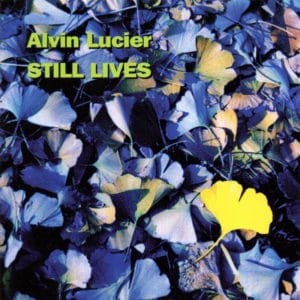
CD
Alvin LUCIER
“Still lives”
Three new pieces for piano soloist with accompanying pure wave oscillation. Titles: “Music for Piano with Slow Sweep Pure Wave Oscillators”(performed / composed for Marilyn Nonken), “On the carpet of leaves illuminated by the moon” (performed / composed for Ryuko Mizutani), and “Still Lives” (performed / composed for Joseph Kubera). All pieces exhibit Lucier’s unique take on performance-environment concepts. Quiet, melancholy, rather soothing. Gaining age with grace I suppose.” Hrvatski
14,00€
In stock
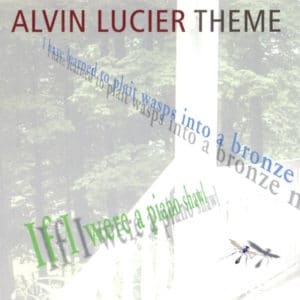
CD
Alvin LUCIER
“Theme”
New 1999 release previously unrecorded Lucier works from the mid-90s. Features: “Music for Piano with Magnetic Strings” (performed by Lois Svard, piano), “Theme” (Sam Ashley, Thomas Buckner, Jacqueline Humbert and Joan La Barbara, voices set to a poem by John Ashbery) and “Music For Gamelan Instruments, Microphones, Amplifiers and Loudspeakers” (performed by the Wesleyan University Gamelan Ensemble). “ ‘Music For Piano...’ is a work in which the strings of a piano sound by themselves. Several EBows (small electromagnets used primarily with electric guitars) are placed on the strings of the piano. The pianist works from a prose score which describes the process and suggests (s)he freely position and reposition five EBows on the piano strings, creating strands of sounds of varying density and texture. Much of the pianist’s time is spent listening for harmonics, audible beating, occasional rhythms produced as one or more magnets vibrate against adjacent strings, and other acoustic phenomena. ‘Theme’ sets a poem of John Ashbery’s to music. Lucier didn’t want to violate the flow of the words of the poem by fragmentation or any other cut-up method. The stanzas seemed musical enough just as they were, and he wanted the audience to hear the poem more or less in its pristine state. So working intuitively and by ear, he wrote out the poem for four readers in the order it was written, repeating words and phrases, overlapping and superimposing them in various ways. To ’set’ the poem, he inserted microphones into the mouths of various vessels, including a small milk bottle, a sea shell, a vase , and an empty ostrich egg, to pick up the words as they were sounding inside the vessels. The readers speak normally, alllowing the pitches of their voices which match those resonances of the vessels to create musical sounds.”a
14,00€
Out of stock
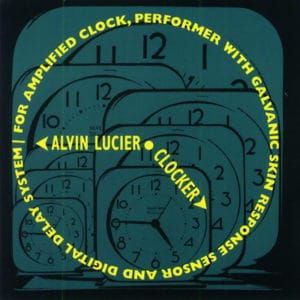
CD
Alvin LUCIER
“Clocker”
“For amplified clock, performer with galvanic skin response sensor, and digital delay system; Alvin Lucier, performer; recorded by Nicolas Collins. Through the means of a galvanic skin response sensor driving a digital delay on a miked clock, Lucier creates the illusions of time expanding and contracting, and of a room that is changing in size. Another classic Lucier catalog item, a 45-minute recording made in 1991 of this piece that he first conceived in 1978. The piece is for: amplified clock, performer with galvanic skin response sensor and digital delay system. The sounds that emanate are beautifully shifting patterns of tock-collage that reveal dramatic sonic detailings. "I wanted to make a work in which a performer could speed up and slow down time, stopping it, if possible, simply by thinking. I bought a Westclox Silver Bell Monogram in a local store and ordered a galvanic skin response sensor through the Edmund Scientific Catalogue. A GSR is designed to measure differences in skin resistance caused by changes in emotional state. A small current is sent through the body, the response to which is amplified, producing an output voltage which can be used to control various devices...later I added a bank of fixed delays which, as they splay out from the voltage controlled delay, create multiple reflections that almost convince the listener that the room is changing size.”
14,00€
In stock
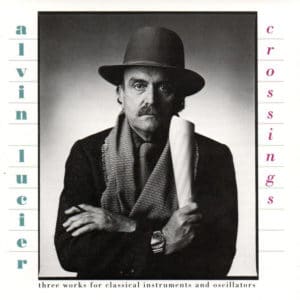
CD
Alvin LUCIER
“Crossings”
1990 CD reissue of prime-era Lucier product, with works from 1982-85. Features ’In Memoriam Jon Higgins (for clarinet in A and slow-sweep pure wave oscillator)’, ’Septet for Three Winds, Four Strings and Pure Wave Oscillator’, and ’Crossings (for small orchestra with slow-sweep pure wave oscillator)’. Said slow-sweep pure wave oscillator produces slowly swept pure waves that oscillate (on separate occasions) a clarinet, three winds and four strings, and a small orchestra. Maximum beat frequency heterodyning, often at an audible pitch. Similar acoustic phenomena as Tony Conrad/Penderecki string work and just as aurally stimulating (for those with lazy ear-ciliae). Hrvatski.
12,00€
Out of stock
CD
Alvin LUCIER
“I am sitting in a room”
Alvin Lucier, recorded voice. “In this fascinating exploration of acoustical phenomena, Alvin Lucier slips from the domain of language to that of music in the course of 40 minutes and 32 repetitions of a simple paragraph of text. In I am sitting in a room, several sentences of recorded speech are simultaneously played back into a room and re-recorded there many times. As the repetitive process continues, those sounds common to the original spoken statement and those implied by the structural dimensions of the room are reinforced. The others are gradually eliminated. The space acts as a filter; the speech is transformed into pure sound. All the recorded segments are spliced together in the order in which they were made and constitute the work. I am sitting in a room was composed in 1970 and was first performed at the Guggenheim Museum in New York City that same year. A second version was made in 1972 to accompany the dance, Dune, performed by the Viola Farber Dance Company at the Brooklyn Academy of Music. Since that time, numerous versions of this composition have been realized in various ways by other musicians, including a Swedish radio broadcast version. This recording was made by Alvin Lucier on October 29th and 31st, 1980, in the living room of his home in Middletown, CT. The material was recorded on a Nagra tape recorder with an Electro-Voice 635 dynamic microphone and played back on one channel of a Revox A77 tape recorder, Dynaco amplifier and a KLH Model Six loudspeaker. It consists of thirty-two generations of Alvin Lucier’s speech and was made expressly for Lovely Music, Ltd.”
12,00€
In stock
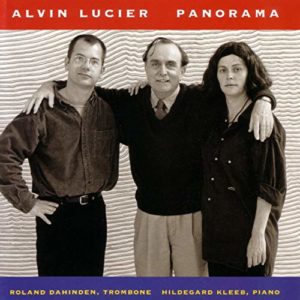
CD
Alvin LUCIER
“Panorama”
Consists of 1990-94 recordings, released in ’97. "A gorgeous recording of works for trombone and piano, transformed by Lucier’s electronics and oscillators. ’Wind Shadows’ (1994), ’Music for Piano with One or More Snare Drums’ (1990), and ’Panorama’ (1993) -- were written for the Swiss musicians Roland Dahinden and Hildegard Kleeb, who play them on this CD. Also included: ’Music for Piano with Amplified Sonorous Vessels’ (1990), which was originally written for Margaret Leng Tan."
14,00€
In stock
CD
Alvin LUCIER
“Music on a long thin wire”
Alvin Lucier, concept & design; the Wire. “A 50-foot length of taut wire passes through the poles of a large magnet and is driven by an oscillator; the vibrations of the wire are miked at either end, amplified and broadcast in stereo. The thin wire is set vibrating four times at four different frequencies; what results is not the low drone one might expect from a long, vibrating wire, but a complexity of evocative, ethereal chords. First released on Lovely Music in 1980, Music on a Long Thin Wire is a classic example of Alvin Lucier’s investigations into the physics of sound and the sonic properties of natural processes.”
12,00€
In stock

2 CD
Alvin LUCIER
“Almost New York”
“CD 1 - Twonings: Charles Curtis, cello; Joseph Kubera, piano; Almost New York: Robert Dick, flutes; Broken Line: Robert Dick, flute; Danny Tunick, vibraphone; Joseph Kubera, piano. CD 2 - Coda Variations: Robin Hayward, tuba. Pogus is extremely delighted to be release this 2 CD set of recordings of works by Alvin Lucier. He is one of the key experimental artists of the 20th and 21st centuries, and is one of my favorite composers. A unique and individual artist: No one sounds quite like Alvin Lucier. Lucier writes about the genesis of the works on this release: Since the early 1980’s I have made a series of works for conventional musical instruments. Before that time I had been mainly occupied with the exploration of such phenomena as echolocation, brain waves, room acoustics and the visual representation of sound. Often these works required special equipment hand held pulse wave oscillators (Vespers), differential amplifiers (Music for Solo Performer), horseshoe magnets Music on a Long Thin Wire). Then players began asking me for pieces. Now I needed to find a way of achieving the same poetry with acoustic instruments as I did with electronic means. One of the things I discovered was that players could create rhythmic patterns by closely tuning with electronically generated pure waves or with each other, producing audible beats. Often, to get continuous motion, I have one or more voices sweep up or down at various speeds against fixed sustained pitches. As a wave approaches a sustained pitch the audible beating slows down to zero when it reaches unison, then speeds up again as the wave leaves the pitch. Almost New York employs slow sweep pure wave oscillators, Broken Line, flute glissandi. In Twonings two different tuning systems collide and in Coda Variations slight variations in pitch are heard chronologically. Recorded by Charles Curtis, Joseph Kubera, Robert Dick, Danny Tunick, and Robin Hayward - some of the leading new music performers of our era, these works are essential additions to the Alvin Lucier oeuvre, as well as satisfying anyone interested in great experimental music.” label info
18,50€
Out of stock
2 CD
Alvin LUCIER
“Still and moving lines of silence in families of hyperbolas”
2 CD release of of a four-part work, initiated in 1972 and recorded as presented here in 1983-4 and 2001. This reissues two long-out-of-print LPs on Lovely, with four added parts (the strings) released for the first time. A series of mostly solo instrument works for the likes of: clarinet, marimba, viola, voice, xylophone, violin, flute, glockenspiel, cello, horn, vibraphone. Performed by: Thomas Ridenour, William Winant, Dan Panner, Rebecca Armstrong, Conrad Harris, Susan Palma, Gregory Hesslink, James de Corsey. An absolute masterpiece of “interference sound”.
23,50€
Out of stock
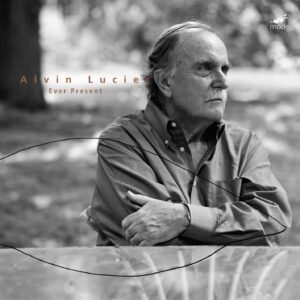
CD
Alvin LUCIER
“Ever Present”
“Piper” (2000) Matt Welch, bagpipe. Fan” (2003) Miki Maruta, Ryuko Mizutani, Kayoko Nakagawa, and Yoko Nishi, kotos. “947” (2001) Jacqueline Martelle, flute. Silver Streetcar for the Orchestra” (1988) Brian Johnson, triangle. “Ever Present” (2002) Drescher-Okabe-Armbruster Trio: Erik Drescher, flute; Akiko Okabe, piano; Sascha Armbruster, alto saxophone. Alvin Lucier’s (b. 1931) works on this CD, for solos and trios, continue to explore his unique sound world, exploration of microtones, and use of unusual instrumentation. Liner notes by the composer: “Piper is probably one of the few avant-garde pieces composed for the bagpipe. The piper is asked to walk slowly around the performance space, sounding his instrument as he does so. From time to time he detunes the chanters, creating beating patterns of slightly varying speeds and minor spatial disturbances (imaginary dopplers). In Fan, 4 koto players play a long series of plucked tones over a 12-minute time span, gradually stepping up to 4 semitones above the starting tone and slowing down to 1 beat every 2, 3, 4, and 5 seconds. As they do so, audible beating at various speeds occurs among the plucked sounds of the instruments. During the course of 947, 4 pure tones are sounded in all their combinations. As they do so a flutist sustains closely tuned long tones against them, creating audible beats at speeds determined by the distances between her tones and those of the pure waves. The farther apart the faster the beating. At unison no beating occurs. Occasionally the flutist bends her pitches a few cycles per second causing the beating patterns to slow down and speed up. In Silver Streetcar, the player dampens the triangle with the thumb and forefinger of one hand while tapping the instrument with the other. The performance consists of moving the geographical locations of these two activities and changing the pressure of the fingers on the triangles as well as the speed and loudness of the tapping. During the course of the performance, the acoustic characteristics of the folded metal bar are revealed. Ever Present is inspired by Robert Irwin’s garden at the Getty Center in Los Angeles. Tone waves in constant motion sweep up and down as the players sustain long tones across them, creating beating patterns at speeds determined by the closeness of the tunings. Four first recordings.”
15,00€
In stock

CD
Alvin LUCIER
“Two Circles”
“Two Circles” (2012) for flute, clarinet, violin, cello, piano and pure wave oscillators. “Fideliotrio” (1986) for viola, cello and piano. “Three Translations of the Works of Maurizio Mochetti” (2008) for flute, clarinet, violin, cello and piano.
All performed by Alter Ego.
“I am Sitting in a Room” (1968) for speaking voice and electronics. Performed by Alvin Lucier.
Alvin Lucier’s (b.1931) work has been more often described in terms of science than of art and his scores often contain experimental procedures. Lucier perfectly represents the fusion of a scientist with an artist. His pieces arise from an inspection of a pure physical phenomenon.
The performers on Mode’s fourth disc of Lucier’s music are the Italian experimental music ensemble Alter Ego — two of the works were written for or dedicated to them — and Alvin Lucier himself.
This new recording of his classic I am Sitting in a Room is from the Biennale Musica 2012 in Italy. This is Lucier’s first new recording of the work since the original from 1980.
The interaction of electronic and acoustic sounds is the central point of Two Circles. These electronic sounds move from the same note in two glissandi, ascending and descending. The acoustic instruments interfere, generating beating (so-called binaural beats) from the interaction of closed frequencies. In some cases, these pulsations give the impression to expand the sonic space, whilst in others they appear to bring to an ending.
In a comparable way, Fideliotrio focuses its attention on the tonal interplays between instruments. In this case, cello, viola and piano form a steady flux: the central note of the piano designs a sort of line around which the string instruments move. When the viola and cello start to drift away from piano’s tone, one may have the impression that the sonic stream is bending and is losing its center of gravity.
Artist Mochetti’s work focuses on light, space, time; it explores the use of materials and often includes a unique conception of the geometry, made of trajectories, lines and surfaces. In the Three Translations of the Works of Maurizio Mochetti, Lucier transfers the exploration of these elements to sound as he literally designs sonic profiles, reflections and music shapes.
The booklet includes an interview with Lucier and flutist Manuel Zurria and liner notes by Riccardo Dillon Wanke and Alvin Lucier.
16,00€