
In stock

3 LP
Octavian NEMESCU
“Passages … à travers le Temps”
3LP + 8 page booklet in offset printed slipcase sleeve.
*One of Romania's most important composers in the last half-century, Octavian Nemescu (1940-2020) is among the few that were not "part of the system", managing to survive and compose in a world that felt more and more "empty", fragile, confused and scarce in prophecies. The mystical approach to his art defines Octavian Nemescu as an essentialist who believed in the power of archetypes in which he found inspiration. His pieces always start from an idea that has spiritual, cosmogonic implications and involves synthesizers, samples from nature and the "ison" (drone) inherent in the spectral current. When defining "meta music" or "imaginary music", Nemescu was an advocate of looking from above, from the top of the mountain. Silence is very important in his work in order to keep the sound flowing and to reflect on the sound from before, as a space, as a pause for thinking. Nemescu put forward another kind of music: a song that has not yet surfaced through human voice, any musical instrument, orchestra or other electro-acoustic means: an intimate, interior, introverted inner sound that focuses on the individual and the imagination. Imaginary music is a reaction, it comes in contrast to the spectacular, it is anti-show. For him, music had a ritualistic function, it served no cultural purpose. This 3LP set collects eight pieces for variable ensemble, tape and electronics, composed between 1968 and 2015, selected together with Erica Nemescu, who also mastered the tracks. Most tracks have been previously released on different CD's but never before on vinyl.
58,00€
In stock
3 LP
Limpe FUCHS – Mark FELL
“Dessogia / Queetch / Fauch”
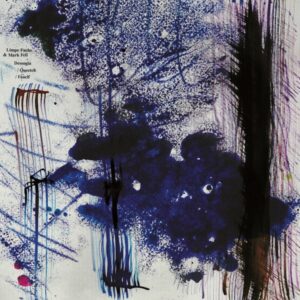
The 2015 edition of Winnipeg's send + receive festival, focussed on rhythm, turned out to be a generative meeting of minds. There, Mark Fell encountered the music of Will Guthrie, a meeting that was eventually to result in the frenetic acoustic drumkit and digital synthesis pairing heard on Infoldings and Diffractions (2020). At the same festival, Limpe Fuchs first heard and appreciated the music of Mark Fell, planting the seed of a collaboration that came to fruition when Fell (along with his son Rian Treanor) visited Fuchs at her home in Peterskirchen, Germany in September 2022. Black Truffle now presents the release of the results of this extensive session in the audacious form of a triple LP, housing over two hours of music across its six sides. The collaboration might appear unlikely: what common ground could exist between Fuchs, classically trained pianist, legend of improvised music, instrument builder and sound sculptor active since the 1960s, whose group Anima Sound connected the dots between free jazz, krautrock and ritual, and Fell, proponent of radical computer music, known for his bracingly austere productions that twist remnants of club music into algorithmic stutters. For all their seeming disparity in technology, approach and background, the music on Dessogia/Queetch/Fauch makes it immediately evident the pair share a great deal in their essentially percussive approach and ability to, in Fuch's phrase, "establish silence." Recording at her home studio, Fuchs had the use of her entire array of instruments, found, invented, and traditional, and treats the listener to some that don't often make their way to concerts, including extensive passages performed (with Gundis Stalleicher) on pieces of wooden parquetry. Fell also stretched himself, with his contributions ranging from characteristically fizzing pitched percussive pops to swarms of sliding tones and abstract digital noise. Showing both remarkable restraint and improvisational freedom, much of the music consists of duets between a single percussion instrument and a distinctive mode of digital sound, often lingering in one timbral-rhythmic space for minutes at a time. Improvisational forward momentum coexists with a free-floating, wandering quality. Epic in scope, immersing the listener in an entirely distinctive world of sounds, and thrillingly bold in its melding of the most ancient musical procedures with cutting edge technologies, Dessogia/Queetch/Fauch is an unexpected major statement from two of the great mavericks of contemporary music.
46,00€
Out of stock

3 LP
Keiji HAINO – Jim O’ROURKE – Oren AMBARCHI
“With pats on the head, just one too few is evil …”
The heavyweight trio of Keiji Haino, Jim O’Rourke and Oren Ambarchi return with their 12th and most epic release to date, the triple LP With pats on the head, just one too few is evil one too many is good that's all it is. Documenting the entirety of their final performance at the dearly departed Roppongi home of Tokyo underground institution SuperDeluxe in November 2018, the music spread across these six sides splits the difference between the guitar-bass-drums power trio moves and experiments with novel instrumentation that have defined the trio’s decade of working together. Containing some of the most delicate music the three have committed to wax since the gorgeous 12-string acoustic guitar and dulcimer tones of Only wanting to melt beautifully away is it a lack of contentment that stirs affection for those things said to be as of yet unseen (BT011), this wide-ranging release also offers up some of their most blistering free rock performances yet.
The side-long opening piece finds Haino on a single snare drum in duet with O’Rourke on unamplified electric guitar, playing in the lovely post-Bailey vein heard on his classic 90s recordings with Henry Kaiser and Mats Gustafsson. Spiky dissonance and ringing harmonics interweave with flowing melodic fragments as Haino single-mindedly explores the resonance of the snare like an untutored Han Bennink. On ‘Right brain, left brain; right, left; right wing, left wing. Just how many combinations can be made from these?’, O’Rourke moves to synth and electronics, joined by Ambarchi on drums, who at first focuses on sizzle cymbals before hypnotic cycles of gentle tom rhythms combine with electronic burbles and flutters to suggest a dream collaboration between Masahiko Togashi and Jean Schwarz. Ambarchi’s percussion is then joined by Haino on wandering, overblown flute, before the man in black switches back to the snare for a bizarre, stuttering drum duet.
For the first trio performance, Haino makes another new addition to his seemingly infinite catalogue of instruments, this time a homemade contraption he refers to as ‘Strings of Dubious Reputation’. Joined by O’Rourke on increasingly spaced-out electric guitar and Ambarchi on skittering percussion, Haino’s wonky, slack strings adds a definite ‘musique brut’ edge to this side-long performance, certainly one of the most enchantingly odd in the trio’s discography. When the group reconvene for the second set, spread out across the final three sides, they seem ready to breathe fire from the first instant. O’Rourke slashes distorted chords on the six-string bass, Ambarchi breaks into his signature irregular caveman thump, and Haino squeals and squawks on heavily delayed oboe before unleashing an overpowering electrical storm when he first picks up the guitar. For over half an hour, the trio pound out one of their most relentless performances, a constantly rearranging kaleidoscope of tortured fuzz guitar, insanely busy bass riffing and propulsive, tumbling drums. A hushed atmosphere initially reigns on the final long piece, given the mournful title ‘There are always things I wish to say but I can only convey them in this language August 6 August 9’. Haino’s clean guitar strumming calls up the shimmering tones of his PSF classic Affection, gradually building to a surging wall of sound, bass and drums lumbering through a roar of jet-engine guitar. Arriving in a deluxe trifold package with photos by Lasse Marhaug alongside inner sleeves with extensive live images, this epic release is perhaps the most remarkable document yet of this unique trio’s stamina and continuing inventiveness.
48,00€
Out of stock

3 LP
Nicole LACHARTRE
“Mundus”
***Second edition of 300 copies. 3LP set in 7,5mm sealed slipcase sleeve (not a boxset as the first issue) + 12 page booklet. ***
“Let’s try to find sound as a primordial act, both a place of convergence of beings and a vector of self-discovery”
First ever release of female French composer, musicologist and writer Nicole Lachartre (1934-1991). This 3LP set comprises most of her electronic and concrete music compositions recorded in the 60’s and 70’s, all previously unreleased. Lachartre had a classical formation, studied with a.o. Darius Milhaud, Iannis Xenakis and Michel Philippot. Her broad formation and interest as well as her profound commitment and singular vision created a solitary voice even within the field of electronic and concrete music, strangely enough unheard till this day. Her first tape composition from 1968 was recorded in Pierre Henry’s Apsome studio and most of her other electronic and electro-acoustic compositions included in this box set were recorded at the IPEM in Ghent.
It took more than two years to realize this project with some complications along the way but it was all worth it and glad the music is finally available.
50,00€
Out of stock

3 LP
COMPILATION
“The Harmonic Series Volume 2”
A collection of long-form works in just intonation by Kali Malone, Duane Pitre, Catherine Lamb, Tashi Wada, Byron Westbrook, and Caterina Barbieri. Each artist occupies an entire side of the collection's three LPs.
Curated by Duane Pitre, Important Records returns with its second volume of compiled works in just intonation. The Harmonic Series II, issued as a triple LP collection, features a series of long-form compositions by six of the most important emerging voices of contemporary experimental music;
Unlike equal temperament - the tuning system most commonly encountered in contemporary music - which equally divides an octave into 12 fixed notes, just intonation utilizes intervals of whole number ratios - chosen by a composer - to determine tonal positions, which can result in a highly individualised tonal language and holds the potential for more nuanced relationships and striking, sympathetic resonances. Rooted in ideas that trace their way across the last 2500 years - seeking to mirror the natural behaviour of sound within music - just intonation lays at the foundation for numerous Indian, Persian, and East Asian musical traditions, as well as a substantial amount of European music prior to the 17th century. Reintroduced into western music during the 20th century by composers like Harry Partch, Ben Johnston, Lou Harrison, James Tenney, Terry Riley, and La Monte Young, it has left an indelible mark on experimental practice ever since.
In the years following the appearance of The Harmonic Series in 2009 - presenting works by Ellen Fullman & Theresa Wong, Michael Harrison, Pauline Oliveros, Charles Curtis, and others - the broad interest in just intonation has continued to swell, inspiring Duane Pitre to curate a second compilation, exploring the work of a new generation of composers that have been drawn toward its remarkable potential.
The full scope of The Harmonic Series II engages the possibility of a multitude of intertwining sequences and relationships between its works. Kali Malone’s "Pipe Inversions” - played by Malone on a small pipe organ, joined by Isak Hedtjärn on bass clarinet - belongs to a larger body of microtonal organ works that have increasingly placed the composer at the forefront of contemporary minimalism and drone music. Thick blankets of shimmering harmonics - sliding at a glacial pace within a fractal structure of rhythmical and melodic sequence - converge as a poignant unwinding of cultural, temporal, and historical location, embedded within the disarming beauty of its interwoven tones.
Across the length of Duane Pitre’s "Three for Rhodes” - a chamber piece for ”unknown instrumentation” - deconstructed rhythms and melodic fragments swell in a dance of harmonic interplay, rising and falling within the work’s engrossing architectural complexity. Imbued with a startling sense of humanity, tonal footsteps and syntactic patterns flower with life, delivering an exacting image of the metaphorical potential of sound.
Catherine Lamb’s "inter sum” - one of a tiny number of available works to encounter the composer and renowned violist working on synthesizer - endeavours to break the visualisation of harmony as a vertical reality, rendering it multidimensionally in space. With its materiality drawn from Lamb’s own environmental field and filtered by the synth - presenting a radical rethinking of the terms of composition and musical mater - subtle tonalities and harmonics, embedded within sheets of textural atmosphere, culminate as a spectral vision of the latent musicality of the natural world.
A canon for eight-violins played by Marc Sabat, Tashi Wada’s "Midheaven (Alignment Mix)” - guided by the internal logic of its tuning system - shape-shifts into an elegantly poetic form of musical conceptualism. Interlacing long-tones bloom with complex harmonic interplay and delicate overtones, as two mirroring, overlain realizations of the composition - one moving forward as the other simultaneously moves backward - slowly converge toward a crescendo of dissonance at the midpoint, imbuing the work with emotive tension, before returning to a final ecstatic release.
Byron Westbrook’s "Memory Phasings”, composed and recorded on a combination of computer controlled modular synthesizers and a Yamaha TX802, employs the ratios of just intonation as harmonic building blocks for texture. Shifting long-tones and insectile buzzes underscore patterns of rapid appreciations and carefully balanced punctuations, forming a shimmering collective of abstractions, that blurs the lines between synthetic and organic readings of sound.
Deploying just intonation as a means for psycho-physiological exploration, Caterina Barbieri’s "Firmamento” - composed for synthesizer - deftly intervenes with the expectations of minimalism, durational music, and drone. Brooding and ecstatic - pushing the possibilities of organised sound into unexplored realms via the triggering of emotional and mental states of being - across the work’s slow evolution, sublime tonalities ride a razors edge between darkness and light, colliding in dense layers that rethink ancient modes in futuristic terms.
Taking form within the gestures of six crucial voices of contemporary experimental music - Malone, Pitre, Lamb, Wada, Westbrook, and Barbieri - The Harmonic Series II sculpts a profoundly human vision of the potential of art, where the historic becomes present and future, and the divisions imposed by cultural and temporal boundaries dissolve. Like the generations that have embraced it before them, each artist harnesses just intonation as a means to progress toward unknown territories of creative possibility and to readdress how we hear, arriving at a musical space that is highly individual and personal - captured by the diversity of the works presented within - while speaking within a collective whole.
45,00€
Out of stock
3 LP
Carlos CASAS
“Mutia”
3xLP Limited Artist Edition limited to 200 copies on red vinyl.
With exclusive handnumbered bonus LP & art print.
---
"While developing my last film about the elephant graveyard myth, I tried to imagine what that jungle and landscape that protected it might sound like. To do this, I created a series of soundscapes, atmospheres to help me understand that park, to imagine it; I tried to place it in the near future, around 2046. All the sounds that make up those sound compositions come from my references throughout the project, and from the atmospheres and radiofrequencies captured during the filming in Sri Lanka; the deep jungles and magical places that helped me undertake that journey. When I finally finished editing the film itself, I decided to rework those sessions, to create an album that would recap that entire imaginary world I had created. The album is a way of inviting audiences to undertake that journey." Carlos Casas, 2019
Sound compositions, field recordings and radio frequencies by Carlos Casas.
Additional sound captured in location by Marc Parazon.
Mastering and cut by Frédéric Alstadt at Ångström studio, Brussels.
49,00€
In stock

3 LP
ELEH
“Homage” [!!damaged cover!!]
Coffret abimé au dos, fente au niveau de la tranche du haut + quelques taches de vieillissement.
Split at upper edge on the back of the box + few foxing spots.
Presenting a unified whole, the Homage 3LP boxed set contains Homage to the Square Wave, ...Sine Wave and ...Pointed Waveforms, all out of print until now. Initially released separately in 2008, 2009 and 2012 respectively with custom letterpress jackets, this collection includes new retrospective artwork by John Brien. Each disc comes in its own one-color silkscreen jacket using the same blue, orange and green from the original editions; all housed in a rigid white satin-coated slipcase with spot varnish printing hand-numbered out of 800.
Eleh, an artist who flourishes in restraint, uses a reduced sonic vocabulary to highlight delicate intricacies in a logical path toward harmonious satisfaction. The organization of hypnotic square waves, rippling sine waves and triangle/saw tooth waveforms is a discourse in the infinity, rather than the limits, of reduction. By employing a natural practice of balanced interpretation Eleh enables an individual reaction free of the clutter of white noise.
Original price was: 52,00€.25,00€Current price is: 25,00€.
In stock

3 LP
Paul PANHUYSEN
“Long String Installations”
After two LPs in 2014 and 2017, Edition Telemark now turns to the group of works that is probably the most well-known within the vast oeuvre of Dutch sound and visual artist Paul Panhuysen (1934–2015): his long string installations. Using this term, he referred to all of his works involving strings and sounds. They were realized all around the world between 1982 and 2012 – until 1991 mostly together with Johan Goedhart –, each installation made specifically for the site where it was displayed.Unlike other artists working with long strings around the same time, e.g. Ellen Fullman and Terry Fox, Panhuysen’s strings were instruments or performative material only secondarily. Rather, his installations can be considered sculptural and sounding events in space, operating in between two lines of tradition, constructivism and situationism, that are evident also in many other parts of his oeuvre.The first recordings of Panhuysen’s long string installations were published in the 1980s, most famously on a 3-LP box set edited on Apollo Records in 1986.This new 3-LP set includes solely unreleased recordings made between 1982 and 2012, with one recording added posthumously in 2017. It is presented in a triple gate-fold sleeve with printed inner sleeves containing liner notes by Rolf Sachsse and Stephan Wunderlich as well as various high-resolution photos.Regular edition of 250.
60,00€
Out of stock

3 LP
Peter KOLOVOS
“Black colors”
Over more than a decade Peter Kolovos has created an incredibly physical and dynamic musical language using the electric guitar. He plays music that unpredictably flows from electrified fragments of sound which fold and expand in dense layers and massive tones that surge and collapse in rapid succession. His approach has been called “massively a-formal” and his control of timing and texture “masterful.” Rather than set harmonic or rhythmic structures, he draws form from open sequences of sound events merged and propelled by a distinct internal logic. In his music Kolovos attempts to erase the line between intent and impulse and to create sounds that are immediate and unrepeatable. Black Colors is the fullest realization of Kolovos’s music to date. Over six sides of vinyl the album presents a vast world of intricate sound-at times dense and teeming with saturated bursts and drones and at others sparse with minute ticks and quiet tones that reverberate in open space. Without a preset listening sequence, the album is intended to be a shifting, prismatic work-with sides that can be arranged in hundreds of different sequences, each yielding a distinct sound experience. The music on Black Colors is coupled with Zoe Crosher’s artwork. Eight photographs from her "L.A. Black Like" series present views from the black spaces and shadows of Los Angeles where light and color only pierce the darkness in filtered and obscured glimpses of the outside world. Beyond being created in the same time and place, Crosher’s images and Kolovos’s music share a deeper consonance. Deluxe Packaging: 3 x 180 gram high-quality vinyl pressed at Pallas Germany. Mastered at 45 RPM for volume, dynamics, and clarity by Rashad Becker at D&M Berlin. Full-color, heavy tip-on slipcase with three full-color sleeves. Digital download included.
20,00€
In stock
3 LP
THIGHPAULSANDRA
“The Golden Communion”
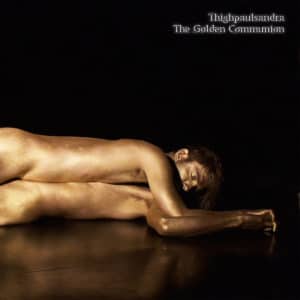
September 2015 will see the release of Thighpaulsandra’s 7th full length album “The Golden Communion”, his first since 2006’s “The Lepore Extrusion”. Well over a decade in the making, this is his debut for Editions Mego. It comprises 10 new songs, running well over two hours with individual pieces clocking in between 4 and 28 minutes. Featured musicians on the album include regular collaborators Martin Schellard and Sion Orgon, plus the odd guest/ghost from bands Thighpaulsandra has worked with in the past.
If you have heard any of Thighpaulsandra's previous albums, you will know that you'd best approach this record with no fixed set of expectations, because once again he changes genres and defies easy classification, sometimes more than once within one song. Drawing on his long-time background as a key member in such diverse groups as Coil, Spiritualized and Julian Cope's band (in each case arguably at the height of their creative prowess) and his work as producer and sound engineer for an even larger variety of customers, you'll find classical passages next to hard rock riffing, krauty experimental work-outs turning into super catchy, almost radio-friendly songs and more.
Many adjectives have been used to describe Thighpaulsandra’s work: epic, challenging, timeless, idiosyncratic, but certainly never predictable or boring.
Possibly his most rewarding album yet and a welcome and unusual entry, in the Mego catalogue, which will entertain and astonish listeners who are fond of having their mind severely altered by sound.
If you have heard any of Thighpaulsandra's previous albums, you will know that you'd best approach this record with no fixed set of expectations, because once again he changes genres and defies easy classification, sometimes more than once within one song. Drawing on his long-time background as a key member in such diverse groups as Coil, Spiritualized and Julian Cope's band (in each case arguably at the height of their creative prowess) and his work as producer and sound engineer for an even larger variety of customers, you'll find classical passages next to hard rock riffing, krauty experimental work-outs turning into super catchy, almost radio-friendly songs and more.
Many adjectives have been used to describe Thighpaulsandra’s work: epic, challenging, timeless, idiosyncratic, but certainly never predictable or boring.
Possibly his most rewarding album yet and a welcome and unusual entry, in the Mego catalogue, which will entertain and astonish listeners who are fond of having their mind severely altered by sound.
31,00€
In stock

3 LP
Ferdinand KRIWET
“Hörtexte”
“Six radio texts by Ferdinand Kriwet in a beautifully designed 3 LP Picture Discs Luxury Box. Ferdinand Kriwet (born in Duesseldorf in 1942) is a multimedia artist and poet who has produced many seminal films and sound works for radio and television, in particular throughout the 1960’s and 1970’s. His works ’Apollo Amerika’ 1969 and ’Campaign’ 1973, rank today as outstanding artistic documents of these spectacular events in the history of mankind. Kriwet created the work ’Apollo Amerika’ whilst in America at the time of the moon launch, his aim being to compose a work of perception derived from all information he gathered on radio and television about the Apollo 11 launch. He describes these as "Hörtexts, Radio Texts" - radio pieces composed of noise and sound bite and samples. Kriwet’s works are an attempt at communicating an idea of listening to something that constantly surrounds us on short, medium and long wave frequencies. His politically engaged and avant-garde approach was influenced by aesthetic and Conceptual currents in Constructivism, New Music, Beat Generation and Pop. Six of Kriwets legendary ’Sehtexts’ (visual texts) reproduced on six picture disc LPs combined with six of his legendary Hörspiel works / sound collages originally broadcast on German radio and previously unreleased: ’Apollo America’ (1969), ’Voice of America’ (1970), ’Campaign’ (1973), snapshots of American media at the beginning of the 1970s; ’Radioball’ (1975) and ’Ball’ (1974), reflecting soccer sports in Germany in the 1970s; and ’Radio’ (1983)”.
55,00€
Out of stock

3 LP
Joris DE LAET
“Sem etc.”
Joris de Laet (Belgium, 1947) is a fully autodidact composer of electroacoustic music. Between 1972 and 1975 he worked at the IPEM along with Lucien Goethals and Karel Goeyvaerts and in 1973 he founded the SEM (Studio for Experimental Music) where he organised plenty of group sessions, live performances, lectures... De Laet’s work is adventurous, complex and difficult to classify, due to many interesting contrasts in his style and approach academic vs intuitive, modern composition vs free improvisation, acoustic vs electronic, sound vs noise... This selection (10 tracks) of his early recordings (1972 1979) represents an overview of his intriguingly radical and highly personal work which includes solo tape experiments, live electronics with Karel Goeyvaerts and group performances with experimental instrumentalists from the SEM ensemble : Pieter Kuyl (chapmanstick), Leo Verheyen (trombone), Paul Adriaenssens (flute and amplified objects), Maurice Verstuyft (flute). All material has been mastered from the original tapes and is previously unreleased. Edition of 300 copies.
55,00€
Out of stock

3 LP
Else Marie PADE
“Electronic Works 1958-1995”
Back in stock.
Else Marie Pade’s Electronic Works 1958-1995 is a heavy duty three LP set which was restored, mastered and cut at Dubplates in Berlin under the watchful ears of curator Jacob Kirkegaard. These monumental works are presented, for the first time, pressed on audiophile grade heavy duty vinyl where they belong. 3LP is pressed in an edition of 500 copies.
“The sounds outside became concrete music, and in the evening I could imagine that the stars and the moon and the sky uttered sounds and those turned into electronic music.” Else Marie Pade
Else Marie Pade (born 1924 in Aarhus, Denmark; currently living in Copenhagen) is a precious golden gem in the world of contemporary electro-acoustic music. She is a true pioneer of Musique Concrete and electronic music recorded on tape. She is Denmarks first lady of electronic music and her piece Syc Cirkler (Seven Circles) became Denmark’s first electronic piece to be performed on the radio.
EMP’s search for sound began in early childhood when she was isolated in her bed for long periods of time due to illness. There she would lie and listen to the sounds around her just as she did years later when she was imprisoned for spying on Nazi compounds in Arhus. Once released from prison she became a piano student at the Royal Danish Conservatory in Copenhagen but chose to instead pursue the nuances of her inner sound world after hearing Pierre Schaeffer in 1952. She began studying with him not too soon thereafter. Her first electronic composition premiered in 1955.
53,00€