La Monte YOUNG – Marian ZAZEELA
“31 VII 69 10:26 – 10:49 PM”
21,00€
Out of stock
La Monte Young was born in Bern, Idaho in 1935. He began his music studies in Los Angeles and later Berkeley, California before relocating to New York City in 1960, where he became a primary influence on Minimalism, the Fluxus movement and performance art through his legendary compositions of extended time durations and the development of just intonation and rational number based tuning systems. With wife and collaborator, artist Marian Zazeela, they would formulate the composite sound environments of the Dream House, which continues to this day.
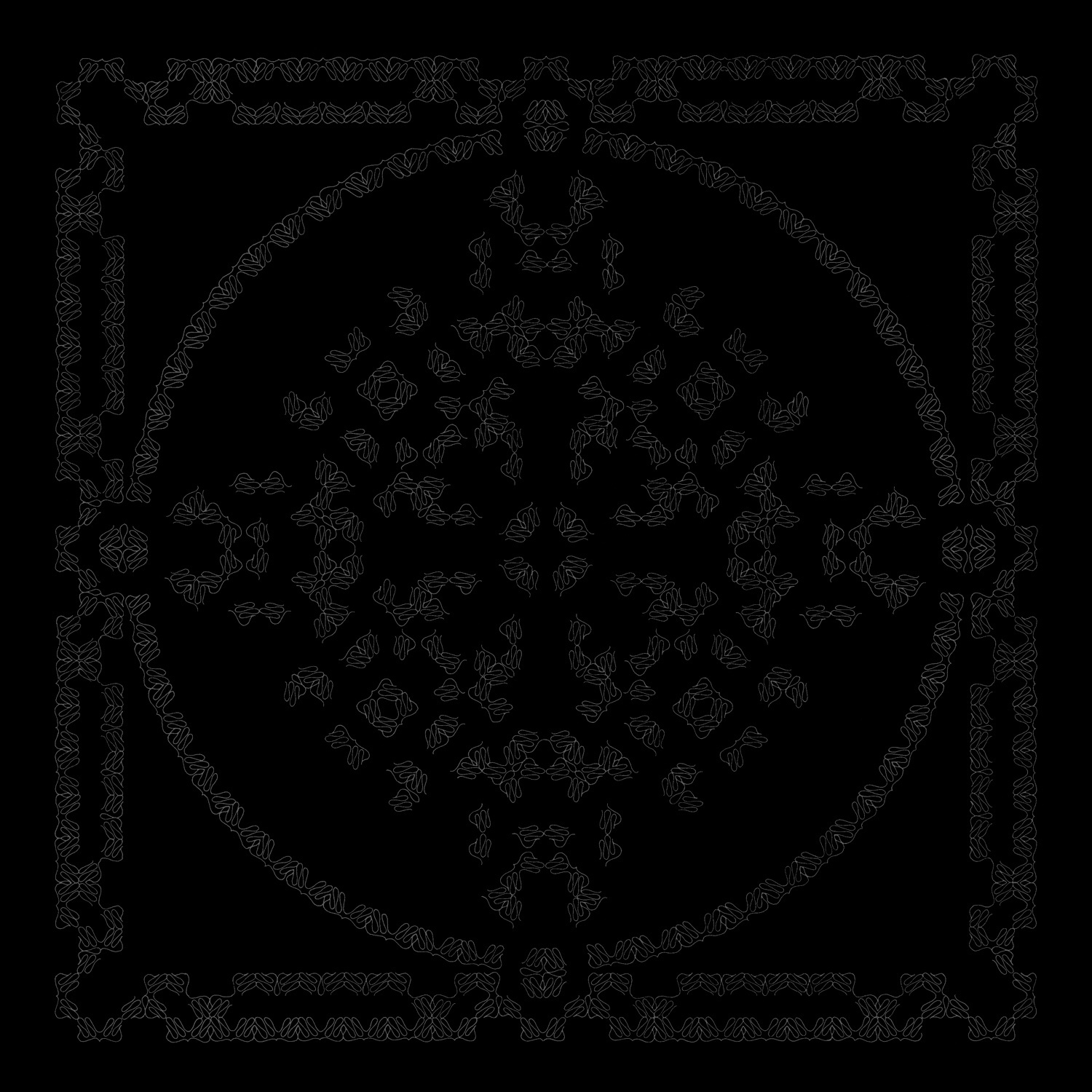
Seeing reissue for the first time since its initial 1969 release, Young and Zazeela’s first full-length album is often referred to as “The Black Record” due to Zazeela’s stunning cover design, complete with the composer’s liner notes in elegant hand-lettered script.
Side one was recorded in 1969 (on the date and time indicated by the title) at the gallery of Heiner Friedrich in Munich, where Young and Zazeela premiered their Dream House sound and light installation. Featuring Young and Zazeela’s voices against a sine wave drone, the recording is a section of the longer composition Map of 49’s Dream the Two Systems of Eleven Sets of Galactic Intervals Ornamental Lightyears Tracery (begun in 1966 as a sub-section of the even larger work The Tortoise, His Dreams and Journeys, which was begun in 1964 with Young’s group The Theatre of Eternal Music). According to Young, the raga-like melodic phrases of his voice were heavily influenced by his future teacher, the Hindustani singer Pandit Pran Nath.
Side two, recorded in Young and Zazeela’s NYC studio in 1964, is a section of the longer composition Studies in the Bowed Disc. This composition is an extended, highly abstract noise piece for bowed gong (gifted by sculptor Robert Morris). The liner notes explain that the live performance can be heard at 33 and 1/3 RPM, but may also be played at any slower speed down to 8 and 1/3 RPM for turntables with this capacity.
“La Monte Young is the daddy of us all.” — Brian Eno
La Monte Young est né à Bern, Idaho, en 1935. Il a commencé ses études musicales à Los Angeles, puis à Berkeley, en Californie, avant de s’installer à New York en 1960, où il a exercé une influence déterminante sur le minimalisme, le mouvement Fluxus et l’art de la performance grâce à ses compositions légendaires aux durées prolongées et au développement de l’intonation juste et des systèmes d’accordage basés sur les nombres rationnels. Avec sa femme et collaboratrice, l’artiste Marian Zazeela, ils ont créé les environnements sonores composites de la Dream House, qui se poursuivent encore aujourd’hui.
Réédité pour la première fois depuis sa sortie initiale en 1969, le premier album complet de Young et Zazeela est souvent appelé “The Black Record” (le disque noir) en raison de la superbe couverture de Zazeela, accompagnée des notes de pochette du compositeur rédigées dans une élégante écriture manuscrite.
La première face a été enregistrée en 1969 (à la date et à l’heure indiquées par le titre) à la galerie de Heiner Friedrich à Munich, où Young et Zazeela ont présenté leur installation sonore et lumineuse Dream House. Mettant en vedette les voix de Young et Zazeela sur un bourdon d’ondes sinusoïdales, l’enregistrement est une section de la composition plus longue Map of 49’s Dream the Two Systems of Eleven Sets of Galactic Intervals Ornamental Lightyears Tracery (commencée en 1966 comme une sous-section de l’œuvre encore plus grande The Tortoise, His Dreams and Journeys, commencée en 1964 avec le groupe de Young, The Theatre of Eternal Music). Selon Young, les phrases mélodiques de type raga de sa voix ont été fortement influencées par son futur professeur, le chanteur hindoustani Pandit Pran Nath.
La deuxième face, enregistrée dans le studio de Young et Zazeela à New York en 1964, est une section de la composition plus longue Studies in the Bowed Disc. Cette composition est une pièce bruitiste étendue et très abstraite pour gong à archet (offert par le sculpteur Robert Morris). Les notes de pochette expliquent que la performance live peut être écoutée à 33 et 1/3 RPM, mais peut également être jouée à n’importe quelle vitesse plus lente jusqu’à 8 et 1/3 RPM pour les platines ayant cette capacité.
Related products
In stock