
PREORDERS, shipped when in stock | PRÉCOMMANDES, envoi une fois en stock
In stock
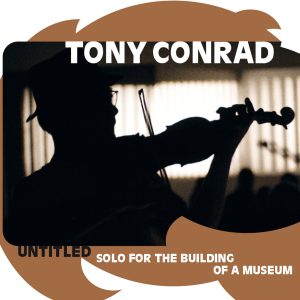
CD
Tony CONRAD
“Untitled (Solo for the Building of a Museum)”
This recording (2002) captures the two instruments central to Conrad's practice at the time: his self-built Long String Instrument and his amplified violin. He performed hidden behind a large sheet, and the nature of what unfolded behind it was never disclosed to the audience.
Mudam
Recorded at the construction site of the future Mudam - Musée d'Art Moderne Grand-Duc Jean, Luxembourg, designed by I. M. Pei - during the Museum Night of October 12, 2002, by invitation of Marie-Claude Beaud. The concert was co-organized by Transhistorics, a coproduction by Sub Rosa and Philippe Franck's Transcultures. Conrad also performed several times in Europe alongside Charlemagne Palestine in the following years, including the October 2005 concert An Aural Symbiotic Mystery.
Short Bio
Tony Conrad (1940-2016) was an American musician, experimental
filmmaker, and composer, active across media since the early 1960s. A pioneer of drone music, he was a central figure in the New York scene of the 1960s and performed as part of the Theatre of Eternal Music. He became known as a filmmaker for his 1966 film The Flicker. Over the following decades he performed and collaborated with a wide range of artists.
Interview
The recording is accompanied by an extended interview conducted by Philippe Franck, published here as a tribute to him.
- Doesn't this relate to intensity - the kind of theatrical intensity largely absent from computer music performance?
- When I started performing again with the violin in the 1980s, some people described what I was doing as "expressionism." I was surprised at first - in my own arrogance I thought: this is mine, I invented it. But I took the criticism seriously, and it led me to ask what actually distinguishes expressionism from other forms of expression.
- Perhaps we should simply speak of expression, rather than 'Expressionism'?
- Exactly. In performance, I like to work at what I'd call the zero degree of sound - harmonic structure itself. I can be entirely satisfied with a pure open fifth: dance, meditation, heroism, all of it is contained within a fifth, provided I can find my way into that sonic space. Once, a student who admired La Monte Young told me I was playing out of tune. I remember thinking thinking: I'm playing music, not notes. I'm making music that speaks to people.
13,50€
In stock
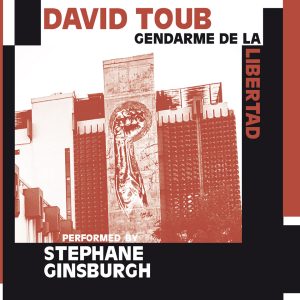
CD
David TOUB
“Gendarme de la Libertad”
David Toub is a unique voice in American minimalism, a genre that has produced quite a few composers over the past 80 years. Our first contact dates back about fifteen years, and from the very beginning, David struck me as a committed composer, dedicated to building a coherent body of work. But he is also an engaged individual, deeply concerned with the challenges of our time and genuinely generous. In other words, a mensch—a rare kind of person. His music, in some ways, reflects today’s anxieties and uncertainties: repetitive, obsessive, often dark, and questioning.
This is the second album of his music that I have recorded, and this time, David has incorporated the human voice to feature a speech given by Che Guevara in 1964. The speech addresses the contradiction between a state's founding principles and its actions. How can a nation advocate for freedom year-round while deliberately acting against minorities, particularly those historically oppressed? The piece does not provide an answer—this question remains just as relevant today, 60 years later.
(Stephane Ginsburg)
David Toub (b. 1961, Newark, NJ) is largely self-taught, with the only formal composition education consisting of attending music school (Mannes College of Music; Juilliard Pre-College Division) during weekends while in high school.
He remains an active composer. While Toub composed serial and dodecaphonic music until 1982, his subsequent works have been described as “minimalist,” although the durations of a subset of his compositions are not at all minimal (1.5 to over 4 hours in some cases).
13,00€