
Out of stock
CD
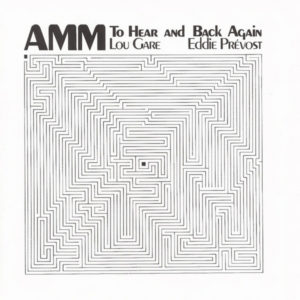
AMM
“To hear and back again” (1973-75)
Lou Gare (tenor sax) and Eddie Prévost (drums).
“1. And Back to Hear Again.
The music herein, like most of the vital music of the last thirty years, is totally improvised. Such non hierarchic and non idiomatic music is beyond pigeon holes, even though it usually gets pigeon holed as abstract and/or jazz.
Of course, all music is essentially abstract. Even such relatively realistic pieces as Charles-Valentin Alkans LE CHEMIN DU FER and Meade Lux Lewis HONKY TONK TRAIN BLUES do not necessarily reveal what they are depicting unless one knows the title. (They certainly do not have any extra appeal to railway buffs!). The analogy to the visual arts is usually raised to justify calling improvisation “abstract”. Visual arts are called abstract if they do not resemble the real world out there. If any music resembles the sound sequences of the real world out there (apart from trains) it is surely totally improvised music, making it the least abstract of all. If one thinks in terms of the real susbstance of music, which is arguably its emotional content (whatever that may be), then total improvisation gives musicians the most unrestricted scope of expressing their emotions, so once again it is the least abstract of musics since it allows for the fullest expression of the substance.
The most succinct definition of jazz that I have come across is that of Peter Riley Afro-American group instrumental part improvised music. Total improvisation hardly fits in with this, especially as so few Afro-Americans seems to have taken any part or interest in it, and since it contains virtually nothing of the Afro-American tradition that permeates all of jazz. Most total improvisation is inherently non idiomatic or pan idiomatic, and therefore should really not be lumped together with any particular idiom. Some improvisation, like that on this disc, does sound somewhat like jazz, but then so do some of the compositions of George Gershwin and Igor Stravinsky. In both cases the methodology - either total improvisation or total composition - is decidedly non jazz.
It is true that jazz was a major influence on the world of total improvisation, and many (perhaps most) of the practitioners came from a jazz background. However, other musics also had important inputs. For instance, there is the area of music usually known by such egocentric names as classical, legitimate, serious and straight, as if there was nothing else worthwhile. (Since this is by far the most popular area of music worth listening to, I usually refer to it as popular music) Shortly after the middle of this century, several composers were producing scores that amounted to improvise but pay me royalties. Groups like AMM decided, quite reasonably, to improvise and keep any royalties themselves, rather than give them to any absentee composer. The musicians became both the composers and the interpreters, and the recordings became the score preserving the music - recorded sound having made scores somewhat redundant. It should also be remembered that AMM has included musicians who were otherwise composers (Cornelius Cardew and Christian Wolff) or interpreters (Rohan de Saram and John Tilbury) of classical, legitimate, serious, straight music.
2. Back And Again Hearing Two In 1963, Lou Gare answered a saxophonist wanted advertisement in a then music trade paper, and as a result became a member of Eddie Prévost's Band. He later joined Mike Westbrook’s band, which at that time also included Keith Rowe and Lawrence Sheaff. Meanwhile, Gare, Rowe and Sheaff also began to make music with Prévost, and in 1965 they left Westbrook, called themselves AMM, and were subsequently joined by Cornelius Cardew. Virtually all the resemblances to a jazz group were soon discarded as more and more emphasis was placed on total group improvisation - they being one of the very first groups to take this direction. There was a decided preference for bowing and live electronics (including radios) in which the overall sound was so unified that it was often impossible to isolate any individual contributions.
Sheaff’s tenure with the group ended in 1967 (after which he dropped out of music making altogether), and AMM became the quartet it remained for a further four years, sometimes augmented either by Christopher Hobbs or Christian Wolff. By 1970, the electronics had been dropped by everyone except Rowe, who alone was left to create the dense mass of sound that seeped around the others contributions. This became a sort of sonic cushion and/or springboard, rather like (in their very different ways) a baroque continuum or a jazz rhythm section.
At the end of 1971, Cardew and Rowe departed for other things leaving just the tenor saxophone and percussion of Gare and Prévost - an acoustic duo in the age of electronics they had presaged. The absence of Rowe’s swirling veil meant that this duo was the most naked version of AMM - there was nothing for Gare and Prévost to hide behind or amongst. It was also the AMM with the most jazz like sound, revealing that this highly original pair of individuals had long absorbed their early influences of Sonny Rollins and Max Roach. However, as before, the methodology was unlike jazz - absolutely nothing (melody, harmony, rhythm, tempo) was predetermined. (Even the use of Gare’s beautiful tune BURNISHED GOLD at the start of BACK AGAIN was improvised on the whim of the moment.)
The two 1974 recordings are unique in that they include natural unedited AMM silences. These were an integral part of the music of both this duo and the preceding quartet - an influence (like the use of radios, not used by this duo) of John Cage (who was probably the first to package silence). In this era when every space is stuffed with noise (sometimes called disco, muzak or internal combustion engines), these silences will probably be the most difficult part of this music for most people. One needs to stop to think whether it is really necessary to say something when there is nothing to say. (And whether the world would be a much better place if all jukeboxes and all muzak tapes were full of recordings of 4’33”).
By contrast, in between the silences, the music sometimes reaches the ferocity usually associated with the more energetic varieties of free jazz, but without that genre’s all too frequent loss of balance. Things never get out of control, and one is always aware of the saxophone’s melodic lyricism and the percussion’s arhythmic propulsion. Gare and Prévost were (and are) superb exponents of the art of creating something substantive of out nothing.
It was not always tenor and percussion, however. Every so often, Gare would produce and bow a gong (lying on its belly and filled with large stones) and other little instruments would appear. An example of this different area of exploration (also related to certain aspects of the earlier, larger AMM) can be heard on one of the three previously unissued performances include herein.
In 1976, Cardew and Rowe rejoined AMM for some rehearsals that were not very successful. This time it was Cardew and Gare that left, leaving Prévost and Rowe to form the second AMM duo. They were eventually joined by John Tilbury to make the trio that has been the nucleus of AMM ever since. Other musicians who have augmented this trio include Rohan de Saram, Ian Mitchell and, from 1989 to 1991, Lou Gare. With hindsight, the 1971-76 duo of Gare and Prévost can be seen as a unique version of AMM that continued the magnificent tradition of constantly evolving AMMmusic in an untypically Roweless manner.
And To Gain A Hearback In common with virtually all writings about music, the above probably reveals more about the writer than about the music. But then music as good as this speaks for itself.” Martin Davidson 1993
“1. And Back to Hear Again.
The music herein, like most of the vital music of the last thirty years, is totally improvised. Such non hierarchic and non idiomatic music is beyond pigeon holes, even though it usually gets pigeon holed as abstract and/or jazz.
Of course, all music is essentially abstract. Even such relatively realistic pieces as Charles-Valentin Alkans LE CHEMIN DU FER and Meade Lux Lewis HONKY TONK TRAIN BLUES do not necessarily reveal what they are depicting unless one knows the title. (They certainly do not have any extra appeal to railway buffs!). The analogy to the visual arts is usually raised to justify calling improvisation “abstract”. Visual arts are called abstract if they do not resemble the real world out there. If any music resembles the sound sequences of the real world out there (apart from trains) it is surely totally improvised music, making it the least abstract of all. If one thinks in terms of the real susbstance of music, which is arguably its emotional content (whatever that may be), then total improvisation gives musicians the most unrestricted scope of expressing their emotions, so once again it is the least abstract of musics since it allows for the fullest expression of the substance.
The most succinct definition of jazz that I have come across is that of Peter Riley Afro-American group instrumental part improvised music. Total improvisation hardly fits in with this, especially as so few Afro-Americans seems to have taken any part or interest in it, and since it contains virtually nothing of the Afro-American tradition that permeates all of jazz. Most total improvisation is inherently non idiomatic or pan idiomatic, and therefore should really not be lumped together with any particular idiom. Some improvisation, like that on this disc, does sound somewhat like jazz, but then so do some of the compositions of George Gershwin and Igor Stravinsky. In both cases the methodology - either total improvisation or total composition - is decidedly non jazz.
It is true that jazz was a major influence on the world of total improvisation, and many (perhaps most) of the practitioners came from a jazz background. However, other musics also had important inputs. For instance, there is the area of music usually known by such egocentric names as classical, legitimate, serious and straight, as if there was nothing else worthwhile. (Since this is by far the most popular area of music worth listening to, I usually refer to it as popular music) Shortly after the middle of this century, several composers were producing scores that amounted to improvise but pay me royalties. Groups like AMM decided, quite reasonably, to improvise and keep any royalties themselves, rather than give them to any absentee composer. The musicians became both the composers and the interpreters, and the recordings became the score preserving the music - recorded sound having made scores somewhat redundant. It should also be remembered that AMM has included musicians who were otherwise composers (Cornelius Cardew and Christian Wolff) or interpreters (Rohan de Saram and John Tilbury) of classical, legitimate, serious, straight music.
2. Back And Again Hearing Two In 1963, Lou Gare answered a saxophonist wanted advertisement in a then music trade paper, and as a result became a member of Eddie Prévost's Band. He later joined Mike Westbrook’s band, which at that time also included Keith Rowe and Lawrence Sheaff. Meanwhile, Gare, Rowe and Sheaff also began to make music with Prévost, and in 1965 they left Westbrook, called themselves AMM, and were subsequently joined by Cornelius Cardew. Virtually all the resemblances to a jazz group were soon discarded as more and more emphasis was placed on total group improvisation - they being one of the very first groups to take this direction. There was a decided preference for bowing and live electronics (including radios) in which the overall sound was so unified that it was often impossible to isolate any individual contributions.
Sheaff’s tenure with the group ended in 1967 (after which he dropped out of music making altogether), and AMM became the quartet it remained for a further four years, sometimes augmented either by Christopher Hobbs or Christian Wolff. By 1970, the electronics had been dropped by everyone except Rowe, who alone was left to create the dense mass of sound that seeped around the others contributions. This became a sort of sonic cushion and/or springboard, rather like (in their very different ways) a baroque continuum or a jazz rhythm section.
At the end of 1971, Cardew and Rowe departed for other things leaving just the tenor saxophone and percussion of Gare and Prévost - an acoustic duo in the age of electronics they had presaged. The absence of Rowe’s swirling veil meant that this duo was the most naked version of AMM - there was nothing for Gare and Prévost to hide behind or amongst. It was also the AMM with the most jazz like sound, revealing that this highly original pair of individuals had long absorbed their early influences of Sonny Rollins and Max Roach. However, as before, the methodology was unlike jazz - absolutely nothing (melody, harmony, rhythm, tempo) was predetermined. (Even the use of Gare’s beautiful tune BURNISHED GOLD at the start of BACK AGAIN was improvised on the whim of the moment.)
The two 1974 recordings are unique in that they include natural unedited AMM silences. These were an integral part of the music of both this duo and the preceding quartet - an influence (like the use of radios, not used by this duo) of John Cage (who was probably the first to package silence). In this era when every space is stuffed with noise (sometimes called disco, muzak or internal combustion engines), these silences will probably be the most difficult part of this music for most people. One needs to stop to think whether it is really necessary to say something when there is nothing to say. (And whether the world would be a much better place if all jukeboxes and all muzak tapes were full of recordings of 4’33”).
By contrast, in between the silences, the music sometimes reaches the ferocity usually associated with the more energetic varieties of free jazz, but without that genre’s all too frequent loss of balance. Things never get out of control, and one is always aware of the saxophone’s melodic lyricism and the percussion’s arhythmic propulsion. Gare and Prévost were (and are) superb exponents of the art of creating something substantive of out nothing.
It was not always tenor and percussion, however. Every so often, Gare would produce and bow a gong (lying on its belly and filled with large stones) and other little instruments would appear. An example of this different area of exploration (also related to certain aspects of the earlier, larger AMM) can be heard on one of the three previously unissued performances include herein.
In 1976, Cardew and Rowe rejoined AMM for some rehearsals that were not very successful. This time it was Cardew and Gare that left, leaving Prévost and Rowe to form the second AMM duo. They were eventually joined by John Tilbury to make the trio that has been the nucleus of AMM ever since. Other musicians who have augmented this trio include Rohan de Saram, Ian Mitchell and, from 1989 to 1991, Lou Gare. With hindsight, the 1971-76 duo of Gare and Prévost can be seen as a unique version of AMM that continued the magnificent tradition of constantly evolving AMMmusic in an untypically Roweless manner.
And To Gain A Hearback In common with virtually all writings about music, the above probably reveals more about the writer than about the music. But then music as good as this speaks for itself.” Martin Davidson 1993
12,00€
Out of stock
CD
John BUTCHER & Eddie PREVOST
“Interworks”
John Butcher - tenor and soprano saxophones. Eddie Prévost - tam-tam and other percussion. Recorded at Gateway Studios, Kingston-upon-Thames, England on July 17th 2005.
12,00€
Out of stock
CD
John TILBURY – Evan PARKER
“Two chapters and an epilogue”
Blistering fast sax tootling from Parker and raindrop-falling piano from Tilbury are contrasted against lower register clumps of reverberation and flaky, polyphonic seagull impersonations. It’s a glorious, immersive experience. The Wire (UK)
12,00€
Out of stock
CD
Evan PARKER & Eddie PREVOST
“Imponderable evidence”
Evan Parker, tenor saxophone. Eddie Prévost, drums.
12,00€
Out of stock
CD
Eddie PRÉVOST – Evan PARKER – Sebastian LEXER
“Tri-Borough Triptych”
Sebastian Lexer, piano+. Evan Parker, saxophones. Eddie Prévost, percussion.
Hearing Evan Parker make music with Eddie Prévost, on the first of these three lengthy duets recorded in three different London boroughs, is like watching a pair of tai chi masters sparring. Parker’s tenor and Prévost’s bowed and struck percussion draw buoyancy from each other’s energy as they alternately push and yield. Together they move with feline lightness, agility and balance, even when the music’s mood is stormy and turbulent. The event was Freedom Of The City 2012; the venue, Cecil Sharp House in Camden Town, London. The character and dynamics of that occasion change continuously, but there’s never a sense that this exhilarating music is getting locked into a formal shape or falling under the shadow of its performers’ individual identities.
Two other engrossing duets on TriBorough Triptych feature pianist Sebastian Lexer: with Prévost at Old Deptford Town Hall, South London, and with Parker on soprano at Dalston’s Cafe Oto. Lexer’s playing is disciplined and rather sparing, although he clearly enjoys pianistic practices and sonorities, not least perhaps for their historical weight, an element of resistance he can work with or against, just as Parker and Prévost parry the associations clinging to their own chosen instruments. But Lexer’s piano+ set-up involves a personally developed software to analyse and adjust the acoustic output, eliciting textures and durations unexpected from a grand piano, enhancing its scope and introducing an air of instability that calls for sharp reactions. Parker and Prévost are kept in states of heightened attentiveness, and the sustained outcome is lucid and graceful music making.
Julian Cowley - The Wire October 2013
Hearing Evan Parker make music with Eddie Prévost, on the first of these three lengthy duets recorded in three different London boroughs, is like watching a pair of tai chi masters sparring. Parker’s tenor and Prévost’s bowed and struck percussion draw buoyancy from each other’s energy as they alternately push and yield. Together they move with feline lightness, agility and balance, even when the music’s mood is stormy and turbulent. The event was Freedom Of The City 2012; the venue, Cecil Sharp House in Camden Town, London. The character and dynamics of that occasion change continuously, but there’s never a sense that this exhilarating music is getting locked into a formal shape or falling under the shadow of its performers’ individual identities.
Two other engrossing duets on TriBorough Triptych feature pianist Sebastian Lexer: with Prévost at Old Deptford Town Hall, South London, and with Parker on soprano at Dalston’s Cafe Oto. Lexer’s playing is disciplined and rather sparing, although he clearly enjoys pianistic practices and sonorities, not least perhaps for their historical weight, an element of resistance he can work with or against, just as Parker and Prévost parry the associations clinging to their own chosen instruments. But Lexer’s piano+ set-up involves a personally developed software to analyse and adjust the acoustic output, eliciting textures and durations unexpected from a grand piano, enhancing its scope and introducing an air of instability that calls for sharp reactions. Parker and Prévost are kept in states of heightened attentiveness, and the sustained outcome is lucid and graceful music making.
Julian Cowley - The Wire October 2013
13,00€
Out of stock
CD
Eddie PREVOST
“Entelechy”
Mesmerizing solo percussion album for tam-tam, from the founder of AMM. Studio recordings from 2005. Here is Eddie’s description of how the title track of this CD came about: "Entelechy is virtually autonomous. The tam-tam was suspended upon its usual rectangular frame. In this instance a battery driven electric motor was set up alongside the tam-tam with wire threads fanning out from a small rotating wheel. I set this in motion and retired to the control room to watch and listen with the recording engineer (Sebastian Lexer) as the tam-tam (as it were) told its own story. Various processes came into play. The fanning wires beat the edge of the tam-tam and began to set up numerous overtone patterns -- due in part to the irregular shape of the wheel motion. These were enhanced, diverted and changed by a gradual oscillating motion as the rotating beaters began to push the tam-tam on its suspending rope (creating a gentle swinging movement), and by the gradual diminishing power of the motor. This process was played out until the batteries were depleted. As a composer, I am struck by the similarities that this approach has to certain experimental tendencies in the world of composition. Various pieces spring to mind that are concerned with setting up a physical situation and then allowing it to play itself out, with no more than a gentle nudge from the performer. Steve Reich’s ’Pendulum Music,’ Takehisa Kosugi’s ’Micro 1’ and Alvin Lucier’s ’Music on a Long Thin Wire’ are all works concerned with revealing the potentiality of materials and allowing those materials to sound themselves, where, after initiating the process, the performer steps back and listens with the rest of the audience."
12,00€
Out of stock
CD
Eddie PRÉVOST QUARTET
“Continuum +”
Larry Stabbins tenor and soprano saxophones Veryan Weston piano Marcio Mattos double bass Eddie Prévost drums. CD re-release of material previously issued as an LP, together with additional music. The original release of Prévost’s 1983 Bracknell appearance represents one of the few ‘must haves’ of British free jazz. Rubberneck (UK)
12,00€
Out of stock
CD
E. PARKER – B. GUY – K. ROWE – E. PRÉVOST
“Supersession”
NEW EDITION. REMASTERED.
Evan Parker - soprano saxophone, tenor saxophone. Keith Rowe - guitar/electronics. Barry Guy - double bass. Eddie Prévost - percussion. “Music- making of formidable integrity (in all senses of the word) which offers seemingly infinite and inexhaustible prospects.” The Wire (UK)
Recorded at a concert given in London, England on 3rd September 1984.
Re-issued 2015. New edition. Remastered. With new notes by Marc Medwin.
Evan Parker - soprano saxophone, tenor saxophone. Keith Rowe - guitar/electronics. Barry Guy - double bass. Eddie Prévost - percussion. “Music- making of formidable integrity (in all senses of the word) which offers seemingly infinite and inexhaustible prospects.” The Wire (UK)
Recorded at a concert given in London, England on 3rd September 1984.
Re-issued 2015. New edition. Remastered. With new notes by Marc Medwin.
12,00€
Out of stock
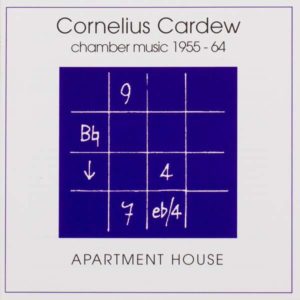
CD
Cornelius CARDEW
“Chamber music 1955-64”
Anton Lukoszevieze, cello, conductor. Gordon MacKay, violin. Bridget Carey, viola. Alan Thomas, guitar. Rhodri Davies, harp. Marco Blaauw, trumpet. Andrew Sparling, clarinet. David Ryan, bass clarinet, piano. Sarah Walker, piano, prepared piano. Dave Smith, prepared piano, melodica. Tania Chen, piano. Robert Coleridge, organ. Michael Parsons, conductor, electronic keyboard. Simon Allen, vibraphone, marimba.
“Solo with accompaniment” (1964). “Three rhythmic pieces for trumpet and piano” (1955). “Autumn ’60” (1960) Version I. “Material” (1964) Version II. “Second string trio” (1955). “Piece for guitar (for Stella)” (1964). “Material” (1964) Version I. “Memories of you” (1964). “Autumn ’60” (1960) Version II. “Octet ’61 for Jasper Johns”. Recorded at Gateway Studio, Kingston-upon-Thames on 6 and 7 April 2001.
“Solo with accompaniment” (1964). “Three rhythmic pieces for trumpet and piano” (1955). “Autumn ’60” (1960) Version I. “Material” (1964) Version II. “Second string trio” (1955). “Piece for guitar (for Stella)” (1964). “Material” (1964) Version I. “Memories of you” (1964). “Autumn ’60” (1960) Version II. “Octet ’61 for Jasper Johns”. Recorded at Gateway Studio, Kingston-upon-Thames on 6 and 7 April 2001.
12,00€
Out of stock
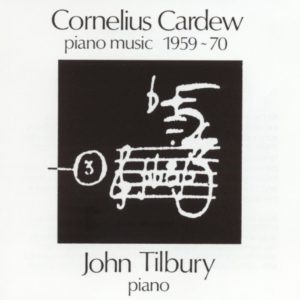
CD
Cornelius CARDEW – John TILBURY
“Piano music 1959-70”
“Long overdue recording (made in 1996) of some of Cardew’s pre-political period music. February Pieces, Volo Solo, Unintended Piano Music are just some of the works which reflect Cardew’s then aesthetic preoccupation with sonorities and touch. The piano is exhaustively and lovingly explored. Tilbury, who was one of Cardew’s closest musical associates, collaborates in Cardew’s search for a creative relationship with musician and materials and succeeds magnificently.”
14,00€
Out of stock

CD
François BAYLE
Vol. 4 “Fabulæ”
Vol. 4 of the series. A series of works from 1990-92. "A polyphony of impacts, a broad, sparkling, iridescent fabric, such as are often to be found in Bayle’s works."
15,00€
In stock
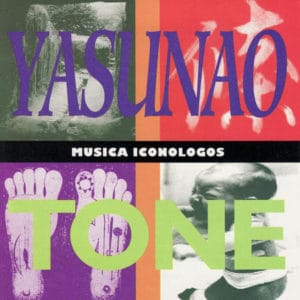
CD
Yasunao TONE
“Musica iconologos”
“Yasunao Tone and Craig Kendall, image selection and processing; Craig Kendall, computer programming, digital sound creation and manipulation; John D.S. Adams, assistant producer and audio consultant. A surprising release from the radical Fluxus composer--an encoded description of the visual image in utmost detail. In the mythical future somebody can translate the sounds of this compact disc back into pictures. 1. “Jiao Liao Fruits”. 2. “Solar Eclipse in October”.”
14,00€
In stock
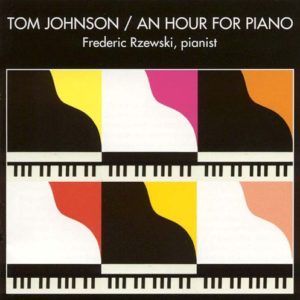
CD
Tom JOHNSON
“An hour of piano”
A trance music piece (1974) made up of repeating 4/4 cells in which an absolutely steady eighth-note motion predominates. Often several cells are going on simultaneously, and one cell frequently mutates into another through the addition or subtraction of a note or two. One has to step back far enough to get a perspective on the large-scale shifts in density and tonality before the impact of An Hour For Piano can be felt. Frederic Rzewski plays very percussively throughout, giving the piece an intense forward motion.
12,00€
Out of stock
CD
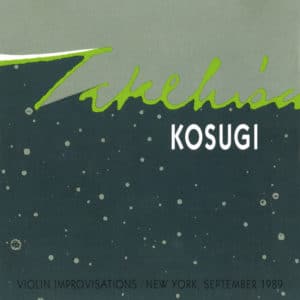
Takehisa KOSUGI
“Violin improvisations”
Takehisa Kosugi, electric violin. "1990 CD release of solo violin & electronics recorded in NYC in September of 1989. Kosugi is of course the main "Taj Mahal Traveler" and a key player in Fluxus-related activities during the sixties. This is some of the most beautiful mathematical-relationship inspired solo performance grate/scrape out there, it’s really hard to believe that all present glossed-out cavern/tank sonics are derived from a single violin & a digital delay unit. Just enough trace of certain ’Eastern’ micro-tonalitites & alien gesture to keep your ears dancing on end. Sublime.”
12,00€
Out of stock
CD
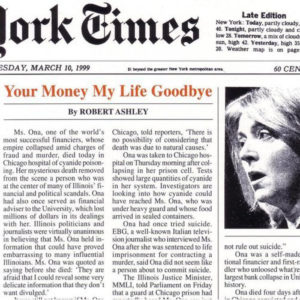
Robert ASHLEY
“Your money my life goodbye”
An opera (1999) commissioned by Bayerisher Rundfunk Munich’s Hörspiel und Medienkunst department about an internationally renowned swindler, who almost took down the European and American banking system. Featuring the voices of Robert Ashley, Sam Ashley, Thomas Buckner, Jackie Humbert, and Joan La Barbara. Recorded and mixed by Tom Hamilton.
14,00€
In stock
CD
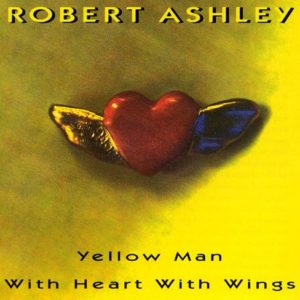
Robert ASHLEY
“Yellow man with heart with wings”
1978. Robert Ashley, English voice and all instruments; except "Blue" Gene Tyranny, clavinet; Spanish voice, Guillermo Grenier.
“A two-part composition with narration (part one in Spanish and part two in heavily altered English) commissioned by public radio station KUNM in Albuquerque, this music has a plain, serene beauty. Part one is a narration by Guillermo Grenier in dreamy, flatly inflected Spanish, backed by a four-note synthesizer track, and punctuated by mysterious, heavily processed vocalizations. Ashley throws in extensive sound washes and other electronic figures which flutter in and out of the mix. The text, "Ideas from The Church," will later show up in the 1994 opera, Foreign Experiences. It is included in the liner notes. In part two, the four-note synthesizer line returns, this time backing an ethereal, sustained chord, and the vocals sound "like a distant rendering of the earth’s electromagnetic halo.”
12,00€
Out of stock
CD
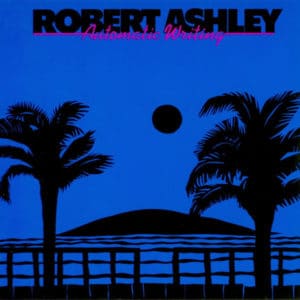
Robert ASHLEY
“Automatic writing”
“Robert Ashley; Cynthia Liddell, Mary Ashley, Mary Lucier, and Barbara Lloyd; The Brandeis University Chamber Chorus, Alvin Lucier, Director.
Three of Ashley’s landmark recordings, Automatic Writing (1979), Purposeful Lady Slow Afternoon (1971) and She Was A Visitor (1967). Composed in recorded form over a period of five years, Automatic Writing is the result of Robert Ashley’s fascination with involuntary speech. He has recorded and analyzed the repeated lines of his own mantra and extracted four musical characters. The result is quiet, mysterious, melancholy and an early form of ambient music. Purposeful Lady Slow Afternoon, and She Was a Visitor are excerpts from an opera entitled That Morning Thing that was composed in 1966-67, as a result of Ashley’s impulse to express something about the suicides of three friends, in particular the intellectual problem of the idea of suicide. The opera takes the form of an alternation of scenes of rationalizations (or explanations) and scenes of descriptions.
Purposeful Lady Slow Afternoon is a woman’s description of a sexual experience. It is Ashley’s attempt "to demonstrate the dichotomy between the rational-whatever can be explained in words-and its opposite-which is not irrational or a-rational, but which cannot be explained in words." The lead voice, the processed back-up chorus, the recurring bell tone, and the pervading tape hiss, create an unsettling mood. She Was a Visitor is another form of description, it is intended to be understood as a form of rumor. The chorus is divided into groups, each headed by a leader. A lone speaker repeats the title sentence throughout the entire performance. The separate phonemes of this sentence are picked up freely by the group leaders and are relayed to the group members, who sustain them softly and for the duration of one natural breath. The time lag between the group leaders’ phoneme choices and those phonemes being picked up by members of the group produces a staggered, chant-like effect, with the sounds moving outward from the nearest performer to the farthest. Booklet notes by Robert Ashley.”
12,00€
Out of stock
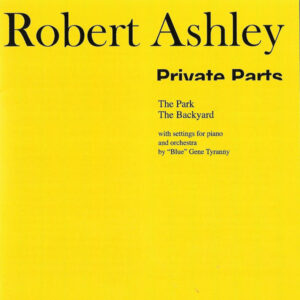
CD
Robert ASHLEY
“Private parts (the record)”
1977. Robert Ashley: voice. “Blue” Gene Tyranny: keyboards. Kris: tablas.
“Centered around the mesmerizing voice of Robert Ashley, this early version (released on LP by Lovely Music in 1979) of The Park and The Backyard is a masterpiece in its simplicity of form and in the purity and intensity of its effect on the listener. These two pieces were later to become the opening and closing segments of the seven part opera for television, Perfect Lives.”
14,50€
In stock

CD
Pauline OLIVEROS
“Crone music”
Pauline Oliveros, solo accordion; Panaiotis, processing and mixing. “Commissioned by Mabou Mines, the experimental theater group from New York, for their interpretation of "King Lear," Oliveros’ Crone Music is a subtle and haunting electronic music endeavor. Interfacing an abundance of digital delay processors, reverb effects and foot pedals to bend pitches from piercing to twisted, sonorous tones, with her one-of-a-kind expanded accordion, Oliveros produces rich, eerie textures. "Studio recordings from 1989-90, ’commissioned by Mamou Mines, the New York based experimental theater collective, for their production of Lear by William Shakespeare.’ In use herein is a fairly complex series of pitch-modulated foot-controlled digital delay units which render Oliveros’ solo accordion playing into a full accordion ensemble. This all results in seriously dense overtone/ghost chord action, complete with microtones and countermelodies emulating something like a grand-pipe-organ jam session. Heavy. By far the most ear-triggering of all Oliveros’s explorations with said instrument."
14,00€
In stock
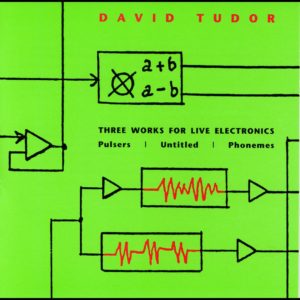
CD
David TUDOR
“Three works for live electronics”
David Tudor, electronics; with Takehisa Kosugi, electronic violin and vocals; produced and recorded by David Tudor, Nicolas Collins, and John D.S. Adams. Originally released on LP in 1984 and rereleased in September 1996, just following Tudor’s death on August 13, with the addition of Phonemes. “Pulsers explores the world of rhythms created electronically by analog, rather than digital, circuitry. With analog circuitry, the time-base common to the rhythms can be varied in many different ways by a performer, and can eventually become unstable. Untitled is a part of a series of works composed in the 1970s that were developed through experiments in generating electronic sound without the use of oscillators, tone generators, or recorded natural sound materials. Composed in 1972, it was designed for simultaneous performance with John Cage’s vocalization of his Mesotics re Merce Cunningham. The work was revived in 1982, and performed with improvised vocals by Takehisa Kosugi. Phonemes was commissioned by the Merce Cunningham Dance Company for Cunningham’s dance Channels/Inserts, a work made both as a "filmdance" and for the stage. Phonemes employs two discrete processes which provide input source material for an array of sound modifying electronics, thus creating a multitude of outputs.”
14,00€
In stock
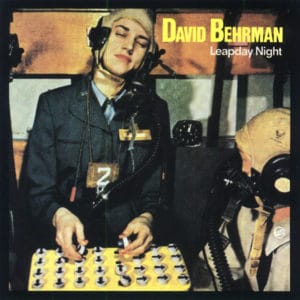
CD
David BEHRMAN
“Leapday night”
David Behrman, electronics; Takehisa Kosugi, violin; Ben Neill and Rhys Chatham, trumpets...A series of three pieces/suites; ’Leapday Night’, ’A Traveler’s Dream Journal’, and ’Interspecies Smalltalk’ involving Rhys Chatham/Ben Neill (on trumpet/mutantrumpet), Fluxus mainstay Takeisha Kosugi (violin), and Behrman himself on electronics. Behrman creates thickly layered liquid sounds utilizing this complex computer music system which absorbs, actually hears, the sounds of instrumentalists, then plays off their improvisations with its own synthesized reactions. The system consists of pitch sensors ("ears" with which it listens to the performing musicians), various music synthesizers (some homemade), a computer graphics color video display and a personal computer. "Heavy period-synth float with bare accompaniment, thankfully just-pre DX-7."
15,00€
In stock
CD
David BEHRMAN
“On the other ocean”
David Behrman, electronics, Kim-1 microcomputer; Maggi Payne, flute; Arthur Stidfole, bassoon; David Gibson, cello. Recording engineers: "Blue" Gene Tyranny and Richard Lainhart. Originally released by Lovely Music on LP in 1978; reissued on CD in 1996.
“On the Other Ocean is an improvisation by Maggi Payne and Arthur Stidfole centered around six pitches which, when they are played, activate electronic pitch-sensing circuits connected to the "interrupt" line and input ports of a microcomputer, Kim-1. The microcomputer can sense the order and timing in which the six pitches are played and can react by sending harmony-changing messages to two handmade music synthesizers. The relationship between the two musicians and the computer is an interactive one, with the computer changing the electronically-produced harmonies in response to what the musicians play, and the musicians influenced in their improvising by what the computer does.
Figure in a Clearing, made a few months before On the Other Ocean, was the first piece of Behrman’s to use a computer for music. For Figure, the Kim-1 ran a program which varied the time intervals between chord changes. The time intervals were modelled on the motion of a satellite in falling elliptical orbit about a planet. David Gibson’s only "score" was a list of 6 pitches to be used in performance, and a request that he not speed up when the computer-controlled rhythm did. The timbral richness and concentrated eloquence of his playing sprang from his own sources.
Charming booklet notes by David Behrman.”
12,00€
In stock
CD
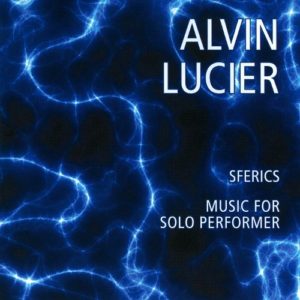
Alvin LUCIER
“Sferics – Music for solo performer”
“Sferics is the shortened term for atmospherics, natural radio-frequency emissions in the ionosphere, caused by electromagnetic energy radiated from nearby or distant lightning. These signals - resonant clicks and pops, called tweeks and bonks by scientists - occur in the audible range of humans and may be picked up by antennas and amplified for listening. They are best received at night, far from power lines. Occasionally, certain sferics get caught on and travel long distances along the magnetic flux lines around the earth, producing whistlers - downward-gliding signals which may last up to two or three seconds. My interest in sferics goes back to 1967, when I discovered in the Brandeis University Library a disc recording of ionospheric sounds by astrophysicist Millett Morgan of Dartmouth College. I experimented with this material, processing it in various ways - filtering, narrow band amplifying and phase-shifting - but I was unhappy with the idea of altering natural sounds and uneasy about using someone else’s material for my own purposes. I wanted to have the experience of listening to these sounds in real time and collecting them for myself. When Pauline Oliveros invited me to visit the music department at the University of California at San Diego a year later, I proposed a whistler recording project. Despite two weeks of extending antenna wire across most of the La Jolla landscape and wrestling with homemade battery-operated radio receivers, Pauline and I had nothing to show for our efforts. About ten years later composer Ned Sublette, who was interested in radio waves of all kinds, recommended a book by Calvin R. Graf, Listen to Radio Energy, Light and Sound, which describe a simple method of building a large loop antenna with which to receive these natural phenomena. Sferics was recorded by the composer on August 27, 1981, in Church Park, Colorado. The sound material was collected continuously from midnight to dawn with a pair of homemade antennas and a stereo cassette tape recorder. At regular intervals the antennas were repositioned in order to explore the directivity of the propagated signals and to shift the stereo field.”
15,00€
In stock
CD
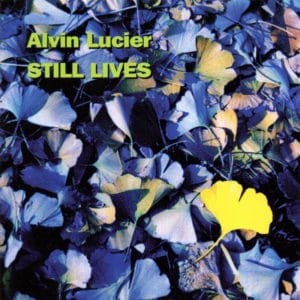
Alvin LUCIER
“Still lives”
Three new pieces for piano soloist with accompanying pure wave oscillation. Titles: “Music for Piano with Slow Sweep Pure Wave Oscillators”(performed / composed for Marilyn Nonken), “On the carpet of leaves illuminated by the moon” (performed / composed for Ryuko Mizutani), and “Still Lives” (performed / composed for Joseph Kubera). All pieces exhibit Lucier’s unique take on performance-environment concepts. Quiet, melancholy, rather soothing. Gaining age with grace I suppose.” Hrvatski
14,00€
In stock
CD
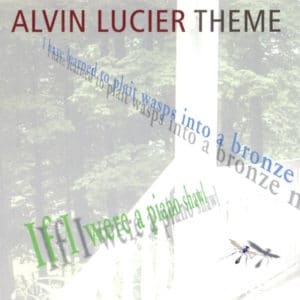
Alvin LUCIER
“Theme”
New 1999 release previously unrecorded Lucier works from the mid-90s. Features: “Music for Piano with Magnetic Strings” (performed by Lois Svard, piano), “Theme” (Sam Ashley, Thomas Buckner, Jacqueline Humbert and Joan La Barbara, voices set to a poem by John Ashbery) and “Music For Gamelan Instruments, Microphones, Amplifiers and Loudspeakers” (performed by the Wesleyan University Gamelan Ensemble). “ ‘Music For Piano...’ is a work in which the strings of a piano sound by themselves. Several EBows (small electromagnets used primarily with electric guitars) are placed on the strings of the piano. The pianist works from a prose score which describes the process and suggests (s)he freely position and reposition five EBows on the piano strings, creating strands of sounds of varying density and texture. Much of the pianist’s time is spent listening for harmonics, audible beating, occasional rhythms produced as one or more magnets vibrate against adjacent strings, and other acoustic phenomena. ‘Theme’ sets a poem of John Ashbery’s to music. Lucier didn’t want to violate the flow of the words of the poem by fragmentation or any other cut-up method. The stanzas seemed musical enough just as they were, and he wanted the audience to hear the poem more or less in its pristine state. So working intuitively and by ear, he wrote out the poem for four readers in the order it was written, repeating words and phrases, overlapping and superimposing them in various ways. To ’set’ the poem, he inserted microphones into the mouths of various vessels, including a small milk bottle, a sea shell, a vase , and an empty ostrich egg, to pick up the words as they were sounding inside the vessels. The readers speak normally, alllowing the pitches of their voices which match those resonances of the vessels to create musical sounds.”a
14,00€
Out of stock
CD
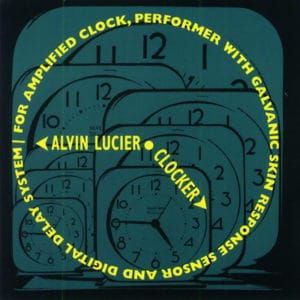
Alvin LUCIER
“Clocker”
“For amplified clock, performer with galvanic skin response sensor, and digital delay system; Alvin Lucier, performer; recorded by Nicolas Collins. Through the means of a galvanic skin response sensor driving a digital delay on a miked clock, Lucier creates the illusions of time expanding and contracting, and of a room that is changing in size. Another classic Lucier catalog item, a 45-minute recording made in 1991 of this piece that he first conceived in 1978. The piece is for: amplified clock, performer with galvanic skin response sensor and digital delay system. The sounds that emanate are beautifully shifting patterns of tock-collage that reveal dramatic sonic detailings. "I wanted to make a work in which a performer could speed up and slow down time, stopping it, if possible, simply by thinking. I bought a Westclox Silver Bell Monogram in a local store and ordered a galvanic skin response sensor through the Edmund Scientific Catalogue. A GSR is designed to measure differences in skin resistance caused by changes in emotional state. A small current is sent through the body, the response to which is amplified, producing an output voltage which can be used to control various devices...later I added a bank of fixed delays which, as they splay out from the voltage controlled delay, create multiple reflections that almost convince the listener that the room is changing size.”
14,00€
In stock
CD
Alvin LUCIER
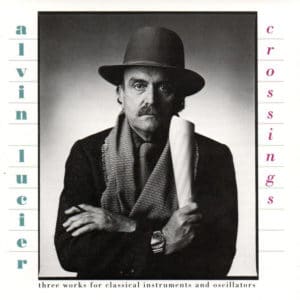
“Crossings”
1990 CD reissue of prime-era Lucier product, with works from 1982-85. Features ’In Memoriam Jon Higgins (for clarinet in A and slow-sweep pure wave oscillator)’, ’Septet for Three Winds, Four Strings and Pure Wave Oscillator’, and ’Crossings (for small orchestra with slow-sweep pure wave oscillator)’. Said slow-sweep pure wave oscillator produces slowly swept pure waves that oscillate (on separate occasions) a clarinet, three winds and four strings, and a small orchestra. Maximum beat frequency heterodyning, often at an audible pitch. Similar acoustic phenomena as Tony Conrad/Penderecki string work and just as aurally stimulating (for those with lazy ear-ciliae). Hrvatski.
12,00€
Out of stock
CD
Alvin LUCIER
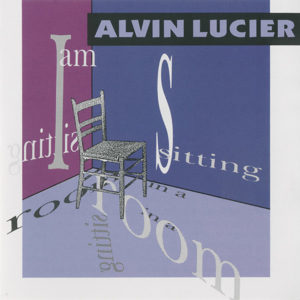
“I am sitting in a room”
Alvin Lucier, recorded voice. “In this fascinating exploration of acoustical phenomena, Alvin Lucier slips from the domain of language to that of music in the course of 40 minutes and 32 repetitions of a simple paragraph of text. In I am sitting in a room, several sentences of recorded speech are simultaneously played back into a room and re-recorded there many times. As the repetitive process continues, those sounds common to the original spoken statement and those implied by the structural dimensions of the room are reinforced. The others are gradually eliminated. The space acts as a filter; the speech is transformed into pure sound. All the recorded segments are spliced together in the order in which they were made and constitute the work. I am sitting in a room was composed in 1970 and was first performed at the Guggenheim Museum in New York City that same year. A second version was made in 1972 to accompany the dance, Dune, performed by the Viola Farber Dance Company at the Brooklyn Academy of Music. Since that time, numerous versions of this composition have been realized in various ways by other musicians, including a Swedish radio broadcast version. This recording was made by Alvin Lucier on October 29th and 31st, 1980, in the living room of his home in Middletown, CT. The material was recorded on a Nagra tape recorder with an Electro-Voice 635 dynamic microphone and played back on one channel of a Revox A77 tape recorder, Dynaco amplifier and a KLH Model Six loudspeaker. It consists of thirty-two generations of Alvin Lucier’s speech and was made expressly for Lovely Music, Ltd.”
12,00€
In stock
CD
Alvin LUCIER
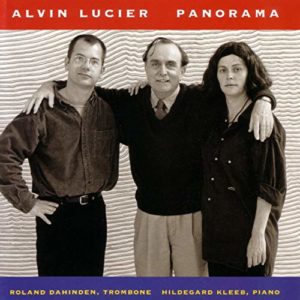
“Panorama”
Consists of 1990-94 recordings, released in ’97. "A gorgeous recording of works for trombone and piano, transformed by Lucier’s electronics and oscillators. ’Wind Shadows’ (1994), ’Music for Piano with One or More Snare Drums’ (1990), and ’Panorama’ (1993) -- were written for the Swiss musicians Roland Dahinden and Hildegard Kleeb, who play them on this CD. Also included: ’Music for Piano with Amplified Sonorous Vessels’ (1990), which was originally written for Margaret Leng Tan."
14,00€
In stock
CD
Alvin LUCIER
“Music on a long thin wire”
Alvin Lucier, concept & design; the Wire. “A 50-foot length of taut wire passes through the poles of a large magnet and is driven by an oscillator; the vibrations of the wire are miked at either end, amplified and broadcast in stereo. The thin wire is set vibrating four times at four different frequencies; what results is not the low drone one might expect from a long, vibrating wire, but a complexity of evocative, ethereal chords. First released on Lovely Music in 1980, Music on a Long Thin Wire is a classic example of Alvin Lucier’s investigations into the physics of sound and the sonic properties of natural processes.”
12,00€
In stock
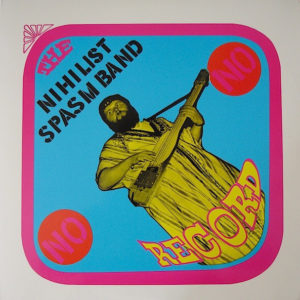
CD
NIHILIST SPASM BAND
“No record”
One of very few indie label releases on Spin Magazine's list of 100 top counter-cultural music, ahead of legends like Mulatu Astatke, Brigitte Fontaine, Pärson Sound, Ornette Coleman, Sun Ra and His Solar Arkestra, Harry Partch, and Os Mutantes. Zowie! “In 1965, eight guys from London, Ontario, decided to start a free-improv group - “free” to the point of building their own instruments, which they decided couldn’t be set up to produce specific pitches. The band got together once a week with their electric kazoos and kludged-together guitars and Art Pratten’s ‘pratt-a-various’. Their vocalist, schoolteacher Bill Exley, banged on a cooking pot and bellowed hilariously about stupidity and destruction and Canada. They didn’t treat what they were doing as an advanced, visionary form of experimental music, but as a big, stupid, fun, ecstatic noise. By the ‘90s, noise artists finally recognized NSB as their ancestors - and, almost 50 years after they started, the surviving members of the Nihilist Spasm Band still play every Monday night while their children haunt loft spaces the world over.” Spin.
“The record you’re holding is one of the masterworks of that big gray area of noise/weirdo/freak-out music. It’s still hard to believe that No Record was released in 1968. This was a time when popular music was still growing up, and these outsider guys from Canada came out of nowhere and made this mindfuck of record that was years ahead of itself. And as with albums like Trout Mask Replica, and The Faust Tapes, it still sounds fresh today. No Record is mandatory listening.” Lasse Marhaug.
Same album as LP, equally great in full file-sized digital edition. Digipack comes with a 32-page color booklet jammed with band history, photos, and a list of live performances.
14,00€
In stock

CD
Frank BRETSCHNEIDER + Steve RODEN
“Suite nuit”
November 2014. Edition of 500.
Suite Nuit was originally commissioned for the 2004 Suite In Parochial festival (a project of Singuhr) in Berlin, Germany, and is the first collaboration between Frank Bretschneider and Steve Roden. Suite Nuit was presented as part of a series of site specific collaborations between sound artists, musicians and video artists who were encouraged to address the unique sonic, visual, and cultural contexts of the Parochial Church of Berlin Mitte.
This edition includes two long-lost live recordings of the collaborative performance and rehearsal and is co-presented by Line and Volume. Recorded live at the tower hall of the Parochial Church (Berlin, Germany) August 26, 2004.
Bretschneider: Micro Modular. Roden: guitar pedals, field recordings, contact microphones, and found objects.
Frank Bretschneider is a musician, composer and video artist in Berlin. His work is known for precise sound placement, complex, interwoven rhythm structures and its minimal, flowing approach. Bretschneider’s subtle and detailed music is echoed by his visuals: perfect translated realizations of the qualities found in music within visual phenomena.
Bretschneider (1956) was raised in Karl-Marx-Stadt (Chemnitz since 1990), where his aesthetic developed as he listened to pirate radio and smuggled Beastie Boys tapes in the former East Germany. After studying fine arts and inspired by science fiction radio plays and films he began experimenting with tape machines, synthesizers, and modified guitars in 1984, as well as exploring the possibilities of exchange between visual art and music by various means such as film, video and computer graphics.
In 1986, after establishing his cassette label klangFarBe, Bretschneider founded AG Geige, a successful and influential East German underground band. Though limited to the East before the wall came down, they were invited to perform across Germany and internationally after 1989 and released three albums before splitting in 1993.
In 1995, Bretschneider and fellow AG Geige member Olaf Bender founded the Rastermusic record label which eventually merged with Carsten Nicolai’s noton to form raster-noton in 1999.
Steve Roden is a visual and sound artist from Los Angeles, living in Pasadena. His work includes painting, drawing, sculpture, film/video, sound installation, text and performance. Roden’s working process uses various forms of specific notation (words, musical scores, maps, etc.) and translates them through self-invented systems into scores, which then influence the process of painting, drawing, sculpture, and composition. These scores, rigid in terms of their parameters and rules, are also full of holes for intuitive decisions, failures and left turns.
The inspirational source material becomes a kind of formal skeleton that the abstract finished works are built upon. In the visual works, translations of information such as text and maps, become rules and systems for generating visual actions such as color choices, number of elements, amounts of time and form building. In the sound works, singular source materials such as objects, architectural spaces, and field recordings, are abstracted through humble electronic processes to create new audio spaces, or possible landscapes. The sound works present themselves with an aesthetic Roden has described as lower case -sound concerned with subtlety and the quiet activity of listening.
14,00€