
Out of stock

CD
Rizan SAID
“King of Keyboard”
It can be justifiably said that without Rizan Said a good number of Syrian singers from the 1990s on might never have been heard -- most notably Omar Souleyman, who has collaborated with Said for two decades. Where synthesizers can bring a certain artifice and death to the sound of music, Said’s torrential speed and flair on the keys bring new life to Syrian and Kurdish sounds, respectfully forcing the component sounds of folkloric dabke to the next level. This is the updated sound of the ages, with hand drums and reed flutes emulated and pounded out on Korg keyboards.
Original price was: 14,00€.8,00€Current price is: 8,00€.
Out of stock

CD
DRØNE
“mappa mundi”
This the first CD released by drøne, after two vinyl albums on Anna von Hausswolff’s label, Pomperipossa. In a 5” jacket with artwork and font by nico, who also provided the hand-written text for the vinyl artwork for the 2015 and 2016 releases, “Mappa Mundi” traces and describes audio surrounding and occupying the planet earth.
Workers toil in smithies, call signs and chants-at-prayer reveal attempts to order the chaos, which always remains one step ahead. Post-lapsarian for sure, but smoke signals and drums have morphed into the ‘bing bong’ of the attention-grabbing, mind-polluting PA system. The coded simplicity of the whistle (“Start!”) has evolved into a more deliberate attempt to control rather than inform by explicit, structured language. Announcements have become commands; signs bark orders. Thus ‘no’ becomes a powerful rejection, rather than merely a preference; and no-ers are more easily to spot… “You’re going the wrong way”! (To which the only sensitive and mature response is: “Good!”)
Call signs, IDs, audio sigils and signatures all combine to describe a polluted, confusing atmosphere which threatens to leave us powerless and bewildered. "Decipher the sounds and you win the game! First prize is, guess what? You get to take the audio poison! Congratulations! You’ve lost!”.
The first album, 'reversing into the future' drew this response from Lend Me Your Ears: "This thrilling piece – surely the most kinetic non-dancefloor record in an age". Anna herself wrote of the follow up record, 'a perfect blind': “I love everything about this release. Such a great presentation and exciting project! And most important: the music is sublime.”
The Quietus wrote: “Last year’s distinctive debut from drøne was likened to a hurtling journey. It's combination of field recordings, shortwave radio and modular synths possessed an excited, driving energy whose route was hitherto unexplored and destination unknowable. But with an expanded sound pool boasting instruments across the ages - from guitar, through pipe organ and strings to dulcimer and psaltery – its follow-up takes a sideways step into more cognizant, reflective pastures.”
Original price was: 10,00€.5,00€Current price is: 5,00€.
Out of stock

CD
Elisabeth HARNK – Joëlle LÉANDRE
“Tender music”
Elisabeth Harnik: piano. Joëlle Léandre: double bass. Liner-notes by Ken Vandermark. Recorded by ORF (austrian broadcasting corp), in concert at WIST, Graz, Austria on april 16th 2016.
“The importance of the music of Elisabeth Harnik and Joëlle Léandre, both in tandem and in other circumstances, also has further resonance and significance in a broader social context. Consider the amount of time they have worked relentlessly in the often male dominated fields of jazz and new, experimental, and improvised music. As we close in on the second decade of the 21st century, it is still clear that we are living in a far from equitable world. To face that discrepancy as an artist for decade after decade, often under the gaze of outright hostility, is something that needs to be identified. […]
I can’t ask more of a musician, a visual artist, a writer, a filmmaker, a choreographer, a dramaturge, a photographer, a architect, a designer, of an artist, than to contribute creatively and with generous passion despite ongoing adversity. Without question, with this album and with their careers, Elisabeth Harnik and Joëlle Léandre have done so. One of the definitions of the word “tender” is “humane.” Is there a better way to identify and celebrate their work, the gift of it to all of us, than to call it humane music?” Ken Vandermark, Chicago, January 21, 2018
“The importance of the music of Elisabeth Harnik and Joëlle Léandre, both in tandem and in other circumstances, also has further resonance and significance in a broader social context. Consider the amount of time they have worked relentlessly in the often male dominated fields of jazz and new, experimental, and improvised music. As we close in on the second decade of the 21st century, it is still clear that we are living in a far from equitable world. To face that discrepancy as an artist for decade after decade, often under the gaze of outright hostility, is something that needs to be identified. […]
I can’t ask more of a musician, a visual artist, a writer, a filmmaker, a choreographer, a dramaturge, a photographer, a architect, a designer, of an artist, than to contribute creatively and with generous passion despite ongoing adversity. Without question, with this album and with their careers, Elisabeth Harnik and Joëlle Léandre have done so. One of the definitions of the word “tender” is “humane.” Is there a better way to identify and celebrate their work, the gift of it to all of us, than to call it humane music?” Ken Vandermark, Chicago, January 21, 2018
Original price was: 15,00€.9,00€Current price is: 9,00€.
Out of stock

2 CD
Michael Vincent WALLER
“The south shore”
The South Shore the debut album of Michael Vincent Waller on XI Records featuring chamber works composed from 2011-2014 performed by the following twenty-five musicians, including ensembles: Christine Kim and Pauline Kim Harris (Project SiS) with Conrad Harris, Daniel Panner, Charity Wicks; Dedalus Ensemble with Didier Aschour, Amélie Berson, Cyprien Busolini, Thierry Madiot, Pierre Stéphane Meugé, Deborah Walker; 20<21 Ensemble with Yael Manor, Itay Lantner, Erin Wight, Clara Kennedy and Jessica Park; Nicolas Horvath; Esther Noh; Carson Cooman; Katie Porter and Devin Maxwell (Red Desert); Luna Cholong Kang; Marija Ilic; Eric Huebner and Max Mandel.
“The music of Michael Vincent Waller offers a welcome and rare alternative to the tempo and noise of modern life. These touching miniatures employ the pure modal scales first described by the ancient Greek philosophers and sustained through millenia in the folk song of many lands, in religious chant, and in the modern era by the works of composers such as Erik Satie (especially his monodrama Socrate) and Terry Riley (especially A rainbow in curved air).”
“Anthems” (2014) for cello and piano duo. “Atmosfera di Tempo” (2013) for string quartet. “Profondo Rosso” (2013) for piano trio. “Per La Madre e La Nonna” (2012) for string trio. “Pasticcio per meno è più” (2014) for piano solo. “La Rugiada del Mattino” (2013) for violin and cello duo. “Tre Pezzi per Trio di Pianoforte” (2014) - Pezzo I for piano trio. “Tre Pezzi per Trio di Pianoforte” (2014) - Pezzo II for piano trio. “Tre Pezzi per Trio di Pianoforte” (2014) - Pezzo III for piano trio. “Nel Nome di Gesù” (2013) - I. for cello and organ duo. “Nel Nome di Gesù” (2013) - II. for cello and organ duo. “Organum” (2014) for organ solo. “Tacca Prima” (2013) for cello solo. “Il Tenuto Mento Alto” (2014) for violin solo. “Ritatto” (2013) for sextet - flute, alto sax, electric guitar, viola, cello, trombone. “La Riva Sud” (2014) for piano and viola duo. “Pupazzo di Neve Partitas” (2013) for cello solo. “Variations for Quintet” (2014) - Variations I for flute, string trio, and piano. “Miniatures” (2014) - III. Return from The Fork for piano solo. “Y per Henry Flynt” (2012) for cello solo. “Capo Finale” (2012) - I. Capo for viola and piano duo. “Vocalise” (2014) for flute solo. “Arbitrage Deux” (2013) for clarinet solo. “Arbitrage” (2011) for bass clarinet and gong percussion duo.
Original price was: 16,00€.8,00€Current price is: 8,00€.
In stock
CD
BLIP
“Dead space”
Blip is a duo collaboration between Jim Denley and Mike Majkowski: two of Australia’s most prominent improvising musicians. They began playing together in 2002, as members of The Splinter Orchestra, and formed Blip in 2009. They have been developing their own approach to the woodwinds/strings duo arrangement, deconstructing and reconstructing this format. Blip music focuses on duration, the subtleties of sound, the pitch within timbre and texture, as well as pulse. With this Blip move from clear and simple structures to multi-layered complexities.
Original price was: 10,00€.5,00€Current price is: 5,00€.
Out of stock
CD
Kasper T. TOEPLITZ
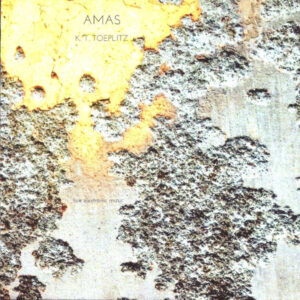
“Amas”
AMAS is one lengthy composition, played live on a computer consisting of long electronic parts; as described by Toeplitz, it is “a growing organism: my idea when working on it was to take some ideas from Don Buchla’s “philosophy” as a starting point - ideas from the “West-Coast” school of music: in building the “engines” which produce sounds, the shaping of the sounds is rather made by modulations and adding harmonics (by distortion or rather waveshaping) than the more “classical” (East-Coast) method of using filtering. But the Buchla/West-Coast influence is also on the structure of the music itself, the work considered as a living organism rather than a strict composition; or perhaps rather like a fixed time and a walk with a given direction, but all the steps are not fixed.”
Kasper T. Toeplitz is a French composer and musician of Polish origin, born in 1960. He lives in Paris. He has worked with academic research organisations, such as GMEM, GRM, IRCAM, and Radio-France, as well as with experimental musicians, such as Éliane Radigue, Zbigniew Karkowski, Dror Feiler, Tetsuo Furudate, Phill Niblock and Art Zoyd. Citing Giacinto Scelsi, Gyorgy Ligeti and Iannis Xenakis as influences, his early work was mostly written for traditional instruments. He received several prizes and distinctions for these works: 1st prize in composition for orchestra at the festival of Besançon, 1st prize in the Opéra Autrement/Acanthes competition, Villa Médicis Hors-les-Murs in New York, prize Léonard de Vinci in San Francisco, Villa Kujoyama in Kyoto, and DAAD in Berlin. He has also written for his electric guitar orchestra, Sleaze Art. He then integrated computers into his work, via the programming language MAX.
Please note: This release packaging comes folded into quarters, ending up as a 5 ” x 5 ” brochure style booklet (liner notes inside), with the CD in a paper sleeve, all inserted into re-sealable plastic sleeves. There is no jewel case, tray card etc.
Original price was: 14,00€.7,00€Current price is: 7,00€.
Out of stock

CD
Patricia BOSSHARD
“Temps suspendu”
“In 2011, the Association Eustache gave me carte blanche to compose a piece on the occasion of Le Grand Eustache’s annual concert in Lausanne, Switzerland.
I composed a work for my favourite sonorities, dear to my universe: the infinite register of strings. Starting with a quartet formation, I added the double bass for
its palette of low sounds, and percussion for its resonances.
The compositional work was put together as rehearsals progressed, with experimentations and improvisations guiding the writing of the score. This quintet explores the full richness of the strings, from the most extreme sounds to the most unknown. It is a bruitist piece, which offers us great refinement and considerable inventiveness.
Disconcerting, dreamlike moments… suspended moments.”
Annik Rody, violin. Patricia Bosshard, violin, composition. Marie Schwab, alto. Sara Oswald, cello. Jocelyne Rudasigwa, doublebass. Luc Müller, percussion.
“Patricia had to stand on tiptoes to reach the gilt handle that only yielded with difficulty under her weight. With both hands, she pushed open the rosewood door and long remained motionless on the threshold. Lining the four walls of the room were maple shelves on which stood hundreds of unknown objects.
After having climbed a pair of steps in ebony, Patricia delicately picked up an object and set it on the long spruce table that occupied the middle of the room.
She made it spin delicately on the table, looking at it from all different angles until
a particular alignment of its elements made a new object suddenly appear
out of the object. Her eyes slowly screwed up, and a smile played in her pupils.
After a few minutes, she went to look for another object and placed it next to the first. This was a fine rectangular plate in metal, flexible, cold and shiny.
A third object, a small, silky ball of black horse hair, soon joined the others.
She had fun putting them together, exploring all possible combinations,
making worlds suddenly appear.
By thus exploring new arrangements of materials, forms, colours, the time passed so quickly that the light was already fading. She pushed the heavy door, resisting the temptation to turn around and without knowing that she was feeling nostalgia for the first time, when she noticed, all about her, that the landscape had changed.” Antonio Albanese
Original price was: 20,00€.7,00€Current price is: 7,00€.
Out of stock

CD
John CAGE
“Music for Speaking Percussionist”
John Cage allowed for some of his works to be combined and performed simultaneously. Percussionist Bonnie Whiting has created uniquely virtuosic solo-simultaneous realizations of some of these works for “speaking percussionist.”
“A Flower” (1950).
“51’15.657” for a speaking percussionist (2010), a solo-simultaneous realization of 45’ for a speaker (1954) and 27’10.554” for a percussionist (1956). Realization by Bonnie Whiting.
“Music for Two (By One)” (2011), a solo-simultaneous realization of “Music for _____” (1984-1987) for solo voice and solo percussion. Realization by Bonnie Whiting.
“The Wonderful Widow of Eighteen Springs” (1942)
“Connecting Egypt to Madison through Columbus Ohio, Cage, and the History of the American Labor Movement” (2011) by Allen Otte and John Cage. Incorporating Music for Marcel Duchamp and Variations 2. Allen Otte, voice, prepared piano & frame drums.
Bonnie Whiting, voice, percussion, piano.
Original price was: 16,00€.10,00€Current price is: 10,00€.
Out of stock

2 CD
Bruce RUSSELL
“Metallic OK”
Bruce Russell is a New Zealand experimental musician and writer. He is a founding member and guitarist of the seminal noise rock trio The Dead C and the free noise combo A Handful Of Dust (with Alastair Galbraith). He has released solo albums featuring guitar and tape manipulation, and has contributed articles to British music magazine The Wire.
“This will be alien music to many listeners. Guitars tuned to the occult settings of revenants like Skip James and then played with a knife in an uncanny re-contextualising of the sound of beer bottles against guitar strings on the original Metallic KO; massively deformed electronics that sound like swarms of static, that sound like the needle eating the vinyl; radio interference; broke down piano; sledgehammer fuzz… this is the sound of taking a live Stooges meltdown as the keys to the goddamn kingdom and as a secret intimation of the arc of the future. Now here it is” from the sleevenotes by David Keenan.
Recorded in Lyttelton and Christchurch, New Zealand between 2008-2013.
Original price was: 15,00€.10,00€Current price is: 10,00€.
In stock

CD
GEINS’T NAÏT
“GN”
Geins't Naït was founded in Nancy, France, in 1986 by Thierry Merigout and Vincent Hachet, both students at the Architecture School of Nancy. A year later Laurent Petitgrand joined the band. Their sound is often described as an equivalent of bands like Einstürzende Neubauten, Coil or Test Dept., but Geins't Naït is not pure classic Industrial. While Geins't Naït offers rough pieces of music as an extension of its punk attitude, Petitgand refines them to create some musicality within the post-industrial collages, adding guitars, piano, and classical instruments. Geins't Naït and Laurent Petitgand sharpen sounds, giving them a kind of balance and density and ensuring that the musical language evokes a deep experience. Their music is raw and fascinating, and largely influenced by Surrealists and Situationists. Their early albums were released by French label Permis De Construire, with G.N. being the first, released in 1986. It features two long tracks which have been carefully remastered for this first ever CD re-issue. G.N. is the start of a re-issue programme for this phenomenal band that is still going strong.
12,50€
In stock

CD
FUSILLER
“Les réalités cannibales”
Fusiller aka Jo Tanz is building his own synth. His music will be like a strange mix between industrial noise, acid patterns and a bit of sad songs !
Original price was: 10,00€.6,00€Current price is: 6,00€.
In stock

CD
Richard BARRETT
“Adrift”
“Three live performances of collaborative electroacoustic compositions from 2007-08, recorded in London, Brisbane and Antwerp, each exploring different points of contact between precomposed structures and spontaneous invention: a duo adrift (in memory of Paul Rutherford) with pianist Sarah Nicolls, a nonet codex IX (in memory of Mauricio Kagel) with the Elision ensemble, and a 17-piece group with Ensemble Champ d’Action realising codex VII (to Vinko Globokar).”
Original price was: 12,00€.7,00€Current price is: 7,00€.
Out of stock

CD
COMPILATION
PANGEA NOISE
“A follow-up to Beyond ignorance and borders including noise artists from Puerto Rico (Cornucopia), Indonesia (Aneka Digital Safari), Singapore (Mindfuckingboy), China (Osci-Vibra-Tor, Li Jianhong), Algeria (Nihil Humanum), Slovenia (Aluviana), Iran (Nyctalllz), Luxembourg (Switchonoff), Tunisia (Heart Burnt To Ashes), Switzerland (Dave Phillips), South Korea-Japan (10), Equador (Industria Masoquista), Canada (Szkieve), France-Belgium (Planet Aldol & C-drík), Belgium ( rno klank), Malta (Grosz Ear), Latvia (Error), Everywhere-Nowhere (Zbigniew Karkowski), Bulgaria (Gokkun). Limited to 500 copies.”
Original price was: 10,00€.5,00€Current price is: 5,00€.
Out of stock

CD
PITA
“Get in”
Recorded and mixed by Peter Rehberg at Twisted, Wien March 2015-January 2016. Mastered and cut by Rashad Becker at D&M, Berlin, January 2016. Artwork by Tina Frank. Dedicated to Thomas Jerome Newton.
Twelve years have passed since Editions Mego boss Peter Rehberg released his last full length release ‘Get Off’ on the Hapna label. In the interim, along with running the label, Rehberg has embarked on a series of soundtracks for the French artist and choreographer Gisele Vienne. Out of this collaboration the seeds were planted for the prolific KTL, guitar-computer duo with Stephen O’Malley.
After a surprise return to live performance in 2015 we are now presented with Pita’s new full length document under the banner of “Get In”.
“Get In” extends the perennial Pita sound into a paradox of intimidation and beauty. “20150609” teases the juncture between the human and the tool, the improvised and composed and the analogue and digital. “Aahn” inhabits a field of electronic nebula, simultaneously inviting and alien. “Line Angel” could be a new form of minimalism for the post internet crowd. “S200729” harks to an acid most splintered whilst “Mfbk” completes proceedings as an ambient drift underscored with classical overtones. “Get in” is a beautiful, engaging and unsettling listen. A multi-headed hydra presented as the ultimate dystopian sonic journey.
Twelve years have passed since Editions Mego boss Peter Rehberg released his last full length release ‘Get Off’ on the Hapna label. In the interim, along with running the label, Rehberg has embarked on a series of soundtracks for the French artist and choreographer Gisele Vienne. Out of this collaboration the seeds were planted for the prolific KTL, guitar-computer duo with Stephen O’Malley.
After a surprise return to live performance in 2015 we are now presented with Pita’s new full length document under the banner of “Get In”.
“Get In” extends the perennial Pita sound into a paradox of intimidation and beauty. “20150609” teases the juncture between the human and the tool, the improvised and composed and the analogue and digital. “Aahn” inhabits a field of electronic nebula, simultaneously inviting and alien. “Line Angel” could be a new form of minimalism for the post internet crowd. “S200729” harks to an acid most splintered whilst “Mfbk” completes proceedings as an ambient drift underscored with classical overtones. “Get in” is a beautiful, engaging and unsettling listen. A multi-headed hydra presented as the ultimate dystopian sonic journey.
Original price was: 12,50€.8,00€Current price is: 8,00€.
In stock

CD
COMPILATION
LES ECHOS DE L’ÉTALE. ECHOES FROM THE FORESHORE. VOL.1
SPECIAL CLEARANCE PRICES ! With Leif Elggren et Carl Michael von Hausswolff, Edvard Graham Lewis, BJ Nilsen et Hildur Gudnadóttir. “Echoes from the foreshoreb is a new collection "entre-deux / à deux" (in between / two of us) organized by the French embassy of the Elgaland~Vargaland Kingdoms, a co-production between the Editions Cactus and Optical Sound. On the 27th of may 2007, at 15.05 a foreshore in Normandy was annexed by the French ambassador of the Kingdoms of Elgaland and Vargaland, and initiated a musical experimental project. Each volume of the collection gathers various authors whose work is an original creation, using the concept of utopian territories and fluctuating spaces. Each listening of the records therefore becomes a sonic journey investigating Elgaland Vargaland, capturing the echoes of the foreshore. The collection’s graphic was conceived by Samuel Ruchot, who created playful graphics, integrating the shape of the kingdom’s flag. Hence, the floating flag, distorted, is associated with different background colours, each one corresponding to a different volume, allowing an easy identification of the various ones. Each cover is also conceived as a way of exhibiting the intimist images of the photographs of Ludivine Mabire, which can be seen when one removes the disk. Each disk from the collection is an experimental space encapsulating the poetic representation of the Elgaland Vargaland territories.”
Original price was: 12,00€.7,00€Current price is: 7,00€.
In stock

CD
MAWJA
“Studio one”
Michael Bullock (contrabass & feedback), Mazen Kerbaj (trumpet) and Vic Rawlings (cello & surface electronics). “One strike isn’t enough. This album struck me like a big wave, a wave that makes you lose your consciousness and equilibrium for several minutes, leaving you wondering what just happened to you during this elusive lapse of time. Probably this is exactly the purpose of this trio, where as their music draws rust from your very skin, suburban rust, from those big suburbs where the individual melts, and all individuality is melted by the heavy burden that eats all. The sound ate the self, ate the collective, ate time, and invaded space. I wasn’t expecting such a radical treatment of sound. The music here goes out of time, depriving it of its value despite the usual ties that link time and music as an art form. What we hear is rather a strong binding with space, using it as a compositional tool. This music does not move, but it wanders like blocks of colours or shapes in the empty. The reunion of Bullock, Rawlings and Kerbaj for this recording leaves no possibilities for any future; it is a meeting of the here and now, like the musical result that is released with this recording. The Present time is simultaneously constructed and deconstructed, making the “now quality” predominant on the atmosphere of this record. The unified sound of the trio fills the air like a short-wave radio signal, carrying its usual load of small marginal details; a sound that resembles music or walks by it without remorse, not stopping at any station along the way. Three musicians, both friends and enemies, yet above all partners of this same game, where there are no rules for improvising; one erases the other, without regret, for the sake of unity in sound.” Raed Yassin, Beirut, March 2007.
Original price was: 14,00€.8,00€Current price is: 8,00€.
In stock
CD
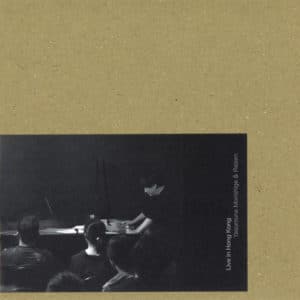
Yasumune MORISHIGE & REIZEN
“Live in Hong Kong”
This live show was organized by The Empty Gallery in Hong Kong. The owner and director listened a CD Music for Piano by cello improviser Yasumune Morishige and musician Atsushi Reizen released by Omega Point, and they decided to hold a live show on retrospective exhibition of experimental filmmaker Toshio Matsumoto.On this live show, two grand pianos provided through the good offices of the owner. This is the best situation for performing without interference of each player. This CD is made by main program “Music for Piano” only. You will listen Morishige's deep key play and Reizen's vibration drone by handy fan and others. Also they often play hardly. It may be induced by free-playable situation.
13,50€
Out of stock

CD
Cyril BONDI / Pierre-Yves MARTEL / Christoph SCHILLER
“tse”
Cyril Bondi (harmonium), Pierre-Yves Martel (viola da gamba) & Christoph Schiller (spinet).Five pieces by a new trio, who improvise but on a pre-agreed sequence of pitches, allowing a much greater use and exploration of pitch and melody than is usual in improvisation. Beautiful and thoughtful music. “I find that music requires a kind of implicit order, though this can consist of the barest rules imaginable. You need something to contain and channel the chaos of creation.” (Pierre-Yves Martel)
12,50€
Out of stock

2 CD
John CAGE
“Two2”
Landmark recording of Cage’s late work for two pianos, played by Mark Knoop and Philip Thomas. Uniquely for Cage’s number pieces, Two2 (1989) doesn’t use time brackets, so duration is open and left to the musicians’ ‘inner clock’. Previous recordings have lasted between 35 and 74 minutes, but this new version stretches across two CDs and lasts 128 minutes, revealing new depths and sonorities in the music. From two excellent early reviews: “This version is more intimate than a concert hall experience and also somehow larger than life, combining the potency of poetic invocation with the all-encompassing narrative arc of the finest stories. It will be some time before I have the pleasure of encountering either Cage or this piece to such revelatory effect.” Marc Medwin“128 minutes of pure, thought-compelling, perception-enhancing, down to earth bliss. Can’t ask for more. A major achievement.” Brian Olewnick
23,00€
In stock

CD
Magnus GRANBERG
“Es schwindelt mir, es brennt mein Eingeweide”
Hot on the heels of his wonderful piece on the Early to Late CD released earlier this year, a new hour-long work for an ensemble of six musicians by Swedish composer Magnus Granberg. Recorded in Geneva in September 2017 and played by Anna Lindal (baroque violin), d’incise (vibraphone & electronics), Cyril Bondi (percussion), Anna-Kaisa Meklin (viola da gamba), Christoph Schiller (spinet) and Magnus Granberg (prepared piano).The piece borrows material from a song by Schubert, but transforms it into Granberg’s typically taut and focused soundworld: “The expressiveness of the song has been subdued or silenced, and has become something which takes place somewhere beneath the surface of the music.” (Magnus Granberg)
12,50€
In stock
Book + CD
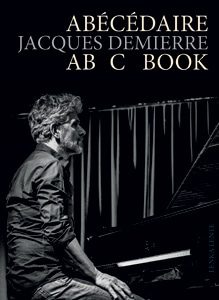
Jacques DEMIERRE
“Abécédaire”
Foreword by Guillaume Belhomme. Bilingual edition (English / French), 15 x 19,5 cm (softcover), 256 pages + CD.
An ABC book with which the pianist, composer and improviser recounts his experience of sound (with the score and recording on CD of an unpublished piece).
20,00€
In stock
CD
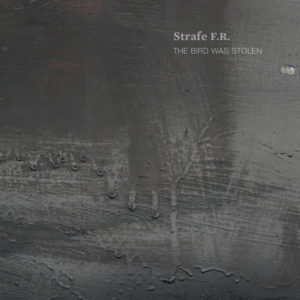
STRAFE F.R.
“The Bird Was Stolen”
Based in Düsseldorf, Germany, Strafe F.R. is a long-term collaboration between the artists Bernd Kastner and S. M. Syniuga, which started in 1979. After a long period of hibernation, The Bird Was Stolen marks their return to Touch following four previous releases in the 80s and early 90s.
From their early connection with the local punk and new wave scene, centered around the Ratinger Hof in Düsseldorf, Strafe went on to develop a unique and influential form of sound sculpture that pioneered the use of field recordings alongside home-made instruments and the use of the studio as a performance space.
A new track, ‘Virgin’, which appeared on the recent Touch Movements CD/book, gave an early indication that they are back at the peak of their powers. The Bird Was Stolen presents 14 new compositions that push the signature sound of Strafe F.R.
12,50€
Out of stock

CD
Ustad Zia Mohiuddin DAGAR
“Raga Yaman (Rudra Veena // Seattle // 15 March 1986)”
Zia Mohiuddin Dagar : rudra veena. Manik Munde : pakhawaj. Gayathri Rajapur & Annie Penta : tanpuras. Recorded by unknown at the University of Washington, HUB Auditorium, Seattle, Washington 15 March 1986 ; concert co-sponsored by the UW Ethnomusicology Division and Ragamala.Liner notes by Renaud Brizard, edited by Ian Christe.“Around ten years ago, deep into a cozy and hazy night following a concert with my sound brothers Daniel O'Sullivan and Kristoffer Rygg in London (as Æthenor), they graciously introduced me to a recording of rudra veena (a kind of noble deeper bass relative to the sitar, in a way) as performed by dhrupad master Zia Mohiuddin Dagar.Dhrupad, for those who do not know, is a branch of Hindustani classical music said to "show the raga in its clearest and purest form". It's pacing concentrates heavily on the slow, contemplative alap section and works with specific microtonal gestures and deep characteristics of resonance ... in short I was hooked on this new (to me) and ancient form of music from the first listen, and feel that a more or less continual listening & reviewing of Zia Mohiuddin Dagar's recordings in the years that followed have influenced my own approach to music quite heavily (if, albeit, indirectly).In early 2015 I was able to make contact with Zia Mohiuddin Dagar's son Bahauddin and some of his American students/disciples, primarily Jeff Lewis. Over time we developed a friendly and educational exchange, access a massive archive of recordings and developed these two paired titles for my label. It's been a long path to arrive at actually releasing them but also probably in many ways one of the most significant releases I've worked on. And I'm proud to be able to reveal these to date unreleased archival recordings of one of the masters of dhrupad, Z. M. Dagar, to the public for the first time.Zia Mohiuddin Dagar was the nineteenth generation in a family tradition known as Dagar gharana, a rich lineage which continued and performed the musical form of dhrupad (Bahauddin Dagar continues the lineage as a master rudra veena dhrupad player of note today). Initially, dhrupad was a rigorous, austere, devotional genre that was sung in Hindu temples. But between the 16th and the 18th centuries, it became the preeminent genre in royal courts in North and Central India, and the Dagar gharana developed and continued publicly following the eventual loss of court patronage for dhrupad in the 19th century. The French ethnomusicologist Renaud Brizard covers the story of Zia Mohiuddin Dagar's life and teaching (a long story also in Seattle, my hometown!), the Dagar family and gharana, the rudra veena and more topics in an extensive set of liner notes in this release.Raga Yaman was recorded at a public concert in Seattle at the HUB Ballroom at the University of Washington in March 1986 (the week after the accompanying release SOMA028 Ragas Abhogi & Vardhani was recorded) at the end of his last tour of the United States. Yaman was a special raga for Zia Mohiuddin Dagar, one of his signature raags. For centuries, Yaman has been considered as one of the most fundamental ragas in Hindustani music and is one of the first ragas which is taught to students. A deep knowledge of Yaman gives a key for understanding many other ragas. It's filled with tranquility, contemplation, pathos and spiritual yearning.”-Stephen O'Malley, March 2018, Paris, France
15,00€
Out of stock

CD
Ustad Zia Mohiuddin DAGAR
“Ragas Abhogi & Vardhani”
Zia Mohiuddin Dagar : rudra veena. Annie Penta : tanpura.Concert recorded at the home of Shantha and Niranjan B. Benegal, Seattle, Washington 9 March 1986. Recorded by Niranjan Benegal. Files obtained from Jeff Lewis. Mastered & Cut by Rashad Becker at Dubplates & Mastering. Liner notes by Renaud Brizard, edited by Ian Christe.“Around ten years ago, deep into a cozy and hazy night following a concert with my sound brothers Daniel O’Sullivan and Kristoffer Rygg in London (as Æthenor), they graciously introduced me to a recording of rudra veena (a kind of noble deeper bass relative to the sitar, in a way) as performed by dhrupad master Zia Mohiuddin Dagar.Dhrupad, for those who do not know, is a branch of Hindustani classical music said to "show the raga in its clearest and purest form". It's pacing concentrates heavily on the slow, contemplative alap section and works with specific microtonal gestures and deep characteristics of resonance ... in short I was hooked on this new (to me) and ancient form of music from the first listen, and feel that a more or less continual listening & reviewing of Zia Mohiuddin Dagar's recordings in the years that followed have influenced my own approach to music quite heavily (if, albeit, indirectly).In early 2015 I was able to make contact with Zia Mohiuddin Dagar’s son Bahauddin and some of his American students/disciples, primarily Jeff Lewis. Over time we developed a friendly and educational exchange, access a massive archive of recordings and developed these two paired titles for my label. It’s been a long path to arrive at actually releasing them but also probably in many ways one of the most significant releases I’ve worked on. And I’m proud to be able to reveal these to date unreleased archival recordings of one of the masters of dhrupad, Z. M. Dagar, to the public for the first time.Zia Mohiuddin Dagar was the nineteenth generation in a family tradition known as Dagar gharana, a rich lineage which continued and performed the musical form of dhrupad (Bahauddin Dagar continues the lineage as a master rudra veena dhrupad player of note today). Initially, dhrupad was a rigorous, austere, devotional genre that was sung in Hindu temples. But between the 16th and the 18th centuries, it became the preeminent genre in royal courts in North and Central India, and the Dagar gharana developed and continued publicly following the eventual loss of court patronage for dhrupad in the 19th century. The French ethnomusicologist Renaud Brizard covers the story of Zia Mohiuddin Dagar’s life and teaching (a long story also in Seattle, my hometown!), the Dagar family and gharana, the rudra veena and more topics in an extensive set of liner notes in this release.Ragas Abhogi & Vardhani were recorded in a private house concert in Seattle at the home of the Benegals in March 1986 (the week before the accompanying release SOMA029 Raga Yaman was recorded). The Benegals were friends (& Shantha Benegal was also a student) of Dagarsahib who sometimes hosted Hindustani music concerts in their home. It's a rare glimpse of a more intimate, personal and perhaps different kind of performance considering the form of dhrupad.”-Stephen O'Malley, March 2018, Paris, France.
15,00€
Out of stock
2 CD
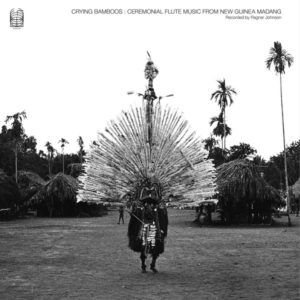
Ragnar JOHNSON
“Crying Bamboos: Ceremonial Flute Music from New Guinea Madang”
Crying Bamboos is a translation of the pidgin description of the sound of sacred flutes: “Mambu i cry, i cry, i cry”.Sacred flutes are blown to make the cries of spirits by adult men in the Madang region of Papua New Guinea. Pairs of long bamboo male and female flutes are played for ceremonies in the coastal villages near the Ramu River. There are seven male initiation flute cries from Bosmun, four flute cries from Bak: Borai with occasional single garamut percussion and two flute cries from Kaean, one with vocals and hand drums. The flute players were of the last generation to have learned this skill during a complete cycle of male initiation. These previously unreleased recordings were made in 1979.Recorded by Ragnar Johnson. Notes by Ragnar Johnson and Jessica Mayer. Photographs by Ragnar Johnson. Tape to digital transfer and mastering by Dave Hunt at Dave Hunt Audio, London. Cut by Rashad Becker at Dubplates and Mastering, Berlin.
18,00€
Out of stock
CD
Daunik LAZRO / Dominique RÉPÉCAUD / KRISTOFF K.ROLL / Géraldine KELLER
“Actions Soniques”
Daunik Lazro, bariton sax. Dominique “Ana Ban” Répécaud, electric guitar. Kristoff K.Roll (J-Kristoff Camps & Carole Rieussec), electroacoustic devices. Géraldine Keller, voice. Recorded in March 2016, “Actions Soniques” is a meeting of free rock with free impro into an electroacoustic environment with a clear and powerfull voice.This is the last CD from Dominique Répécaud (1955 - 2016).
13,00€
Out of stock

2 CD
Jakob ULLMANN
“Müntzers stern / Solo II”
“Münzers stern” (2015) for bassoon solo. Dafne Vicente-Sandoval: bassoon.Between 2014 and 2016 Jakob Ullmann composed the orchestral work steine, feuer, sterne (stones, fire, stars). This work is based on a largely modular structure, with the result that individual sections can also be played outside of a complete performance, solo or in predetermined combinations. One section among these is the section for a solo bassoon, which may be performed independently under the title Müntzers stern. “solo II für Fagott” (1992 / 2010 / 2015). Dafne Vicente-Sandoval: bassoon.solo II is part of a group of works with the title Buch der Stille 1 (Book of Silence 1) trägt. This is a series of solo pieces for flute / oboe da cacchia (solo I), trombone / bassoon (solo II), organ (solo III), low string instrument (solo IV), and piano (solo V ), all of which were developed from the same compositional idea; the series is a generalisation of disappearing musics, itself a composition for three winds, two strings and two pianos written between 1989 and 1991. The individual solo compositions can be performed separately, as well as in all combinations simultaneously.
24,00€
In stock
CD
NORTH OF NORTH
Anthony Pateras: piano, Scott Tinkler: trumpet, Erkki Veltheim: electric violin.North of North is an Australian trio featuring Anthony Pateras (piano), Scott Tinkler (trumpet) and Erkki Veltheim (violin). Drawing from improvisation, Carnatic music, 20th and 21st century compositional strategies, mathematical theories and open forms of jazz, their music is fused together by virtuosic instrumentalism, critical listening and a shared philosophy of musical and physical discipline. Their self-titled 2nd release was recorded in Melbourneʼs beautiful Church of All Nations, and is the first release on the new label offcompass, which was founded by the band in 2018. Aside from the bandʼs collective projects, the label aims to release and promote under-represented contemporary music practices, traversing free improvisation, electro-acoustic music, art-song & hybrid forms of composition.Black CD Ecopak with gold foil. 300 copies
14,00€
Out of stock

2 CD
Bruno DUPLANT
“Chamber and Field Works 2015 – 2017”
Performed by The Suidobashi Chamber Ensemble - a Tokyo-based group for new music with Wakana Ikeda, flute & harmonica, Yoko Ikeda, violin & viola, Masahiko Okura, clarinets, Taku Sugimoto, guitar & mandolin, Aya Naito, bassoon & voice, Hikaru Yamada, electronics - and by Taku Sugimoto (guitar).
22,00€
In stock

CD
Magnus GRANBERG / Jürg FREY
“Early to Late”
Performed by Ensemble Grizzana, Jürg Frey (clarinet), Magnus Granberg (celesta, harmonica & stones), Angharad Davies & Mira Benjamin (violins), Anton Lukoszevieze (cello), Dominic Lash (double bass), John Lely (electronics, harmonica & stones), Richard Craig (flute & electronics), Philip Thomas (piano), Simon Allen (dulcimer & glass harp), Dimitra Lazaridou-Chatzigoga (zither & electronics).Recorded at Huddersfield University, November 2017.
13,00€
Out of stock

CD
Taku SUGIMOTO
“h”
Cristián Alvear & Taku Sugimoto (guitars). Recorded live in concert at Ftarri, Tokyo, November 2017.
13,00€
In stock

CD
Clara DE ASIS
“Do Nothing”
Electroacoustic and minimal studio composition for guitar and percussion performed by Clara de Asis. Six beautiful solo pieces developed over the course of 2017. “It’s the way I work now. To me, one of the differences between improvisation and composition is how I think about and experience time. Meaning the time within the piece itself, but also the time of my life in which I develop the piece, and how I live through that time. I believe that, as with any other activity, music is very much related to the moment, the stage of one’s life, where it is produced – be it either in a perceptibly evident or in a subtle way. There is a correspondence between one’s life and way of living and the music one makes. And when I’m developing a piece, during the process of composing it and making it, which can last months, weeks, or days, I learn things about myself; there’s a feedback between the developing piece and my own life. And that feedback leads me to make choices. Choices that set up a frame regarding a situation that goes beyond the present time. In that sense, I do find improvisation limiting as a means of music-making, because improvised music is formally circumscribed by one instant.”
12,50€