
Out of stock

book
COMPILATION
ECHTZEITMUSIK BERLIN
“Shaped by the perspectives of participants and various observers, the book Echtzeitmusik Berlin - Self-Defining a Scene investigates, documents, and reflects on a multilayered phenomenon within Berlin’s musical culture, a phenomenon whose influence and meaning has effects that extend far beyond Berlin itself. Having emerged in the open spaces of the city’s east side after the fall of the Berlin Wall, and rooted in a cultural coordinate system made up of squats and free improvisation, punk and New Music, social experimentation and performance art, the Echtzeitmusik scene has passed through an eventful history of musical and social development and matured into a wide spectrum of predominantly experimental forms of music, bordering on fields as varied as noise, electronica, trash pop, free jazz, and contemporary composed music, not to mention performance and sound art.
This book is a theoretical approach to a scene that constituates itself through practice, that describes itself with every single contribution here, that invents, defines, and positions itself through writing. It is a verbal act of uncovering. There is not the history, but a myriad of histories, not the theory, but the widest range of somewhat discordant conceptions and approaches. Echtzeitmusik - Self-Defining a Scene mirrors this multiperspectivity. It is more than a mere documentation of the history of Echtzeitmusik, it might be considered a part of this history. Theoretical texts, memories, statements and artwork by Thomas Ankersmit, Harald Ansorge, Serge Baghdassarians, Boris Baltschun, Jürg Bariletti, Johannes Bauer, Burkhard Beins, Marta Bla anovi , Nicholas Bussmann, Lucio Capece, Diego Chamy, Clare Cooper, Werner Dafeldecker, Rhodri Davies, Bertrand Denzler, Bill Dietz, Axel Dörner, Phil Durrant, Ekkehard Ehlers, Sabine Ercklentz, Andrea Ermke, Kai Fagaschinski, Fernanda Farah, Kerstin Fuchs, Björn Gottstein, Matthias Haenisch, Hanna Hartman, Franz Hautzinger, Robin Hayward, Teresa Iten, Sven-Åke Johansson, Margareth Kammerer, Christian Kesten, Annette Krebs, Christof Kurzmann, Greg Malcolm, Thomas Meadowcroft, Chico Mello, Thomas Millroth, Toshimaru Nakamura, Gisela Nauck, Vered Nethe, Andrea Neumann, Nina Polaschegg, Michael Renkel, Ana Maria Rodriguez, Adeline Rosenstein, Arthur Rother, Olaf Rupp, Ignaz Schick, Ulf Sievers, Stefan Streich, T. Turner, Michael Vorfeld, Antje Vowinckel and Steffi Weismann”.
29,00€
Out of stock
book
Peter BRÖTZMANN
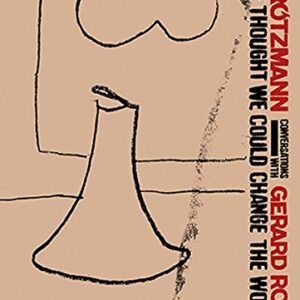
“We thought we could change the world – Conversations with Gérard Rouy”
One day in 2008 an old friend of mine came to me and said, ”I want to make a film about Peter Brötzmann, do you want to be part of it?” What a question! He didn”t know that much about (free) jazz and freely improvised music but from the late 70s on, he had been very much attracted - as we all were - by the graphic work of most of the Free Music Production records, a lot of them being worked out by Brötzmann. He also knew that I had been one of Brötzmann”s great fans and I had been acquainted to him for a very long time.
”Soldier of the road” was shot between November 2008 and August 2009. We went to different venues where Brötzmann was playing between those dates. We also had four long interviews with Brötzmann in his home in Wuppertal. Interviews of other people were made at the same time with Jost Gebers, Evan Parker, Fred Van Hove, Han Bennink, Fred Frith, Michael Wertmüller. And others with Joe McPhee, Conny and Johannes Bauer, Michael Zerang and Paal Nilssen-Love, Ken Vandermark and Mats Gustafsson, that were not used in the movie. Bernard Josse suggested me to ask Brötzmann some specific questions, some of them I did, some others I didn’t.
But I felt frustrated about the fantastic amount of information that Brötzmann gave us about the history of this music that would not going to be used in that 90 minutes long film - we can easily understand why. That’s how I started to realize that not using all that information would be a great loss.
All interviews appearing happened either during the shooting period of the movie, or have been published by the French Jazz Magazine during the last forty years, or were never published.
Illustrated with 58 photos by Gérard Rouy and 18 artworks by Peter Brötzmann.
in English.
28,00€
Out of stock
book
Peter BRÖTZMANN
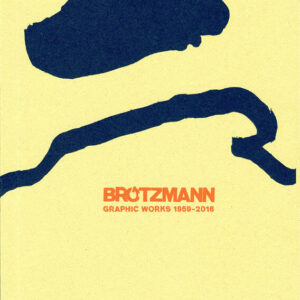
“Graphic Works 1959-2016”
With contributions by Lasse Marhaug, John Corbett, Gérard Rouy, David Keenan, Karl Lippegaus, and Jost Gebers.
Brötzmann has always created and still creates the covers of his recordings himself – sometimes also for other musician colleagues – and in the past also often the posters for various FMP projects (Workshop Freie Musik in the Academy of Arts or Total Music Meeting in the Quartier Latin, later in Podewil).
“Looking at his early posters and record covers it’s striking how fully formed his visual sense was from the very beginning. He had a background from both advertising and Fluxus art and built upon that. Just like his playing, he knew what he wanted to say with his graphic design. The music and visuals were coming from the same place. And there’s no question who it’s coming from. When you see a design by Peter there is little doubt who made it. His work has such a strong character that when we try to copy the style (and many have) it’s obvious who we’re stealing from – so we fail”. (Lasse Marhaug)
“In his graphic endeavors, Brötzmann has in fact made a body of work consistent with his music and his art, an oeuvre that undermines the presumption that design is inherently rigid. More than just the decoration of information, Brötzmann"s five decades of design bear witness to a sophisticated, delicate, and earthy sensibility, along with a dogged sense of internal logic. His record covers and posters are passionate and thoughtful, playful and brutal, basic and human”. (John Corbett)
This catalog with about 260 works is published to the exhibition at the Bimhuis, Amsterdam, Sept. 2016. 368 pages, catalogue, soft cover.
49,00€