
Out of stock

2 CD
Philip CORNER
“Satie Slowly”
American composer Philip Corner likes Satie too well not to object to how he is played. From the time of his participation in the first performance of Satie’s “Vexations” he realized that here was, lurking under the travesties of the 1st Gymnopédie, one of the greats of this or any other century... a “secret genius” who masked with humility and seeming conformity a profoundly innovative thorough-going critique of the limitations and pretensions of our High Culture as it has come down to us. A 44 page booklet of commentary and and additional 16 page booklet of graphic analyses set out to demonstrate this - with implication for performance of the works. As the record title “Satie Slowly” shows, the indication “lent” is taken at its full value. An ample selection of piano pieces, spread across two CDs, come from his early period, music with great spiritual content.
Original price was: 21,00€.12,00€Current price is: 12,00€.
In stock
CD
Jacqueline HUMBERT & David ROSENBOOM
“Daytime viewing”
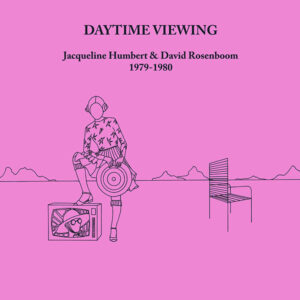
“Daytime Viewing (1979-80) is an extended narrative song, based on a casual analysis of daytime television drama and the audience phenomena such programming addresses. The piece explores the use of fantasy as a survival mechanism against loneliness, illustrating the human compulsion to inflate the mundane to mythological proportions. A central female character weaves tales, using threads of personal experience and the idea of TV as friend, as mantra, and as transformational window between imagined spectacle and the pedestrian plane.
Originally released as a private cassette edition documenting the collaborative performance piece of the same name by Jacqueline Humbert & David Rosenboom, this heady, thoroughly enjoyable work is available for the first time ever on CD and LP. Jacqueline Humbert (aka J. Jasmine) is a songwriter of brains and wit on par with Robert Ashley, with whom she’s worked extensively. David Rosenboom’s complex, harmonic electronic arrangements are accentuated brilliantly by percussion from William Winant. Daytime Viewing can happily be added to a small but significant group of work that, through lesser-known paths, engaged in an equally revelatory reexamination of the Great American Songbook as Minimalism did with 20th Century composition. Mastered by David Rosenboom.
13,00€
In stock

LP
Girma YIFRASHEWA
“Love and Peace”
Unseen Worlds presents new recordings of solo piano pieces by Ethiopian composer Girma Yifrashewa, the first release of Yifrashewa's music outside of Africa. Born in Addis Ababa in 1967, Girma Yifrashewa is a worthy new torchbearer of African pianism. His highly personalized approach to the piano likens him to Ethiopian composer Emahoy Tsege Mariam, while his use of Ethiopian pentatonic scale within the Western Art Music format places his compositions in conversation with more academically minded work. Traditionally Ethiopian in melody, cinematic in vision, and deep in beauty, his compositions occupy a lyrical middle ground between classical and jazz that is supremely listenable yet defies easy classification.
Beginning his musical life at a young age with the traditional krar (influenced by Ethiopian folk legends like Kassa Tessema) Girma did not discover the piano until he was sixteen years old. He enrolled quickly thereafter in the Yared Music School, eventually earning a scholarship to study at the Sofia Conservatory in Bulgaria. Despite a short period as a refugee in Italy following communism's demise in Bulgaria and the consequent loss of his scholarship, Girma completed his conservatory training in Bulgaria gathered through charitable organizations in direct recognition of his talents. Following the passing of Ethiopian composer Ashenafi Kebede in 1998, Girma moved beyond his conservatory repertoire and began his career as a composer, penning the composition "The Shepherd With The Flute" - an homage to Kebede's most famous work, "The Shepherd Flutist." Since then, Yifrashewa has established himself a pre-eminent composer of Ethiopia, touring Africa and Europe extensively on cultural commissions. The emotional directness and unique quality of his work make it destined for wider popularity, still.
10,00€