
In stock
Book
Ursula BLOCK & Michael GLASMEIER
“Broken music”
*** Back in stock ***
Broken Music is an essential compendium for records created by visual artists. The publication was edited by Ursula Block and Michael Glasmeier and originally published in 1989 by DAAD. Broken Music focuses on recordings, record-objects, artwork for records, and record installations made by thousands of artists between WWII and 1989.
It also includes essays by both editors as well as Theodor W. Adorno, René Block, Jean Dubuffet, Milan Knizak, László Moholy-Nagy, Christiane Seiffert, and Hans Rudolf Zeller, as well as a flexi disc of the Arditti Quartet performing Knizak’s “Broken Music.” The centerpiece of the publication is a nearly 200-page bibliography of artists’ records.
Works chosen for the publication revolved around four criteria: (1) record covers created as original work by visual artists; (2) record or sound-producing objects (multiples/editions/sculptures); (3) books and publications that contain a record or recorded-media object; and (4) records or recorded media that have sound by visual artists.
Artists documented in the volume include Vito Acconci, albrecht/d., Laurie Anderson, Guillaume Apollinaire, Karel Appel, Arman, Hans Arp, Antonin Artaud, John Baldessari, Hugo Ball, Claus van Bebber, John Bender, Harry Bertoia, Jean-Pierre Bertrand, Joseph Beuys, Mel Bochner, Claus Böhmler, Christian Boltanski, KP Brehmer, William Burroughs, John Cage, Henri Chopin, Henning Christiansen, Jean Cocteau, William Copley, Philip Corner, Merce Cunningham, Hanne Darboven, Jim Dine, Marcel Duchamp, Max Ernst, Lawrence Ferlinghetti, Fischli and Weiss, R. Buckminster Fuller, Allen Ginsberg, Philip Glass, Jack Goldstein, Peter Gordon, Hans Haacke, Richard Hamilton, Bernard Heidsieck, Holger Hiller, Richard Huelsenbeck, Isidore Isou, Marcel Janco, Servie Janssen, Jasper Johns, Joe Jones, Thomas Kapielski, Allan Kaprow, Martin Kippenberger, Per Kirkeby, Cheri Knight, Milan Knizak, Richard Kriesche, Christina Kubisch, Laibach, John Lennon, Sol Lewitt, Roy Lichtenstein, Annea Lockwood, Paul McCarthy, Meredith Monk, Josef Felix Müller, Piotr Nathan, Hermann Nitsch, Albert Oehlen, Frank O’Hara, Claes Oldenburg, Yoko Ono, Dennis Oppenheim, Nam June Paik, Charlemagne Palestine, A.R. Penck, Tom Phillips, Robert Rauschenberg, The Red Crayola, Ursula Reuter Christiansen, Gerhard Richter, Jim Rosenquist, Dieter Roth, Gerhard Rühm, Robert Rutman, Sarkis, Thomas Schmit, Conrad Schnitzler, Kurt Schwitters, Selten Gehörte Musik, Richard Serra, Robert Smithson, Michael Snow, Keith Sonnier, Strafe für Rebellion, Jean Tinguely, Moniek Toebosch, Tristan Tzara, Ben Vautier, Yoshi Wada, Emmett Walsh, Andy Warhol, William Wegman, and Lawrence Weiner.
Ursula Block is a curator living in Berlin, Germany. From 1981 until 2014, she ran gelbe Musik, a gallery and record shop in Berlin that featured work by artists at the crossroads between music and art.
Michael Glasmeier is a professor, writer, and editor living in Berlin, Germany. Since the early 1980s, he has curated dozens of shows that explore the intersection between the visual arts, music, film, and language.
34,00€
Out of stock
book
John CAGE
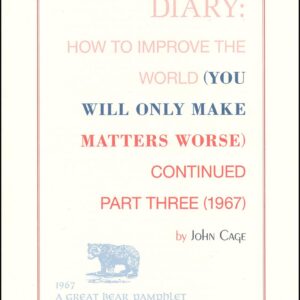
“Diary: How to Improve the World (You Will Only Make Matters Worse) Continued Part Three (1967)”
The third in Cage’s series of “Diary” essays (the other parts were published in different contexts), defined broadly as “collections of thoughts that develop out of working and being alive.” The text is formally and discursively roving: its margins, typeface, and color undergo continuous alteration by chance methods as Cage contemplates computers, Erik Satie; life on the road with Merce Cunningham; death; encounters with Mies van der Rohe, Duchamp, and Marshall McLuhan; books; cold remedies, and more. Above all, Diary seems to confront the problem of truly ecumenical thought. Dick Higgins, as the publisher’s original printing technician, meticulously engineered the variations in color, and as such, this may be the most outwardly beautiful of the Great Bears series.
Originally published by Something Else Press between 1965 and 1967, the Great Bear Pamphlet series was envisioned by founding editor Dick Higgins as a “poor man’s keys to the new art,” or a means of exposing the most vital work of the time to a mass-market audience, and vice versa. The series made uncompromisingly radical work maximally accessible, with slim, chapbook-like publications of a mostly uniform, pared down design. Taken together, the pamphlets constitute a firsthand survey of the sixties avant-garde (Higgins, Barbara Moore, and Emmett Williams all had a hand in the editorial process) that is both sweeping and utterly unique, transmitting a still-vibrant signal of expanded possibility in art, music, and poetry. Presented here in a facsimile edition, the Great Bears epitomize the utopian vision of Higgins and Something Else.
5 x 8 inches, 16 pages, Paperback, B&W.
7,50€
Out of stock

LP
The GUERILLA ART ACTION GROUP
“Action-Interview at WBAI Radio Station-N.Y.”
The participants making up The Guerrilla Art Action Group on this recording were Jon Hendricks, Poppy Johnson, Jean Toche. They were joined by Laurin Raiken, a member of the New York Free Theater and Art Workers Coalition.
The recording documents a liven bonne et dûe formee action/interview by the group on January 5, 1970 on the progressive radio station WBAI.
Action-Interview at WBAI Radio Station-N.Y. was first published in 1983 by Edizioni Lotta Poetica and Studio Morra as part of their Radio Taxi series. The gatefold sleeve contains the complete text of the performance. The LP is produced in an edition of 500.
The LP consists of a series of spoken statements describing the problematic relationship between art and business, art and the military, art and class, art and community, and art and race. Some of these statements are directed to an open public, but others are questions addressed to artists, forcing them to question their role in a dehumanizing, repressive, and corrupt system:
“How long will you accept being the repressed lackey of society’s manipulations?”
“Are you guilty of being a repressor?”
“Is it more important to you to sell your painting, or help human beings?”
“What is more important to you? To exhibit in a museum, or to fight for the human rights of the oppressed?”
These questions, like many of the group’s activities, undermine the notion that there is a separation between art and life or that art can enjoy an exemption from the systemic discrimination and corruption that permeates all aspects of American society. The group sought an artist model that could enact political and social change and they encouraged their fellow artists to follow suit by focusing less on aesthetic abstractions and more on direct personal experiences and expression. They believed that artists had become dehumanized through their willingness to operate inside of a racist and sexist cultural system that relied on corporate money while aiding and abetting a military that used art to distract people from wartime atrocities.
18,00€
Out of stock
LP
C Spencer YEH
“RCA Mark II”
The RCA Mark II is a follow-up to Yeh’s recent vocal work and is focused solely on the non-musical operation of the famed RCA Mark II synthesizer. Built and installed in 1959 at Columbia University, it was the first programmable synthesizer and became the bedrock upon which the Columbia-Princeton Electronic Music Center was founded. The machine has not worked since 1997.
While visiting a friend at the university, Yeh discovered the synthesizer and began to make regular trips to work with it acoustically: flipping switches, rubbing surfaces, turning knobs, and plugging/unplugging cables. Using contact and room microphones, Yeh recorded these operations over the course of several sessions, and the recordings became the basis from which he composed this 12-track LP. The artist then further manipulated and processed the material through a series of live performances, which were recorded and edited to complete the album.
The finished tracks are jagged, sparse, and hypnotically rhythmic. In listening to the record, one does not so much hear the original synthesizer, but rather an artist dismantling the historical weight of the source through a composition of its transformation from a legendary machine to a one-ton hunk of scrap metal no longer operational. It is here perhaps that Yeh finds virtuosity and spectacle in the most basic acts of instrumentation, the movement and clank of mechanical parts.
The album was designed by Robert Beatty and includes liner notes by Andy Battaglia.
500 copies.
18,00€
Out of stock
book
Max NEUHAUS
“Program notes”
Max Neuhaus’ Program Notes records the aphoristic statements of the innovative sound artist as he redefined the boundaries of his new audio practice. Seeking to eschew the “small area music [had] been concentrating on for the past several hundred years,” Neuhaus consciously relocated his work in the late ‘60s to what he deemed “the realm of space” as opposed to that of time—choosing to present his music in public and communal settings, decidedly outside of the “proscenium situation.” This short pamphlet was initially published in 1974 by York University Press.
Max Neuhaus (1939 – 2009) began his career as a percussionist and experimental musician in the late ‘50s, working with the likes of John Cage and Karlheinz Stockhausen. By the mid-‘60s however, Neuhaus became increasingly interested in the broader realm of sound, eventually becoming a pioneer in the field of sound art. His sound installations are permanently installed in New York’s Times Square, at Dia Beacon, and at Houston’s Menil Collection.
5.4 x 8.4 inches, 32 pages, Paperback, Edition of 500.
7,50€