
In stock

CD
ID M THEFT ABLE
“Well I Fell in Love With the Eye at the Bottom of the Well”
"The initial idea for "Well I Fell in Love with the Eye at the Bottom of the Well" was actually to attempt to make a doo wop song with that as the title. I kept adding more and more ideas and those ideas blossomed into other ideas to the extent that there's only the faintest hint of that initial doo wop impulse on the album but a whole other sort of garden grew up around it and through it. It was probably a decade from the moment that that title popped into my head as an idea for a doo wop song to its completion as a full length album, one that has absolutely nothing whatsoever to do with doo wop."
But maybe think experimental/musique concrete/sound poetry/noise and all around amazingness...
id m theft able performs within and without the realms of noise, avant-improvisation, sound poetry, performance, et c. et c. et c. using voice, found objects, electronics, and whatever else is available......
He has given over a thousand performances across 4 continents, in 40 countries and 40 states in settings ranging from the scummiest of squats to the fanciest of festivals.
13,00€
Out of stock
CD
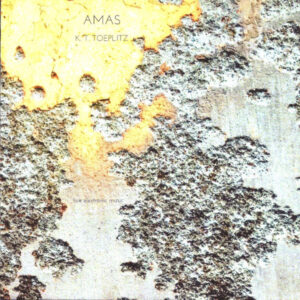
Kasper T. TOEPLITZ
“Amas”
AMAS is one lengthy composition, played live on a computer consisting of long electronic parts; as described by Toeplitz, it is “a growing organism: my idea when working on it was to take some ideas from Don Buchla’s “philosophy” as a starting point - ideas from the “West-Coast” school of music: in building the “engines” which produce sounds, the shaping of the sounds is rather made by modulations and adding harmonics (by distortion or rather waveshaping) than the more “classical” (East-Coast) method of using filtering. But the Buchla/West-Coast influence is also on the structure of the music itself, the work considered as a living organism rather than a strict composition; or perhaps rather like a fixed time and a walk with a given direction, but all the steps are not fixed.”
Kasper T. Toeplitz is a French composer and musician of Polish origin, born in 1960. He lives in Paris. He has worked with academic research organisations, such as GMEM, GRM, IRCAM, and Radio-France, as well as with experimental musicians, such as Éliane Radigue, Zbigniew Karkowski, Dror Feiler, Tetsuo Furudate, Phill Niblock and Art Zoyd. Citing Giacinto Scelsi, Gyorgy Ligeti and Iannis Xenakis as influences, his early work was mostly written for traditional instruments. He received several prizes and distinctions for these works: 1st prize in composition for orchestra at the festival of Besançon, 1st prize in the Opéra Autrement/Acanthes competition, Villa Médicis Hors-les-Murs in New York, prize Léonard de Vinci in San Francisco, Villa Kujoyama in Kyoto, and DAAD in Berlin. He has also written for his electric guitar orchestra, Sleaze Art. He then integrated computers into his work, via the programming language MAX.
Please note: This release packaging comes folded into quarters, ending up as a 5 ” x 5 ” brochure style booklet (liner notes inside), with the CD in a paper sleeve, all inserted into re-sealable plastic sleeves. There is no jewel case, tray card etc.
Original price was: 14,00€.7,00€Current price is: 7,00€.
Out of stock

CD
Ulrich KRIEGER
“Winters in the abyss”
Matt Barbier, trombone. Zara Rivera, French horn. Paul Rivera, contrabass trombone.
Winters in the Abyss are the first five pieces of Ulrich Krieger’s Deep-Sea cycle, which compromises a total of 14 pieces. Each movement of Winters in the Abyss can stand on its own and be performed as an independent piece. Numbered in order of their composition, the movements from V to I follow the sinking of this material from light flooded, warm near-surface waters to high pressure, pitch black and extreme cold deep-sea trenches.
Winters in the Abyss takes the fictional undertone series, an upside-down overtone series, as its compositional material. Analogue to water pressure, the density of pitches is higher in the lower range and gets thinner in the upper range. The structures of the individual pieces follow the pressure, amount of live and movement being present in the respective depths. Therefore there is more movement in the higher regions and less in the lower regions. Based on an undertone series Winters in the Abyss is in Just Intonation, making its performance even more challenging by having the series ‘on its head’.
An hour long endeavor on three brass instruments is a daunting task, but it also provides an unique opportunity for the performers to explore their physical and instrumental limits in a separate mode from the traditional pitfalls of brass endurance - missed high tones and playing wrong overtones. Winters removes that - the extremely low tessitura eliminates concerns of fatigue decreasing one's range or a lack of focus causing pitch errors. Long held concerns are stripped away and all that's left is staying in the middle of the sound and maintaining it. The instruments are all close-microphoned, therefore amplifying elements of the sound normally not or only weakly audible: air within tone, sound of spit, weaker partials, tiny tone fluctuations, and more. This results in a redefined brass sound that only pretends to be acoustic, due to the lack of electronic manipulation, but is inherently processed.
Please note: This release packaging comes folded into quarters, ending up as a 5 ” x 5 ” brochure style booklet (liner notes inside), with the CD in a paper sleeve, all inserted into re-sealable plastic sleeves. There is no jewel case, tray card etc. There is a bar code.
Original price was: 14,00€.8,00€Current price is: 8,00€.
In stock

CD
Marta SAINZ and IF, BWANA
“Sable”
Marta Sainz: voice, dan bau; If, Bwana (Al Margolis): amplified detritus box, recorder, clarinet.
Marta Sainz and Al Margolis (If, Bwana) met and performed together in Madrid, Spain for the first time in October 2014. That initial performance – she on voice/performance and he on laptop, was such a joy, that they both determined that they would work together again as soon as possible. That opportunity arose again in June 2015, when the duo did a brief tour in Spain, as well as going into the studio in Madrid – which is Sable.
On this recording of 3 improvised pieces, Sainz vocalizes as well as performs on an amplified dan bau - a Vietnamese single string instrument. Margolis makes use of what he calls a “detritus box” - one side wood, one side laminate, each half amplified with contact microphones - and all manner of detritus used to make sounds, as well as alto recorder and clarinet.
Through the use of her voice and body, Sainz’s performance refers to elements of German Expressionism and the theater of cruelty of Artaud: she is seeking to emotionally shock the viewer with their own experience, without the content and performance having a specific meaning intended in itself. Margolis shows increasing clarity of vision in his work - both as a composer, and on this recording, as an improvisor.
Together, they manage to fuse beauty and terror into something truly remarkable. This recording is a very special experience for anyone willing to travel the length of a terrifying way with these accomplished and visionary performers.
Please note: This release packaging comes folded into quarters, ending up as a 5 ” x 5 ” brochure style booklet (liner notes inside), with the CD in a paper sleeve, all inserted into re-sealable plastic sleeves. There is no jewel case, tray card etc. There is a bar code.
Original price was: 15,00€.5,00€Current price is: 5,00€.
In stock

CD
Lionel MARCHETTI & Olivier CAPPAROS
“Equus”
“Equus is a collaborative work of musique concrète recorded in 2001-02 on a commission from the INA-GRM. It is truly a delight for Pogus to add this title to our catalog. As Capparos notes: "Equus guides us through human memory and history. It may sound a bit strange that sound & music would appear as a "vehicle", or as we had cast a lead into a labyrinth. This brings us to the question of whether we are alive or not; travelling the path throughout these soundings would drive us down and up our consciousness and our listening, not to mention that we are dead or alive."
13,00€
In stock

maxi CD
SECLUDED BRONTE
“Secluded in Jersey City”
“Well talk about your long gestations for a project. Secluded in Jersey City, by Secluded Bronte was recorded live on WFMU in November of 2002. And we spoke about releasing this on Pogus pretty quickly after that. So to take twelve years to release a CD is a pretty long time. But it was most certainly worth the wait.
This trio features Jonathan and Adam Bohman with the added experimental irreverence of Richard Thomas. The Bohman Brothers are known for their unique live performances mixing theatre, speech and sounds made from a Heath-Robinson-style array of found objects connected to microphones and laptops.”
“It's hard to describe the raw, explosive audio art they perpetrate. Everyday objects and sounds are worked on until they become saturated with lurid suggestion, resulting in a bizarre, hysterical immediacy … in the traditions of the Bonzo Dog Doo-Dah Band, the Bohman Brothers kitchen-sink realism laughs at the grand claims of lofty art. They will show you fear in a sponge from a drainer.” (Ben Watson in The Wire).
Please note: This CD is 22 minutes and 24 seconds in length. This release packaging comes folded into quarters, ending up as a 5 ” x 5 ” brochure style booklet (liner notes inside), with the CD in a paper sleeve, all inserted into re-sealable plastic sleeves. There is no jewel case, tray card etc. There is a bar code.
5,00€
In stock

CD
Pauline OLIVEROS – Francisco LÓPEZ – Doug VAN NORT – Jonas BRAASCH
“Quartet for the end of space”
“This recording consists of 8 electro-acoustic compositions. 2 pieces by each of the 4 composers. The works span a vast sonic terrain, challenging listener and performer alike through a seamless blend of Deep Listening and Absolute Noise, moving between ever-fluid improvisation and carefully controlled sound manipulation.
The quartet convened for two improvisational sessions between February and May of 2010, with López sitting in on a Triple Point (Oliveros-Van Nort-Braasch) recording session and bringing his finely crafted sonic objects-as-instruments, further spanning the electro-acoustic divide that has become Triple Point’s calling. The four later re-formed for their debut concert at the Deep Listening Institute in Kingston, NY in September of 2010. These sessions have since become raw material for the individual artists to construct new visions of this shared sonic body through extensive and thorough evolution of the recordings - personal reflections culled from a collective tapestry.
Pauline Oliveros has influenced American music extensively in her career spanning more than 60 years as a composer, performer, author and philosopher. She pioneered the concept of Deep Listening, her practice based upon principles of improvisation, electronic music, ritual, teaching and meditation, designed to inspire both trained and untrained musicians to practice the art of listening and responding to environmental conditions in solo and ensemble situations.
Francisco López is internationally recognized as one of the major figures of the sound art and experimental music scene. Over the past 30 years he has developed an astonishing sonic universe, absolutely personal and iconoclastic, based on a profound listening of the world. Destroying boundaries between industrial sounds and wilderness sound environments, shifting with passion from the limits of perception to the most dreadful abyss of sonic power, proposing a blind, profound and transcendental listening, freed from the imperatives of knowledge and open to sensory and spiritual expansion.
Doug Van Nort is an experimental musician and digital music researcher whose work is dedicated to personal and collective creative expression through noise, free improvisation and generally electro-acoustic means of production, from the lo-fi of broken electronics to the hi-tech of custom signal processing algorithms. Recent projects have spanned telematic music, laptop ensemble compositions,, immersive electro-acoustic works, interactive sonic installations and machine listening systems.
Jonas Braasch is an experimental soprano saxophonist and acoustician with interests in Telematic Music and Intelligent Music Systems. He has performed with Curtis Bahn, Chris Chafe, Michael Century, Mark Dresser, Pauline Oliveros, Doug van Nort and Stuart Dempster among others. His saxophone style expands the traditional repertoire by incorporating various non-western elements and extended techniques.” label info
14,00€
Out of stock

CD
Pauline OLIVEROS
“No mo”
In the summer of 1966 I worked in the classical Electronic Music Studio at the University of Toronto for six weeks. The system I used to create No Mo and Something Else consisted of Layfette tone generators, noise source and tape delay. In the Fall of 1966 I was the newly appointed director of the Mills Tape Music Center formerly the San Francisco Tape Music Center and now the Center for Contemporary Music at Mills College. Bog Road was created at the Mills Tape Music Center in the Summer of 1967 with the Buchla Series 100 Box. The studio overlooked a pond where frogs were singing a chorus that inspired a series of Bog pieces.
14,50€
Out of stock

CD
Pauline OLIVEROS
“Alien bog – Beautiful soop”
Pauline Oliveros completed Beautiful Soop (1966) and Alien Bog (1967) utilizing the original Buchla Box 100 series created for the Tape Music Center by Don Buchla and her tape delay system. “I was deeply impressed by the sounds from the frog pond outside the studio window at Mills. I loved the accompaniment as I worked on my pieces. Though I never recorded the frogs I was of course influenced by their music.”
14,50€
In stock

CD
David ROSENBOOM
“Invisible gold”
“David Rosenboom (b. 1947) has been widely acclaimed as a pioneer in American experimental music since the 1960’s. He is a composer, performer, conductor, interdisciplinary artist, author, and educator having explored ideas in his work about the spontaneous evolution of forms, languages for improvisation, new techniques for ensembles, cross-cultural collaborations, performance art, computer music systems, interactive multi-media, compositional algorithms, and the structure of the brain and nervous system. These two works, “Portable Gold and Philosophers Stones” (1972) and “On Being Invisible” (1976-77), are classics of live electronic music involving extended musical interface with the human nervous system.”
14,00€
In stock

CD
Annea LOCKWOOD
“Thousand year dreaming-floating world”
“Performers on Thousand Year Dreaming: Art Baron, conch shell, trombone, didjeridu; Libby Van Cleve, oboe, English horn; Jon Gibson, didjeridu; Annea Lockwood, voice; J.D. Parran, clarinet, contrabass clarinet; Michael Pugliese, tam-tam, clapping sticks; N. Scott Robinson, conch shell, frame drums, pod rattle, tam-tam; John Snyder, didjeridu, waterphone; Charles Wood, tam-tam, stones; Peter Zummo, trombone, didjeridu
Thousand Year Dreaming (1990) was commissioned by Essential Music and was written with the musicians on this recording, their particular strengths and inclinations, very much in mind. It grew out of an improvisatory piece, Nautilus, which Art Baron, Scott Robinson and Lockwood realised in 1989. They found that the sound of conch shell trumpets, didjeridu and frame drums really flowered in the resonant spaces they were using for the piece. Lockwood started imagining the sonorities possible with four didjeridus, gongs, conches and trombones and frame drums, all shaped by the penetrating and sensuous edge of oboes and clarinets. Four sections emerged to which she gave the subtitles: breathing and dreaming; the Chi stirs; floating in mid-air; in full bloom. While most of the work is fully scored, it contains two improvisations: a duet for John Snyder (didjeridu) and Scott Robinson (frame drum), and a section for all four didjeridus. In performance, at this point the four players wander amongst the audience, exploring the space s acoustics, playing into a listener’s shoulder here, a foot there - sonic massage. When close to completing the piece Lockwood realised that its underlying, generative idea was the gradual awakening and release of sonic energy, energy which I think of as coiled and latent, in breathing and dreaming, but with an embedded power which will nourish when summoned. Floating world (1999) is an immersion in place and transience. The composer invited friends who work with environmental sounds themselves, and who have a strong sense of place, to make recordings for her in places of personal, spiritual significance to them, so it is a collaborative work. From their field recordings (edited but not processed), and other sounds Lockwood wove the slowly shifting texture forming floating world.”
12,00€
In stock

2 CD
Alvin LUCIER
“Almost New York”
“CD 1 - Twonings: Charles Curtis, cello; Joseph Kubera, piano; Almost New York: Robert Dick, flutes; Broken Line: Robert Dick, flute; Danny Tunick, vibraphone; Joseph Kubera, piano. CD 2 - Coda Variations: Robin Hayward, tuba. Pogus is extremely delighted to be release this 2 CD set of recordings of works by Alvin Lucier. He is one of the key experimental artists of the 20th and 21st centuries, and is one of my favorite composers. A unique and individual artist: No one sounds quite like Alvin Lucier. Lucier writes about the genesis of the works on this release: Since the early 1980’s I have made a series of works for conventional musical instruments. Before that time I had been mainly occupied with the exploration of such phenomena as echolocation, brain waves, room acoustics and the visual representation of sound. Often these works required special equipment hand held pulse wave oscillators (Vespers), differential amplifiers (Music for Solo Performer), horseshoe magnets Music on a Long Thin Wire). Then players began asking me for pieces. Now I needed to find a way of achieving the same poetry with acoustic instruments as I did with electronic means. One of the things I discovered was that players could create rhythmic patterns by closely tuning with electronically generated pure waves or with each other, producing audible beats. Often, to get continuous motion, I have one or more voices sweep up or down at various speeds against fixed sustained pitches. As a wave approaches a sustained pitch the audible beating slows down to zero when it reaches unison, then speeds up again as the wave leaves the pitch. Almost New York employs slow sweep pure wave oscillators, Broken Line, flute glissandi. In Twonings two different tuning systems collide and in Coda Variations slight variations in pitch are heard chronologically. Recorded by Charles Curtis, Joseph Kubera, Robert Dick, Danny Tunick, and Robin Hayward - some of the leading new music performers of our era, these works are essential additions to the Alvin Lucier oeuvre, as well as satisfying anyone interested in great experimental music.” label info
18,50€