
Out of stock

CD
James TENNEY
“Selected works 1961 – 1969”
“A collection of pioneering computer works by American Icon Tenney which includes the celebrated ur-plunderphonic piece Collage No.1 (Blue Suede).The music on the rest of the CD - like much computer music - is rather bloodless; an exception being the hurricane of sound that is Fabric for Chè. For those concerned with the early history of electronic music this is a useful CD, for those with a more general interest, the two pieces above and the 6 minute Music for Player Piano remain significant early works.”
15,00€
Out of stock
CD
COMPILATION
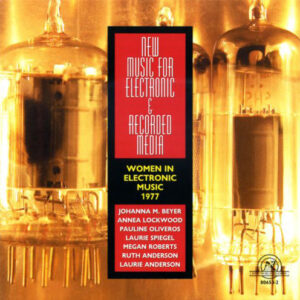
WOMEN IN ELECTRONIC MUSIC
“This is a long-awaited reissue of the CRI CD of the classic 1750 Arch LP. "The music on this album exhibits an exciting, wide-open, freewheeling approach to the medium of electronic music which has come to be typical of this genre in the late 1970s. No longer are composers obsessively concerned with the agonizing, expressionistic, and purely “electronic” (synthesized) sound formulas which marked much of this music composed between the mid Fifties and the late Sixties. Instead, today we have composers willing to mix media and sonic materials in thoroughly inventive ways to achieve ends which are new-sounding, and often more engaging, than that of the “academic” avant-garde. This is the outgrowth of a fundamental change in concerns which has been evolving not only among the composers on this album but also in a growing segment of the musical avant-garde, of which these members are some of the most fecund and inspired. These new sources of inspiration certainly were not as widely shared fifteen years ago. Several composers represented here are deeply concerned with Eastern influences: meditation, healing, trance, states of serenity. Others are inspired by traditional (or “ethnic”) musics and their subsequent metamorphoses into such popular forms as rock and roll. Still others bring to bear a sense of wit and satire, rarely a prominent feature of avant-garde music in the early 1960s. This first anthology of women’s electronic music demonstrates great refinement and skill at work in a variety of different styles, several of which are unfamiliar or new even to those who follow contemporary music. The fact that these pieces are more listenable than that of the Sixties avant-garde does not point to a musical regression as some critics have overeagerly assumed when discussing modern works using, say, consonant harmonic structures. Rather, and I think this is common denominator for these pieces and something which women composers and artists have been instrumental in legitimizing again for this period in time, these works signify a new consciousness of the relationship of art to human life and the important and positive interaction which can be the role of a more personalized art in our day-to-day experience.” Charles Amirkhanian, August 1977. “Music of the Spheres” (1938) (Johanna M. Beyer), “World Rhythms” (1975) (Annea Lockwood), “Bye Bye Butterfly” (1965) (Pauline Oliveros), “Appalachian Grove I” (1974) (Laurie Spiegel), “I Could Sit Here All Day” (1976) (Megan Roberts), “Points” (1973-74) (Ruth Anderson), “New York Social Life” (1977), “Time to Go” (1977) (Laurie Anderson).
15,00€
Out of stock

CD
MOONDOG
“Round The World Of Sound”
Moondog’s music performed by Dedalus & Muzzix. WithDidier Aschour, guitar and artistic director; Christian Pruvost, trumpet and co-director; Stéphane Garin, percussion, glockenspiel; Peter Orins, drums; Vincent Bouchot and Nathalie Duong, voice; Sakina Abdou, alto & baritone saxophones, recorder, spinet; Julien Favreuille, sopranino & tenor saxophones, flute; Denis Chouillet, piano, toy piano; Barbara Dang, spinet, organ; Deborah Walker, cello; Sébastien Beaumont, classical & electric guitars, banjo; Nicolas Mahieux, double bass; Maxime Morel, saxhorn, trombone.
“To reduce the music of Louis Thomas Hardin (1916-1999) to the legendary figure of Moondog would be to pass over the real work of the composer. The melodic invention, the prodigious rhythms, and the mixture of genres, as original as they are obvious, all come together to form a music that merits consideration strictly as music. To interpret Moondog’s Madrigals, we wanted to develop aspects of the original recording of 1970, but also to produce a “live” version, one that would express the vitality and energy of ensemble music, and in order to enrich the instrumentation we chose a different combination of instruments for each piece. Round the World of Sound is an album of songs, and the singers were employed in many ways: alone or in duets, polyphonic (sometimes a capella) or in chorus, and sometimes the musicians added their own voices to those of Vincent Bouchot and Nathalie Duong. When we were invited to play this music in a festival that contained many types of music, the organizer asked to try to define the genre, and we answered, “Well, let’s just call it pop chamber music”.” -Didier Aschour, music director, Dedalus.
This twenty-five piece selection is entitled Madrigal Book 1, and is a nod to the system Johann Sebastian Bach used for his Well-Tempered Clavier. Here, Moondog passes through all the major and minor tonalities, following the cycle of fourths. Thus, the opening Bells Are Ringing is in C major, followed by Voices of Spring in A minor, What's the Most Exciting Thing in F major and so on until the return to C major with Sparrows. The album spans twenty years of composing and bohemian life in the very heart of Manhattan, on its streets and under its porches. The record features pieces from the early 1950s (All Is Loneliness, Be a Hobo) as well as later canons written in June 1968. All are autobiographical, or at least reflect the state of mind of their author. As such, they are either melancholic or cheerful, and can evoke the everyday life (Coffee Beans) or a longing for recognition (Maybe), at all times vibrant with his good turns of phrase and his distinctive philosophy. This collection constitutes a marvelous window on Moondog’s universe.
“To reduce the music of Louis Thomas Hardin (1916-1999) to the legendary figure of Moondog would be to pass over the real work of the composer. The melodic invention, the prodigious rhythms, and the mixture of genres, as original as they are obvious, all come together to form a music that merits consideration strictly as music. To interpret Moondog’s Madrigals, we wanted to develop aspects of the original recording of 1970, but also to produce a “live” version, one that would express the vitality and energy of ensemble music, and in order to enrich the instrumentation we chose a different combination of instruments for each piece. Round the World of Sound is an album of songs, and the singers were employed in many ways: alone or in duets, polyphonic (sometimes a capella) or in chorus, and sometimes the musicians added their own voices to those of Vincent Bouchot and Nathalie Duong. When we were invited to play this music in a festival that contained many types of music, the organizer asked to try to define the genre, and we answered, “Well, let’s just call it pop chamber music”.” -Didier Aschour, music director, Dedalus.
This twenty-five piece selection is entitled Madrigal Book 1, and is a nod to the system Johann Sebastian Bach used for his Well-Tempered Clavier. Here, Moondog passes through all the major and minor tonalities, following the cycle of fourths. Thus, the opening Bells Are Ringing is in C major, followed by Voices of Spring in A minor, What's the Most Exciting Thing in F major and so on until the return to C major with Sparrows. The album spans twenty years of composing and bohemian life in the very heart of Manhattan, on its streets and under its porches. The record features pieces from the early 1950s (All Is Loneliness, Be a Hobo) as well as later canons written in June 1968. All are autobiographical, or at least reflect the state of mind of their author. As such, they are either melancholic or cheerful, and can evoke the everyday life (Coffee Beans) or a longing for recognition (Maybe), at all times vibrant with his good turns of phrase and his distinctive philosophy. This collection constitutes a marvelous window on Moondog’s universe.
14,00€
Out of stock
CD
Richard MAXFIELD – Harold BUDD
“The oak of the golden dreams”
“Important reissue of two historic minimalist albums, originally released on LP via the Advance label and out of print for decades now. Mastered from original tapes according to the composers original specifications. Packaged with informative liner notes by Kyle Gann, including an overview discography for seminal works within the field of minimalism. "This timely CD reissue combines two LPs from the Advance label -- Richard Maxfield’s Electronic Music and Harold Budd’s The Oak Of The Golden Dreams -- both containing seminal works which are key to a better understanding of the complex origins of minimalism. A mostly forgotten figure, Richard Maxfield (1927-1969) exerted a powerful influence over a broad range of composers through his classes at The New School. The works here predate the minimalist movement while forecasting a wide range of developments in the future of electronic work. The prophetic ’Pastoral Symphony’ (1960) is composed of continuously generated electronic tones; while ’Bacchanale’ (1963) is a musique concrète collage juxtaposing jazz with Korean folk music, spoken word, and various instrumental contributions, including Terry Jennings on saxophone. ’Piano Concert for David Tudor’ (1961) draws its multifarious noises from a single source -- antedating in that respect Stockhausen’s ’Mikrophonie I’ for amplified tam-tam (1964). Tudor plays live alongside a three-channel montage constructed from sounds made on the inside of the piano with chains, spinning a gyroscope on the strings, showering the strings with tiddlywink discs, and other unusual operations. ’Amazing Grace’ (1960) mixes tape loops from two sources which are played back at various speeds, causing the fragments to overlap in complex ways, predating both Riley’s and Reich’s tape-loop pieces. If the Maxfield pieces represent the state of new music in the months before minimalism was born, Harold Budd’s (b. 1936) works from 1970 reflect minimalism’s initial impact. ’The Oak Of The Golden Dreams’ was made on the Buchla Box which Budd uses here as an electric organ capable of the kind of fast modal improv, over an unchanging E-flat drone, that Terry Riley and La Monte Young had been doing on saxophone and piano. ’Coeur D’Orr’ features a soprano sax improv against an electronic background on organ comprised of two tracks, one of which is another 1970 Budd work, the famous ’Candy Apple Revision’."
15,00€
Out of stock
CD
Michael PISARO
“a mist is a collection of points”
Phillip Bush, piano; Greg Stuart, percussion; Michael Pisaro, sine tones.
Michael Pisaro (b. 1961) is a member of the Wandelweiser collective, an international organization of musicians which he has defined as “a particular group of people who have been committed, over the long term, to sharing their work and working together.” Its members have shared an interest in John Cage and experimental music, and extended durations, indeterminacy, and silence have featured in many works they have made; but Pisaro is quick to point out that the members of the collective have a far from uniform aesthetic stance. Pisaro’s work over the past decade bears little surface resemblance to the pieces made by other members of the collective apart from a commitment to experimental music and to deeply collaborative processes. Many of the recent trajectories of his work intersect in A mist is a collection of points (2014).
“A mist is a collection of points”, while a grid is an organized collection of points. There is the unspoken tension in this work between regular and aperiodic, solid and vague, artificial and organic, order and sprawl. This interplay takes place from one section to the next, and also in the interactions between the parts: between the pianist (Phillip Bush), the percussionist (Greg Stuart), and the sine tones (by Michael Pisaro). It affects the melody and the resonance, the timing and the coordination between parts. The intermingling of shadow pitches and extended resonances creates effects that are at least as vivid as any articulation.
Gradual change is a feature of the entire work, on the most local scale (measure by measure) and on the macro scale as well. Timing, resonance, melody, register, and dynamics are all intertwined in these slow transformations. “The work is essentially about the morphology and topography of this resonance.” This recording, like the piece itself, best reveals itself when it is “let loose in an environment,” played on speakers rather than headphones, in order to continue to develop its shape.
15,00€
Out of stock
CD
Julius EASTMAN
“The Zürich concert”
“The composer is therefore enjoined to accomplish the following: she must establish himself as a major instrumentalist, he must not wait upon a descending being, and she must become an interpreter, not only of her own music and career, but also the music of her contemporaries, and give a fresh new view of the known and unknown classics”. Julius Eastman
Just when you think you are grasping the breadth and quality of the music of Julius Eastman (1940–1990), a recording such as Julius Eastman: The Zürich Concert shows up, and you have to go back and reassess his work and wonder what will show up next. This recording is from a 1980 solo seventy-minute improvisatory concert in Zürich, a cherished cassette made by a friend of Eastman’s, who recently realized its uniqueness and decided that he should share it. The Zürich Concert was performed on October 25, 1980 in the Aula R.mibühl gallery. Eastman was in Europe participating in The Kitchen tour, and a Swiss friend, Dieter Hall, a painter who had been living in the East Village, arranged the concert. Hall recorded it on a cassette machine, so there is the inevitable gap when the tape had to be turned over, as Eastman played non-stop for seventy minutes. Simply put, The Zürich Concert is a revelation. Listening to this recording, one is overwhelmed by the cascades of sound, the power of the playing. It almost seems as if the piano will start bouncing across the floor like an out-of-control washing machine. But there is also space and delicacy in the playing. As a whole, the music never flags, and your attention doesn’t wane, as you are drawn in by the intensity of the playing and the coherence and wonder of the music being made.
Just when you think you are grasping the breadth and quality of the music of Julius Eastman (1940–1990), a recording such as Julius Eastman: The Zürich Concert shows up, and you have to go back and reassess his work and wonder what will show up next. This recording is from a 1980 solo seventy-minute improvisatory concert in Zürich, a cherished cassette made by a friend of Eastman’s, who recently realized its uniqueness and decided that he should share it. The Zürich Concert was performed on October 25, 1980 in the Aula R.mibühl gallery. Eastman was in Europe participating in The Kitchen tour, and a Swiss friend, Dieter Hall, a painter who had been living in the East Village, arranged the concert. Hall recorded it on a cassette machine, so there is the inevitable gap when the tape had to be turned over, as Eastman played non-stop for seventy minutes. Simply put, The Zürich Concert is a revelation. Listening to this recording, one is overwhelmed by the cascades of sound, the power of the playing. It almost seems as if the piano will start bouncing across the floor like an out-of-control washing machine. But there is also space and delicacy in the playing. As a whole, the music never flags, and your attention doesn’t wane, as you are drawn in by the intensity of the playing and the coherence and wonder of the music being made.
14,00€
Out of stock
CD
Joseph BYRD
“NYC 1960-63”
American Contemporary Music Ensemble. Clarice Jensen, Artistic Director and Alan Zimmerman, percussion. The imaginative and carefully crafted music of Joseph Byrd (b. 1937) assumes an astonishing variety of guises: he was an integral part of the experimental arts scene in New York and Los Angeles in the 1960s and he founded the psychedelic rock band The United States of America, and its successor Joe Byrd and the Field Hippies, to name just the most salient. Byrd’s career resists easy categorization because his collective activities encompass a broader sound world than is typically admitted within the confines of a single genre. In this sense, Byrd possesses the spirit of radical exploration that has long characterized composers of the American experimental tradition. He initially moved to New York in 1960 to study with John Cage, but among the most influential of his experiences during this period were his two lessons with Morton Feldman, whose delicately floating music enchanted the young composer. The works on this recording provide a rich musical document of Byrd’s activities in New York between 1960 and 1963, when he studied with Feldman, served as an apprentice to Cage, and participated in the Fluxus group. Crafted with technical precision, all of the works were designed to explore the “singularity of sound” that was central to Byrd’s lessons with Feldman. When Byrd’s music was performed at Carnegie Recital Hall in the spring of 1962, Eric Salzman of The New York Times described the concert as a “thimbleful of tiny sounds” that were “generally just this side of the threshold of inaudibility.” Initially, the “thimbleful of tiny sounds” assembled on this recording may not appear to anticipate the extraordinary diversity of Byrd’s subsequent work, but they reveal the key to his early studies and the foundation of his artistic development. As with much of Feldman’s music, the low dynamic levels and subtly shifting timbres and textures persuade the listener to attend to the sounds more carefully, thereby enriching the perceptual experience.
13,00€
In stock
CD
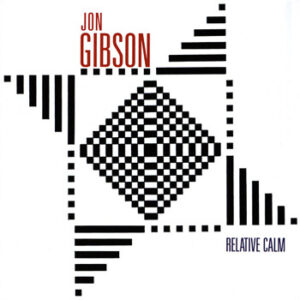
Jon GIBSON
“Relative Calm”
Jon Gibson, saxophone, soprano saxophones (overlaid), winds, keyboards, autoharp, ambient recording; Joseph Kubera, keyboards; David Van Tieghem, percussion.
Relative Calm (Rise) (1981), Q-Music (Race) (1981), Extensions RC (Reach) (1981), Return (Return) (1981)
“Gibson stakes out a small but verdant territory more satisfying than the concrete landscapes of many more ambitious minimalist oeuvres.” Kyle Gann
“In Relative Calm, I am very much involved with texture and collage, and it is mainly intuitive. I don’t want to be compulsive about the concepts that may inspire a piece. An idea may look wonderful on paper, and may feature an exciting and innovative formula, but the music must sound. Some composers care only about the idea … but I care only about the actual sound of the music”.Jon Gibson
“Some of the harmonies in Gibson’s music—its ringing organ tones rising, smearing, melting, tumbling above the piano’s hammered rhythms—make me think of fine old hymn tunes, now iced by repetition into components of an intergalactic anthem.” Deborah Jowitt, Village Voice (1981)
“[Jon] uncovered some multitracks of four pieces he recorded in 1980 and 1981 and I am honored to be mixing them now. These tapes are like a time capsule of the late 1970s New York Minimalist movement: dense, claustrophobic and yet so open. Sculptural in composition and texture, they reveal an entirely different way of seeing music, and are possibly more effective today in their stark contrast than they would have been had they been released 34 years ago.” Chuck Zwicky
Jon Gibson (b. 1940) is one of the less frequently mentioned pioneering composers of minimal music and is probably best known as a founding member of the Philip Glass Ensemble. Gibson also holds the unique distinction of having performed with Steve Reich, Terry Riley, and La Monte Young (as a member of the Theatre of Eternal Music), in addition to Glass, the four composers widely regarded as the founding fathers of minimal music. Gibson also has a track record of composing for modern and post-modern dance and Relative Calm (1981) is the fruit of one of his numerous collaborations with well known choreographers, in this case Lucinda Childs, who commissioned the work. The rediscovery of Relative Calm, one of Gibson’s major works, is cause for rejoicing among aficionados of minimalist music.
14,00€
Out of stock
CD
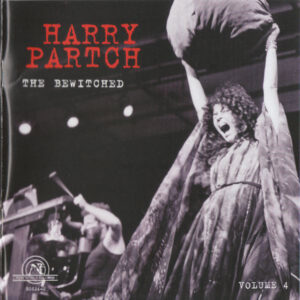
Harry PARTCH
“Volume four”
2005 remaster, from original mono master tapes (recorded in 1957). The Bewitched was Partch’s first work solely intended for dance (and mime-dance at that; he was not overly enamored in his lifetime of so-called ’modern dance’). Drawing heavily from his deep affection for the music-theatrical performance traditions of Greek theater, as well as those from Africa, Bali, and Chinese opera, Partch conceived of a contemporary American music ritual-theater where musicians not only play, but also function at times as movers-singers-actors. Such is the case of The Bewitched, where the instruments are the set, in front of (and around) which dancers ’dance,’ but where the onstage musicians also move and sing. Partch’s masterpiece has been lovingly remastered from the original mono masters and the 24-page booklet includes never-before-published photographs from productions of The Bewitched. This is the definitive document of this very important work." "The Bewitched is in the tradition of world-wide ritual theatre. It is the opposite of specialized. I conceived and wrote it in California in the period 1952-55, following the several performances of my version of Sophocles’ Oedipus. In spirit, if not wholly in content, it is a satyr-play. It is a seeking for release -through satire, whimsy, magic, ribaldry -- from the catharsis of tragedy. It is an essay toward a miraculous abeyance of civilized rigidity, in the feeling that the modern spirit might thereby find some ancient and magical sense of rebirth. Each of the 12 scenes is a theatrical unfolding of nakedness, a psychological strip-tease, or - a diametric reversal, which has the effect of underlining the complementary character, the strange affinity, of seeming opposites." Harry Partch.
13,00€
Out of stock
CD
Harry PARTCH
“Volume three”
“The four works on this newly remastered are eloquent testimony to Harry Partch’s aesthetic of corporeality. The music he composed for “The Dreamer That Remains” (1972), for “Rotate the Body in All its Planes” (1961), for “Windsong” (1958),and for“Water! Water!” (1961), was intended as only one component in the total artistic experience. In this works music joins with drama, with film, with dance, even gymnastics, as integral parts of the composer’s vision.”
13,00€
Out of stock
CD
Harry PARTCH
“Volume two”
The Harry Partch Collection, Volume 2 : “The Wayward”: “US Highball” (1943, rev. 1955), “San Francisco” (1943, rev. 1955), “The Letter” (1943, rev. 1972), “Barstow” (1941, rev. 1968); “And on The Seventh Day…” (1963-64, rev. 1966).
Harry Partch’s compositions of the 1940s-and to some extent his work in general-have remained until recently an unwritten chapter in the history of American music. And yet it was these very pieces-the collection of four works he would later collectively entitle The Wayward-that brought him to the attention of the New York musical world. His concert of these pieces for the League of Composers (April 22, 1944) established for him a small but permanent reputation as a musical maverick who had wandered off well-worn tracks and had developed a sort of lateral extension of his art, independently of any of the main circles of American music.
The musical starting point of the compositions of The Wayward is the inflections and rhythms of everyday American speech. From the beginnings of his mature output in 1930 Partch had been devoted to what he called “the intrinsic music of spoken words,” and these four works capture something of the spontaneous musicality of the conversations of the hoboes he befriended during the Depression. In their original form these pieces used only the small collection of instruments Partch had built or customized by 1943: Adapted Viola, Adapted Guitar, Chromelodeon, and Kithara. The versions recorded here are all later reworkings, sometimes with only small changes (as in the case of San Francisco), and sometimes involving a substantial amount of recomposition (as in the case of U.S. Highball).
The final work on this disc dates from twenty years later than the compositions of The Wayward, and represents one of the high points of Partch’s later instrumental idiom. And on the Seventh Day Petals Fell in Petaluma was composed in Petaluma, California, in March-April 1964, and revised at various times and places until the completion of the final copy of the score in San Diego in October 1966. It marks a radical departure from the theater works he had written at the University of Illinois in the early 1960s, and shows a renewed concentration on technical innovation and on fusing his activities as composer and instrument-builder within the context of a single composition. Newly remastered.
Harry Partch’s compositions of the 1940s-and to some extent his work in general-have remained until recently an unwritten chapter in the history of American music. And yet it was these very pieces-the collection of four works he would later collectively entitle The Wayward-that brought him to the attention of the New York musical world. His concert of these pieces for the League of Composers (April 22, 1944) established for him a small but permanent reputation as a musical maverick who had wandered off well-worn tracks and had developed a sort of lateral extension of his art, independently of any of the main circles of American music.
The musical starting point of the compositions of The Wayward is the inflections and rhythms of everyday American speech. From the beginnings of his mature output in 1930 Partch had been devoted to what he called “the intrinsic music of spoken words,” and these four works capture something of the spontaneous musicality of the conversations of the hoboes he befriended during the Depression. In their original form these pieces used only the small collection of instruments Partch had built or customized by 1943: Adapted Viola, Adapted Guitar, Chromelodeon, and Kithara. The versions recorded here are all later reworkings, sometimes with only small changes (as in the case of San Francisco), and sometimes involving a substantial amount of recomposition (as in the case of U.S. Highball).
The final work on this disc dates from twenty years later than the compositions of The Wayward, and represents one of the high points of Partch’s later instrumental idiom. And on the Seventh Day Petals Fell in Petaluma was composed in Petaluma, California, in March-April 1964, and revised at various times and places until the completion of the final copy of the score in San Diego in October 1966. It marks a radical departure from the theater works he had written at the University of Illinois in the early 1960s, and shows a renewed concentration on technical innovation and on fusing his activities as composer and instrument-builder within the context of a single composition. Newly remastered.
14,00€
Out of stock
CD
Harry PARTCH
“Volume one”
The Harry Partch Collection: Volume 1 : “Eleven Intrusions” (1949-50), “Plectra & Percussion Dances” (1952), Ulysses at the Edge” (1955). This newly remastered reissue marks a welcome return to the catalog of the first volume of the classic 4-CD collection that was formerly available on the CRI label. The works recorded on this disc span the first six years of what Harry Partch (1901-1974), slightly tongue-in-cheek, called the “third period” of his creative life. They show him moving away from the obsession with “the intrinsic music of spoken words” that had characterized his earlier output (the vocal works of 1930-33 and 1941-45) and towards an instrumental idiom, predominantly percussive in nature. This path was to take him through the “music-dance drama” King Oedipus (1951)-the culmination of his “spoken word” manner-to the “dance satire” The Bewitched (1954-55), in which his new percussive idiom manifests itself. The three works on this disc show Partch before, during, and after this period of transition. In their quiet, forlorn way, the Eleven Intrusions are among the most compelling and beautiful of Partch’s works. The individual pieces were composed at various times between August 1949 and December 1950, and only later gathered together as a cycle. Nonetheless they form a unified whole, with a nucleus of eight songs framed by two instrumental preludes and an essentially instrumental postlude. Although foreshadowed by the dance sequences of King Oedipus, the Plectra and Percussion Dances (1952) are the first of Partch’s major works to be wholly instrumental in conception. They stand in relation to Oedipus as a satyr play in relation to a Greek tragedy-hence the work’s subtitle, “Satyr-Play Music for Dance Theater.” He felt that after the prolonged period of composition and production of Oedipus it was “almost a necessity to give vent to feelings and ideas, whims and caprices, even nonsense, that seem to have no place in tragedy.”
The final work on this disc is Ulysses at the Edge, written at Partch’s studio at Gate 5 in July 1955. Ulysses, which Partch describes as a “minor adventure in rhythm,” is unique among his mature compositions in that, in its original form, it did not call for any of his own instruments. The version recorded here, for alto and baritone saxophones, Diamond Marimba, Boo, Cloud-Chamber Bowls, and speaking voice, is considered the third version of the piece.
The final work on this disc is Ulysses at the Edge, written at Partch’s studio at Gate 5 in July 1955. Ulysses, which Partch describes as a “minor adventure in rhythm,” is unique among his mature compositions in that, in its original form, it did not call for any of his own instruments. The version recorded here, for alto and baritone saxophones, Diamond Marimba, Boo, Cloud-Chamber Bowls, and speaking voice, is considered the third version of the piece.
15,00€
In stock
CD
David DUNN
“Autonomous and dynamical systems”
A relentless explorer, composer, performer and theorist, David Dunn (born 1953) uses electro-acoustic resources, voice, non-human living systems, as well as traditional instruments. This CD features four new compositions, all for electronic sound makers of one sort or another, and all four reveal his innate musicality. “Lorenz” (2005) is a collaboration between Dunn and chaos scientist James Crutchfield. In this piece, Crutchfield’s program for exploring chaos equations, MODE (Multiple Ordinary Differential Equations), is linked through an interface program called OSC into a sound synthesis program. The sound synthesis program feeds information back through OSC into MODE, so the whole thing is not only a use of chaos to control sound-it’s a feedback loop itself, embodying the principles of chaos not only in its mathematics, but also in its very structure. Another aspect of Dunn’s work has been setting up interactive systems within nature, whereby humans, machines, and the environment interact with each other. In the mid-1980s, as the technology became smaller, and cheaper, he began a series of works where he tried to set up interactive systems in which the environment could interact with itself. “Autonomous Systems: Red Rocks” (2003) is the latest in this series of works, and possibly the most elegant realization of the idea yet. In “Nine Strange Attractors” (2006), Dunn guides us through a whole zoo of chaotic attractions. Each one has different behavior, and each produces a different sound world. This is a work that is not simply about playing with new mathematical toys-it’s a work that exemplifies the structure of those toys, placing human, computer, and sound-making machine into a feedback loop that embodies the essential characteristics of that new science (chaos), and then lets us live within it for an extended period of time. Gradients (1999) is a work Dunn made with a freeware graphics-to-sound conversion program. In this program, graphic lines become sounding sines, each single pixel-wide line being realized as one sounding pure electronic sine wave. If the sound world of Red Rocks represents nature at her messiest, and the attractor pieces show the slightly less messy world of mathematical abstractions of natural processes, in this piece we have the clean lines and simple shapes of man-made geometry. It is best heard at high volume, where the dynamism of the sound is revealed-gloriously.
12,00€
Out of stock

CD
Christian WOLFF
“Ten exercises”
“Exercises 18 (two versions), 7, 16, 8, 14b, 3, 1, 15, 10 (two versions), 11”. Natacha Diels, Garrett List, Larry Polansky, Michael Riessler, Frederic Rzewski, Robyn Schulkowsky, Chiyoko Szlavnics, Christian Wolff. “This marvelous recording of these elusive works features composer-supervised performances by a hand-picked group of renowned new-music exponents”. “Your first encounter with the music of Christian Wolff leaves you with the impression you’ve just heard (or played, or read) something totally strange, unlike anything else you know. And yet, upon reflection, you realize it is at the same time something completely ordinary and normal, as familiar in its way as any number of repetitive actions characteristic of everyday life, getting up in the morning, going to school, work, church, washing the dishes, performing the daily tasks of home and family. Weird little tunes, sounding as if they had been beamed at some remote point in the universe and then bounced back again as a kind of intergalactic mutant music; recognizable melodic and rhythmic patterns, somehow sewn together in monstrous pairings, sometimes reminiscent of the demons of Hieronymus Bosch, composites of animals, fish, flowers, and common household objects: there is order, but also constant interruption, intrusions of disorderly reality upon regularity and lawfulness, combining to create an effect of both familiarity and strangeness: Shklovsky’s ostranenie. You could say this music is surrealist-not reproducing familiar forms, but revealing, behind these, life’s unpredictability. You could say it is political; improvisatory; concerned with collaborative, non-hierarchical forms of social organization; but you can’t really say what it is like (although John Cage came close when he said, after a performance of the Exercises in New York, that it was like the classical music of an unknown civilization).” Frederic Rzewski
15,00€
In stock
CD
Charlemagne PALESTINE
“Schlingen-Blängen”
Schlingen Blängen is an invaluable addition to the slender but precious discography of Charlemagne Palestine, one of the legendary figures of the amazingly fertile New York and West Coast experimental music/art scene of the sixties and seventies. He is considered to be a seminal figure of early minimalism-as important as his better-documented contemporaries. His performances on the giant bells at St. Thomas Church and his evening-length Bösendorfer shows are still spoken of with awe by those who were present. Palestine left the music scene in the mid-seventies to focus on his visual art; he eventually moved to Europe where he still resides.
Schlingen Blängen-a 70-minute long perambulation through the organ’s sonic landscape-was recorded in 1988 (ten years after its initial performance) in a small Dutch church near the North Sea. It is difficult to describe because so little happens in it, yet at the same time an immensity of activity is going on and there is so much of it that it boggles the mind. We experience sounds set into motion by the initial choosing of a chord and its timbres (the setting of the registers or stops); the melodic changes that occur are subtle and few. In short, it is a relentless and uncompromising exploration of the physicality of sound as well as its spiritual dimensions. Palestine’s music left its mark on a number of slightly younger composer-performers, among them Rhys Chatham and Glenn Branca. Absolutely essential for a comprehensive understanding of the roots of minimalism and its offshoots.
15,00€
Out of stock
CD
Alvin LUCIER
“Orchestral works”
“Diamonds for 1, 2, or 3 orchestras” [for three orchestras] (1999), “Slices” [for cello and orchestra] (2007), “Exploration of the house” (2005).
Janá ek Philharmonic Orchestra, Christian Arming, Petr Kotik, and Zsolt Nagy,
conductors; Charles Curtis, cello solo, with members of the San Diego
Symphony.
For nearly fifty years the work of Alvin Lucier (b. 1931) has marked off a space unlike any other in American music. By now a hero to three generations of experimentalists, Lucier continues to make work at a brisk pace, finding new, surprising and radical approaches to the same artistic concerns. His subject is the human as listener, and his music can be understood as a detailed, exhaustive investigation into the complexities of the act of listening. The results are often uncanny, but the approach is through the familiar and the ordinary; and the production is invariably of rare composerly discipline and exactness of execution. The three works presented on this album set forth three perspectives on the orchestra, monument of the European concert tradition. In each work we hear unmistakable echoes of the familiar iconography of the orchestra, associations with the past that are the bearers of complex meanings. Yet in a kind of tandem reality, sound itself pushes forward, bringing us back to the present, to our immediate presence as listeners, and to meanings independent of association. The world construed as what is known, as a set of received notions, is gently put in question; another world, the one we live in moment to moment, is briefly illuminated.
Janá ek Philharmonic Orchestra, Christian Arming, Petr Kotik, and Zsolt Nagy,
conductors; Charles Curtis, cello solo, with members of the San Diego
Symphony.
For nearly fifty years the work of Alvin Lucier (b. 1931) has marked off a space unlike any other in American music. By now a hero to three generations of experimentalists, Lucier continues to make work at a brisk pace, finding new, surprising and radical approaches to the same artistic concerns. His subject is the human as listener, and his music can be understood as a detailed, exhaustive investigation into the complexities of the act of listening. The results are often uncanny, but the approach is through the familiar and the ordinary; and the production is invariably of rare composerly discipline and exactness of execution. The three works presented on this album set forth three perspectives on the orchestra, monument of the European concert tradition. In each work we hear unmistakable echoes of the familiar iconography of the orchestra, associations with the past that are the bearers of complex meanings. Yet in a kind of tandem reality, sound itself pushes forward, bringing us back to the present, to our immediate presence as listeners, and to meanings independent of association. The world construed as what is known, as a set of received notions, is gently put in question; another world, the one we live in moment to moment, is briefly illuminated.
14,00€
Out of stock
CD
Alvin LUCIER
“Vespers and other early works”
Alvin Lucier (b. 1931) is best known for his pioneering work in the mid-sixties in the exploration of sonic environments, particularly sounds that we would never perceive under ordinary circumstances. Vespers and Other Early Works restores to the catalog several of his key works from that time. In ’Vespers’ (1969) performers with Sondols (sonar-dolphin), hand-held pulse wave oscillators, explore the acoustic characteristics of given indoor or outdoor spaces by monitoring the echoes of the pulse waves off the walls, floors and ceilings, as well as any objects or obstacles in range of the sound waves. Over time, the listener receives an acoustic signature of the room. In ’Chambers’ (1968), battery-operated radios, tape recorders, and electronically powered toys of various kinds are hidden in paper bags, shoes, kettles, and small suitcases and other small resonant environments. As performers carry these small ’rooms’ into larger ones, such as concert halls, football stadiums and underground cisterns, the sounds, already altered by the acoustics of the small environments, are altered a second time by the acoustics of the larger ones. This version was recorded in 2002. ’North American Time Capsule’ (1967), for voices and vocoder, is described metaphorically by Lucier as a message to listeners who don’t know about us. ’(Middletown) Memory Space’ (1970) is a reenactment of the composition called ’(Hartford) Memory Space’, for any number of instrumental players with recordings of environmental sounds. ’Elegy for Albert Anastasia’ (1961-1963) is described as composed ’for electromagnetic tape using very low sounds most of which are below human audibility.”
13,00€
In stock
CD
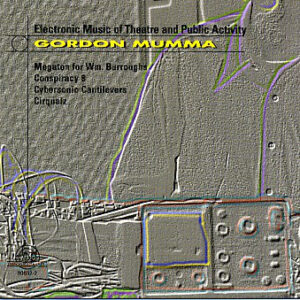
Gordon MUMMA
“Electronic music of theatre and public activity”
Gordon Mumma (born 1935) has played a pioneering role in the development and evolution of ’live-electronic’ music. ’Live-electronics’ as a concept and practice appears to have originated in the United States in the late 1950s, outside the few institutional electronic studios and often in the context of innovative theatre activity. From its inception, it frequently involved two processes: (1) live performance with accompanying or interacting sound materials on magnetic tape; and (2) the use of electronic circuitry as sound-modifying and sound-producing instruments. Beginning with his classic ’Megaton for Wm. Burroughs’ of 1963, Mumma’s live-electronic and cybersonic works of the 1960s and 1970s, especially ’Medium Size Mograph’ (1963) and ’Hornpipe’ (1967), display his resourceful use of both live-electronic processes. ’Cybersonic Cantilevers’ (1973) extends them to include the active participation of audience members, many of them children and teenagers who were quick to grasp the artistic potential of cybersonic technology, while ’Conspiracy 8’ (1969-70) is an early example of live interaction between performers and computer. A major addition to the contemporary music discography, this is essential listening for anyone interested in the history of electronic music.
13,00€
Out of stock
7 CD
David TUDOR
“The art of David Tudor (1963-1992)”
David Tudor’s (1926-1996) identity morphed seamlessly from interpreter of mainly acoustic music to composer-performer of predominately electronic music over a period of about ten years, from the mid-1950s to the mid-1960s. This set of seven CDs, the first truly comprehensive survey of Tudor’s work as a composer, goes beyond any previous attempt to document that process of transformation. It captures his touch and sensitivity and offers an expansive, previously unavailable view onto more than three decades of Tudor’s astonishingly original work as an electronic musician. It neatly describes the arc of his career, from his first composition, Bandoneon ! (A Combine), through the fully-realized works of his long collaboration with the Merce Cunningham Dance Company. Six works that were issued in excerpted form in Music for Merce (1952-2009) are issued here complete. Other highlights include the live soundscapes for the Pepsi Pavilion at the 1970 Osaka World Expo, the marvelous simultaneous performance with John Cage of Mesostics Re Merce Cunningham/Untitled, and two extended binaural recordings of Rainforest IV with Composers Inside Electronics, the best recorded documents of this signature work. While Cage has finally more or less received his due, Tudor’s own accomplishments have been somewhat overshadowed and are ripe for a proper re-evaluation. It is our hope that the release of this set will prompt a thorough reconsideration of his seminal achievements.
David Tudor : Anima Pepsi, Bandoneon ! (A Combine), Neural Network Plus, Pepscillator, Pepsibird, Phonemes, Rainforest IV [Berlin, 1980], Rainforest IV [Stockholm, 1980], Virtual Focus, Weatherings, Webwork
John Cage / David Tudor [simultaneous performance]: Mesostics re Merce Cunningham / Untitled.
John Cage : Variations II.
Christian Wolff : For 1, 2, or 3 People.
David Tudor, Takehisa Kosugi, live electronics. John Cage, voice. Composers Inside Electronics : John Driscoll, Phil Edelstein, Ralph Jones, Martin Kalve, David Tudor, Bill Viola, live electronics.
David Tudor : Anima Pepsi, Bandoneon ! (A Combine), Neural Network Plus, Pepscillator, Pepsibird, Phonemes, Rainforest IV [Berlin, 1980], Rainforest IV [Stockholm, 1980], Virtual Focus, Weatherings, Webwork
John Cage / David Tudor [simultaneous performance]: Mesostics re Merce Cunningham / Untitled.
John Cage : Variations II.
Christian Wolff : For 1, 2, or 3 People.
David Tudor, Takehisa Kosugi, live electronics. John Cage, voice. Composers Inside Electronics : John Driscoll, Phil Edelstein, Ralph Jones, Martin Kalve, David Tudor, Bill Viola, live electronics.
90,00€
Out of stock
4 CD
MUSICA ELETTRONICA VIVA
“Mev 40”
This 4-CD set, covering the years 1967-2007, comprises the best surviving recorded documents from four decades of performances, personally curated by its three core members - Alvin Curran, Frederic Rzewski, and Richard Teitelbaum. As such, it is an invaluable historical anthology of one of the pioneering and truly legendary exponents of live-electronic music. With Alvin Curran, Frederic Rzewski, Richard Teitelbaum, Karl Berger, Allan Bryant, Steve Lacy, George Lewis, Garrett List, Carol Plantamura, Gregory Reeve, Ivan Vandor… “Musica Elettronica Viva (MEV) was begun one evening in the spring of 1966 by Allan Bryant, Alvin Curran, Jon Phetteplace, Carol Plantamura, Frederic Rzweski, Richard Teitelbaum and Ivan Vandor in a room in Rome overlooking the Pantheon. MEV’s music right from the start was also totally open, allowing all and everything to come in and seeking in every way to get out beyond the heartless conventions of contemporary music. Taking its cue from Tudor and Cage, MEV began sticking contact mics to anything that sounded and amplified their raw sounds: bed springs, sheets of glass, tin cans, rubber bands, toy pianos, sex vibrators, and assorted metal junk; a crushed old trumpet, cello and tenor sax kept us within musical credibility, while a home-made synthesizer of some 48 oscillators along with the first Moog synthesizer in Europe gave our otherwise neo-primitive sound an inimitable edge. In the name of the collectivity, the group abandoned both written scores and leadership and replaced them with improvisation and critical listening. Rehearsals and concerts were begun at the appropriate time by a kind of spontaneous combustion and continued until total exhaustion set in. It mattered little who played what when or how, but the fragile bond of human trust that linked us all in every moment remained unbroken. The music could go anywhere, gliding into self-regenerating unity or lurching into irrevocable chaos-both were valuable goals. In the general euphoria of the times, MEV thought it had re-invented music; in any case it had certainly rediscovered it”. Alvin Curran.
49,00€
Out of stock
3 CD
Julius EASTMAN
“Unjust malaise”
Members of Creative Associates; Jodi Beder, Sarah Carter, Barry Gold, Julie Green, Christine Gummere, Maureen Hynes, Chase Morrison, Abby Newton, Larry Rawdon, David Sabee, cellos; Frank Ferko, Janet Kattas, Patricia Martin, pianos; Julius Eastman, piano, voice, conductor. This three-disc set marks the first appearance on disc of the music of the African-American composer Julius Eastman (1940-1990), who died sixteen years ago under unexplained circumstances and whose musical legacy was thought lost. This comprehensive and definitive document, which comprises almost all of Eastman’s signature works, will undoubtedly be a revelation for those who have thus far been unable to hear his work.
In his book American Music in the Twentieth Century, composer/author Kyle Gann briefly sums up Eastman’s work and its importance: “Born in New York, he graduated from the Curtis Institute in composition and was discovered by Lukas Foss, who conducted his music, including Stay On It (1973), one of the first works to introduce pop tonal progressions and free improvisation in an art context… Applying minimalism’s additive process to the building of sections, he developed a composing technique he called “organic music,” a cumulatively overlapping process in which each section of a work contains, simultaneously, all the sections which preceded it. The pieces he wrote in this style often had intentionally provocative titles intended to reinterpret the minorities Eastman belonged to in a positive light: for example, Evil Nigger, Crazy Nigger, and Gay Guerrilla (all circa 1980). These three pieces, all scored for multiple pianos, build up immense emotive power through the incessant repetition of rhythmic figures.”
Eastman was an energizing underground figure, one whose forms are clear, whose methods were powerful and persuasive, and whose thinking was supremely musical. His works show different routes minimalism might have taken, and perhaps some of those will now be followed up. This set of discs is a bold beginning to restoring to history the works of one of the most important members of the first post-minimalist generation.
Stay on It (1973). If You’re So Smart, Why Aren’t You Rich? (1977). Prelude to The Holy Presence of Joan D’Arc (1981). The Holy Presence of Joan D’Arc (1981). Gay Guerrilla (1980). Evil Nigger (1979). Crazy Nigger (1980).
In his book American Music in the Twentieth Century, composer/author Kyle Gann briefly sums up Eastman’s work and its importance: “Born in New York, he graduated from the Curtis Institute in composition and was discovered by Lukas Foss, who conducted his music, including Stay On It (1973), one of the first works to introduce pop tonal progressions and free improvisation in an art context… Applying minimalism’s additive process to the building of sections, he developed a composing technique he called “organic music,” a cumulatively overlapping process in which each section of a work contains, simultaneously, all the sections which preceded it. The pieces he wrote in this style often had intentionally provocative titles intended to reinterpret the minorities Eastman belonged to in a positive light: for example, Evil Nigger, Crazy Nigger, and Gay Guerrilla (all circa 1980). These three pieces, all scored for multiple pianos, build up immense emotive power through the incessant repetition of rhythmic figures.”
Eastman was an energizing underground figure, one whose forms are clear, whose methods were powerful and persuasive, and whose thinking was supremely musical. His works show different routes minimalism might have taken, and perhaps some of those will now be followed up. This set of discs is a bold beginning to restoring to history the works of one of the most important members of the first post-minimalist generation.
Stay on It (1973). If You’re So Smart, Why Aren’t You Rich? (1977). Prelude to The Holy Presence of Joan D’Arc (1981). The Holy Presence of Joan D’Arc (1981). Gay Guerrilla (1980). Evil Nigger (1979). Crazy Nigger (1980).
40,00€
Out of stock
2 CD
James TENNEY
“Postal pieces”
James Tenney (b. 1934) is one of the most important American composers and theorists of the past fifty years. For a very long time, his work was known mainly to other musicians and its tremendous influence was belied by its obscurity. In the past twenty years, however, as his music and writings have been more and more published, recorded, performed, and studied, his place in the context of American contemporary music has become far better understood. He has pioneered musical fields as diverse as computer music, tuning theory, and integrating ideas from acoustics and music cognition into his work. Tenney has also been important as a teacher, performer, and scholar of other radical American composers.
This CD contains recordings of the complete set of his Postal Pieces, written primarily during a very brief tenure at California Institute of the Arts in the early 1970s. These works, although frequently performed over the years, have not been recorded (with a few exceptions). This recording is a natural and important companion to the recent New World reissue of Tenney’s computer and electronic music from the 1960s. Both collections represent complete, highly individualistic and essential bodies of work by a major American artist.
The postal pieces, which Tenney called “Scorecards,” are a remarkable series of eleven short works printed on postcards. Each card contains a complete if minimally stated work to be performed by instrumentalists. These pieces elucidate to a large degree some of Tenney’s bedrock compositional ideas. Each is a kind of meditation on acoustics, form, or hyper-attention to a single performance gesture. This set is essential listening for anyone interested in the evolution of American experimental music.
Maximusic (1965), Swell Piece (1967), A Rose Is a Rose Is a Round (1970), Beast (1971), Swell Piece
2 (1971), Having Never Written a Note for Percussion (1971), Koan (1971), For Percussion Perhaps, Or . . . (night) (1971), Swell Piece
3 (1971), Cellogram (1971), August Harp (1971).
The Barton Workshop (Jos Zwaanenburg, flutes; Alex Geller, cello; Nina Hitz, cello; Marieke Keser, violin; Jacob Plooij, violin; Judith van Swaaij, cello; Elisabeth Smalt, viola; John Anderson, clarinets; Gertjan Loot, trumpet; Krijn van Arnhem, bassoon, contrabassoon; Frank Denyer, melodica; Charles van Tassel, baritone; Theo van Arnhem, contrabass; Jos Tieman, contrabass; James Fulkerson, conductor).
This CD contains recordings of the complete set of his Postal Pieces, written primarily during a very brief tenure at California Institute of the Arts in the early 1970s. These works, although frequently performed over the years, have not been recorded (with a few exceptions). This recording is a natural and important companion to the recent New World reissue of Tenney’s computer and electronic music from the 1960s. Both collections represent complete, highly individualistic and essential bodies of work by a major American artist.
The postal pieces, which Tenney called “Scorecards,” are a remarkable series of eleven short works printed on postcards. Each card contains a complete if minimally stated work to be performed by instrumentalists. These pieces elucidate to a large degree some of Tenney’s bedrock compositional ideas. Each is a kind of meditation on acoustics, form, or hyper-attention to a single performance gesture. This set is essential listening for anyone interested in the evolution of American experimental music.
Maximusic (1965), Swell Piece (1967), A Rose Is a Rose Is a Round (1970), Beast (1971), Swell Piece
2 (1971), Having Never Written a Note for Percussion (1971), Koan (1971), For Percussion Perhaps, Or . . . (night) (1971), Swell Piece
3 (1971), Cellogram (1971), August Harp (1971).
The Barton Workshop (Jos Zwaanenburg, flutes; Alex Geller, cello; Nina Hitz, cello; Marieke Keser, violin; Jacob Plooij, violin; Judith van Swaaij, cello; Elisabeth Smalt, viola; John Anderson, clarinets; Gertjan Loot, trumpet; Krijn van Arnhem, bassoon, contrabassoon; Frank Denyer, melodica; Charles van Tassel, baritone; Theo van Arnhem, contrabass; Jos Tieman, contrabass; James Fulkerson, conductor).
27,00€
Out of stock
2 CD
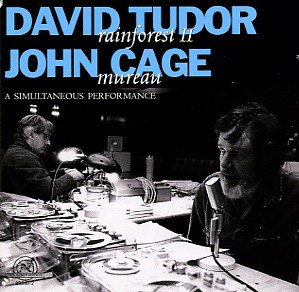
David TUDOR – John CAGE
“Rainforest II” – “Mureau”
David Tudor, live electronics. John Cage, voice, pre-recorded tape. “This historic release of a simultaneous performance by David Tudor and John Cage of Rainforest II and Mureau, recorded live by Radio Bremen on May 5, 1972, preserves the only surviving performance of the second of Tudor’s Rainforest series. In addition, it documents one of the precious few recorded collaborations between these two visionaries. In 1970 Cage composed the piece called Mureau, in which phrases from Thoreau’s journals (in particular, passages which touch on the subject of music) are used as the springboard for an elaborate collage. The resultant fabric combines elements of sense and nonsense, as it veers between contextual meaning and a sort of abstract, linguistic vocalise. In Cage’s public readings of Mureau, he explored a number of performance variables-differences in tempo, vocal timbre, pitch, register, and dynamics. A similar range will be apparent, in fact, when listening to this recorded performance. This simultaneous performance of Mureau and Rainforest II took place in a large concert hall before an audience, rather than privately in a recording studio. Whereas in other performance realizations (such as their legendary Indeterminacy collaboration) the two men had been placed in separate isolation booths, here the two shared the same performance space, so that each could hear and see the other person’s activity. In fact, Cage and Tudor sat quite close to one another at the center of the stage, Cage performing Mureau as a four-channel realization-one live channel against three pre-recorded tracks, all of them his own voice-and Tudor actively engaged in real-time processing of Cage’s vocal material, using it to generate electronic loudspeaker-filter events. Essential listening for anyone interested in the work of either composer.”
24,00€
Out of stock
2 CD
Alvin CURRAN
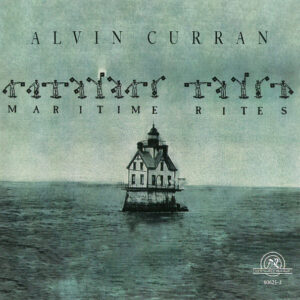
“Maritime rites”
“In the middle 1970s I began to formulate ideas and projects leading to the making of music outside the concert halls-often in large open and naturally beautiful sites. Ports, rivers, lakes, caves, quarries, fields, and woods, always ready sources of my musical inspiration, now became my new music theaters.” - Alvin Curran
Maritime Rites is a series of ten environmental concerts for radio composed by Alvin Curran (b. 1938) in 1985. This series features the Eastern Seaboard of the United States as a musical source in collaboration with improvised musical performances by ten distinguished artists in the American new-music scene: John Cage, Joseph Celli, Clark Coolidge, Jon Gibson, Malcolm Goldstein, Steve Lacy, George Lewis, Pauline Oliveros, Leo Smith and Alvin Curran. The programs use specifically recorded natural sounds as musical counterpoint to the soloists whose improvisations are freely restructured and mixed by Curran. Featured here are the foghorns of Virginia, Maryland, Delaware, New Jersey, New York, Connecticut, Rhode Island, Massachusetts, New Hampshire, Maine and New Brunswick, Canada. Also included are maritime bells, gongs, whistles and regional bird and animal life. Comments from lighthouse keepers, Coast Guard personnel and other local people are woven impressionistically throughout.
Rich in ambient detail, Maritime Rites presents the foghorn as indigenous American “found” music par excellence and the source of one of the most enduring minimal musics around us. The series is also a comprehensive aural documentary of our regional and national maritime heritage including such historical sounds as the Nantucket II Lightship, now out of service and doing service as a museum docked in Boston Harbor. The Lightship’s horn is the only one of its kind (and the loudest!) on the East coast and was recorded extensively during an exclusive session ten miles off shore with the special cooperation of the ship’s crew. As the foghorn gives way to other electronic navigational aids, this work may serve as a historical document of some of the most beautiful and mysterious sounds of the sea.
As an expression of sonic geography, Maritime Rites brings together different areas of the Seaboard in a single musical moment. The series was expressly conceived for radio, the only medium that can safely accommodate over sixty foghorns at once and bring an entire coastline, seemingly live, into anyone’s home! An essential document for anyone interested in sound art.
24,00€