
Out of stock

CD
Patricia BOSSHARD
“Temps suspendu”
“In 2011, the Association Eustache gave me carte blanche to compose a piece on the occasion of Le Grand Eustache’s annual concert in Lausanne, Switzerland.
I composed a work for my favourite sonorities, dear to my universe: the infinite register of strings. Starting with a quartet formation, I added the double bass for
its palette of low sounds, and percussion for its resonances.
The compositional work was put together as rehearsals progressed, with experimentations and improvisations guiding the writing of the score. This quintet explores the full richness of the strings, from the most extreme sounds to the most unknown. It is a bruitist piece, which offers us great refinement and considerable inventiveness.
Disconcerting, dreamlike moments… suspended moments.”
Annik Rody, violin. Patricia Bosshard, violin, composition. Marie Schwab, alto. Sara Oswald, cello. Jocelyne Rudasigwa, doublebass. Luc Müller, percussion.
“Patricia had to stand on tiptoes to reach the gilt handle that only yielded with difficulty under her weight. With both hands, she pushed open the rosewood door and long remained motionless on the threshold. Lining the four walls of the room were maple shelves on which stood hundreds of unknown objects.
After having climbed a pair of steps in ebony, Patricia delicately picked up an object and set it on the long spruce table that occupied the middle of the room.
She made it spin delicately on the table, looking at it from all different angles until
a particular alignment of its elements made a new object suddenly appear
out of the object. Her eyes slowly screwed up, and a smile played in her pupils.
After a few minutes, she went to look for another object and placed it next to the first. This was a fine rectangular plate in metal, flexible, cold and shiny.
A third object, a small, silky ball of black horse hair, soon joined the others.
She had fun putting them together, exploring all possible combinations,
making worlds suddenly appear.
By thus exploring new arrangements of materials, forms, colours, the time passed so quickly that the light was already fading. She pushed the heavy door, resisting the temptation to turn around and without knowing that she was feeling nostalgia for the first time, when she noticed, all about her, that the landscape had changed.” Antonio Albanese
Original price was: 20,00€.7,00€Current price is: 7,00€.
Out of stock

2 LP
Steve REICH
“WTC 9-11”
Vinyl version. WTC 9/11 on one side A and Different Trains on sides C and D. 180g, limited and numbered 500 copies + postal card.
Performed by Quatuor Tana.
Steve Reich composed WTC 9/11 in 2010 in homage to the victims of the attack on the World Trade Center, September 11th, 2001. First performed on March 19, 2011 at Duke University in North Carolina by the Kronos Quartet, WTC 9/11 would be played for the first time in New York, at Carnegie Hall, in late April of the same year.
WTC 9/11 is written for a string quartet playing live, on which are juxtaposed pre-recorded voices and two string quartets. With a playing time of 16 minutes, the work is in three movements played without a break: “9/11”, “2010” and “WTC”.
The first movement, “9/11”, is moving, disturbing and even stressful. Deliberately bruitist, it begins and develops to the haunting rhythm of the alarm of a telephone left off the hook: an F played on the violin with the superimposed archive voices of the NORAD (North American Aerospace Defense Command) air traffic controllers and the FDNY (Fire Department City of New York).
The second movement, entitled “2010”, uses interviews of memories from 2001. In it, we hear Steve Reich’s neighbors, an officer of the FDNY and the first ambulance driver to arrive at the scene.
In the third movement, Steve Reich takes inspiration from his friend the composer David Lang, creator in 2003 of World To Come, “WTC” being the common acronym of both their works. Steve Reich’s is concerned with metaphysical and spiritual preoccupations. Brought up in the Jewish faith, he knows that it imposes the ritual of presence around the body to accompany the deceased from the time of death to burial, thus accompanying the soul, which floats above the body until inhumation. It was impossible for the composer to ignore the fact that after the 9-11 attacks, the problem of identifying the bodies lasted seven months...
In 2011, for the release of WTC 9/11, the cover photo showing the Twin Towers at the moment of the attack created such a shock and controversy that it was replaced by another visual showing a cloud of smoke.
Steve Reich, who was a neighbor of the World Trade Center for 25 years, wrote on his label’s website: “I believed… that a piece of music with documentary material from an event would best be matched with a documentary photograph of that event”.
Serge Thomassian, the producer of the Megadisc Classics label - whose offices, four blocks from the Twin Towers, were destroyed during the 2001 attack - now proposes an unambiguous cover photo of the World Trade Center being struck by the plane.
DIFFERENT TRAINS
The idea for this work comes from Steve Reich’s childhood. He was a year old when his parents separated, his mother going to live in Los Angeles, his father staying in New York. Thus, accompanied by his nanny, the young Steve was going to make frequent trips between the East and West Coasts. Those pleasant train trips, taking four days, doubtless did not prevent him from knowing that, between 1939 and 1942, European Jewish children his age were getting into very different trains…
This is what would result in Different Trains (1988), a 27-minute work laid out in three movements: “America-Before the War”, “Europe-During the War” and “After the War”. The composition uses and superimposes conversations on tape and the instruments of the string quartet. The retrieval of numerous sonorities of daily life, voices like announcements, recorded sounds of trains from the 1930s and ‘40s make up the musical material of Different Trains. To his composition he adds recorded interviews of witnesses from his childhood: his nanny, Virginia Mitchell, who evokes their train trips; Lawrence Davis, an employee of the New York-Los Angeles railroad line, who relates his life; and finally, testimony collected from Rachella, Paul and Rachel, Holocaust survivors.
Different Trains opened new directions and new perspectives for Steve Reich. Although he brings together four string quartets, one playing live, the three others being added to the pre-recorded tape, it is above all the taped voices that make for the work’s originality. The spoken language thus becomes a full-fledged musical material, and after Different Trains, this technique would lead to The Cave, composed in 1990, Three Tales (2002) then WTC 9/11 (2010)…
Steve Reich, born October 3, 1936, is one of the most important and influential composers of today’s music, his impact on his contemporaries being considerable. Since the Minimalism of his beginnings, he has remained faithful to repetitive writing (patterns), even though his latest creations have become more harmonic and thereby richer and more delightful, tinged with the fantastic.
Performed by Quatuor Tana.
Steve Reich composed WTC 9/11 in 2010 in homage to the victims of the attack on the World Trade Center, September 11th, 2001. First performed on March 19, 2011 at Duke University in North Carolina by the Kronos Quartet, WTC 9/11 would be played for the first time in New York, at Carnegie Hall, in late April of the same year.
WTC 9/11 is written for a string quartet playing live, on which are juxtaposed pre-recorded voices and two string quartets. With a playing time of 16 minutes, the work is in three movements played without a break: “9/11”, “2010” and “WTC”.
The first movement, “9/11”, is moving, disturbing and even stressful. Deliberately bruitist, it begins and develops to the haunting rhythm of the alarm of a telephone left off the hook: an F played on the violin with the superimposed archive voices of the NORAD (North American Aerospace Defense Command) air traffic controllers and the FDNY (Fire Department City of New York).
The second movement, entitled “2010”, uses interviews of memories from 2001. In it, we hear Steve Reich’s neighbors, an officer of the FDNY and the first ambulance driver to arrive at the scene.
In the third movement, Steve Reich takes inspiration from his friend the composer David Lang, creator in 2003 of World To Come, “WTC” being the common acronym of both their works. Steve Reich’s is concerned with metaphysical and spiritual preoccupations. Brought up in the Jewish faith, he knows that it imposes the ritual of presence around the body to accompany the deceased from the time of death to burial, thus accompanying the soul, which floats above the body until inhumation. It was impossible for the composer to ignore the fact that after the 9-11 attacks, the problem of identifying the bodies lasted seven months...
In 2011, for the release of WTC 9/11, the cover photo showing the Twin Towers at the moment of the attack created such a shock and controversy that it was replaced by another visual showing a cloud of smoke.
Steve Reich, who was a neighbor of the World Trade Center for 25 years, wrote on his label’s website: “I believed… that a piece of music with documentary material from an event would best be matched with a documentary photograph of that event”.
Serge Thomassian, the producer of the Megadisc Classics label - whose offices, four blocks from the Twin Towers, were destroyed during the 2001 attack - now proposes an unambiguous cover photo of the World Trade Center being struck by the plane.
DIFFERENT TRAINS
The idea for this work comes from Steve Reich’s childhood. He was a year old when his parents separated, his mother going to live in Los Angeles, his father staying in New York. Thus, accompanied by his nanny, the young Steve was going to make frequent trips between the East and West Coasts. Those pleasant train trips, taking four days, doubtless did not prevent him from knowing that, between 1939 and 1942, European Jewish children his age were getting into very different trains…
This is what would result in Different Trains (1988), a 27-minute work laid out in three movements: “America-Before the War”, “Europe-During the War” and “After the War”. The composition uses and superimposes conversations on tape and the instruments of the string quartet. The retrieval of numerous sonorities of daily life, voices like announcements, recorded sounds of trains from the 1930s and ‘40s make up the musical material of Different Trains. To his composition he adds recorded interviews of witnesses from his childhood: his nanny, Virginia Mitchell, who evokes their train trips; Lawrence Davis, an employee of the New York-Los Angeles railroad line, who relates his life; and finally, testimony collected from Rachella, Paul and Rachel, Holocaust survivors.
Different Trains opened new directions and new perspectives for Steve Reich. Although he brings together four string quartets, one playing live, the three others being added to the pre-recorded tape, it is above all the taped voices that make for the work’s originality. The spoken language thus becomes a full-fledged musical material, and after Different Trains, this technique would lead to The Cave, composed in 1990, Three Tales (2002) then WTC 9/11 (2010)…
Steve Reich, born October 3, 1936, is one of the most important and influential composers of today’s music, his impact on his contemporaries being considerable. Since the Minimalism of his beginnings, he has remained faithful to repetitive writing (patterns), even though his latest creations have become more harmonic and thereby richer and more delightful, tinged with the fantastic.
40,00€
In stock
CD
Steve REICH
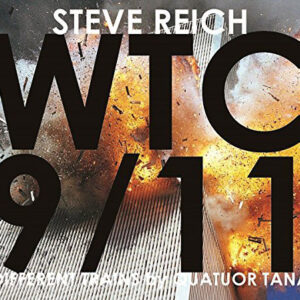
“WTC 9-11”
32 pages & Notes in English ans French.
Performed by Quatuor Tana.
Steve Reich composed WTC 9/11 in 2010 in homage to the victims of the attack on the World Trade Center, September 11th, 2001. First performed on March 19, 2011 at Duke University in North Carolina by the Kronos Quartet, WTC 9/11 would be played for the first time in New York, at Carnegie Hall, in late April of the same year.
WTC 9/11 is written for a string quartet playing live, on which are juxtaposed pre-recorded voices and two string quartets. With a playing time of 16 minutes, the work is in three movements played without a break: “9/11”, “2010” and “WTC”.
The first movement, “9/11”, is moving, disturbing and even stressful. Deliberately bruitist, it begins and develops to the haunting rhythm of the alarm of a telephone left off the hook: an F played on the violin with the superimposed archive voices of the NORAD (North American Aerospace Defense Command) air traffic controllers and the FDNY (Fire Department City of New York).
The second movement, entitled “2010”, uses interviews of memories from 2001. In it, we hear Steve Reich’s neighbors, an officer of the FDNY and the first ambulance driver to arrive at the scene.
In the third movement, Steve Reich takes inspiration from his friend the composer David Lang, creator in 2003 of World To Come, “WTC” being the common acronym of both their works. Steve Reich’s is concerned with metaphysical and spiritual preoccupations. Brought up in the Jewish faith, he knows that it imposes the ritual of presence around the body to accompany the deceased from the time of death to burial, thus accompanying the soul, which floats above the body until inhumation. It was impossible for the composer to ignore the fact that after the 9-11 attacks, the problem of identifying the bodies lasted seven months...
In 2011, for the release of WTC 9/11, the cover photo showing the Twin Towers at the moment of the attack created such a shock and controversy that it was replaced by another visual showing a cloud of smoke.
Steve Reich, who was a neighbor of the World Trade Center for 25 years, wrote on his label’s website: “I believed… that a piece of music with documentary material from an event would best be matched with a documentary photograph of that event”.
Serge Thomassian, the producer of the Megadisc Classics label - whose offices, four blocks from the Twin Towers, were destroyed during the 2001 attack - now proposes an unambiguous cover photo of the World Trade Center being struck by the plane.
DIFFERENT TRAINS
The idea for this work comes from Steve Reich’s childhood. He was a year old when his parents separated, his mother going to live in Los Angeles, his father staying in New York. Thus, accompanied by his nanny, the young Steve was going to make frequent trips between the East and West Coasts. Those pleasant train trips, taking four days, doubtless did not prevent him from knowing that, between 1939 and 1942, European Jewish children his age were getting into very different trains…
This is what would result in Different Trains (1988), a 27-minute work laid out in three movements: “America-Before the War”, “Europe-During the War” and “After the War”. The composition uses and superimposes conversations on tape and the instruments of the string quartet. The retrieval of numerous sonorities of daily life, voices like announcements, recorded sounds of trains from the 1930s and ‘40s make up the musical material of Different Trains. To his composition he adds recorded interviews of witnesses from his childhood: his nanny, Virginia Mitchell, who evokes their train trips; Lawrence Davis, an employee of the New York-Los Angeles railroad line, who relates his life; and finally, testimony collected from Rachella, Paul and Rachel, Holocaust survivors.
Different Trains opened new directions and new perspectives for Steve Reich. Although he brings together four string quartets, one playing live, the three others being added to the pre-recorded tape, it is above all the taped voices that make for the work’s originality. The spoken language thus becomes a full-fledged musical material, and after Different Trains, this technique would lead to The Cave, composed in 1990, Three Tales (2002) then WTC 9/11 (2010)…
Steve Reich, born October 3, 1936, is one of the most important and influential composers of today’s music, his impact on his contemporaries being considerable. Since the Minimalism of his beginnings, he has remained faithful to repetitive writing (patterns), even though his latest creations have become more harmonic and thereby richer and more delightful, tinged with the fantastic.
20,00€
In stock
CD
Christian ZANÉSI
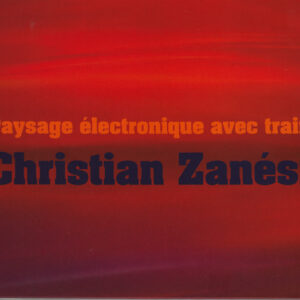
“Paysage électronique avec train”
“Audio visage” (2004). “Ambiance Matisse” (2010-12). “Paysage électronique avec train” (2006-14).
“My current artistic propensity has been drawn to electronic sound. Far from being soft and appeasing, it is a rather tense sound; almost acidic: the sound of an alert. I reached it thanks to a very old synthesiser; build at the GRM in the sixties by the engineer Francis Coupigny. A modular synthesiser with its own audio matrix – it might have been the first of its kind – discarded (forgotten) in a basement, but still fully operational. I have shaped this ‘today’ sound by combining it with materials charged with emotions: train noises and signals, blasts, breaths, etc, the very sonorities that have been lingering inside me as available memories. The original title of the piece was «2006, l’aube rouge» (2006, Red Dawn) because when I finished this work, a few hours before the 2006 New Year, I might have wanted to talk about a world that had become terribly disquieting and dangerous: a red dawn was rising. Eight years later, around the same period, towards the end of the year, I worked again on the piece by simplifying it, only keeping (I hope) its essential elements.”
Former student of Guy Maneveau and Marie-Françoise Lacaze at the Pau University (South of France) (1974-1975), of Pierre Schaeffer and Guy Reibel at the Paris Conservatory (1976-1977), he joined the Groupe de Recherches Musicales (GRM) in 1977. There, he learnt and practised all the technical skills linked to sound, thanks to a wide range of experiences, productions and encounters. He has initiated many projects in the field of radio, publications and musical events.
20,00€
In stock

CD
Charlemagne PALESTINE
“Nothing to tell, only listen”
Born in Brooklyn, New York in 1947, Palestine began by singing sacred Jewish music and studying accordion and piano. At the age of 12 he started playing backup conga and bongo drums for Alan Ginsberg, Gregory Corso, Kenneth Anger, and Tiny Tim. Throughout the seventies Palestine created records, videos, abstract expressionist visual scores and performed regularly in the company of his stuffed animals! This new release entitled Nothing to Tell, only Listen explores his unique soundscape.
Recorded at Boghossian Foundation Villa Empain January 26, 2015.
20,00€