
Out of stock
2 CD
Robert ASHLEY
“Now Eleanor’s idea”
Music and libretto by Robert Ashley. With Joan La Barbara, Amy X Neuberg, Marghreta Cordero, Robert Ashley, Sam Ashley, Thomas Buckner and Jacqueline Humbert. Performance Orchestra mixed and processed by Tom Hamilton. 2CD + 132 pages booklet. Robert Ashley’s Now Eleanor’s idea is a quartet of short operas based on the notion of a sequence of events seen from four different points of view. At the same time, each opera is an allegory, like Bunyan’s Pilgrim’s Progress, for an individual’s self-realization within the context of a major “religion” found in the United States. “Improvement” takes its imagery and plot from Judaism, “Foreign Experiences” from Pentecostal Evangelism, “eL-Aficionado” from corporate mysticism, and “Now Eleanor’s Idea” from (Spanish) Catholicism. As “versions” of a single series of events, the four libretti involve a common group of characters. But the continuation of the characters’ roles in the different versions is not dramatized and so the four operas can be heard (and described) as separate projects. They may be produced separately, or together, as a single performance work. The operas share principal characters and vocal techniques (including the relationship of the voice to instrumental settings.) The operas differ, principally, in the language style of the librettos and in the relationship of the music to the presentation of the visual imagery.Robert Ashley tells us that the inspiration for these works came specifically from four sources: the work of the historian, Frances A. Yates (1900-1983), whose specialty of interests included the influence of Kabalistic mysticism on the birth of modernism and scientific philosophy in Italy in the 16th century (as a result of the expulsion of Jews from Spain during the Inquisition); the writings of Carlos Castaneda (and the arguments about him as a writer and about the intentions of his work); “Low Rider Magazine,” the fan-cult magazine of the “Low Rider” movement in the Southwestern United States; and finally, “corporate vocabulary”-what it sounds like and how it is used in popular publications, like “The New York Times,” “The Wall Street Journal” or “Fortune Magazine.”
30,00€
Out of stock
2 CD
Robert ASHLEY
“Celestial excursions”
“Celestial Excursions delves into the wild intermingling of reminiscence, regret, love, nightmare, old sayings, and songs on the radio-all seemingly to no purpose, except for the operatic end of relentless speed and precision in ensemble singing and the possible stage magic inherent in illusion, hallucination, and a physically changed state of the senses. The opera’s originality lies in a use of a new vocal technique Ashley has built over the last 20 years, which enables several stories to be heard at the same time. In an intricate vocal system, a principal voice is “chased” by other voices whose parts rotate in sequence in a given order. The result of this technique creates a complex jungle of voices, delivered with an extraordinary rhythmic intensity rarely heard in ensemble singing.
As for all of Ashley’s latest works, the orchestra music of Celestial Excursions was composed in the computer-synthesizer studio. All the voices and the orchestra (on multi-track tape or on disc) are processed again during the concert in order to match the sound of the opera to the performance space. And for this CD release, Ashley went back to the studio with live recordings to rework the piece, extending the orchestra in the final act.
“With the exception of a few condescending and silly movies, “old” people are one of the few “minority” groups basically unrecognized in the arts. Not that they care, but among the “marginalized,” old people are the most marginalized, because, obviously, unlike racial or ethnic groups or the poor, they have no future. Or rather, in the most important sense, their future will never change for the better.” Robert Ashley
As for all of Ashley’s latest works, the orchestra music of Celestial Excursions was composed in the computer-synthesizer studio. All the voices and the orchestra (on multi-track tape or on disc) are processed again during the concert in order to match the sound of the opera to the performance space. And for this CD release, Ashley went back to the studio with live recordings to rework the piece, extending the orchestra in the final act.
“With the exception of a few condescending and silly movies, “old” people are one of the few “minority” groups basically unrecognized in the arts. Not that they care, but among the “marginalized,” old people are the most marginalized, because, obviously, unlike racial or ethnic groups or the poor, they have no future. Or rather, in the most important sense, their future will never change for the better.” Robert Ashley
30,00€
Out of stock
2 CD
Robert ASHLEY
“Dust”
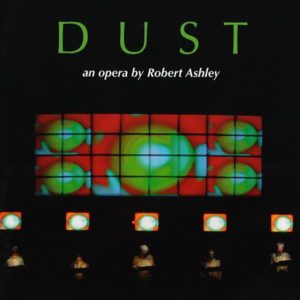
DUST, an opera by Robert Ashley and Yukihiro Yoshihara (video direction) whose imaginary setting is a street corner anywhere in the world, where those who live on the fringes of society gather to talk, to each other and to themselves, about life-changing Spotlight , missed opportunities, memory, loss and regret.
Five "street people" recount the memories and experiences of one of their group, a man who has lost his legs in some unnamed war. As part of the experience of losing his legs, he began a conversation with God, under the influence of the morphine he was given to ease his pain. Now he wishes that the conversation, which was interrupted when the morphine wore off, could be continued so that he could get the "secret word" that would stop all wars and suffering. (90 minutes)
Voices: Robert Ashley, Sam Ashley, Thomas Buckner, Jacqueline Humbert, Joan La Barbara; Musicians: "Blue" Gene Tyranny, synthesizer, Tom Hamilton, live mixing and sound processing; electronic orchestration by Robert Ashley, Tom Hamilton and "Blue" Gene Tyranny; sound effects for "Friends" composed by Tom Hamilton.
Five "street people" recount the memories and experiences of one of their group, a man who has lost his legs in some unnamed war. As part of the experience of losing his legs, he began a conversation with God, under the influence of the morphine he was given to ease his pain. Now he wishes that the conversation, which was interrupted when the morphine wore off, could be continued so that he could get the "secret word" that would stop all wars and suffering. (90 minutes)
Voices: Robert Ashley, Sam Ashley, Thomas Buckner, Jacqueline Humbert, Joan La Barbara; Musicians: "Blue" Gene Tyranny, synthesizer, Tom Hamilton, live mixing and sound processing; electronic orchestration by Robert Ashley, Tom Hamilton and "Blue" Gene Tyranny; sound effects for "Friends" composed by Tom Hamilton.
30,00€
In stock
2 CD
Joan LA BARBARA
“Voice is the original instrument”
Collection of early works and her first vocal compositions, originally released on LPs in the 1970s and early 1980s on her own Wizard Records. “One of my earliest pieces, ‘Hear What I Feel’, was a self-exploratory, sensory-deprivation experimental work, designed to help me discover new sounds, delve into psychological aspects, as well as communicate with the audience on a pre-verbal level of awareness. After spending an hour in isolation with my eyes taped shut and not touching anything with my hands, I was led our into the performance space where my assistant had placed a variety of substances in six small glass dishes. As I touched the material, I tried to give an immediate vocal response to what I felt both emotionally and physically, without the benefit of visual information. I expected the shock of bringing a solitary state of mind into the heightened awareness of a performance situation to intensify my experience, and the poignancy of my ‘prepared’ state to affect the audience. The sounds are presented here in their raw state; it is truly an experimental work with no intentional musical implications or designs. ‘Voice Piece: One-Note Internal Resonance Investigation’ explores the color spectrum of a single pitch. Circular Song was inspired by the circular breathing technique of horn players. ‘Des Accords pour Teeny’, an exploration of multi-phonic technique or choral singing, was dedicated to Teeny Duchamp. In much of my early work I dealt with sound as a physical presence, sculpting it, building up layers in complex constructions, letting the flow of thought and the visualization of sonic gestures direct my studio art. Voice Is the Original Instrument was both a statement of purpose and a manifesto as, through various experiments and explorations, I tried to rediscover the basic function of the voice as the first means of expression as well as to release untapped sonic material. As I gave my classically trained voice its freedom, letting it direct me toward new places and ideas, I developed what was a unique vocabulary and used those sounds to score an orchestra of layered voices.”
23,50€
Out of stock

2 CD
Eliane RADIGUE
“Jetsun Mila”
Performed (Arp synthesizer) and recorded digitally by Eliane Radigue. “Jetsun Mila (1986) is inspired by the life of Milarepa, a great yogi and poet of Tibet who lived in the 11th Century. The story of his life as told to his closest disciple, Rechungpa, represents one of the most famous works within Tibetan culture. The Mila Kabum, or Namthar, has been translated into several Western languages, including English and French. Eliane Radigue’s 84-minute musical evocation of Milarepa’s life is in nine sections, with prelude, which correspond to major periods of the life of this famous yogi. The sections flow from one to the other without breaks, one giving birth naturally to the next.”
24,00€
Out of stock

2 CD
Eliane RADIGUE
“Songs of Milarepa”
Performed (Arp synthesizer) and recorded by Eliane Radigue; Robert Ashley, English voice; Lama Kunga Rinpoche, Tibetan voice. “2 CD of all 5 of Radigue’s songs in tribute to the Tibetan saint and poet from the eleventh century. Two of the tracks date from an 1983 LP (Radigue’s first release), two are previously unreleased and the final 62-minute track was previously issued as a sole CD in 1987. The material is performed by Radigue (synthesizer and recording), Robert Ashley (English voice) and Lama Kunga Rinpoche (Tibetan voice). Radigue was born in France and has studied under Pierre Shaeffer and Pierre Henry; her musical has an extremely organic and mystical electronics vibe, and has been previously documented on Phill Niblock’s XI label, as well as Metamkine and Lovely. Milarepa is a great saint and poet of Tibet who lived in the 11th Century. Through years dedicated to meditation and related practices in the solitude of the mountains, Milarepa achieved the highest attainable illumination and the mental power that enabled him to guide innumerable disciples. His ability to present complex teachings in a simple, lucid style is astonishing. He had a fine voice and loved to sing. When his patrons and disciples made a request or asked him a question, he answered in spontaneously composed free-flowing poems or lyric songs. It is said that he composed 100,000 songs to communicate his ideas in his teachings and conversations.”
24,00€
In stock
2 CD
David TUDOR
“Neural synthesis N° 6-9”
Performed by David Tudor; produced and recorded by David Tudor and John D.S. Adams. Binaural and stereo mixes on 2 CDs. This recording combines the art of music, the engineering of electronics, and the inspiration of biology. In it, David Tudor orchestrates electronic sound in ways analogous to our biological bodies’ orchestration of consciousness. The performance originates from a neural-network synthesizer conceived and built especially for Tudor. He surrounds this synthesizer with his own unique collection of electronic devices, and in the recording on this CD made for headphone playback, he uses a new binaural technique for translating sound into out-of-head localizations in which sound seems to originate from specific, changing points within a space around the listener.
23,50€
Out of stock
2 CD
Alvin LUCIER
“Still and moving lines of silence in families of hyperbolas”
2 CD release of of a four-part work, initiated in 1972 and recorded as presented here in 1983-4 and 2001. This reissues two long-out-of-print LPs on Lovely, with four added parts (the strings) released for the first time. A series of mostly solo instrument works for the likes of: clarinet, marimba, viola, voice, xylophone, violin, flute, glockenspiel, cello, horn, vibraphone. Performed by: Thomas Ridenour, William Winant, Dan Panner, Rebecca Armstrong, Conrad Harris, Susan Palma, Gregory Hesslink, James de Corsey. An absolute masterpiece of “interference sound”.
23,50€