
In stock
CD extra
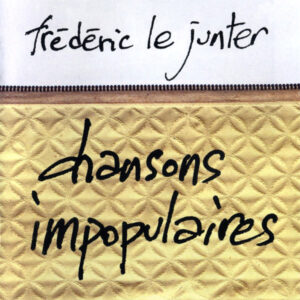
Frédéric LE JUNTER
“Chansons impopulaires”
“Frédéric Le Junter builds mechanical instruments that strip down banal music.
His workshop is far from contemporary cool electronic processes. That’s the reason why Le Junter is a true “Hickno Pop” follower (and took part of the compilation released by In-Poly-Sons). To move forward he needs space to stock raw material, to cut into the flesh, extract intestines, solder membranes, automate cardboards and nail down salvage wood. Therefore one would think that’s just a brutish work which could hardly transform a badly dented saucepan into a slide valve trombone. In the contrary it’s always the brain that works in Le Junter ! And he’s got lots of clouds and fancy in his head, humor and puns, rhymes and songs, roots and sincerity. So one could think that he’s just a gullible fool obsessed by a post-1968 utopia, who like to sing the beauty and the kindness hitting his undeted saucepans. But it’s rather subtility that drives Le Junter. Someone like him doesn’t agree with the world as it is. You should listen like him to the surroundings to extract ridiculousness, then shout out that even if you would become unpopular towards the good society. This is the meaning of the simple but beautiful lyrics of these unpopular songs. A kind of anti-populist manifesto that criticizes today’s absurdities and claims the right not to follow the letter of the law. Frédéric Le Junter’s work is close to Pierre Bastien’s or to his former partner Pierre Berthet’s and to every mechanical instruments or mechanical music promoters. He’s been on the road since the mid-eighties with his machines for exhibitions and sound art performances. Besides he improvises on his machines in a regular group called Silent Block with Xavier Charles, Jérôme Jeanmart and Stéphane Levigneront. A new release by Frédéric Le Junter should be noticed as this lively musician produces few records. Finally Le Junter is a complete artist as he designed his own cover and sleeves for this record and also created the two video that you can read on your computer on this enhanced CD.”
12,00€
In stock
CD
COMPILATION
RYTHMÉ BRUT
“With Dragibus, Guylain Damonneville, Jaber, Fred Thabaut, André Robillard, Paul Bourre, Jean Clerembaux, Mordysabbath, Michel Dalmaso, Donna Collins. Does “raw” music exist? Is there any correlation with Raw Art? Don’t be afraid, this cd does not give any clue. One could find everything he wants in these recordings: musicians which could belong to the “Neuve Invention”, improvisers of noisy belches on a microphone, outstanding technicians accumulating several keyboards like other obsessionaly accumulate things (I think of the puppets of Michel Nedjar), soft and-or violent musicians. But from what I have listened to, there were sincere people, an essential quality for the raw approach. For some of them, their music was never “exported” before. This cd has the defaults and the advantages of a compilation. Default of heterogeneity and advantage of heterogeneity. Everybody can pick what he needs to imagine... Fullishly destroyed.”
12,00€
Out of stock

CD
Jean-François PAUVROS
“La belle décisive”
New edition in digisleeve !
1996. Jean-François Pauvros: guitar, voice. “Jean-François Pauvros is still a far lesser known name to those outside France, but he has a solid-gold history in European free-rock shenanigans stretching all the way back to the late seventies, when he played alongside Jac Berrocal in Catalogue. Recent years have seen many collaborations with dancers, poets, and Japanese musicians such as Makoto Sato, Setsuko Chiba, and Keiji Haino.” Alan Cummings
1996. Jean-François Pauvros: guitar, voice. “Jean-François Pauvros is still a far lesser known name to those outside France, but he has a solid-gold history in European free-rock shenanigans stretching all the way back to the late seventies, when he played alongside Jac Berrocal in Catalogue. Recent years have seen many collaborations with dancers, poets, and Japanese musicians such as Makoto Sato, Setsuko Chiba, and Keiji Haino.” Alan Cummings
10,50€
In stock
CD
BERTHET – LE JUNTER
“L’enclume des jours”
“(This title is taken for « foam of the days », a novel by Boris Vian. « Foams » has been changed for « anvil » since in french, « foam » stands for « écume » and « anvil » for « enclume »). Raw concrete music. Tubular dums, horns, nails, wind and rotary organs, water droplets, automatic bow, springs, foot bass, iron wires, tins, barrels, mirrors, singing... So many indications to penetrate the music of Pierre Berthet and Frédéric Le Junter, two french artists. This is a clever mix between the soundscape of our society (the concrete item of the music) and the creative diversion for construction and composition, in order to give an expressive signification of this world. We really are in the center of the globalization of our lifes; our urban future based on our agricultural roots. These recordings of the CD professionnaly duplicated (27 min long) were performed in the mid 90’s, when Pierre Berthet and Frédéric Le Junter played duo, with already some memories recorded on a CD published in 1994 on the Vand’Oeuvre french label. Today, InPolySons produces unreleased material from the same days, composed for the ballet show « Love is a stranger» of the late William Douglas (1953-1996) (excepted the last piece which appeared on a Vand’Oeuvre compilation). These are sounds staged for us, meaning sounds through simple and raw words, as a metaphor of the real life.”
9,50€
In stock
CD
GRIMO
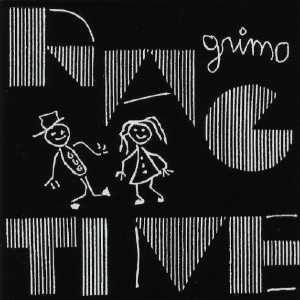
“Rag-time”
Dominique Grimaud plays guitar, synthesizer, banjo, mandolin, harmonica with old 78rpm. He plays with our memory, with the history of recording and with the surface noises of the old records.
Original price was: 12,00€.5,00€Current price is: 5,00€.
In stock
CD
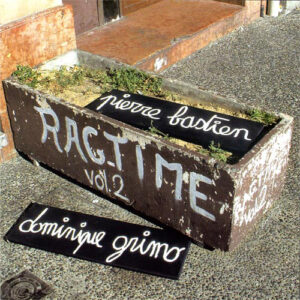
Dominique GRIMO-Pierre BASTIEN
“Rag-time vol.2”
“Rag-Time: jazz precursor, plenti-syncopes. Bastien et Grimo converted themselves into two analogical DJs, slicing old 78 rpm Lps and assembling them into Mecano wheels: with the aim to construct a true concept-album to criticize our present time which is getting irreversibly slashed. The different pieces of this cd are connected together by old and new diseases such as pest and cholera, the misery of our world. For that, Grimo took out his old Teppaz, cleaned the needle, wiped off the dust of his old 78 rpm Lps with their brownish sleeves and prepared-composed a strange program to his colleague Bastien. The so-call colleague sweap his little trumpet, oiled the movements of his mecanic robots and arranged the last year’s melodies, giddy and charming tunes. This produced a transe music, trans-duced, trans-versed and trans-formed that resembles nothing but the imaginary world we hear. Volume 2: the first (already on InPolySons) was a solo. Grimo-Bastien today act as a duo. Two mechanical DJs who officiate without mix artifice, recording in mono.”
12,00€