
In stock

CD
Christine ABDELNOUR & Joachim NORDWALL
“A higher state of body and mind”
Lebanese saxophonist Christine Abdelnour brings an impressive, extended instrumental vocabulary to Joachim Nordwall’s cryptic electronics in this live recording made at Ystad Konstmuseum for Sweden’s Firework Edition Recordings
Falling deeply within the label’s taste for sounds that exist on the liminal edge of perception, ‘A Higher State of Body and Mind’ sees Abdelnour coaxing spittle-inflected small sounds and bestial whimpers from her brass tool while Nordwall colours the negative space in elemental, greyscale drones and sheets of coruscating electronic texture.
Their results are organic and drily, soberly expressive in a transfixing style of sonic dialogue that covers all tiers of the frequency spectrum. As the release’s title implies, ‘A Higher State of Body and Mind’ is attuned to extremes of penetrative highs and rich, sonorous low end, but neither dominate the other, rather they buoy and balance each other in their quest to elevate listeners to experience, feel and perceive the recording on its purely sensual, synaesthetic terms.
Original price was: 12,50€.7,00€Current price is: 7,00€.
Out of stock

LP
Hampus LINDWALL & Leif ELGGREN
“Attempt No. 6”
“Attempt No. 6 is the result of a cooperation between Swedish organist Hampus Lindwall and the Stockholm-based artists Joakim Forsgren and Leif Elggren with the Werkleitz Gesellschaft e.V. in Halle (Saale), Germany.
Upon the invitation of curator Martin Hartung, the audio-visual performance Attempt No. 6 formed the core of the Werkleitz Festival 2016, titled Trans-Positionen, which was addressed to the power of the imagination associated with radio broadcasting.
The performance referred to the history of transcommunication research, which was pioneered by the Swedish archaeologist, opera singer, and painter Friedrich Jürgenson in the late 1950s. The audio recordings of Attempt No. 6 were used to produce this LP. Hampus Lindwall, Joakim Forsgren, and Leif Elggren attempted to draw the German composers Johann Sebastian Bach (1685–1750) and Georg Friedrich Händel (1685–1759) into a dialogue in the Church of St. Moritz in Halle (Saale). Though for a time the two composers worked not far from one another in the cities of Halle (Saale) and Leipzig, no personal encounter was ever documented.“ (Martin Hartung, curator)
20,00€
Out of stock

flexi disc
Michael ESPOSITO – Per SVENSSON
“The ghosts of Ogilvie Station”
“Sound localization relates to the listener being able to identify the origin of a specific sound signal by direction and distance. This passive acoustic location is based on a sound or vibration created is the object being detected. Active acoustic location creates a sound or vibration producing an echo, which can be measured for location. This is also known as echo location. One of the characteristics of Electronic Voice Phenomena is the lack of sound localization. In most recordings, human voice, sounds from animals, machines and nature have a sense of sound localization. Sound localization as we know it is a well studied biological effect. The human auditory system uses many cues for sound source localization such as spectral information, correlation information, timing analysis and analysis between time and level changes between both ears. This lateral information is analyzed by our ears in a very specific manner. Time changes are mainly observed in frequencies below 800 Hz. As sound from the right side reaches the right ear sooner than the left ear the interaural time difference is measured in phase delays for low frequencies and group delays at higher frequencies. Level changes are mainly observed in frequencies above 1600 Hz. As sound from the right side reaches the right ear sooner than the left ear the interaural level difference is measured at a higher level. Both time and level differences come into play for sounds between 800 Hz and 1600 Hz.
Human voices are roughly in the range of 80 Hz to 1100 Hz. The voice frequency or audio frequency used for the transmission of speech is between 300 Hz and 3400 Hz. Below 80 Hz on the auditory level, it is virtually impossible to use either time or level difference to determine a sound’s lateral source. The directional evaluation between the phase difference between the left and right ears becomes too small to tell any difference. Intelligible speech, where we should be able to speak words that can be heard, starts at about 200Hz. Human speech is a known spectrum and with the help of the perceived sound distance can be roughly estimated. In determining sound localization in the median plane; front, above, back and below, the shape of the outer ear plays a keen role. The outer ear, including the external ear canal, creates direction-selective filters that create filter resonances. These outer ear transfer functions create and implant resonance based direction-specific patterns to determine localization. One of the main auditory system clues we use to determine sound localization is reflection. The listener is subjected to two types of sound. The direct sound is a sound that a listener hears without being reflected off of some type of surface. A reflected sound is a sound that has reflected off of at least one object. Sound localization can be gained by the ratio of the direct sound to the reflected sound or echo. If the reflective object is too close to the direct sound and the listener, the sound created will be a reverberation versus an echoic reflection. In the case of reverberation, the phase difference overlaps with the direct sound and the difference will be too small to gain any useful localization information. An echo on the other hand, creates an independent sound, completely separate from the direct sound. Our auditory system will only analyze the direct sound, which arrives first, for sound localization. This is known as the law of the first wave front. This echo cancellation physically occurs in the Dorsal Nucleus of the Lateral Lemniscuses, allowing sound localization even in echoic environments.
In EVP, there is no direct sound source. Atmosphere is manipulated creating interference and air pressure too small to register a direct sound. Is it possible that it does create a reflected or echoic sound that can be picked up by recording devices? If an entity can only push wavelength towards an object and all we register is the reflected sound, then echo cancellation would cause the sound we hear upon playback to appear to have no sound localization. In order to determine direction, a strong attack in several critical bands of our hearing range must be experienced. This strong attack from a direct sound must prevail over reflections, which arrive later. Directional cues from the direct sound become unstable from the reflected sounds, which add no loudness inside the critical bands. So, no new directional information is triggered by the auditory system. One of the reasons the voices we capture seem to come from everywhere at once may be because what we are listening to is their echo and without the direct sound response with which to measure it, we cannot determine any sound localization. These psycho acoustical phenomena would be akin to an anti-audio masking where the absence of one sound affects the perception of another sound. In Ghosts of Ogilvie Station, Per Svensson and I look at just these phenomena. In the Ogilvie Station, Chicago, originally built in 1911, there are many ghosts. There is a great deal of sound localization also. Each of the 16 tracks has an individual speaker that allows a female voice to repeatedly call out the track number. By walking in front of, behind, in between and among the different speakers at varying paces, I was able to generate an almost unearthly sense of binaural simulated sound localization. In different areas of the station, I was able to capture EVP. This was well away from the speakers calling out the track identities. On the recording, the EVPs sound flat and as if coming from no direction at all, while the almost Vocoder like female voices of the loud speakers sound not only very specific in their direction but crash into each other and compete for the listener’s attention often creating new sounds and even a sort of musical sound. To further illustrate the purity of difference between the sounds with the passive acoustic location and the EVP seemingly without, Per uses an Oscilloscope, OSCILLOGRAPH UO963 NORDMENDE, to measure the frequency relationships and provide an audio output through its tone generator. The result is a very clear exercise in how we experience the audible and inaudible world around us.” Michael Esposito
Human voices are roughly in the range of 80 Hz to 1100 Hz. The voice frequency or audio frequency used for the transmission of speech is between 300 Hz and 3400 Hz. Below 80 Hz on the auditory level, it is virtually impossible to use either time or level difference to determine a sound’s lateral source. The directional evaluation between the phase difference between the left and right ears becomes too small to tell any difference. Intelligible speech, where we should be able to speak words that can be heard, starts at about 200Hz. Human speech is a known spectrum and with the help of the perceived sound distance can be roughly estimated. In determining sound localization in the median plane; front, above, back and below, the shape of the outer ear plays a keen role. The outer ear, including the external ear canal, creates direction-selective filters that create filter resonances. These outer ear transfer functions create and implant resonance based direction-specific patterns to determine localization. One of the main auditory system clues we use to determine sound localization is reflection. The listener is subjected to two types of sound. The direct sound is a sound that a listener hears without being reflected off of some type of surface. A reflected sound is a sound that has reflected off of at least one object. Sound localization can be gained by the ratio of the direct sound to the reflected sound or echo. If the reflective object is too close to the direct sound and the listener, the sound created will be a reverberation versus an echoic reflection. In the case of reverberation, the phase difference overlaps with the direct sound and the difference will be too small to gain any useful localization information. An echo on the other hand, creates an independent sound, completely separate from the direct sound. Our auditory system will only analyze the direct sound, which arrives first, for sound localization. This is known as the law of the first wave front. This echo cancellation physically occurs in the Dorsal Nucleus of the Lateral Lemniscuses, allowing sound localization even in echoic environments.
In EVP, there is no direct sound source. Atmosphere is manipulated creating interference and air pressure too small to register a direct sound. Is it possible that it does create a reflected or echoic sound that can be picked up by recording devices? If an entity can only push wavelength towards an object and all we register is the reflected sound, then echo cancellation would cause the sound we hear upon playback to appear to have no sound localization. In order to determine direction, a strong attack in several critical bands of our hearing range must be experienced. This strong attack from a direct sound must prevail over reflections, which arrive later. Directional cues from the direct sound become unstable from the reflected sounds, which add no loudness inside the critical bands. So, no new directional information is triggered by the auditory system. One of the reasons the voices we capture seem to come from everywhere at once may be because what we are listening to is their echo and without the direct sound response with which to measure it, we cannot determine any sound localization. These psycho acoustical phenomena would be akin to an anti-audio masking where the absence of one sound affects the perception of another sound. In Ghosts of Ogilvie Station, Per Svensson and I look at just these phenomena. In the Ogilvie Station, Chicago, originally built in 1911, there are many ghosts. There is a great deal of sound localization also. Each of the 16 tracks has an individual speaker that allows a female voice to repeatedly call out the track number. By walking in front of, behind, in between and among the different speakers at varying paces, I was able to generate an almost unearthly sense of binaural simulated sound localization. In different areas of the station, I was able to capture EVP. This was well away from the speakers calling out the track identities. On the recording, the EVPs sound flat and as if coming from no direction at all, while the almost Vocoder like female voices of the loud speakers sound not only very specific in their direction but crash into each other and compete for the listener’s attention often creating new sounds and even a sort of musical sound. To further illustrate the purity of difference between the sounds with the passive acoustic location and the EVP seemingly without, Per uses an Oscilloscope, OSCILLOGRAPH UO963 NORDMENDE, to measure the frequency relationships and provide an audio output through its tone generator. The result is a very clear exercise in how we experience the audible and inaudible world around us.” Michael Esposito
5,00€
Out of stock
CD
THE SONS OF GOD & Mats GUSTAFSSON
“Reception”
The Sons of God: 32 amplified iron plates. Mats Gustafsson: live electronics. Recorded by Olof Madsen on the 5th of March 2006 at Färgfabriken, Stockholm, Sweden. Reception was a sound installation at Färgfabriken (February 18 - March 5, 2006). by the Sons of God and Emanuel Swedenborg and a part of the festival Place and Space, Stockholm New Music. The festival was curated by Magnus Haglund and Magnus Andersson. During the installation period, the following guest-artists were invited for performances and concerts : Mats Gustafsson, Per Jonsson, Anna Koch, Nora Kvassman, Lotta Melin, Lise-Lotte Norelius, Daniel Rozenhall, Amit Sen, Wenche Sundsrud and Pär Thörn.
13,00€
Out of stock
CD
Leif ELGGREN-Michael ESPOSITO
“Fire station 6”
“Recorded 28 November 2007 in Fire Station 6, Hammond, Indiana, USA. EVPs from Phantom Airwaves case file PAW067. P&C Leif Elggren, Michael Esposito, Chicago 2008. All rights reserved. Leif Elggren and Michael Esposito are published by Touch Music [MCPS].”
12,00€
Out of stock
CD
Francisco MEIRINO & Michael ESPOSITO
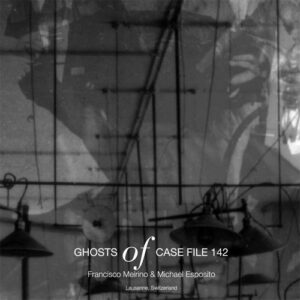
“Ghosts of case file 142”
“EVP research by Michael Esposito, Case File 142 from source recordings done by Francisco Meirino at an ancient school of anatomy, now a library, in Lausanne, Switzerland 2011. Assembled, edited and mastered by Francisco Meirino at Shiver Mobile, Nov-Dec. 2011.
Michael Esposito was born 1964 in Gary, Indiana. He is an experimental artist and researcher in Electronic Voice Phenomena (EVP). An ancestor of Alfred Vail, who invented the Morse Code and several early telegraph devices with his partner Samuel Morse. Another ancestor, Jonathan Harned Vail was office manager and assistant to Thomas Edison in his later years when Edison was attempting to develop a device to communicate with the dead. Over the years, under the Phantom Airwaves institution, Michael has participated in hundreds of paranormal investigations all over the world.
Born in 1975, Francisco Meirino is active since 1994 (as phroq until 2009) in sound and live performance, he explores the tension between programmable material and the potential for its failure by working mainly with the computer, magnetic fields detectors, reel-to-reel tape recorders, piezo transducers and various acoustic devices.”
12,00€
In stock
CD
Francisco MEIRINO & Leif ELGGREN
“Trop tôt”
Highly recommended collaboration between these two sound artists. Noises, drones, ghosts and text. With the participation of Laura Daengeli.
12,00€