
Out of stock

3 CD box
Roland KAYN
“Simultan”
Die Schachtel, in collaboration with SZ Sugar, is finally able to make available in CD format (a deluxe 3CD boxed edition with a lavishly illustrated booklet) of the legendary vinyl-only edition of 2017, the first in a series named “K-Kybernetische Musik /Cybernetic Music” that documents the birth of Roland Kayn cybernetic music, remastered from the original analog master tapes.
One of the great pioneers of electronic, computer, and instrumental avant-garde music, for most of his life, the German composer Roland Kayn (1933 - 2011) remained almost entirely unknown, a founding member of the legendary ensemble, Gruppo di Improvvisazione Nuova Consonanza, heralded as a singular genius by a small number of figures like Jim O’Rourke, who is currently curating the archive of the artist.
While Kayn might be easily described as a composer of electronic, electro-acoustic, or computer music, most of his career was in fact largely dedicated to the revolutionary sculpting of an entirely new territory of sound - Cybernetic Music, a generative process of composition through programming. Simultan was among the first of the composer’s works to emerge from this process. Cybernetic Music grew from Kayn’s longstanding engagement and fascination with data processing theory, which far outweighed his interest in the work of other composers and the zeitgeists of the day - a fact which contributed to his being declared persona non grata by the avant-garde establishment, and ultimately his lasting obscurity. This territory of creativity was the composer’s attempt to allow sound to be self-self-sufficient, stripping away notions of harmony, melody and rhythm, as much as those of the composer and art, deploying complex networks of electronic devices - early computers, to follow his instructions, taking form through a system of signals and commands.
Created during the period in which Kayn was living in the Netherlands, and recorded with the assistance of electronic music legends Jaap Vink and Leo Küpper, Simultan is a work of astounding beauty – filled with a remarkable sense of humanity and touch – a strange incongruity considering the system through which it was made, doubling as an indication of the inherent power of sound which Kayn spent his life fighting to reveal. For fans of avant-garde electronic music, particularly those drawn to the work coming out of Utrecht and Groupe de recherches musicales (GRM), but who have not encountered Simultan, the work is likely to represent a towering revolution. It stands among the most striking works from the world of sound. Ranging from seductive ambiences, grinding swells of atonally and pure texture, to buried tone clusters, it does everything Kayn set forth in his ambitious project. It is an immersive image of what might be when sound organizes itself, and a metaphor for a way of being – the wonders which happen when we relinquish ego and control.
A stunning journey in sound and work of profound and intoxicating power, Simultan stands among the best of all avant-garde electronic works of its era, yet, like its composer, has never received its rightful due. Die Schachtel’s lovingly produced boxed edition, produced with a booklet with liner notes exploring the composer’s work and ideas at length, takes great strides to rectifying this sin – bringing this seminal work back into print for the first time in CD + digital edition in more than 35 years. Its reemergence has been long awaited by many and should be celebrated by all. Totally essential and not to be missed.
38,00€
Out of stock
2 LP
Luigi ARCHETTI – Bo WIGET
“Weltformat”
Edition of 200 copies pressed on 2x 180g clear vinyl housed in a six-panel gatefold cover that unfolds to reveal the musical score of the album.
Ending the decade of silence which followed more than ten years of remarkable, critically acclaimed activity by the partnership of veteran experimentalists, Luigi Archetti and Bo Wiget, the duo returns with what may be their most ambitions effort to date, "Weltformat", issued by Die Schachtel.
Switzerland-based Luigi Archetti and Bo Wiget began collaborating in 1998, the fruits of which initially emerged as the critically heralded, three-part "Low Tide Digitals" series, released by Rune Grammofon between 2001 and 2009. "Weltformat", like its predecessors, builds on decades of solo and collaborative efforts by its creators - Archetti with famed Krautrock pioneers, Guru Guru, among many others, and Wiget with Werner Lüdi, Taku Sugimoto, Tetuzi Akiyama, and others. Sculpted from the intricate tonal interventions and responses of Archetti on guitar, mandolin, and electronics, and Wiget on cello, electronics, and vocals, across the album's four sides the duo constructs a remarkably diverse landscape in sound, folding touchstones of modern classical, free improvisation, minimalism, harsh noise, and ambient music, into a seamless, singular expanse.
Clusters of tone and dissonance merge, collide, and abrade against drones, textures, and pulsing electronics, each element a representative voice of its creator, caught in an imagistic conversation beyond words, which feels as immediate and intuitive, as it does perfectly balanced and thoughtful. "Weltformat", encountering Archetti and Wiget just past the 20 year mark of their collaborative partnership, bears the fruit of rigorous experiments in sound - an immersive, effortless form of sonic realism, built from the optimism and hope which lays at the root of the avant-garde. As beautiful, inviting, immersive, and slow moving, as it is challenging, destabilizing, and thought provoking, Die Schachtel is overwhelmingly proud to release "Weltformat" in both clear double LP and CD formats.
Original price was: 27,50€.15,00€Current price is: 15,00€.
In stock
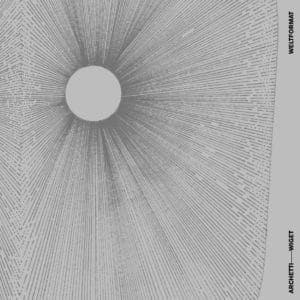
CD
Luigi ARCHETTI – Bo WIGET
“Weltformat”
Edition of 300 copies housed in a six-panel gatefold cover that unfolds to reveal the musical score of the album.
Ending the decade of silence which followed more than ten years of remarkable, critically acclaimed activity by the partnership of veteran experimentalists, Luigi Archetti and Bo Wiget, the duo returns with what may be their most ambitions effort to date, "Weltformat", issued by Die Schachtel.
Switzerland-based Luigi Archetti and Bo Wiget began collaborating in 1998, the fruits of which initially emerged as the critically heralded, three-part "Low Tide Digitals" series, released by Rune Grammofon between 2001 and 2009. "Weltformat", like its predecessors, builds on decades of solo and collaborative efforts by its creators - Archetti with famed Krautrock pioneers, Guru Guru, among many others, and Wiget with Werner Lüdi, Taku Sugimoto, Tetuzi Akiyama, and others. Sculpted from the intricate tonal interventions and responses of Archetti on guitar, mandolin, and electronics, and Wiget on cello, electronics, and vocals, across the album's four sides the duo constructs a remarkably diverse landscape in sound, folding touchstones of modern classical, free improvisation, minimalism, harsh noise, and ambient music, into a seamless, singular expanse.
Clusters of tone and dissonance merge, collide, and abrade against drones, textures, and pulsing electronics, each element a representative voice of its creator, caught in an imagistic conversation beyond words, which feels as immediate and intuitive, as it does perfectly balanced and thoughtful. "Weltformat", encountering Archetti and Wiget just past the 20 year mark of their collaborative partnership, bears the fruit of rigorous experiments in sound - an immersive, effortless form of sonic realism, built from the optimism and hope which lays at the root of the avant-garde. As beautiful, inviting, immersive, and slow moving, as it is challenging, destabilizing, and thought provoking, Die Schachtel is overwhelmingly proud to release "Weltformat" in both clear double LP and CD formats.
15,50€
In stock

LP
Luigi NONO
“Musica manifesto n. 1”
First ever repress of this seminal work. LP version, edition of 300 copies on black vinyl. This edition is on black vinyl, it is hosted in an outstanding shiny/refelecting silver cover (a hommage to the notorious Philips Prespective Series of the same period) and features the tabloid/poster with unpublished photos of the Venice Biennale riots of 1968
Long considered, with Pierre Boulez and Karlheinz Stockhausen, to be one point in the trinity of the post-war avant-garde, Luigi Nono was, without question, one of the most important and singular composers to emerge in the years following the Second World War – defining the zeitgeist, taking the his idiom into startling new territories, while standing decidedly apart. Nono's music infused the avant-garde with a sense of emotion and moral consciousness which had been previously unheard, seeking to join advanced forms of music in the social struggles of every day life. Unlike most of his peers, the composer was political in everything he did. His music is a rallying call of the left. Originally issued in 1969, none of Nono's works illuminate this radical consciousness and concern better than his seminal Musica-Manifesto N.1. Now reissued for the first time by die Schachtel in collaboration with Archivo Storico Ricordi, it is revolution led by one man – a window into the creative and political potential of sound.
Nono's music emerged from the ashes of war – a voice in a social and intellectual landscape trying to cope with what had been, and build itself anew. While most of his contemporaries divorced themselves from the political forum, focusing themselves on more abstract concerns, Nono's work was vocally political from its earliest days – first as explicitly anti-fascist, pointedly embracing Marxism (he officially joined the Communist Party in 1952), before, as 60s and 70s unfolded, becoming a voice in the international worker and student struggles and the fight against the Vietnam War.
It's hardly coincidental that a work as important and powerful as Musica-Manifesto N.1 emerged at the time it did. It is among the greatest sonic culminations of 1960's, composed and released just before the decade's end – emotion, empathy, and politic, manifesting as some of the most forward thinking and radical sounds and structures of their day. Nearly half a century on, what is says, and how its says, remain startling fresh.
Musica-Manifesto N.1, original intended to be the first part in a suite which never appeared, was commissioned by the communist administrated town of Chatillon-sous-Bagneux, in France, during the Spring of 1969. The work, manifesting in two parts, can be understood as snapshot of its moment – incorporating texts taken from the walls of Paris in May, 68, read by Edmonda Aldini against the voices of Communist leaders like Che Guevara, Ho Chi Minh, and Mao, as well as recordings of the riots and protests which occurred at the Venice Biennale in June, 68 – the materiality of the streets and political struggle taking form as the sounds whistles, howls, shouts through a megaphone, and battles with the police, joined with the history of the movement from which those events sprang via a lyrical poem, Mattino (Morning) by Cesare Pavese, one of most important Italian anti-fascist intellectual voices during Second World War, sung under the instruction of the composer by Liliana Poli and Kadigia Bove. Both sides of Musica-Mainifesto N.1, Un volto, e del mare and Non consumiamo Marx, are works for magnetic tape, the first archived through careful editing to achieve a singular polyphonic complexity, while the second utilizes manipulation of its source material through filters and modulators, played against electronically generated sounds. The cumulative result remains a legendary culmination of avant-garde practice and political struggle – an astounding, immersive, and thought proving body of sound, which remains as relevant today as the day it was made.
24,00€
Out of stock
CD
Luigi NONO
“Musica manifesto n. 1”
Long considered, with Pierre Boulez and Karlheinz Stockhausen, to be one point in the trinity of the post-war avant-garde, Luigi Nono was, without question, one of the most important and singular composers to emerge in the years following the Second World War – defining the zeitgeist, taking the his idiom into startling new territories, while standing decidedly apart. Nono's music infused the avant-garde with a sense of emotion and moral consciousness which had been previously unheard, seeking to join advanced forms of music in the social struggles of every day life. Unlike most of his peers, the composer was political in everything he did. His music is a rallying call of the left. Originally issued in 1969, none of Nono's works illuminate this radical consciousness and concern better than his seminal Musica-Manifesto N.1. Now reissued for the first time by die Schachtel in collaboration with Archivo Storico Ricordi, it is revolution led by one man – a window into the creative and political potential of sound.
Nono's music emerged from the ashes of war – a voice in a social and intellectual landscape trying to cope with what had been, and build itself anew. While most of his contemporaries divorced themselves from the political forum, focusing themselves on more abstract concerns, Nono's work was vocally political from its earliest days – first as explicitly anti-fascist, pointedly embracing Marxism (he officially joined the Communist Party in 1952), before, as 60s and 70s unfolded, becoming a voice in the international worker and student struggles and the fight against the Vietnam War.
It's hardly coincidental that a work as important and powerful as Musica-Manifesto N.1 emerged at the time it did. It is among the greatest sonic culminations of 1960's, composed and released just before the decade's end – emotion, empathy, and politic, manifesting as some of the most forward thinking and radical sounds and structures of their day. Nearly half a century on, what is says, and how its says, remain startling fresh.
Musica-Manifesto N.1, original intended to be the first part in a suite which never appeared, was commissioned by the communist administrated town of Chatillon-sous-Bagneux, in France, during the Spring of 1969. The work, manifesting in two parts, can be understood as snapshot of its moment – incorporating texts taken from the walls of Paris in May, 68, read by Edmonda Aldini against the voices of Communist leaders like Che Guevara, Ho Chi Minh, and Mao, as well as recordings of the riots and protests which occurred at the Venice Biennale in June, 68 – the materiality of the streets and political struggle taking form as the sounds whistles, howls, shouts through a megaphone, and battles with the police, joined with the history of the movement from which those events sprang via a lyrical poem, Mattino (Morning) by Cesare Pavese, one of most important Italian anti-fascist intellectual voices during Second World War, sung under the instruction of the composer by Liliana Poli and Kadigia Bove. Both sides of Musica-Mainifesto N.1, Un volto, e del mare and Non consumiamo Marx, are works for magnetic tape, the first archived through careful editing to achieve a singular polyphonic complexity, while the second utilizes manipulation of its source material through filters and modulators, played against electronically generated sounds. The cumulative result remains a legendary culmination of avant-garde practice and political struggle – an astounding, immersive, and thought proving body of sound, which remains as relevant today as the day it was made.
300 copies
15,50€
In stock

LP
Marino ZUCCHERI
“Parete 67”
The regular LP only edition: Deluxe silver cover + foil stamping, insert (Features only the piece “Parete ‘67”.In the world of artifacts, there are the known, the unknown, the forgotten, and the lost. An artefact may pass easily between the four, entirely at the mercy of the care it is offered, or which finds along the way. The music in question - Marino Zuccheri’s Parete 1967 Per Emilio Vedova, an massive electronic composition created by the multi-talented engineer of the famous Milan RAI Studio of Phonology for the Italian Pavillion at the Montreal Expo ’67, is one such case.It began as part of something known - a wild, sonic public event, was almost entirely forgotten, becoming lost and then unknown. It wasn’t until 2005, when these recordings entered the orbit of Die Schachtel, that anyone had been able to hear them since they were made in 1967, offering their world premiere. As is often the case, the limited edition LP quickly sold out and drifted from view. Finally, after more than a decade long wait, Die Schachtel has wondrously pressed it again, allowing its beautiful challenges to reenter the world.Parete 1967 Per Emilio Vedova is one of the great artifacts of 1960’s Italian avant-garde - a wild, grinding metallic expose which sucks the ear into its depths, made, like so much of the best work of the era, in the spirit of collaboration and the meeting of two minds. Die Schachtel’s edition is the realisation of a life long dream of Marino Zuccheri’s to see this recordings issued. Pulled from the original tapes in his archive, and working closely with him before his death in 2005. A true wonder of towering historical importance. As essential as it gets for any fan of experimental music, or the history of the Italian avant-garde.
24,00€
Out of stock

LP
Luciano CILIO
“Dialoghi Del Presente”
Faithful to the 1977 pressing, exclusive edition available in very limited supply. Clear Vinyl and an original insert that functions as Obi. Edition made in collaboration with Btf/Universal.
Dialoghi Del Presente represents a truly unique approach to music making where each instrument and each sound are given ample time and space to develop. For the recording sessions leading to this remarkable work Luciano Cilio took up a role as multi-instrumentalist, performing on piano, guitar, flute, bass and mandola, also joined by musicians coming from different experiences and areas, who supply strings, extra woodwind and percussion. Almost impossible to define, the all-acoustic music of Cilio occupies a space between the devotional music of Popol Vuh’s Florian Fricke and the deep spiritual places of what would later be called holy minimalism (without any of the religious intents of the afore-mentioned references), with a surprising anticipation of the crystalline sparseness of pieces like “Fur Alina” by Arvo Part, and a feeling of intense suspension of time that can be associated to some of the most intimate compositions of Ligeti or Morton Feldman, yet maintaining a definite position outside the contemporary music of serial and academic inspiration.
“These recordings sound as they feel self contained, introspective, and determined, you can feel in the music a sort of necessity that can be rarely found, as in Bill Fay’s “Time of the Last Persecution”, or in Nick Drake's “Pink Moon”: this enormous weight that is bearing on it's creators, the absolute need to exorcize it from their lives, a moment in time where you are invited to hear artists truly in contact with their existence. Luciano Cilio holds that moment in time, an authentic emotional testament, something to be cherished" has written Jim O’Rourke in his inspiring liner notes.
Dialoghi Del Presente represents a truly unique approach to music making where each instrument and each sound are given ample time and space to develop. For the recording sessions leading to this remarkable work Luciano Cilio took up a role as multi-instrumentalist, performing on piano, guitar, flute, bass and mandola, also joined by musicians coming from different experiences and areas, who supply strings, extra woodwind and percussion. Almost impossible to define, the all-acoustic music of Cilio occupies a space between the devotional music of Popol Vuh’s Florian Fricke and the deep spiritual places of what would later be called holy minimalism (without any of the religious intents of the afore-mentioned references), with a surprising anticipation of the crystalline sparseness of pieces like “Fur Alina” by Arvo Part, and a feeling of intense suspension of time that can be associated to some of the most intimate compositions of Ligeti or Morton Feldman, yet maintaining a definite position outside the contemporary music of serial and academic inspiration.
“These recordings sound as they feel self contained, introspective, and determined, you can feel in the music a sort of necessity that can be rarely found, as in Bill Fay’s “Time of the Last Persecution”, or in Nick Drake's “Pink Moon”: this enormous weight that is bearing on it's creators, the absolute need to exorcize it from their lives, a moment in time where you are invited to hear artists truly in contact with their existence. Luciano Cilio holds that moment in time, an authentic emotional testament, something to be cherished" has written Jim O’Rourke in his inspiring liner notes.
25,00€
Out of stock
LP
Lino Capra VACCINA
“Antico Adagio”
2017 small repress.
Notes to the release: Deluxe edition, silver and gloss varnish print with printed inner sleeves housing a transparent anti-static record sleeve, limited to 300 copies. Includes insert with notes in Italian and English.
Before an aberrant idea of progress and workaholic ethic ludicrously sped up our daily lives, even in the hectic city of Milan it was possible to “play slowly” – with no pressure, simply following the path your art was showing you. After a classic artistic journey and an experimental stint with Aktuala and other brilliant fellow musicians (like Franco Battiato, above all), Lino Capra Vaccina, near the end of the 70s, recorded Antico Adagio. It was an amazing album, anticipating countless future experiments in the field of new age and world music but also in avantgarde and electronic music. Apart from a few violin parts and the extraordinary vocal lines (sung by Vaccina himself and Juri Camisasca), Antico Adagio is an album fully built on percussions. But, at the same time, it’s the farthest thing from the typical idea of percussions. You won’t find a single trace of African or primitive beats: instead, this is a collection of rather long, subtle and thoughtful compositions, crafted with vibraphones, marimbas and gong. Together they create a work which will remain unique – both in Capra Vaccina’s discography as well as in a more general sense.
From Kieran Hebden/FourTet liner notes: «There are records I have found in my life that I was almost wishing existed before hearing them. Recordings with new combinations of sound and atmosphere I knew could be wonderful to me if I ever discovered them, and then on discovery the sound was even better than I could have imagined. I felt this way when first hearing music by Alice Coltrane (Journey to Satchidananda) and Don Cherry (Organic Music Society) and I also felt it with Antico Adagio. The combinations of the rhythms and melodies resonate with me in a very clear way and I feel transported by this music every time I hear it.… I first heard this record when it was posted on the Mutant Sounds blog a few years ago and am very happy to see it get another release. The music is timeless and brilliant and maybe there are other people out there wishing for a sound like this too who will now have chance to find it».
Notes to the release: Deluxe edition, silver and gloss varnish print with printed inner sleeves housing a transparent anti-static record sleeve, limited to 300 copies. Includes insert with notes in Italian and English.
Before an aberrant idea of progress and workaholic ethic ludicrously sped up our daily lives, even in the hectic city of Milan it was possible to “play slowly” – with no pressure, simply following the path your art was showing you. After a classic artistic journey and an experimental stint with Aktuala and other brilliant fellow musicians (like Franco Battiato, above all), Lino Capra Vaccina, near the end of the 70s, recorded Antico Adagio. It was an amazing album, anticipating countless future experiments in the field of new age and world music but also in avantgarde and electronic music. Apart from a few violin parts and the extraordinary vocal lines (sung by Vaccina himself and Juri Camisasca), Antico Adagio is an album fully built on percussions. But, at the same time, it’s the farthest thing from the typical idea of percussions. You won’t find a single trace of African or primitive beats: instead, this is a collection of rather long, subtle and thoughtful compositions, crafted with vibraphones, marimbas and gong. Together they create a work which will remain unique – both in Capra Vaccina’s discography as well as in a more general sense.
From Kieran Hebden/FourTet liner notes: «There are records I have found in my life that I was almost wishing existed before hearing them. Recordings with new combinations of sound and atmosphere I knew could be wonderful to me if I ever discovered them, and then on discovery the sound was even better than I could have imagined. I felt this way when first hearing music by Alice Coltrane (Journey to Satchidananda) and Don Cherry (Organic Music Society) and I also felt it with Antico Adagio. The combinations of the rhythms and melodies resonate with me in a very clear way and I feel transported by this music every time I hear it.… I first heard this record when it was posted on the Mutant Sounds blog a few years ago and am very happy to see it get another release. The music is timeless and brilliant and maybe there are other people out there wishing for a sound like this too who will now have chance to find it».
24,50€
Out of stock
5 LP
GRUPPO DI IMPROVVISAZIONE NUOVA CONSONANZA
“Azioni-Reazioni 1967-1969”
5LP box, edition of 500 copies. The year 2007 saw one of the most remarkable findings in the long treasure-hunting history of Die Schachtel: the complete set of recordings of the early manifestation (1967-1969) of one of the most legendary improv group of all times, the Gruppo di Improvvisazione Nuova Consonanza. Rescued by the private archives of Mr. Walter Branchi, one of the original founding members – alongside with Franco Evangelisti, Ennio Morricone, Ivan Vandor, Roland Kayn, Egisto Macchi, Mario Bertoncini and John Heineman – the tapes were then restored in their entirety, but only a part of them were published in an epic 500 copies -CD-only boxset titled "Azioni 1967-1969", which also featured a DVD with the original film "Nuova Consonanza" shot by Theo Gallher during the rehearsal and the concert that the group held on March 19th and 20th, 1967, at the Galleria d'arte Moderna in Rome. Spanning from free-jazz to total abstract noise to wild electronic sounds (thanks mainly to the wizardry of Roland Kayn and Walter Branchi), their music was – and remains – one of the most dynamic, original and uncompromising expression of a period defined by intense experimentation and musical bravery, that anticipated a lot of the experiments to come in later years. Or, to put it simple, "They were utterly unique", as per the words that John Zorn – a long time admirer of the Gruppo – expressely wrote for this edition.
To mark the 10-years anniversary of its original release, and to finally make it available for the vinyl aficionados throughout the world, Die Schachtel is proud to present AZIONI/REAZIONI 1967-1969, the complete cycle of improvisations (which in fact means thirteen additional pieces never published before, spanning over 2 and a half LPs and two CDs ), taken from the original tapes, lovingly remastered by Mr. Giuseppe Ielasi and masterly cut to five black vinyls, with a new design and an even more complete information apparatus, that includes a 64 page LP-size book in English and Italian, complete with essays, memories from the members of the Group, a new article by Valentina Bertolani exploring in detail the techniques of the group (based on the enclosed DVD), a chronology and a collection of original reviews by Maurizio Farina, and – to add an additional cherry on the almost rather juicy cake - a set of stunning (and unpublished) black and white photos of the group playing in the glorious Venice "Teatro della Fenice" in 1968, taken from the archives of the Venice Biennale.
The "AZIONI/REAZIONI" LP boxset includes:
- 5 vinyl LPs
- 1 DVD (with English and Italian subtitles)
- a 64-page sewn-bound large book
To mark the 10-years anniversary of its original release, and to finally make it available for the vinyl aficionados throughout the world, Die Schachtel is proud to present AZIONI/REAZIONI 1967-1969, the complete cycle of improvisations (which in fact means thirteen additional pieces never published before, spanning over 2 and a half LPs and two CDs ), taken from the original tapes, lovingly remastered by Mr. Giuseppe Ielasi and masterly cut to five black vinyls, with a new design and an even more complete information apparatus, that includes a 64 page LP-size book in English and Italian, complete with essays, memories from the members of the Group, a new article by Valentina Bertolani exploring in detail the techniques of the group (based on the enclosed DVD), a chronology and a collection of original reviews by Maurizio Farina, and – to add an additional cherry on the almost rather juicy cake - a set of stunning (and unpublished) black and white photos of the group playing in the glorious Venice "Teatro della Fenice" in 1968, taken from the archives of the Venice Biennale.
The "AZIONI/REAZIONI" LP boxset includes:
- 5 vinyl LPs
- 1 DVD (with English and Italian subtitles)
- a 64-page sewn-bound large book
95,00€
Out of stock
CD
Mario BERTONCINI
“Arpe eolie”
CD only. The CD presents the complete selection of his compositions for aeolian objects, from 1973 to more recent days. “Chanson pour instrument à vent” (1974), “Istantanee” (1995), “Istantanee II” (2006), “Chanson pour instrument à vent” (1974 - 2000), “Chain reaction” (1973), “Fuochi (introduzione” (1982).
16,00€
Out of stock
CD
Lino Capra VACCINA
“Antico Adagio”
Before an aberrant idea of progress and workaholic ethic ludicrously sped up our daily lives, even in the hectic city of Milan it was possible to “play slowly” - with no pressure, simply following the path your art was showing you. After a classic artistic journey and an experimental stint with Aktuala and other brilliant fellow musicians (like Franco Battiato, above all), Lino Capra Vaccina, near the end of the 70s, recorded Antico Adagio. It was an amazing album, anticipating countless future experiments in the field of new age and world music but also in avantgarde and electronic music. Apart from a few violin parts and the extraordinary vocal lines (sung by Vaccina himself and Juri Camisasca), Antico Adagio is an album fully built on percussions. But, at the same time, it’s the farthest thing from the typical idea of percussions. You won’t find a single trace of African or primitive beats: instead, this is a collection of rather long, subtle and thoughtful compositions, crafted with vibraphones, marimbas and gong. Together they create a work which will remain unique - both in Capra Vaccina’s discography as well as in a more general sense.
From Kieran Hebden/FourTet liner notes: «There are records I have found in my life that I was almost wishing existed before hearing them. Recordings with new combinations of sound and atmosphere I knew could be wonderful to me if I ever discovered them, and then on discovery the sound was even better than I could have imagined. I felt this way when first hearing music by Alice Coltrane (Journey to Satchidananda) and Don Cherry (Organic Music Society) and I also felt it with Antico Adagio. The combinations of the rhythms and melodies resonate with me in a very clear way and I feel transported by this music every time I hear it.… I first heard this record when it was posted on the Mutant Sounds blog a few years ago and am very happy to see it get another release. The music is timeless and brilliant and maybe there are other people out there wishing for a sound like this too who will now have chance to find it».
Available as two individual LPs: Antico Adagio (DS27/1LP) and Frammenti da Antico Adagio (DS27/2LP), which features previously unreleased material from the original 1978 sessions. The deluxe CD edition (Antico Adagio, DS27CD) contains both albums.
From Kieran Hebden/FourTet liner notes: «There are records I have found in my life that I was almost wishing existed before hearing them. Recordings with new combinations of sound and atmosphere I knew could be wonderful to me if I ever discovered them, and then on discovery the sound was even better than I could have imagined. I felt this way when first hearing music by Alice Coltrane (Journey to Satchidananda) and Don Cherry (Organic Music Society) and I also felt it with Antico Adagio. The combinations of the rhythms and melodies resonate with me in a very clear way and I feel transported by this music every time I hear it.… I first heard this record when it was posted on the Mutant Sounds blog a few years ago and am very happy to see it get another release. The music is timeless and brilliant and maybe there are other people out there wishing for a sound like this too who will now have chance to find it».
Available as two individual LPs: Antico Adagio (DS27/1LP) and Frammenti da Antico Adagio (DS27/2LP), which features previously unreleased material from the original 1978 sessions. The deluxe CD edition (Antico Adagio, DS27CD) contains both albums.
18,00€
In stock

CD
Fabio SELVAFIORITA – Valerio TRICOLI
“Death by water”
“Die Schachtel is proud to present Death by Water: a four-hand musique concrète composed by Fabio Selvafiorita and Valerio Tricoli. This one track disc has been realized between Milan, where it has been composed, and Giudecca Island, in Venice, the location of the field recordings and reel-to-reel tape treatments. The music stresses and questions the dramatic and alchemical potential of a musical landscape marked by water, as the work is intended to approach the fourth movement of T. S. Eliot’s poem “The waste Land”. Fabio Selvafiorita e Valerio Tricoli created a work full of narrative suggestions, visceral and metaphysical at same time.” label info
15,00€
Out of stock
7 CD
Luigi ARCHETTI
“Null I – VII”
Epic in scale, static, timbre and stillness, “Null” is a vast and profound music project that Luigi Archetti has been pursuing over a longer period. His musical research is not about Null (the German word for zero) as a mathematical object, as a real number. Instead, the term Null (zero) is used here as a metaphor in order to describe a state of pausing and anticipatory waiting. The music in project Null is characterised by static sounds, by drones and their overlapping and layering. The sound surfaces turn into acoustic sluggish material which flows slowly through time and gradually transforms itself. It is a constant gliding, a constant mutation of sound structures. Attempts to discover clearly defined melodies, rhythmically ordered structures or even beats are to no avail. A universe of sound particles diffuse in the foreground of the musical atmosphere, whereby the sounds do not provide any reference whatsoever to a possible location.
detail
All the sounds in the Null project are sourced from e-guitars, which are in part extensively defamiliarized through digitalization and thereby redefined. The e-guitars (frequently in scordatura tuning) are used to this end as suppliers of sound. The acoustic sedimentation of the diverse sounds and sound structures results in a dense and filigree sound fabric which develops a pull effect on the listeners. It is an invitation to travel in uncharted regions, a hypnotically captivating journey through timeless and minimal acoustic events.
detail
All the sounds in the Null project are sourced from e-guitars, which are in part extensively defamiliarized through digitalization and thereby redefined. The e-guitars (frequently in scordatura tuning) are used to this end as suppliers of sound. The acoustic sedimentation of the diverse sounds and sound structures results in a dense and filigree sound fabric which develops a pull effect on the listeners. It is an invitation to travel in uncharted regions, a hypnotically captivating journey through timeless and minimal acoustic events.
45,00€