
In stock

LP
Léo DUPLEIX with ASTERALES
“Round Sky”
Léo Dupleix return to Black Truffle with Round Sky, following the enchanting Resonant Trees (BT119). The composer here performs on analogue synthesizer, harpsichord and spinet as one member of Asterales, a group that brings together four important figures in the international community of musicians working with just intonation: Dupleix, Jon Heilbron (double bass), Rebecca Lane (quarter-tone flute) and Frederik Rasten (guitars). The quartet perform three recent pieces by Dupleix, each of which is like a different view on the same landscape of unruffled calm, where the unique harmonic events made possible by just intonation flicker across melodies and harmonies like light on the surface of water. The first side is dedicated to ‘Poème d’air’, composed while Dupleix was immersed in the music of 14thcentury ars nova composer-poet Guillaume de Machaut. A sustained study of the ‘sonic possibilities of low-pitched sounds in just intonation’, it begins with a long, rumbling pitch from Heilbron’s bass, soon joined by the organ-like tones of the composer on synthesizer. The piece is made up of cycling sequences of chords, each of which is repeated for several minutes before the music either freezes on a single harmony or silently pauses before the next episode begins. These structures are initially dominated by the bass and synthesizer, with Lane’s pure vibrato-less flute tone and Rasten picked harmonics adding flashes of colour. As the piece develops, flute and guitar become more prominent and the bass climbs to higher registers. The development culminates in a stunning episode around fifteen minutes in where the texture thins out, casting a spotlight on a melodic figure exploiting the uncanny sound of Lane’s quarter-tone flute. On the second side we are treated to two briefer pieces, closer to the sound of Resonant Trees as they return harpsichord and spinet to the foreground. ‘Ghosts’ centres on a harpsichord melody that slowly expands as it repeats, growing from a haunting six-note cell to a flowing succession of notes whose shape become increasingly difficult to perceive. Alongside this melodic development, an increasingly lush accompaniment grows, with long tones from bass, flute, e-bowed guitar and synthesizer holding notes picked out the harpsichord melody in a swaying harmonic cloud. Dupleix notes that the concluding ‘Round Sky’ was written in the countryside in spring, a circumstance that seems far from irrelevant to the impression the piece makes when its euphonous spinet arpeggios emerge from a gentle synthesizer drone like a flower from a bud. Performed as a duo with Rasten, with both instrumentalists also singing, this title piece exemplifies what makes Dupleix’s music so unique: grounded in a rigorous application of just intonation principles yet as open as Harold Budd or Andrew Chalk to an uncomplicated, intuitive experience of beauty.
28,00€
In stock

2 LP
NIJIUMU (K. Haino, T. Akiyama and T. Matsuoka)
“When I sing, I slip into the microphone.”
Among the true Keiji Haino devotees, Nijiumu’s Era of Sad Wings (released on P.S.F. in 1993) has always held a special place in the pantheon. Operating for only a few years in the early 90s and apparently only performing a handful of shows, Nijiumu operated at the opposite end of the dynamic spectrum to Haino’s famed power trio Fushitsusha, dwelling in a hushed, meditative realm of mysterious droning sonorities and free-floating melodies that occasionally erupts into violence. Black Truffle is pleased to announce a new double-LP edition of a lesser-known 1994 Nijiumu recording, When I sing, I slip into the microphone. Into that void, I bring comrade “prayers”, then, turning to face the outside, together we explode. Here, Nijiumu is the trio of Haino, Tetuzi Akiyama and the obscure Takashi Matsuoka, the three performing on a wide variety of string, wind and percussion instruments, as well as electric guitar and bass, and Haino’s unmistakeable voice.
Like on the early solo Haino album that shares the group’s name (released on P.S.F. in 1993), the instrumentation swims in reverb (the use of which Akiyama recalls as ‘a kind of point of the band’), often obscuring the instrumental sources. On the short opening piece, a distant reed instrument arcs long buzzing melodies over a bed of cymbals and gongs, like a psychedelic take on Tibetan music. The epic second part, occupying almost 50 minutes, begins as a splayed, near-formless cloud of electric guitar and bass, shadowed by bowed and plucked strings, the three elements working through twisting atonal shapes. At various points in the recording, we hear what seems to be the sounds of musicians moving between instruments, their shuffling and bumps fitting seamlessly into this radically open music. Eventually, what sounds like electric guitar moves closer to the foreground, fixing on a repeated melodic cell around which hover mysterious clouds of long tones and a sporadic shaker. At the half-hour mark, the music begins to build to a violently emotive climax, Haino’s impassioned vocal cries punctuating a lumbering, bass-heavy murk, contrasted at points by what sounds like a tin whistle. Suddenly, the volume drops to a near-whisper, opening the way for the stunning final moments, which touch on the slow-motion balladry of Haino’s classic Affection, here given an eccentric twist by an occasional woodblock hit. The third piece opens with a hazy trio of rumbling bass, bowed strings and abstracted slide guitar, the latter calling to mind some of Akiyama’s later solo work. Eventually joined by Haino’s voice, its fragile, haunted tone might remind the listener of the man in black’s documented love of the madrigals of the murderous Count Gesualdo, before the recording abruptly breaks off mid-note. In this new edition, the Nijiumu trio recording is supplemented by a piece recorded solo by Haino in 1973, a bracing electronic blowout stretching almost half an hour. Using a homemade electronics setup to unleash a barrage of crunching distortion and shuddering harmonic fuzz, it takes its place in the canon of extreme live electronics next to Robert Ashley’s Wolfman and Walter Marchetti’s Osmanthus fragrans, looking forward to extreme noise years before Merzbow. Taken as a whole, these four sides of music are a stunning document of some of the lesser-known waystations of Haino’s singular creative path.
40,00€
In stock

LP
Amelia CUNI
“Melopea”
Black Truffle is pleased to announce Melopea, presenting two new pieces highlighting the incredible voice of Amelia Cuni (1958-2024), the great Italian singer, based in Berlin in later life, whose mastery of the classical Indian dhrupad developed in parallel with a commitment to contemporary experimental approaches. After two stunning archival releases documenting traditional dhrupad performances in India in the 1990s (BT079 and BT092), the two side-long pieces here embody the freedom with which Cuni explored new contexts and settings for her singing. Both make use of a long recording of Cuni singing the pentatonic Raag Bhoop (or Bhopali) made in 2012 by her partner Werner Durand in Berlin. ‘Melopea’ began from Cuni and Durand’s superimposition of this recording with violinist Silvia Tarozzi and cellist Deborah Walker’s performance of Éliane Radigue’s ‘Occam River II’. Inspired by the beauty of this chance encounter (and other experiments with non-synchronous collaboration during the pandemic years), Tarozzi and Walker recorded independently, without hearing Cuni’s voice but ‘having her present in memory’. Tarozzi and Walker’s bowed strings places Cuni’s magisterial performance in a new context, emphasising, as Radigue commented upon hearing the initial layering of her piece with Cuni’s voice, a shared ‘searching toward the partials, overtones, these natural constituents of acoustical sounds in their richness’. Beginning with whispered bowed harmonics, the violin and cello swap the stability of dhrupad’s traditional tanpura drone for a slowly evolving, uneasy web of harmonic interactions recalling some of Harley Gaber’s work, sometimes sitting on dissonances for long periods or allowing changing interference patterns to come to the fore. Primarily focusing on her lower register, Cuni’s performance demonstrates her mastery of microtonal pitch subtleties, elegant sweeping glissandi and meditatively unhurried pacing. The continuation of the same recording by Cuni forms the foundation of ‘Bhoop-Murchana’, with Anthea Caddy on cello and Werner Durand on soprano saxophone. In contrast to the randomised layering of the first piece, here Durand and Caddy have carefully selected pitches based on the raag Cuni sings, using the ‘Murchana’ form, which uses the constituent notes of the raag as tonics of new raags, retaining the same interval structure. Both players who have developed tones of striking depth and harmonic purity on their instruments, Caddy and Durand’s patient long tones are simultaneously rigorously grounded in the physical properties of sound and possessed of an immaterial, floating quality. Combined with Cuni’s voice and, near the piece’s end, her contributions on hammered and plucked tanpura, the effect borders on miraculous. To surrender to this music is like slipping into an onsen pool, feeling the instantaneous release of every tension. Accompanied by liner notes from Durand, Tarozzi and Walker, Melopea is both a moving tribute to the profound art of Amelia Cuni and, for the uninitiated, a perfect introduction to it.
28,00€
In stock

LP
Christer BOTHÉN
“Christer Bothén Donso n’goni”
Black Truffle is thrilled to present the first ever solo Donso n’goni recording from octogenarian Swedish multi-instrumentalist Christer Bothén. Active in the Swedish jazz and improvisation scene since the 1970s, often heard on bass clarinet, Bothén travelled to Mali in 1971, eventually making his way to the Wassoulou region in the country’s south where he encountered the Donso n’goni, the sacred harp of the hunter caste of Wassoulou society. Though playing the instrument has traditionally been restricted to those who belong to the hunters’ brotherhood, Bothén found an enthusiastic teacher in Brouema Dobia, who, after many months of intensive one-on-one lessons, gave Bothén his blessing to play the instrument both traditionally and in his own style. Returning to Sweden, he would go on to pass on what he had learned to Don Cherry and play the Donso n’goni in a wide variety of inventive settings, including the driving Afro-jazz-fusion of his Trancedance (reissued as BT118).
The seven pieces of Christer Bothén Donso n’goni offer up a stunning showcase of Bothén’s work on this remarkable instrument, heard entirely unaccompanied, except for the final piece where he is joined on a second Donso n’goni by his student and collaborator, the virtuoso bassist Kansan/Torbjorn Zetterberg, and Marianne N’Lemvo Linden on the metal Karanjang scraper. Recorded in three sessions in Stockholm between 2019 and 2023 in richly detailed high fidelity, the instrument’s buzzing, sonorous bass strings make an immediate, overwhelming sonic impression. Hyper-focused on hypnotically repeating pentatonic patterns, the seven pieces are at once relentlessly single-minded and endlessly rich in subtle variations. The concentrated listening environment turns small details, such as the deployment of the instrument’s segesege rattle on two of the pieces, into major events. Six of the seven pieces are traditional, with Bothén contributing the remaining ‘La Baraka’, but the line between tradition and the individual talent is imaginary here: as Bothén explained in a recent interview with The Wire’s Clive Bell, ‘I play traditional and untraditional, and I play the music forward and backward’. While the traditional Wassoulou pieces provide the rhythmic and harmonic elements, Bothén’s individuality as a performer is alive in every moment, felt acutely in boundless variations of attack, improvisational flourishes, and unexpected accelerations and decelerations. Captured entirely live and bristling with spontaneity, this music is undeniably the product of almost half a decade of Bothén’s devotion to the Donso n’goni and its traditional music. Accompanied by detailed new liner notes by Bothén and stunning colour photos from his time in Mali, Christer Bothén Donso n’goni is a stunning document of a remarkable instrument, played with an almost spiritual intensity by one of contemporary music’s great explorers.
28,00€
In stock

LP
Giuseppe IELASI – Jack SHEEN
“The Vestige”
The Vestige is the first fruit of a new intergenerational collaboration between Giuseppe Ielasi, a quietly prolific key contributor to the European experimental music scene for over twenty years, and Jack Sheen, a young composer-conductor-sound artist from Manchester whose recent projects have seen him moving seamlessly from enigmatic chamber music composition and installations to conducting the London Symphony Orchestra. Their materials and working methods differ significantly, with Ielasi having focussed for many years on electro-acoustic techniques alongside his ongoing commitment to the guitar, and Sheen primarily composing for traditional instruments. More important, though, is what they share: a fascination with what Sheen calls “mysterious, liminal musical material,” using irregular repetition and cyclical forms to create structures at once alive with activity and almost static, as well as a rigorous exploration of spatial diffusion and the interaction of sound event and environment. Working individually with a library of acoustic instrument sounds from Sheen’s recent projects and Ielasi’s guitar, the pair eventually met for several days at Ielasi’s home studio in Monza, sculpting the fourteen pieces that make up The Vestige. Like Ielasi and Sheen’s solo works, the record shows an exquisite attention to details of sequencing and pacing, the sound palette and compositional approach consistent throughout while each piece asserts its own identity. The twenty-five seconds of the opening piece serve as an entrée into the record’s distinctive world of sound: repeated chirps fluctuate in volume as they move across the stereo spectrum, woven between strangled snatches of string glissando against a backdrop of percussive ticks, long tones, and white noise. Across the remaining thirteen pieces, Ielasi and Sheen sketch further dimensions of the ambiguous space, where distinctions between pitch and noise, repetition and irregularity, electronic and acoustic remain pointedly unclear. As the record’s title suggests, the origins of the sounds we hear have become remote: while at moments we get flashes of timbres and attacks that could come from wind instruments, bowed strings, or prepared guitar, these remain vestigial traces, glimpsed through a veil of shifting white noise textures. These textures are themselves difficult to trace, suggesting artefacts of the recording process, electronic synthesis, amplified room sound, rubbed instruments or objects. The Vestige shows an unusual degree of attention to frequency range as a compositional tool, something it shares with the hyper-subtle variations of Ielasi’s electroacoustic works and the deliberately ‘unbalanced’ midrange-heavy ensemble of Sheen’s Sub. Here, movement between episodes is as much about adding or removing a frequency band as it is about changes in density, harmonic content, or instrumental texture. Tracks are marked by the sudden appearance of subbass or exaggeration of high frequencies in otherwise similar material, contributing to our sense that these fourteen pieces are like different views on a scene that we can never quite see clearly. While calling up a range of past music, from the early works of Rolf Julius to Simha Arom’s recordings of layered polyrhythms embedded in the background sounds of central African villages to the temporal distortions and layered hiss of DJ Screw, the alluring and disconcerting world of The Vestige is entirely its own. Photographs by Anton Lukoszevieze
28,00€
In stock

LP
Kassel JAEGER
“Fernweh”
Black Truffle presents a new edition of Kassel Jaeger's Fernweh, returning François J. Bonnet's electroacoustic project to the label five years after the acclaimed Meith. Originally released on Giuseppe Ielasi and Jennifer Veillerobe's impeccably curated Senufo Editions in 2012, Fernweh stands near the beginning of the gradual expansion of Bonnet's approach after the austere acoustic textures of Aerae and Algae (both released on Senufo), leading to the lush, layered environments of recent solo works on Shelter Press and the epic electronic expeditions undertaken in duo projects with Stephen O'Malley and Jim O'Rourke. A major work in the Kassel Jaeger oeuvre, stretching over two LP sides, Fernweh draws together synthesized and musique concrète materials into a drifting assemblage. Its title's meaning is close to the concept of "Wanderlust," fitting for this music that moves freely and unexpectedly between what Bonnet calls "climates." Beginning with fizzing electronics whose rhythm of gradual approach suggests breaking waves, the clinical atmosphere is soon haunted by intangible traces of lived reality. Drawing from the rigorous formal language and conceptual apparatus of the French musique concrète tradition -- with which Bonnet, as director of the GRM and researcher into its deepest archival recesses, is intimately familiar -- the music of Kassel Jaeger is equally informed by how underground experimental music has rethought electroacoustic techniques, with Fernweh at times calling up the grit and grime of para-industrial eccentrics like Maurizio Bianchi or the Toniutti brothers, and at other moments suggesting the slow-moving grandeur of early Olivia Block. Subtle features of dynamics and rhythm act as connective tissue between the numerous "scenes," with wave-like envelopes, rapid pulsations, and short, tape-loop patterns all recurring throughout the piece, shared ambiguously between electronic and concrete sounds. Amid these shifting, often inharmonic textures, the electronic elements sometimes cohere into melodic shapes and chordal patterns, cutting through the fog in distorted arcs or underpinning the layered surface with slow-moving harmonies. Like his friend and collaborator Jim O'Rourke, Bonnet displays a radical openness at odds with academic tradition, allowing unabashed emotion to coexist with rigorous experimentation. As Fernweh dies away with mysterious shudders, listeners are left at once moved and unsure of exactly what they just heard.
28,00€
In stock

LP
ENSEMBLE NIST-NAH
“Spilla”
Black Truffle presents Spilla, the second album from Nantes-based Ensemble Nist-Nah, 48 minutes of music for Gamelan, drum kits, wood and metal percussion instruments, and plucked strings that will surely count as one of the most electrifying records you hear. Founded by the Australian drummer/percussionist Will Guthrie in 2019, continuing the explorations begun in solo form on Nist-Nah, the ensemble (eight or nine core members with occasional guests) has been consistently active in the half-decade since: composing, rehearsing, recording and touring Europe (with a mass of equipment in tow) to great acclaim. Spilla tracks the continuing evolution of the project since the recording of their first album, Elders (BT 086CD). The two sides of this record document two different iterations of the group, and the members' compositional input has increased: each side contains one piece by a member other than Guthrie. It has become clearer than ever that Ensemble Nist-Nah is not an attempt at a European Gamelan ensemble but rather a hybrid percussion ensemble that uses instruments from a Javanese Gamelan alongside other percussion to perform original music informed by a variety of South East Asian music but also by everything from free jazz to contemporary hip-hop: while Nist-Nah and Elders both featured traditional Javanese pieces, on Spilla the only tune not generated by a member of the group is by Guthrie's long-time musical hero and occasional collaborator Roscoe Mitchell. The epic closing track presents a take on Roscoe Mitchell's "Uncle," performed by the Art Ensemble of Chicago on their classic Urban Bushmen live album. Where the Art Ensemble used Mitchell's dirge-like melody as a jumping off point for virtuosic improvisational flights, Ensemble Nist-Nah rethink the piece as a near-static dialogue between the monumental, slow-moving sequence of unison tuned percussion notes and a textural cloud that grows in richness and intensity from whispering cymbal rolls into a mass of gong overtones and bowed metal. Beautifully recorded and mixed, Spilla arrives in a sleeve decorated with core member Charles Dubois' drawings of cymbals and gongs. Against the backdrop of a wider musical landscape dominated by over-produced electronic slop and bland harmonic wallpaper, Ensemble Nist-Nah stands out as a reminder, vital and unpretentious, of the joys and possibilities of human beings playing instruments together.
28,00€
Out of stock
CD
ENSEMBLE NIST-NAH
“Spilla”
Black Truffle presents Spilla, the second album from Nantes-based Ensemble Nist-Nah, 48 minutes of music for Gamelan, drum kits, wood and metal percussion instruments, and plucked strings that will surely count as one of the most electrifying records you hear. Founded by the Australian drummer/percussionist Will Guthrie in 2019, continuing the explorations begun in solo form on Nist-Nah, the ensemble (eight or nine core members with occasional guests) has been consistently active in the half-decade since: composing, rehearsing, recording and touring Europe (with a mass of equipment in tow) to great acclaim. Spilla tracks the continuing evolution of the project since the recording of their first album, Elders (BT 086CD). The two sides of this record document two different iterations of the group, and the members' compositional input has increased: each side contains one piece by a member other than Guthrie. It has become clearer than ever that Ensemble Nist-Nah is not an attempt at a European Gamelan ensemble but rather a hybrid percussion ensemble that uses instruments from a Javanese Gamelan alongside other percussion to perform original music informed by a variety of South East Asian music but also by everything from free jazz to contemporary hip-hop: while Nist-Nah and Elders both featured traditional Javanese pieces, on Spilla the only tune not generated by a member of the group is by Guthrie's long-time musical hero and occasional collaborator Roscoe Mitchell. The epic closing track presents a take on Roscoe Mitchell's "Uncle," performed by the Art Ensemble of Chicago on their classic Urban Bushmen live album. Where the Art Ensemble used Mitchell's dirge-like melody as a jumping off point for virtuosic improvisational flights, Ensemble Nist-Nah rethink the piece as a near-static dialogue between the monumental, slow-moving sequence of unison tuned percussion notes and a textural cloud that grows in richness and intensity from whispering cymbal rolls into a mass of gong overtones and bowed metal. Beautifully recorded and mixed, Spilla arrives in a sleeve decorated with core member Charles Dubois' drawings of cymbals and gongs. Against the backdrop of a wider musical landscape dominated by over-produced electronic slop and bland harmonic wallpaper, Ensemble Nist-Nah stands out as a reminder, vital and unpretentious, of the joys and possibilities of human beings playing instruments together.
14,50€
In stock

LP
Salamat Ali KHAN
“Metamusik Festival Berlin ’74”
Carrying on from recent archival releases from masters of Indian classical tradition such as Kamalesh Maitra and the Dagar Brothers, Black Truffle presents a previously unheard recording of a concert by Pakistani vocalist Salamat Ali Khan. Born to a musician family in Hoshiarpur in the northwestern state of Punjab, Khan moved with his family to Lahore in Pakistan after the 1947 partition of India, becoming a child musical prodigy. Khan was a master of the kyhal form of Hindustani classical vocal music, a style integrating influences from Middle Eastern musical traditions that gives the singer a great deal of improvisational freedom. Travelling widely across the globe from the 1960s until his death in 2001, Khan approached ragas performed in the kyhal style as expressive forums for risk-taking improvisation, enlivened by ceaseless ornamental invention. This remarkable recording was captured by Michael Hönig (of krautrock legends Agitation Free) in concert at Berlin's Neue Nationalgalerie as part of the MetaMusik festival in 1974. Khan, who is also heard accompanying himself on a specially tuned alpine zither (in place of the traditional swarmandal, an Indian style of zither), is joined by Shaukat Hussein Khan on tabla and Hussein Bux Khan on harmonium. The lack of a familiar underlying tanpura drone gives this performance a weightless, floating quality, with all three of the musicians playing masterfully with the interaction between silence and the pulse propelling each section of the raag. Virtuoso tabla interjections at first barely state the tempo, and the interplay between musicians is so spacious that we hear scraps of audience noise and the squeak of the harmonium's mechanism in between the notes. Gradually picking up rhythmic definition and melodic complexity, after around fifteen minutes the music builds dramatically, with Khan letting out emotive yelps and swooping scalar shapes ranging across his full vocal range. Accompanied by stunning black and white concert photographs, the LP also contains a moving and entertaining recollection from acclaimed German musicologist Peter Pannke, looking back on his experience assisting Khan and his musicians in Berlin at the Metamusik festival (including a mouth-watering description of a feast cooked by the maestro himself). As Pannke describes in his account of attending the concert, the beauty and spiritual intensity of this music leaves the listener speechless.
28,00€
In stock

LP
Annea LOCKWOOD
“On Fractured Ground / Skin Resonance”
Legendary New Zealand-born experimental composer and sound art pioneer Annea Lockwood returns to Black Truffle with On Fractured Ground/Skin Resonance, her third release for the label. Having recently celebrated her 85th birthday, Lockwood shows no sign of slowing down in her exploration of new sound sources and collaborations with an ever-growing intergenerational pool of performers -- here with Vanessa Tomlinson. Her creative vibrancy is alive as ever on the two recent works presented here, which demonstrate both her engagement with the social dimensions of sound and the deeply reflective, meditative aspect of her art. "On Fractured Ground" derives from material recorded with Pedro Rebelo and Georgios Varoutsos for the soundtrack of Maria Fusco and Margaret Salmon's opera-film, History of the Present (2023). Working together in Belfast, Lockwood, Rebelo and Varoutsos made extensive recordings of the city's "peace lines," the dozens of walls erected since the beginning of the Troubles in the late 1960s to separate Catholic and Protestant areas of the city. Continuing to work in her studio with the material collected for the soundtrack after its completion, Lockwood composed the work presented here, occupying a space somewhere between her own extended-technique percussion music and the Cagean tradition of hyper-amplified small sounds. "Skin Resonance" is a collaboration with Australian composer and percussionist Vanessa Tomlinson. Developed through conversations in which the two discussed the idea of "sonic attraction," the piece focuses on Tomlinson's relationship to the bass drum, reflecting on the complex web of connections embodied in this seemingly simply instrument, which is at once "animal, wood, and metal." Approaching the instrument in a suitably elemental fashion, Tomlinson's performance strips away conventional technique to explore the resonance and timbral properties of skin, drum, and metal hardware, producing overlapping waves of texture that at times seem closer to wind swishing through leaves or the ocean than anything usually associated with a drum. Emphasising the symbiotic relationship between performer and instrument, Tomlinson's voice is heard at times, exploring the field of associations and connections the bass drum suggests to her. Accompanied by insightful liner notes on both pieces and photographs documenting the recording of "On Fractured Ground" and a performance of "Skin Resonance," this LP is a moving testament to the engagement, generosity, and openness that sustain Annea Lockwood's work, still finding new directions after more than fifty years of activity.
28,00€
In stock

LP
Konrad SPRENGER
“Set”
Black Truffle presents a rare solo release from Konrad Sprenger, alias of elusive Berlin composer-producer-instrument builder Jörg Hiller. A prolific collaborator, Sprenger has worked extensively with icons of American minimalism such as Ellen Fullman (with whom her recorded the gloriously eccentric song album Ort) and Arnold Dreyblatt (as a core member of the Orchestra of Excited Strings since 2009), as well as releasing their music on his impeccably curated label, Choose. As an instrument builder and installation artist, he has overseen the creation of a computer-controlled multi-channel electric guitar and, with Phillip Sollmann, a modular pipe organ system designed to be reconfigured from space to space. Set brings together the various strands of Sprenger's work into a wildly infectious, playful epic, performed by the composer and the mysterious Ensemble Risonanze Moderne. On the LP's second side, listeners are also treated to a guest appearance from longtime collaborator Oren Ambarchi, on whose recent solo releases Simian Angel and Shebang Sprenger has made key production contributions. Ambarchi's signature stuttering, swirling harmonics weave through a sparkling assemblage of electric guitars, acoustic instruments, percussion and electronics -- though, given the deft use that much of Sprenger's recent production work makes of midi-controlled sampled instrumentation, it's anyone's guess where the acoustic ends and the digital begins here. As soon as the needle drops on the first side, listeners are inside a musical world that Set will inhabit for its 33 minutes: sparkling guitar harmonics and palm-muted notes, tuned percussion, crisp electronic drum hits, flashes of horns, and untraceable bursts of synthetic sound are arranged into a skittering polyrhythmic framework calling up the detail-rich percussive constructions of contemporary techno filtered through the pointillism of the post-serialist European avant-garde. Behind this shifting mist of particulate sound, winds and strings sound out held chords, reminiscent of Arthur Russell's Tower of Meaning in their epic yet seemingly aimless drift. The relationship between elements is mysterious, appearing both carefully considered and almost random. Though never straying too far from where it begins, as the piece moves along, it spotlights increasingly bizarre instrument choices as well as momentary liftoffs into motorik propulsion. Set is a fascinating, mercurial thing: at once propulsive and fragmented, essentially static in form yet ever-changing in detail, unabashedly egghead in its construction yet sure to get the feet tapping.
28,00€
In stock
LP
Kamalesh MAITRA
“Raag Kirwani on Tabla Tarang”
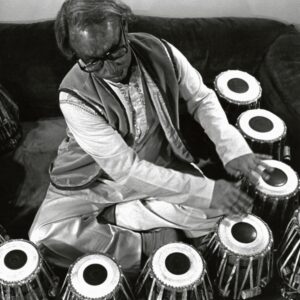
Carrying on a string of stunning archival releases from major figures of Indian classical tradition (including releases from members of the Dagar family and Amelia Cuni), Black Truffle presents an unheard recording from tabla master Kamalesh Maitra (1924-2005). For over fifty years, Maitra devoted himself to the rare tabla tarang, a set of between ten and sixteen hand drums tuned to the notes of the raga to be performed. While the tabla tarang has its origins in the late 19th century, Maitra was the first to recognize its potential as a solo concert instrument, using the set of tuned drums to perform full-length raags. Seated behind a semi-circular array of drums, Maitra produced stunning waves of melodic improvisation enlivened with the rhythmic invention of a master percussionist. Across his career, Maitra performed in ensembles led by Ravi Shankar, collaborated with George Harrison, and led his own East-West fusion group, the Ragatala Ensemble. However, it is in the solo setting that his remarkable artistry and the otherworldly timbral qualities of the tabla tarang are most strikingly on display. Recorded during the same 1985 Berlin sessions that produced Maitra's self-released solo LP Tabla Tarang: Ragas on Drums, on Raag Kirwani on Tabla Tarang listeners are treated to Maitra stretching out for over forty minutes on the late-night Raag Kirwani, accompanied by Laura Patchen on tabla and Mila Morgenstern and Marina Kitsos on tanpura. The performance begins with the traditional free-floating exposition section, where Maitra's spacious melodic improvisation at times almost resembles a plucked string instrument (like the sarod, which Maitra also played). For the listener unaccustomed to the tabla tarang, the sound of these microtonally inflected melodic patterns played on drums has a magic quality. As Maitra begins to imply the rhythmic cycles more strongly, Patchen joins on tabla, beginning half an hour of rhythmic-melodic exploration, where virtuosity sits side by side with delicacy and meditative attention. Accompanied by beautiful archival images and extensive liner notes from Laura Patchen, for many listeners Raag Kirwani on Tabla Tarang will be the perfect introduction to the magical world of Kamalesh Maitra, released to coincide with the hundredth anniversary of the master musician's birth.
28,00€
Out of stock
3 LP
Limpe FUCHS – Mark FELL
“Dessogia / Queetch / Fauch”
The 2015 edition of Winnipeg's send + receive festival, focussed on rhythm, turned out to be a generative meeting of minds. There, Mark Fell encountered the music of Will Guthrie, a meeting that was eventually to result in the frenetic acoustic drumkit and digital synthesis pairing heard on Infoldings and Diffractions (2020). At the same festival, Limpe Fuchs first heard and appreciated the music of Mark Fell, planting the seed of a collaboration that came to fruition when Fell (along with his son Rian Treanor) visited Fuchs at her home in Peterskirchen, Germany in September 2022. Black Truffle now presents the release of the results of this extensive session in the audacious form of a triple LP, housing over two hours of music across its six sides. The collaboration might appear unlikely: what common ground could exist between Fuchs, classically trained pianist, legend of improvised music, instrument builder and sound sculptor active since the 1960s, whose group Anima Sound connected the dots between free jazz, krautrock and ritual, and Fell, proponent of radical computer music, known for his bracingly austere productions that twist remnants of club music into algorithmic stutters. For all their seeming disparity in technology, approach and background, the music on Dessogia/Queetch/Fauch makes it immediately evident the pair share a great deal in their essentially percussive approach and ability to, in Fuch's phrase, "establish silence." Recording at her home studio, Fuchs had the use of her entire array of instruments, found, invented, and traditional, and treats the listener to some that don't often make their way to concerts, including extensive passages performed (with Gundis Stalleicher) on pieces of wooden parquetry. Fell also stretched himself, with his contributions ranging from characteristically fizzing pitched percussive pops to swarms of sliding tones and abstract digital noise. Showing both remarkable restraint and improvisational freedom, much of the music consists of duets between a single percussion instrument and a distinctive mode of digital sound, often lingering in one timbral-rhythmic space for minutes at a time. Improvisational forward momentum coexists with a free-floating, wandering quality. Epic in scope, immersing the listener in an entirely distinctive world of sounds, and thrillingly bold in its melding of the most ancient musical procedures with cutting edge technologies, Dessogia/Queetch/Fauch is an unexpected major statement from two of the great mavericks of contemporary music.
46,00€
In stock
LP
Crys COLE
“Making Conversation”
crys cole returns to Black Truffle with Making Conversation, her third solo release for the label. After the intimate song-like constructions of Other Meetings (BT 096LP), Making Conversation documents a different facet of cole's work, presenting three rigorously conceptualized commissioned pieces, each of which extend her signature approach to highly amplified small sounds into new directions. The side-long title piece is a stereo version of an eight-channel sound installation exhibited in 2023 at the Tabakalera Art Center in Donostia/San Sebastian, Spain. The piece uses a multitude of instrumental, vocal, concrete and electronic sounds to evoke the soundscapes cole encountered during nocturnal listening session in Bali, Indonesia in 2018 and 2019. In this world of night sounds, she explains, she "observed the complex interplay between amphibian, lizard, bird and insect communication, domestic animals (roosters, dogs), man-made sounds (airplanes, vehicles, conversations and evening activities) and sounds that were difficult to place." Drawing on field recordings as memory aids (but including none in the finished piece), cole's piece uncannily reproduces the spatiality and pacing of environmental sound without attempting strictly to replicate it. While at times it can be difficult to imagine the source of these sounds, at other points they are clearly instrumental or electronic in origin; in its placement and layering, though, the whole assemblage suggests the glorious, unthinking richness of a non-musical sound environment. Suggesting at once the electronic gardens of Rolf Julius and the little instrument expanses of classic AACM, the piece is a brilliant enactment of the Cage-ian drive to "imitate nature in her manner of operation." "Valid ForeverrRrrRRrrr? (pt. 1)" began as cole's contribution to an Issue Project Room commission to realize a score from Alison Knowles and Annea Lockwood's Women's Work, a 1975 collection of text and conceptual scores by women artists and composers. cole's piece begins from Beth Anderson's "Valid for Life," a complex arrangement of the letter R in various typefaces. Accompanied with extensive liner notes, photographic documentation and a download code, Making Conversation is an exciting next step in cole's work, extending her signature concerns in new sonic and conceptual directions.
28,00€
Out of stock
LP
Léo DUPLEIX
“Resonant Trees”
Black Truffle presents Resonant Trees, the first vinyl release from French composer-performer Léo Dupleix. An active member of the international community of younger musicians working with just intonation, Dupleix has composed works for solo instrumentalists and ensembles in Europe and Japan, as well as performing extensively on harpsichord, piano and electronics. His music is distinguished by a formal clarity and elegance of surface, gently shaping pure intervals into delicate melodic patterns and shimmering harmonic planes. Resonant Trees presents two side-long pieces for harpsichord and ensemble, both setting slowly repeating patterns played on harpsichord and guitar within an environment of sustained tones. Dupleix performs on a French double manual harpsichord and Prophet synthesizer, joined by Juliette Adam (bass clarinet), Johanna Bartz (traverso flute), Cyprien Busolini (viola), Fredrik Rasten (6- and 12-string guitars), and Mara Winter (traverso flute). The harpsichord begins "Resonant Tree I" alone, slowly sounding out a series of arpeggiated chords that emphasize the unique (and for unaccustomed listeners, sometimes unsettling) harmonic and timbral qualities of justly tuned intervals. Long tones from synthesizer, bass clarinet, viola and Baroque traverso flutes slowly creep into the spaces between the arpeggiated chords, joined after several minutes by delicate patterns of harmonics played by Rasten on acoustic guitars. On "Resonant Tree II," a similar structure and ensemble (without the flutes) are used with quite different results. Joined again by long tones from the ensemble, here the viola is particularly prominent and its interplay with the harpsichord creates fascinating acoustic effects. In both pieces, repetition gives the music a static, stable quality while, at the same time, the exact shape of the repeating patterns remains difficult to grasp. As Dupleix writes, these pieces dream of music as "space and a sound that one could grasp in one's hand." As the near-static quality of the repetitions and long tones with little incident make these two stretches of musical time feel like spaces for the listener to inhabit, the small variations on a narrow range of related material act like a three-dimensional object whose each facet is examined in turn. At once austere and seductive, Resonant Trees takes its place beside the work of contemporaries like Catherine Lamb, while also calling up the languorous melodic world of Mamoru Fujieda, the dignified melancholy of Satoshi Ashikawa's classic Still Way and the espaliered chamber atmospherics of the Obscure catalogue.
26,50€
Out of stock

LP
Olivia BLOCK
“The Mountains Pass”
Black Truffle announces The Mountains Pass, a major new work from Olivia Block. A key player in Chicago's vibrant experimental music scene since the late 1990s, Block has developed an extensive body of work grounded in a personalized, at times emotive approach to the studio-based practices of the musique concrète tradition, while also encompassing improvisation, orchestral pieces, sound installations, and a sustained engagement with the piano. On The Mountains Pass, recorded by Greg Norman at Steve Albini's Electrical Audio and meticulously edited and constructed over the course of three years, Block pushes into new terrain, introducing her singing voice and drums played by Jon Mueller into flowing assemblages that move seamlessly from ruminative organ tones and fragmented piano airs to explosions of sizzling synths and thundering percussion. Like many of Block's past works, which include, for example, a sculptural installation using the sound of oyster beds, The Mountains Pass draws inspiration from nature and the animal world. Time spent in a particular mountain range in Northern New Mexico informs this suite of pieces, whose lyrics and titles refer particularly to animal life in the area. The music sometimes suggests the great outer-limits works of '70s Italian prog figures like Franco Battiato or Arturo Stalteri in the languorous drift of synthesizer, organ, and piano tones and the meticulous yet organic flow of its construction. Block's crystalline voice and rich piano chords at times call up the restrained chamber songs of Janet Sherbourne, but fragmented and threaded through passages of woozy pitch-bent keyboards, hypnotic distant thuds, tinkling bells, and searing distorted synth tones. On "f2754," the freedom of the roaming wolf surges through dense layers of rapid keyboard attacks and long organ tones over a propulsive drum performance straight out of Animal Magnetism-era Arnold Dreyblatt. This distinctive sound world is then reencountered in a darkened mirror image in the uneasy, metallic shimmer of the closing "Ungulates," named in reference to a heard of elk roaming through the mountains. Like Battiato's Clic or Gastr del Sol's Upgrade & Afterlife, The Mountains Pass inhabits the underexplored terrain where the beauty of song coexists with a radical formal openness, illuminating the deep musicality and warmth that have been present in Block's work all along.
26,50€
Out of stock

3 LP
Keiji HAINO – Jim O’ROURKE – Oren AMBARCHI
“With pats on the head, just one too few is evil …”
The heavyweight trio of Keiji Haino, Jim O’Rourke and Oren Ambarchi return with their 12th and most epic release to date, the triple LP With pats on the head, just one too few is evil one too many is good that's all it is. Documenting the entirety of their final performance at the dearly departed Roppongi home of Tokyo underground institution SuperDeluxe in November 2018, the music spread across these six sides splits the difference between the guitar-bass-drums power trio moves and experiments with novel instrumentation that have defined the trio’s decade of working together. Containing some of the most delicate music the three have committed to wax since the gorgeous 12-string acoustic guitar and dulcimer tones of Only wanting to melt beautifully away is it a lack of contentment that stirs affection for those things said to be as of yet unseen (BT011), this wide-ranging release also offers up some of their most blistering free rock performances yet.
The side-long opening piece finds Haino on a single snare drum in duet with O’Rourke on unamplified electric guitar, playing in the lovely post-Bailey vein heard on his classic 90s recordings with Henry Kaiser and Mats Gustafsson. Spiky dissonance and ringing harmonics interweave with flowing melodic fragments as Haino single-mindedly explores the resonance of the snare like an untutored Han Bennink. On ‘Right brain, left brain; right, left; right wing, left wing. Just how many combinations can be made from these?’, O’Rourke moves to synth and electronics, joined by Ambarchi on drums, who at first focuses on sizzle cymbals before hypnotic cycles of gentle tom rhythms combine with electronic burbles and flutters to suggest a dream collaboration between Masahiko Togashi and Jean Schwarz. Ambarchi’s percussion is then joined by Haino on wandering, overblown flute, before the man in black switches back to the snare for a bizarre, stuttering drum duet.
For the first trio performance, Haino makes another new addition to his seemingly infinite catalogue of instruments, this time a homemade contraption he refers to as ‘Strings of Dubious Reputation’. Joined by O’Rourke on increasingly spaced-out electric guitar and Ambarchi on skittering percussion, Haino’s wonky, slack strings adds a definite ‘musique brut’ edge to this side-long performance, certainly one of the most enchantingly odd in the trio’s discography. When the group reconvene for the second set, spread out across the final three sides, they seem ready to breathe fire from the first instant. O’Rourke slashes distorted chords on the six-string bass, Ambarchi breaks into his signature irregular caveman thump, and Haino squeals and squawks on heavily delayed oboe before unleashing an overpowering electrical storm when he first picks up the guitar. For over half an hour, the trio pound out one of their most relentless performances, a constantly rearranging kaleidoscope of tortured fuzz guitar, insanely busy bass riffing and propulsive, tumbling drums. A hushed atmosphere initially reigns on the final long piece, given the mournful title ‘There are always things I wish to say but I can only convey them in this language August 6 August 9’. Haino’s clean guitar strumming calls up the shimmering tones of his PSF classic Affection, gradually building to a surging wall of sound, bass and drums lumbering through a roar of jet-engine guitar. Arriving in a deluxe trifold package with photos by Lasse Marhaug alongside inner sleeves with extensive live images, this epic release is perhaps the most remarkable document yet of this unique trio’s stamina and continuing inventiveness.
48,00€
In stock

LP
Sam DUNSCOMBE
“Two Forests/Oceanic”
Following on from the psychoacoustic concrète of Outside Ludlow/Desert Disco LP (BT 075LP, 2021), Sam Dunscombe returns to Black Truffle with Two Forests/Oceanic. Dunscombe has been active in recent years on multiple fronts, including as a key member of the Berlin community of Just Intonation researchers and practitioners; working with composers like Taku Sugimoto, Mary Jane Leach, and Anthony Pateras; and the release of Horatiu Radulescu - Plasmatic Music Vol. 1 (the result of many years performance research into the thought and music of this seminal Romanian spectralist). "Two Forests" begins in a central Californian sequoia grove. Bird songs and buzzing insect life are treated with a variety of time-based processing methods (slicing and recombination, primitive granular synthesis, delay, and so on), which strip the field recordings of their linear, documentary character, reframing them in an enchanted web of traces and echoes. Analyzing the pitches found in the original recordings, Dunscombe used them to generate a large Just Intonation pitch set. These tones are woven slowly into the field recordings, gradually building in density and complexity until the forest has been transformed into an unreal space of infinite proportions. On "Oceanic," several recordings of different beaches fade in and out to create a texture both homogenous and constantly shifting in both the rhythm of the waves and each recording's sense of depth and distance. Tones relating in simple ratios to the average rhythm of each beach float over each other, coloring the white noise texture of the field recordings with shifting hues. In both pieces, Dunscombe forgoes the easy consonance that bogs down much contemporary ambient music for a richer harmonic array informed by extended tuning practices and spectralism. The end results suggest a hitherto undreamt-of meeting of Radulescu's undulating sonic masses and the discreetly processed location recordings of Irv Teibel's "psychologically ultimate" environments. Looking beyond the insularity that can afflict experimental music culture, Dunscombe's work is a moving argument for the healing power of expanded approaches to sound and music. Even outside of a psychedelics-assisted therapy, frequent immersion in Two Forests/Oceanic is almost guaranteed to produce beneficial psychological results.
26,50€
In stock

LP
Sombat SIMLA
“Master Of Bamboo Mouth Organ – Isan, Thailand”
Black Truffle announces the first LP documenting master khene player Sombat Simla, the label's first collaboration with Japanese sound artist, field recordist, and researcher Yasuhiro Morinaga. Simla is known in Thailand as one of the greatest living players of the khene, the ancient bamboo mouth organ particularly associated with Laos but found throughout East and Southeast Asia. His virtuosic and endlessly inventive renditions of traditional and popular songs have earned him the title "the god of khene," and he is known for his innovative techniques and ability to mimic other instruments and non-musical sound, including, as a writer for the Bangkok Post describes, "the sound of a train journey, complete with traffic crossings and the call of barbecue chicken vendors." Aided by a group of Thai friends, in 2018 Morinaga travelled to the Maha Sarakham province in the Isan region, arranging to meet Simla in a remote spot surrounded by rice fields. Then and there, Morinaga recorded the solo performances heard on the LP's first side. To listeners unfamiliar with Thai music, the pentatonic scales and rhythmic chug of many of the pieces can have surprising echoes of the rawest American blues. The range of Simla's performance is astonishing, moving from compulsive rhythmic workouts on single chords and rapid-fire runs of single notes to gentle sing-song melodies, and using a fascinating array of techniques, including a rapid tremolo that sometimes sounds almost electronic. Later the same day, Morinaga followed Simla to a cattle shed where he met percussionist Mali Moodsansee to play some molam (folk songs found in Isan and neighbouring Laos), with Pattardon Ekchatree joining in on cymbal. At times, these molam songs have a wistful, romantic character quite different from the solo pieces. Backed up by the propulsive hand drums, Simla again dazzles with his melodic fluidity, rhythmic drive, and wild displays of unorthodox technique. As Morinaga writes, "It felt like they had been playing together so long that their breathing was perfectly in sync, and it was like listening to the precision of James Brown's funk." Accompanied by extensive liner notes by Morinaga detailing the day of recording, this is a stunning document of a master musician, seamlessly integrating tradition and innovation.
26,50€
In stock

LP
Alvin LUCIER
“Works for the Ever Present Orchestra Vol. II”
Works for the Ever Present Orchestra Vol. II continues Black Truffle’s documentation of the late work of legendary American experimental composer Alvin Lucier, who sadly passed away in 2021 at the age of 90. Like the first volume of the series, the two works recorded here were written for The Ever Present Orchestra, an ensemble founded in Zürich in 2016 to perform Lucier’s work exclusively. At the core of the music Lucier wrote for the ensemble is the electric guitar, an instrument he began to explore in 2013. Played with e-bows, in these works electric lap steel guitars take on roles akin to the slow sweep pure wave oscillators heard in many of Lucier’s works since the early 1980s. This strikingly elegant pair of compositions would serve as an ideal introduction to Lucier’s late music for a listener as yet unfamiliar with its graceful exploration of beating patterns and other acoustic phenomenon.
The two pieces have quite different characters, exemplifying Lucier’s ability to harvest a remarkable range of musical results from closely related compositional procedures and concerns. In Arrigoni Bridge (2019), Lucier uses a technique familiar from earlier works such as Still Lives (1995), where sine waves traced the shapes of household objects. Here, three lap steel electric guitars (played by Oren Ambarchi, Bernhard Rietbrock, and Jan Thoben) follow the form of the Arrigoni Bridge that connects Middletown and Portland, Connecticut. The bridge’s two enormous steel arcs become slowly sweeping pitches, alongside which alto saxophone (Joan Jordi Oliver Arcos), violin (Rebecca Thies) and cello (Lucy Railton) sustain long tones, creating a variety of audible beating patterns depending on their distance from or proximity to the guitars. With its stately pacing, warm middle register tones, and rich timbral variety in the sustaining instruments, Arrigoni Bridge is a beautiful example of compositional reduction producing immersive results. Flips (2020), on the other hand, is more austere. Scored for two lap steel electric guitars (Rietbock and Thoben), double bass (Ross Wightman) and glockenspiel (Trevor Saint), the two acoustic instruments played with bows, the piece zooms in on the range of a major second (two semitones). The two guitars sweep in opposite directions within the range, crossing every four minutes; the double bass and glockenspiel sustain long tones, producing beats of different speeds determined by their distance from the guitar tones. This limitation of the tonal range means the music is often dissonant and forces the phenomenon of audible beating to the surface, resulting in a paradoxical music composed entirely of long tones yet alive with pulsating rhythm. Exemplifying Lucier’s ability to uncover near-infinite complexity within seemingly simple materials, Works for the Ever Present Orchestra Vol. II is a fitting tribute to one of the major figures of the experimental music tradition and a testament to the continuing power of his work.
25,00€
In stock

2 LP
Ustad Zia Mohiuddin DAGAR
“Vrindavan 1982”
Black Truffle is thrilled to present a previously unheard performance by rudra veena master Ustad Zia Mohiuddin Dagar, recorded in the North Indian city of Vrindavan at the Druhpad Samaroh festival in 1982. Z.M. Dagar was a nineteenth-generation descendant of the Dagar family of musicians, famed for their profoundly meditative approach to the tradition of Hindustani court music. Perhaps the most revered members of the family were the brothers Mohinuddin and Aminuddin Dagar, who played a key role in reawakening interest in dhrupad in the mid-20th century. The great exponents of the tradition from whom Z.M. Dagar descended were all singers, and dhrupad is essentially vocal music. However, as Z.M. Dagar explained, the veena family of instruments plays an important role in the education and practice of dhrupad singers, especially as an aid to mastering the fine microtonal nuances of pitch essential to the genre. Introduced as a child by his father to the rudra veena, a large and low-pitched veena amplified by two enormous gourds, Z.M. Dagar became the first modern dhrupad musician to perform with it as an instrumental soloist, giving his first recital at the age of 16. Devoted to the instrument throughout his life, he made innovations to its design and materials, as well as introducing novel techniques (such as playing without the use of the traditional wire plectrum, resulting in the remarkable warmth of his tone). In the great Dagar family tradition, his approach to the various ragas that make up the dhrupad repertoire was stately, slow, and considered, with a great emphasis on the alap, the heavily improvised exposition section. True to form, in this recording of Dagar performing the night raga Yaman Kalyan, the alap section stretches out to more than forty minutes of slow-motion bliss, a frozen tanpura drone hovering above Dagar’s gracefully bent notes and elegantly twisting phrases. In the alap’s first half, Dagar’s figures are so intently focused on the lower reaches of the rudra veena’s range that they register more as shudders and moans than melodic patterns. As the performance continues, he slowly climbs in pitch, though continuing with the same intent focus on the articulation of single notes and subtle microtonal variations. This leads to the jod section of the performance, which, though still accompanied only by the tanpura, gradually takes on a more rhythmic character. Developing almost imperceptibly over the course of nearly thirty minutes, the jod moves from the stillness of the opening alap to a rapid pulse that announces the closing section of the piece, where Dagar is joined by Shrikant Mishra on the pakhawaj (a double headed hand drum). Where many performers use the final section of the raga as an exercise in unrestrained virtuosity, Dagar and Mishra subtly weave a web of finely shifting accents and hypnotic melodic variations, bringing the recording to a fitting conclusion while remaining within the meditative space occupied by the performance as a whole. Adorned with beautiful archival photographs of Dagar taken by Swedish percussion legend Bengt Berger and accompanied by detailed notes from Bradford Bailey, Vrindavan 1982 is a stunning document of music unmatched in its patient focus and mysterious emotional depth.
35,00€
In stock

LP
Marja AHTI
“Tender Membranes”
Black Truffle is pleased to announce Tender Membranes, the label’s first release from Swedish-Finnish sound artist and electro-acoustic composer Marja Ahti. Active for a decade in the Finnish underground music scene, in recent years Ahti has developed a distinctive approach to patiently unfolding electro-acoustic constructions, documented on a string of solo releases and collaborative projects with Judith Hamann and her husband Niko-Matti Ahti. Working with concrete and instrumental sounds, field recordings, and electronics, Ahti favours neither disjunctive collage nor monolithic consistency; rather, her work is composed of organically unfolding sequences of details and textures, which, as she says, ‘can stretch out or cut fast as long as they have a sense of inner stillness’, a sense that she connects to moments of heightened attention in everyday life. Tender Membranes consists of four lengthy pieces, partly inspired by the image of the senses and mind as membranes allowing for the passage between inner and outer spaces, sensation and its causes, creating a world. Ahti’s unhurried pacing encourages this sense of listening as an opening or surrender to sound, which can often create the impression that the listener is moving through a space zooming in on details. The opening Shrine (Aether) exemplifies this aspect of Ahti’s approach: a bell clears the air with a single long tone, followed by the ambience of outdoor spaces, crackling electronics, an archival recording of a horsefly on a windowpane. Dozens of these moments, varying in length, density, and intensity, move past the listener’s attention, momentarily brought into focus then slipping away. Like those of the masters of the French musique concrète tradition, Ahti’s sounds are not often recognisable, though they might suggest proximity or distance, open environments or closed spaces, the urban or rural, day or night. In Ahti’s work, we do not encounter spectacular metamorphoses à la Parmegiani but rather a state of ambiguity where the listener is often unsure what is organic and what is inorganic, where the careful productions of the synthesizer might end and sounds discovered in the environment begin. What Ahti calls her ‘poetic way of experiencing and organising the familiar and the unfamiliar’ is sustained throughout Tender Membranes, but each piece has its own character. On Dust / Light, human presence is more overt, as what appear to be whispers, singing, and distant speech thread between high frequencies, untraceable drips and pops, and metallic shimmers. In all this there is a melody that you can sing and to which you may dance makes more prominent use of musical instruments, gaining a sombre beauty from half-buried piano chords and organ tones. On the closing Oh Fragrant Witness, a delicate cloud of subtly bending pitches is repeatedly disrupted by a resounding, almost ominous mass of low tones, at once a strange detour from much of what has gone before and an almost classical finale. Arriving in a sleeve reproducing contemporary Finnish photographer Sini Pelkki’s fragmented visions of the everyday, Tender Membranes is a balm to reawaken tired ears.
26,00€
In stock

LP
Cassandra MILLER
“Traveller Song / Thanksong”
Black Truffle is pleased to announce its first release from celebrated London-based Canadian composer Cassandra Miller. Though her body of mature work stretches back almost twenty years, many listeners were introduced to Miller through the success of her astonishing 2015 Duet for Cello and Orchestra, which sets an imperturbable two-note cello part against a series of increasingly dense orchestrations of an Italian folk melody; in 2019, it was selected by The Guardian as one of the ‘best classical music works of the 21st century’. Traveller Song / Thanksong, the first release of her music on vinyl, presents a pair of compositions for voice and ensemble that exemplify Miller’s gently absurd, strikingly beautiful, and utterly unique work.
Like many of Miller’s compositions, these pieces originate in existing music. Traveller Song (2016/2018) begins from a 1950s song of an anonymous Sicilian cart driver recorded by Alan Lomax and Diego Carpitella, which Miller recorded herself singing along to, going on to then record herself singing to her own layered voices. Miller’s untutored voice is an unsteady, wavering wail that has, in her words, ‘more in common with a quasi-shamanistic keening than anything Sicilian’. Heard sometimes alone, sometimes layered, her pre-recorded voice is accompanied by a chamber sextet drawn from London’s Plus-Minus Ensemble. In the first section, Miller’s exposed warble is set to a spare piano accompaniment, somehow both faintly preposterous and magisterial. Following the voice note for note, the piano part often makes use of almost mechanical sequences of parallel chords, reminiscent both of Satie’s Rosicrucian period and the abrupt harmonic movements of a chord organ. The orchestration then opens up to guitar, clarinet, and sliding strings, a delicate environment for Miller’s voice, which, especially when it begins to be layered, generates a powerful sense of intimacy. In its concluding minutes, the folk roots of the original melody return in the form of a glorious full ensemble setting dominated by accordion, clarinet, and strummed guitar. Thanksong begins from recordings of Miller singing along to the third movement of Beethoven’s late quartet in A minor (Op. 132), the ‘holy song of thanks’ the composer wrote to express his gratitude for (temporarily) recovering from illness. Recording herself singing along repeatedly to each of the individual parts of the quartet, Miller created an aural score where each member of the string quartet listens to their own part on headphones, playing by ear. Performed on this recording by Montreal's Quatuor Bozzini, with whom Miller has a decades-long relationship, they are joined by the British soprano Juliet Fraser, who sings material from the Beethoven quartet ‘as slowly and quietly as possible’. The atmosphere of the opening of Beethoven’s Dankgesang, of hushed reawakening and thoughtful reflection, is sustained throughout the fourteen minutes of Miller’s piece, building at points almost to sentimentality before the five individual parts again fall back into a gentle burble of unsynchronised melodic gestures. Like Traveller Song, here the use of the voice is a long way from the mannered performance of much contemporary music, reaching for a human and bodily presence more connected to the reality of the everyday, albeit suffused with wonder. Presented in a stylish sleeve adorned with photography by Lasse Marhaug and liner notes by Cassandra Miller, this is a key release from a major contemporary composer whose work challenges and dazzles in equal measure.
25,50€
In stock

LP
Joe McPHEE – Mette RASMUSSEN – Dennis TYFUS
“Oblique Strategies”
Black Truffle is pleased to welcome free jazz legend Joe McPhee back to the fold with Oblique Strategies, a wild trio recorded in Antwerp in 2018 in the company of Mette Rasmussen’s fire-breathing alto saxophone and Dennis Tyfus’s post-Fluxus antics on tape, voice, and percussion. Rasmussen and Tyfus have previously recorded together as Bazuinschal, and some similar strategies are on display here: mysterious metallic scrapes, extended tones in which voice and sax become indistinguishable, comic explosions of varispeed tape. With McPhee on board, however, proceedings are more sumptuous, with the two horns moving fluidly from expeditions into the extremes of their instruments’ registers to pointillistic note-splatter and Ayler-esque folk melodies; we even get to bask in some of the slow-motion free blues that McPhee has now been playing for half a century.
McPhee is heard primarily on tenor, Rasmussen mainly on alto, but with Rasmussen doubling on sundry objects, and the whole trio contributing vocals, certainty about who is doing what becomes nigh impossible. The recording and production add to this hazy unclarity. Where much contemporary improvised music aims at dryly clinical hi-fi, the lively reverberant space of Oblique Strategies calls to mind the less-than-pristine sonics of classic free jazz artefacts like John Tchicai’s Afrodisiaca or McPhee’s own Underground Railroad. A further dimension of oblique unpredictability is added by subtle changes in the sense of space: at times merely a reverb tail glimpsed between phrases, at other points the whole mix seems to be momentarily swallowed up in slap-back, blurring the lines between acoustic instruments and the decayed fidelity of Tyfus’ tape playback.
Spread across four pieces ranging from four to nineteen minutes in length, Oblique Strategies moves with anarchic swagger from explosions of clattering cymbals and bellowing horns to near-silent episodes of mysterious rumble and clunk. ‘Death or Dinner?’ opens the record with a lovely duet of climbing melodic patterns shared between the two saxophones, played with a buzzing oboe-like tone. A long, wavering note sung by Tyfus cues the first of countless changes of direction, eventually leading to a crescendo of watery splutters and duelling saxes. At points Tyfus’ keening resemble the signature moves of his friend and collaborator, Ghédelia Tazartès; at others, his tape-sped huffs and puffs possess a rawness reminiscent of Henri Chopin or Gil Wolman. The dialogue between wailing saxophones and vocal cries, punctuated by percussive thuds and crashes, can at times feel less like a musical performance and more like the calls of some mysterious forest creatures, possessing a primordial energy that might remind some listeners of the outdoor antics of Brötzmann and Bennink’s Schwarzwaldfahrt.
Oblique Strategies can also be delicate at times, as on the beautiful third piece, ‘Destilled Edible’, dominated by a slow, microtonal melody played with a breathy tone resembling a shakuhachi. The closing side-long ‘Light My Fire’ ranges across classic improv call and response, skittering trumpet blurts, inept cymbal clatter, mock-operatic vocals, and crude tape manoeuvres. Momentarily pausing at the ten-minute mark for an interlude of ghostly room sound and crackling texture, its closing moments unfurl a glorious dual saxophone finale, the almost epic tone subtly undermined by Tyfus quietly tapping out swing rhythms. Arriving in a striking sleeve adorned with Tyfus’ drawings, Oblique Strategies is an invigoratingly free-spirited blast of improvisation.
25,50€
In stock
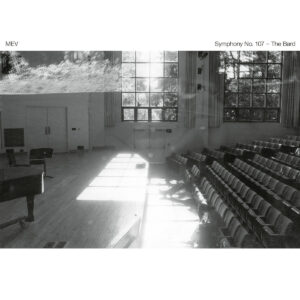
LP
MUSICA ELETTRONICA VIVA
“Symphony No. 107 – The Bard”
Black Truffle is pleased to announce Symphony No. 107 –The Bard, a previously unheard archival recording of the legendary improvising ensemble MEV (Musica Elettronica Viva), captured in concert at Bard College, New York in 2012. Formed by a group of American expat composers in Rome in 1966, the MEV ensemble played an important role in the development of free improvisation, bridging the live electronics tradition begun by Cage and Tudor and the high-energy squall of free jazz. Early recordings like Spacecraft or The Sound Pool unleash volleys of metal and glass amplified with contact microphones, howling winds, primitive synthesizer bleep and raucous audience participation, the intensity of which puts much later ‘noise’ to shame. In later decades, the ensemble would go through many iterations, often including legendary free players like Steve Lacy and George Lewis. In its final years, MEV settled into the core trio of founding members heard here: Alvin Curran, Frederic Rzewski, and Richard Teitelbaum, using piano, electronics, and small instruments.
Curran, Rzewski, and Teitelbaum were life-long friends blessed, as Curran says, with ‘incompatible personalities’: major figures in the post-Cagean experimental tradition, they explored countless divergent and even contradictory paths as composers and performers, from agitprop songs to brainwave-controlled synthesis. MEV is the sound of these three personalities coming together, their contributions radically individual yet attaining a state of ‘fundamental unity’ that Rzewski, in a text written in the collective’s earliest years, defined as the ‘final goal of improvisation’. Of course, listeners familiar with aspect of the trio’s individual works might hazard some guesses about who is doing what: the crisp piano figures are probably Rzewski’s, the cut-up hip-hop samples most likely Curran’s, the sliding, squelching synth possibly Teitelbaum’s. But often these identities are dissolved in a constantly shifting hall of mirrors, the listener unable to tell which of these pianos is live and which is a sample of a past virtuoso, or whether a horn blast derives from ethnographic documentation or Curran cutting loose on Shofar.
The two side-long sets here occupy a similar terrain of constantly shifting texture and instrumentation, unexpected interruptions, and moments of sudden beauty. The first set is sparser, at times almost ominous, as a bell repeatedly sounds across wheezing harmonica, seasick orchestral textures, and creaking wood, making room for episodes of yodelling and delicate prepared piano before exploding into a storm of buzzing synth and piano fragments. The second set is more frenetic, moving rapidly across centuries and continents: cars crash into post-serial piano pointillism, wailing voices collide with chopped and screwed hip-hop samples, Hollywood strings are buried under layers of electronic gurgles. The performance slows in its final moments, making way for a sampled voice repeating the phrase ‘protest and the good of the world’, reminding us that MEV’s idea of freedom was always more than musical.
Symphony No. 107 –The Bard is a beautifully recorded example of the endlessly multi-layered later MEV sound, accompanied by new liner notes by Alvin Curran (now the only surviving member of the group) and a selection of previously unseen photographs from across the many decades of the group’s activity. Arriving in an elegant sleeve bearing a beautiful photograph by Francis Zhou of the Olin Hall at Bard College where the concert was recorded, this is an essential document from a major group in the history of experimental music. As Rzewski wrote, this music is ‘like life, unpredictable, sometimes making sense, mostly not’.
28,00€
In stock

LP
Jeanne LEE – Gunter HAMPEL – Michel WAISVISZ – Freddy GOSSEYE – Sven-Åke JOHANSSON
“Scheiße ’71”
Following on from the Bergisch-Brandenburgisches Quartett’s anarchic Live ’82 (BT095), Black Truffle continues its deep dive into the archives of legendary drummer/accordionist/photographer/composer/conceptual prankster Sven-Åke Johansson with Scheisse ’71. Recorded in November 1971 during the Berliner Jazztage at a heavy-hitting concert that also included the Spontaneous Music Ensemble and groups led by Peter Brötzmann, Manfred Schoof, and Masahiko Sato, Scheisse ’71 is the only document of a wild, otherwise unrecorded quintet featuring Johansson on drums, accordion and oboe d’amore, legendary free jazz vocalist Jeanne Lee, her husband Gunter Hampel on vibes, flute and bass clarinet, live electronics pioneer Michael Waisvisz on modified Putney (VCS 3) synthesizer, and the unknown Freddy Gosseye on electric bass. Part of a festival centred on giants of jazz like Duke Ellignton and Dizzy Gillespie, the radical performance shocked its audience, who can be heard heckling and yelling abuse at points, including the titular exclamation of ‘Scheiße!’
Clocking at just over half an hour and recorded in raw but detailed stereo by Johansson himself, the music burns with intensity while also making room for spacious passages and frequent dynamic movement. Beginning with Lee’s voice, Hampel on flute and Johansson on oboe d’amore in a bird-like game of call and response, the unexpected entry of Waisvisz’s tortured, squelching synth bursts prompts the first of many changes in energy and instrumentation, as Gosseye’s busy, roving bass enters and Johansson moves to the kit, his swinging cymbal work and juddering toms extending the approach of Sunny Murray or early Milford Graves.
The presence of synthesizer, electric bass, and Lee’s highly amplified voice moves the quintet away from conventional free jazz textures, at times pushing into zones of abstract free sound reminiscent of what groups like MEV, AMM or Johansson’s MND were exploring in the same years. But the energy and joyful melodicism of the music keep it rooted in the tradition of American fire music and its European inheritors. Capable of changing gears in an instant from ferocious blow outs to fragile tapestries of chiming vibes and fizzing synth, the music finds space for Lee’s post-bop free scat (which integrates shrieks and howls just as a post-Ayler saxophonist might), Gosseye’s virtuosic bass runs (a rare attempt to apply the classic free jazz style of players like Alan Silva or Henry Grimes to the electric instrument), Johansson’s folkish accordion interjections, and even a sustained passage of unison bass clarinet and electric bass riffing in its second half.
Special mention should be made of Waisvisz’s Putney performance, one of the earliest documents of this under-recorded instrument inventor and player, here playing a major role in giving the music its wildly exploratory, primordial air, his buzzing glissandi and bubbling filter sweeps at times howling like a distressed monkey. Arriving in an austerely stylish sleeve with beautiful black and white photographs by Johansson, Scheisse ’71 is an essential recording that adds yet another layer to our appreciation of this golden era of radical free music.
25,50€
In stock

LP
Giuseppe IELASI
“Down On Darkened Meetings”
Black Truffle is pleased to announce Down On Darkened Meetings, the first solo release on the label from the quietly prolific Giuseppe Ielasi. Recorded at Ielasi’s studio in Monza outside of Milan over two days in February 2022, the seven pieces presented here continue the renewed exploration of the guitar that marks much of his solo work over the last few years. Emerging in the late 1990s as an improviser working primarily with prepared acoustic and electric guitars, the instrument became less prominent in his work over the next decade, ceding to loop-based constructs that would eventually split into abstracted takes on club music and hip-hop (including his work as Inventing Masks), on the one hand, and spectral electroacoustic explorations (such as the stunning triple disc 3 pauses), on the other. Returning to the guitar in recent years, he has approached the instrument as a source of shimmering metallic glissandi (Five Wooden Frames) or as the vehicle of elegiac double-tracked lines that feel almost like Frisell playing Feldman (The Prospect). Here the focus is on electric guitar filtered, looped, and splayed out into fields of irregular echoes through a bank of pedals.
Like many of Ielasi’s releases, Down On Darkened Meetings is structured as a set of short untitled pieces (here ranging between two and six minutes in length) that single-mindedly explore a single instrument or source throughout. The opening track immediately introduced the distinctive timbral world of fizzing, heavily filtered tones, chiming harmonics, and woozy looping bass figures inhabited throughout. At points it becomes near impossible to trace these sounds to the strings of an electric guitar; at others, as on the final two pieces, the instrument is unmistakable, as Ielasi builds up his shifting loops from snatches of almost unintentional sounding half-playing that give these closing tracks a hushed, private atmosphere reminiscent of Tolerance’s Anonym. While the repeating chords and hanging melodic figures present on many tracks call to mind earlier Ielasi classics like Gesine and Untitled, here the music feels less meticulously constructed than played: Ielasi’s lyrical guitar lines obscured by a battery of effects at times come across like a dilated take on the outer-fringe fretwork of improvisers like Henry Kaiser and Raymond Boni, and the muddy, asynchronous fields of pops and hiss at times wander into areas reminiscent of the hand-played dub techno of Vladislav Delay’s Multila.
Like much of Ielasi’s work in recent years, these seven pieces perform a delicate balancing act: between abstraction and immediacy, austerity and abundance. Imbued with Ielasi’s distinctive lightness of touch, considered approach to pacing, and subtly psychedelic approach to the stereo field, Down on Darkened Meetings is a major new work from a quiet master of contemporary experimental music.
25,00€
In stock

LP
Richard YOUNGS
“Modern Sorrow”
The endlessly prolific and unpredictable Richard Youngs returns to Black Truffle with Modern Sorrow. As any Youngs fan knows, one of the great pleasures of following his career comes from not being able to predict what the next entry in his inexhaustible string of releases will bring: Unaccompanied voice? Country songs? Shakuhachi? Guitar pieces played with his feet? Shredding fuzz bass over the top of hyper-speed distorted drum machine beats? Continuing in the grand Youngs tradition of exploring new techniques, instrumentation and approaches while bringing to all of them his idiosyncratic touch, Modern Sorrow serves up two sides of twistedly elegiac, radically stark takes on contemporary pop production. The side-long title track is built from a piano sample, synthetic bass notes and organ swells, and an iterative blurt that seems to have wandered out of a 90s jungle track. Eventually joined by a shuffling drum machine, the track moves very slowly through a series of chords, each delayed long enough that its arrival comes as a major event. Over the top, Youngs’ heavily pitch-corrected voice is heard. The processing paints his signature wandering melodic improvisations with shades of contemporary R&B; at the same time, it cuts the natural swoops and glides of Youngs’ melodies into rapid microtonal trills, giving his voice a quavering, middle eastern feel. Unfolding languorously over more than 17 minutes, the piece’s final minutes make room for an extended drumless coda, returning to the stark palette of its opening moments. On the second side, the two parts of ‘Benevolence’ push this minimalism ever further, its first half consisting of nothing more than a remarkably slow drum machine hit, bass-heavy chords and pitch-corrected voice, here so heavily processed that it starts to resemble a shawn solo. In its second part, the harmonic foundation drops out from under the piece while two more voices join; at some moments the voices pause, leaving nothing more than isolated, metronomic drum hits. Though Youngs has explored the sound worlds associated with dance music and contemporary pop in previous work, here these elements are radically reduced, foregrounding a meditative bed of silence with a boldness equal to any more academically inclined contemporary composer. Embracing the accessible digital tools of contemporary music production just as at another moment he would pick up a kazoo, like much of Youngs’ work Modern Sorrow uses simple DIY tools to generous ends, producing formally radical music that remains both free from pretension and deeply moving.
25,00€
In stock

LP
AMM
“Ammmusic”
2023 repress
Black Truffle is honoured to present the first vinyl reissue of the classic debut album from AMM, Ammmusic. Coinciding with the 50th anniversary of its recording in 1966, this reissue makes one of the cornerstones of the experimental music tradition available again in its original form, replete with Keith Rowe’s beautiful pop art cover and the terse aphorisms by the group that served as its original liner notes. A testament to the interaction between the experimental avant-garde and the countercultural underground, the album was originally released on Elektra, recorded by Jac Holzman (the label’s founder, responsible for signing The Doors, Love, and The Stooges) and produced by DNA, a group that included Pink Floyd's first manager Peter Jenner. (Pink Floyd paid tribute to AMM’s influence on their improvisational sensibility with the track ‘flaming’ on their debut album, named after the piece that occupies Ammmusic’s first side, ‘later during a flaming riviera sunset’).
Formed in 1965 by three players from the emerging british jazz avant-garde – Keith Rowe and Lou Gare had played with the great progressive big band leader Mike Westbrook and Eddie Prévost played in a post-bop group with Gare – amm quickly evolved from a free jazz group into something decidedly more difficult to categorise. By the time these recordings were made, two more members had joined the group: another Westbrook associate, Lawrence Sheaf, and the radical composer Cornelius Cardew. Then at work on his masterpiece of graphic notation treatise, Cardew brought with him extensive experience of the post-serialist and cageian currents in contemporary composition. Using a combination of conventional instruments and unconventional methods of sound production (most famously Keith Rowe’s prepared tabletop guitar, but also prepared piano and transistor radio), the group performed improvised pieces often running for over two hours and ranging from extended periods of silence to terrifying cacophonies.
Evan Parker famously described the improvisational logic of AMM’s music as ‘laminal’, in contrast to the ‘atomistic’ approach more common among the generation of british improvisers (Bailey, Rutherford, Stevens and co.) To which he himself belonged. AMM improvised in layers: layers of sound subtly rising and falling or abruptly starting and stopping without being propelled by the implied pulse of free jazz improvisation. Rather than a pulse, AMM’s music began with the sound of the room in which it was played, the cageian anarchy of silence. By embracing the non-synchronous simultaneity of layered sound, AMM was able to create a musical container into which nearly anything could be incorporated at any moment: on ammmusic, long tones sit next to abrasive thuds, the howl of uncontrolled feedback accompanies Cardew’s purposeful piano chords, radios beam in snatches of orchestral music (and, on the lp’s second side, an extended fragment of ‘mockingbird’).
AMM’s clearest break with jazz-based improvisation concerned the idea of individuality. Where improvised music has tended to foster the development of idiosyncratic stylists who move freely from one group to another, AMM, initially through an engagement with eastern philosophy and mysticism and later though a politicized communitarianism, sought to develop a collective sonic identity in which individual contributions could barely be discerned. In the performances captured on ammmusic the use of numerous auxiliary instruments and devices, including radios played by three members of the group, contribute to the sensation that the music is composed as a single monolithic object with multiple facets, rather than as an interaction between five distinct voices. - Francis Plagne
22,00€
Out of stock

2 LP
Oren AMBARCHI
“Grapes From The Estate”
2023 repress.
Black Truffle is pleased to make Oren Ambarchi’s Grapes from The Estate available once more on vinyl. Originally released on CD on Touch in 2004 and reissued on Southern Lord as a limited 2 LP in 2006 during Ambarchi’s tenure as a member of Sunn O))), Grapes from the Estate was a landmark release for Ambarchi, seeing him expand his sonic palette beyond the clipped, bass-heavy electric guitar tones he was known for at that point. Incorporating subtle layers of strings, keyboards, percussion over a bedrock of his signature guitar tones, in retrospect this album can be seen as the beginning of a broadening and evolution in Ambarchi’s work that would lead to his acclaimed, densely layered epics for Editions Mego, Quixotism (2014) and Hubris (2016). Beginning with the shuddering pure tones of opener ‘Corkscrew’, which looks back to previous guitar-only releases such as Suspension (2001), the album’s next two pieces show a progressive broadening of the instrumental palette and a corresponding move away from textural abstraction and sustained tones towards more traditional notions of musicality. This reached its high point on the album’s third piece, the fifteen-minute long ‘Remedios The Beauty’, where guitars, both acoustic and electric, strings, piano, and bells build from a murmur to an interlockinging web of repeating melodic patterns over gently swinging brushed snare and cymbals. The epic closer, ‘Stars Aligned, Webs Spun’, returns us to a space populated only by the electric guitar, but unlike everything Ambarchi had produced up until this point in his career, the piece has a liquid, psychedelic edge that looks forward to the shimmering harmonics of his more recent work. As Brendan Walls wrote at the time of the original release, this is ‘another outpouring of personal, intimate and enduring music from Oren Ambarchi’. Presented in a stunning gatefold sleeve featuring the original artwork and design by Jon Wozencroft. Redesigned by Stephen O’Malley. Remastered and cut by Rashad Becker at D&M, Berlin.
32,00€
In stock
LP
Tony CONRAD – Arnold DREYBLATT – Jim O’ROURKE
“Tonic 19-01-2001”
Celebrating its one hundredth release, Black Truffle is honoured to present a major archival discovery: a stunning document of the only performance by the trio of Tony Conrad, Arnold Dreyblatt and Jim O’Rourke. Across a two-night programme organised by David Weinstein at legendary New York experimental venue Tonic in January 2001, Conrad, Dreyblatt and O’Rourke presented individual projects before performing a collaborative set each night, the first with members of Dreyblatt’s ensemble and the second the trio heard here. As Dreyblatt points out in the wonderfully informative and reflective liner notes written for this release, this was a collaboration across generations, reflecting the profound impact of Conrad’s pioneering minimalism on Dreyblatt and O’Rourke. Both Dreyblatt and O’Rourke came to this collaboration armed with a deep appreciation of Conrad’s music and the just intonation principles at its core, Dreyblatt having first encountered the incredible power of Conrad’s precisely tuned violin chords during his tenure as an archivist for La Monte Young in 1975, while O’Rourke had performed with Conrad in various settings since the mid-1990s (as well as admiring, reissuing, and performing Dreyblatt's music).
The flyer for the concert promised ‘massive, ecstatic, pulsating overtones’, and the trio certainly delivered. From the moment this keening stream of bowed strings begins, it is clear, as Dreyblatt writes, that we are in ‘Tony’s sonic universe’, as massively amplified, slowly shifting combinations of precisely chosen pitches fill the room with complex beating patterns and ghostly difference tones. For more than twenty-five minutes, the music operates at a level of intensity comparable to classic recordings such as Conrad’s Four Violins, until the texture thins out slightly in the performance’s final quarter, allowing for the listener’s first recognition of the individual voices that make up this enormous, overwhelming harmonic edifice. The constant stream of bowed tones is broken by a beautifully rich pizzicato from Conrad on monochord, the sliding low tones and metallic shimmer of the other strings taking the set's final moments on an unexpected detour into spacious pastoral psychedelia.
Though produced by three individuals known for their own distinctive bodies of the work, this is egoless music, the perfect expression of Conrad's desire 'to move away from composing to listening', to 'working "on" the sound from "inside" the sound'. Historically important and overwhelming in sonic impact, this release also serves as a moving tribute to Tony Conrad from two musicians profoundly marked by the example set by his art and life.
24,50€
Out of stock
LP
Alvin CURRAN
“Fiori Chiari, Fiori Oscuri”
2023 repress.
Black Truffle is pleased to announce the first-ever vinyl reissue of Alvin Curran’s classic Fiori Chiari, Fiori Oscuri, originally issued in 1978 on Ananda, the cooperative label run by Curran, Roberto Laneri, and Giacinto Scelsi. Fiori Chiari, Fiori Oscuri (Light Flowers Dark Flowers) – its title inspired by an intersection in Milan – is the second in the series of four solo recordings Alvin Curran issued in the 1970s and early 1980s, preceded by Songs and Views from the Magnetic Garden (1975), followed by The Works (1980) and Canti Illuminati (1982).
Each of these solo works combines field recordings with performances on synthesiser, various acoustic instruments, and voice, arranged in languorously paced, dreamy sequences. Far from the bracing pointillism of much musique concrete, the elements encountered on the meandering course followed by Fiori Chiari, Fiori Oscuri – whether a frenetic piano improvisation, dense layers of Serge synthesiser and ocarina, or a monologue from Frederic Rzewski’s five-year old son, Alexis – often occupy the foreground of our attention for minutes at a time. As Curran explains, his approach is like that of a filmmaker in the editing process, working with “whole blocks of recorded time”.
The purring of a cat, toy piano, a child counting, plaintive synthesiser tones, the cacophony of exotic birds at the London Zoo – each disappears into the next, until, on the LP’s second side, a solo piano performance takes centre stage, moving unexpectedly from percussive minimalist permutations to a halting rendition of Georgia on My Mind. A subtle yet stunning work that more than forty years on still seems charged with possibility, Fiori Chiari, Fiori Oscuri arrives in a loving reproduction of the original sleeve, featuring Edith Schloss’ beautiful cover painting, remastered audio and with new liner notes by Alvin Curran and Francis Plagne.
24,50€