
In stock
CD
Werner DURAND
“Schwingende Luftsäulen 2”
Werner Durand "Schwingende Luftsäulen 2" (CD), the second chapter dedicated to Durand's music applied to the Pan-Ney, the wind instrument of his own invention.
From the liner notes:
"Schwingende Luftsäulen 2 is the second chapter of a trilogy featuring the Pan-Ney with its tubes or columns of vibrating air. This second chapter, in which the Pan-Ney is flanked by the tenor sax, reconnects where the first one ends (ANTS, 2017), and proceeds along a path that is coherent and uniform, and whose imaginative ideas go beyond the strictly musical sphere.
Wald (forest) is the centerpiece of the three works that make up Schwingende Luftsäulen 2. It is the forest with its multiple meanings, real and symbolic, mythological, religious, literary, folkloric. The forest as a place that is sacred or magical, dreamlike or fairy-tale. A place of adventure and misadventure, to trek through with a view toward growth or rebirth.
In Spiegel (Mirror), dedicated to the Tonaliens Ensemble, the Pan-Ney and the tenor saxophone weave a layered dialogue in which they call and respond to each other. Not only. In their 'mirroring conversation' the two instruments seem to suggest a choreography. Durand's music stands out for its ability to make some 'scenes' visible. In the dance evoked in Spiegel, the gestures - and perhaps even the bodies - appear suspended and rarefied, just as the music is suspended and rarefied, while, during listening, time expands beyond the duration of the piece. Music and dance remain there, in midair, even at the end of the ritual.
Panga, for Pan-Ney, tenor sax and digital delay, contains an allusion to nature. Panga (note the morpheme "pan", which refers to Durand's instrument) is the name of a plant that grows in New Zealand but that occurs in the botany of other areas of the planet (for example, in the Amazon) in connection with ancient practices both pharmacological and aphrodisiac. But the plant could easily belong to a manual of imaginary botany, if one thinks that nature, for Durand, is both a source of real inspiration and a place to reinvent according to subjective visions and coordinates."
With gorgeous artworks by Karlheinz Bux and extensive liner notes by Adelio Fusé.
12,00€
In stock
CD
Werner DURAND
“Schwingende Luftsäulen”
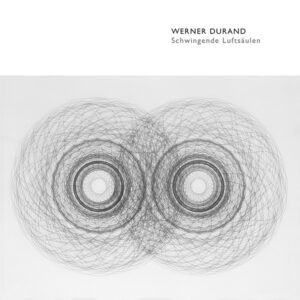
“Schwingende Luftsäulen” (Vibrating Air Columns) was composed, played and recorded by Werner Durand between Fall 2010 and Spring 2011, using the Pan-Ney, an instrument that he invented in 1984 and used in these recordings as the only sound source. This is music made of air. Built from air, transmitted by air. Durand’s work is conceived starting from the properties of the air passing thru the plastic tubes that constitutes the Pan-Ney. In the stream of acoustic phenomena applied to musical construction, by way of his ethno-minimalistic approach, this music talk to us about the most ancient feeling and the most contemporary concept in music. A music coming from the far times and made for the future times. The music is accompanied/underlined by the beautiful drawings by Karlheinz Bux, that, as in his own words: “... are abstracted emblems of figures set in rotation. In their appearance, they may resemble oscillating air columns…” This music is dedicated to Tony Conrad, whose piece “Ten Years Alive On The Infinite Plane” from 1972 inspired this particular tuning.
Cardboard Folded cover, 8 pages insert with liner notes in german and english. Edition of 300 copies.
12,00€