
Out of stock
7" single
Steve RODEN
“O.T.R. and U.T.R.”
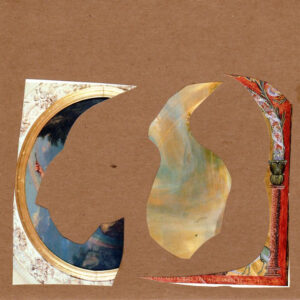
Limited edition of 150 copies (of which only 100 are for sale) with unique hand made collages on every cover
In Steve Roden's onw words: "a few years ago, my mother gave me a small stack of 45s of some of her favorite songs as a kid; chuck berry, the platters, and others. when i began to listen to the records, i was not only excited about the music, but the surface-scuffs from my mother¹s repeated listening over the years of wear and tear.
the source for u.t.r. and o.t.r. is a recording of 'somewhere over the rainbow' by the dimensions.
What you are hearing are the processed sounds of the surface noise at the beginning and end of the record - the first and last notes of the song.
the experience of listening to a vinyl record is not only a durational experience, but a physical experience. when the needle is dropped upon the record at the beginning and picking it up at the end, it is a kind of performance.
in this piece, i wanted to explore the unintentional sounds - to emphasize the 'before-song' and the 'after-song'.
In the final seconds of listening to a 45, when the needle becomes trapped in the repetitive rhythm that is born of a locked groove, these clicks become a process of disintegration. the constant clicks offer a kind of lullaby like the aging process of a human being¹s body and skin as it changes. every time a piece of vinyl is played, new wrinkles, scars, scratches, scrapes, chips, and detritus are created and so here, i wanted to highlight the unintentional soundings caused by handling, to move away from the perfect veneer. The more a record is handled, the more the music is transformed to an entirely different atmosphere - where disturbances and interruptions can overwhelm a song. Listening to the sound of a needle trapped within the final groove of one of my mother's records, i think i must be hearing the exact thing she heard while listening to the same object possibly 10 years before i was born. as the record continues to offer the clicks and nothing else, i imagine my mother falling asleep to one of her favorite songs. there, in her darkened bedroom, she sleeps to the after-sound of the needle stuck in a groove.
As she sleeps, her ears absorb the minimalist rhythmic click, like a lullaby - and as the needle endlessly circles the outer realm of the record label clicking until morning..."
25,00€
In stock
CD
AMM
“Live at the roundhouse”
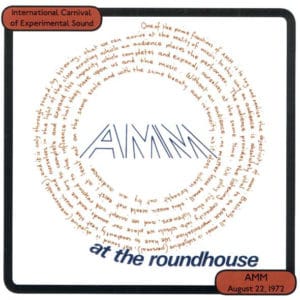
The first release from the ICES concerts from August of 1972 in London.
The International Carnival of Experimental Sound, or ICES ’72 for short, was an ambitious festival sprung from the mind of Harvey “Job” Matusow (1926-2002). Jumping off from his associations with Source magazine, Harvey brought together over 300 artists from over 21 countries to perform in London, England over the course of two weeks in August of 1972. Based on the theme of Myth, Magic Madness and Mysticism, he assembled an amazing diversity of performers working in diverse range of audio-visual arts. Encompassing happenings, films, dance, a train ride, and the phantom soft pool table, the focus was on sound - specifically that of artists who were both composers and performers. Most of the concerts were held at The Roundhouse, a cavernous structure that was formerly a railroad engine house, and recorded by John Lifton and his assistants. Now, for the first time in 30 years, these recordings can be heard.
AMM was formed in 1965 by Lou Gare, Eddie Prevost, Keith Rowe, and Lawrence Sheaff. The line-up swelled to also include Cornelius Cardew and Christopher Hobbs, and sometimes composer Christian Wolff. From 1971 up until 1976, AMM found itself stripped down to the duo of Prevost and Gare. After that time, Rowe replaced Gare, and Eddie and Keith have continued making AMMusic ever since, mostly with the help of John Tilbury, and occasionally others, and are still a powerful force.
The aesthetic of AMM is that of improvised music freed from the constraints of musical style. Their sound is ever evolving and free from the ego of individual players.
The International Carnival of Experimental Sound, or ICES ’72 for short, was an ambitious festival sprung from the mind of Harvey “Job” Matusow (1926-2002). Jumping off from his associations with Source magazine, Harvey brought together over 300 artists from over 21 countries to perform in London, England over the course of two weeks in August of 1972. Based on the theme of Myth, Magic Madness and Mysticism, he assembled an amazing diversity of performers working in diverse range of audio-visual arts. Encompassing happenings, films, dance, a train ride, and the phantom soft pool table, the focus was on sound - specifically that of artists who were both composers and performers. Most of the concerts were held at The Roundhouse, a cavernous structure that was formerly a railroad engine house, and recorded by John Lifton and his assistants. Now, for the first time in 30 years, these recordings can be heard.
AMM was formed in 1965 by Lou Gare, Eddie Prevost, Keith Rowe, and Lawrence Sheaff. The line-up swelled to also include Cornelius Cardew and Christopher Hobbs, and sometimes composer Christian Wolff. From 1971 up until 1976, AMM found itself stripped down to the duo of Prevost and Gare. After that time, Rowe replaced Gare, and Eddie and Keith have continued making AMMusic ever since, mostly with the help of John Tilbury, and occasionally others, and are still a powerful force.
The aesthetic of AMM is that of improvised music freed from the constraints of musical style. Their sound is ever evolving and free from the ego of individual players.
15,00€
Out of stock

CD
Ellen FULLMAN
“Staggered stasis”
Staggered Stasis (1989) was commissioned by the Deborah Hay Dance Company for part 1, "The Navigator" in Hay’s trilogy, "The Man Who Grew Common In Wisdom". Microtonal shifts in the coloring occur in a staggered fashion, traveling on an axis of Pythagorean intervals, (the circle of fifths). Chords created by stacking 3/2s, or fifths, are referred to as "suspended chords". There is a flatness in this drama, what I imagine it must be like in the middle of an ocean, continually moving yet appearing the same. The four part score was plotted on a timeline. Each track was recorded and performed by myself. An excerpt of Staggered Stasis was released on the Arial CD series.
"Duration" (1986) was composed as a 13-limit study for the Long String Instrument, in the key of C. The fundamental tone is continually sounded, under chords constructed with pitches from the overtone series. The intention of the piece was to listen to the variations within each chord, as it is sounded continually while the performer walked the length of the instrument. As the performer’s position changes, one clearly hears a cascade of overtones. "Duration" was never previously released.
The original recordings were made direct to a PCM digital processor using a vintage AKG C24 stereo tube condenser microphone placed about 15 feet from the resonators.
"Duration" (1986) was composed as a 13-limit study for the Long String Instrument, in the key of C. The fundamental tone is continually sounded, under chords constructed with pitches from the overtone series. The intention of the piece was to listen to the variations within each chord, as it is sounded continually while the performer walked the length of the instrument. As the performer’s position changes, one clearly hears a cascade of overtones. "Duration" was never previously released.
The original recordings were made direct to a PCM digital processor using a vintage AKG C24 stereo tube condenser microphone placed about 15 feet from the resonators.
14,00€