
In stock
CD
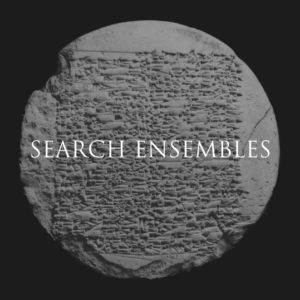
SEARCH ENSEMBLES
“Prescient / Legend”
The second Search Ensembles artifact sees the return of Cédric Peyronnet (Toy Bizarre, Kaon / Ingeos, Sechres Mound,), Cyril Herry (Ninth Desert, Sechres Mound), Phil Legard (Xenis Emputae Travelling Band, Hawthonn), Michael Northam, Alan Courtis (Anla Courtis, Reynols), Jani Hirvonen (Uton), Slavek Kwi (Artificial Memory Trace), Jon Tulchin and Dale Lloyd (and/OAR, Seattle Phonographers Union, Lucid), plus first time involvement from Eric Lanzillotta (Eye Music, Ri Be Xibalba, Anomalous Records), Mark Reynolds and Mike Hallenbeck (Archive, Junior Birdman Audio).
Whereas the first album mostly presented unrefined aural snapshots of elusive and impenetrable civilizations and phenomena, the second album continues along similar lines with longer pieces while also presenting an increased utilization of electronic instruments and processes. The title is partially in reference to what were initially two different albums gradually becoming combined into one after a long process of being reworked and revised into one integrated whole. Furthermore, the title points toward a mental state of foretelling and recollection which in turn illustrates the idea that everything really exists in the eternal present (on an infinite number of time lines) rather than on one locked linear time line. Many indigenous people around the world have traditionally perceived life this way.
Limited to 150 copies.
Alan Courtis: field recording
Cedric Peyronnet: bass guitar, electronics, field recording,
objects, percussion, synthesizer, voice
Cyril Herry: objects, voice
Dale Lloyd: bass guitar, field recordings, vocal sounds, objects,
percussion, plexiglass, production, recorder (flute), synthesizer
Eric Lanzillotta: synthesizer
Jani Hirvonen: electronics
Jon Tulchin: field recording
Mark Reynolds: percussion
Michael Northam: field recordings, flute
Mike Hallenbeck: field recording
Phil Legard: flute
Slavek Kwi: percussion, synthesizer
8,50€
Out of stock

CD
Ralph KOPER with Norma PANDURO
“Shushupe”
Shushupe presents field recordings by Ralph Koper primarily pertaining to an ayahuasca ceremony which took place on February 8th, 2006 in Iquitos, Peru conducted by Norma Aguila Panduro Navarro (1944 - 2007) who was one of the very few female ayahuasca shamans in the world. The entheogenic brew known as ayahuasca (or yage) is made from the snake-like ayahuasca vine and the chacruna leaf. The brew is used as a traditional spiritual medicine in ceremonies among the Indigenous peoples of Amazonian Peru, many of whom say that they received the instructions of its use directly from the plants or plant spirits.
Shushupe is a Peruvian word for the bushmaster snake frequently encountered as an anthropomorphized guide during ayahuasca-induced visions and experiences into parallel realities that often take place during the ayahuasca ceremonies. Also, the spirit of Ayahuasca is often seen as a snake during visions.
Norma’s apprentice at the time, Paula Liebe joined in with singing one or two of the ceremonial icaros.
Ralph Koper is a field recording artist from The Hague, Netherlands. His main interest is capturing the sonic / energetic atmospheres of ecstasy of various cultures and nature. “I love it when elements, animals and sometimes people come together and celebrate. The interactions in sound are unintentional magical music.” Apart from and/OAR, Ralph has also had his work published or made available by 3Leaves, A Closer Listen and Sublunar Society.
Shushupe is a Peruvian word for the bushmaster snake frequently encountered as an anthropomorphized guide during ayahuasca-induced visions and experiences into parallel realities that often take place during the ayahuasca ceremonies. Also, the spirit of Ayahuasca is often seen as a snake during visions.
Norma’s apprentice at the time, Paula Liebe joined in with singing one or two of the ceremonial icaros.
Ralph Koper is a field recording artist from The Hague, Netherlands. His main interest is capturing the sonic / energetic atmospheres of ecstasy of various cultures and nature. “I love it when elements, animals and sometimes people come together and celebrate. The interactions in sound are unintentional magical music.” Apart from and/OAR, Ralph has also had his work published or made available by 3Leaves, A Closer Listen and Sublunar Society.
Original price was: 12,00€.5,00€Current price is: 5,00€.
Out of stock

CD
Billy GOMBERG
“Comme”
Billy Gomberg (b 1979, Chicago) is a musician and video artist living in Brooklyn, New York. His studio practice incorporates analog synthesis, digital treatments, acoustic recordings and custom programming that gives rise to electronic sound caught gazing at its own physicality, acoustics in love with their own abstraction. Billy’s debut CD release displays abstract and complex dimensions of texture and tone that might make more sense at first on a subconscious level before it will on a conscious one. Therefore, it is advised to first approach this music from a pure listening standpoint, free from preconceived notions of musical structure and form since it can defy such prosaic logic. "These tracks are the start of my working toward a more immediate sound-improvisation w-software, real-time construction of the sound material and structure, taking priority. While some material comes from software in real-time, all other sound was generated by Roland Juno synthesizers, plus a few tracks incorporate my voice. Post-production editing and treatment were mostly employed to find the clearest expression of my improvisations and shape them into more conventional “tracks” or “songs”.”
5,00€