
In stock
CD
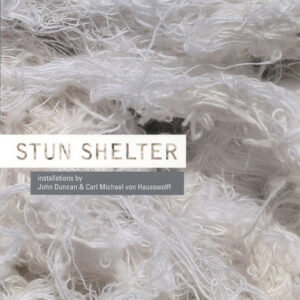
John DUNCAN & Carl Michael von HAUSSWOLFF
“Stun shelter”
50-pages catalogue with full color photos and audio CD in DVD plastic cover. Audio and still images from the Stun Shelter installation at Galleria Nicola Fornello, Prato.
Created and composed by John Duncan & Carl Michael von Hausswolff. Installation recording by Carl Michael von Hausswolff. Mastered at Scrutto by John Duncan. Catalogue text by Daniela Cascella.
From the text of the catalogue : “John Duncan’s See is a video installation made up of four separate and simultaneous projections of sequences taken from the John See Series, a series of adult movies he directed (...). In those moments in which the sound is softer, a voice emerges, whispering Japanese phrases until it is drowned once again by the wave of louder sounds. Carl Michael von Hausswolff’s Thinner & Low Frequency Bar / Glue & High Frequency Lounge consists of two bars made of steel and glass on which lie bottles and cans containing (...) glue and thinner. On the bar two oscillators produce frequencies varying in intensity, whose sound penetrates the ears altering normal perception levels. Both works fill the space perfectly, one by means of strong images (See), the other through the substances shown. Attention level is at its maximum in attempts to grasp the Japanese whispering (See) and the ghost-sounds of the oscillators (Thinner Bar...), defying the threshold of audibility as they act on the unconscious.” Daniela Cascella
15,00€
Out of stock

CD
John DUNCAN – Mika VAINIO – Ilpo VAÏSÄNEN
“Nine suggestions”
John Duncan: shortwave, processing. Mika Vainio: oscillators, processing. Ilpo Väisänen: oscillators, processing.
Composed by John Duncan, Mika Vainio and Ilpo Väisänen. Processed and mixed in Barcelona, Berlin and at Scrutto by John Duncan, Mika Vainio and Ilpo Väisänen. Mastered at Scrutto by John Duncan.
Composed by John Duncan, Mika Vainio and Ilpo Väisänen. Processed and mixed in Barcelona, Berlin and at Scrutto by John Duncan, Mika Vainio and Ilpo Väisänen. Mastered at Scrutto by John Duncan.
15,00€
Out of stock
CD
Paolo PARISI-John DUNCAN
“Conservatory (San Sebastiano)”
Back in stock. Full color 64 pp. paperbound catalogue with installation audio CD mounted in separate cover, both inserted in paper box. Catalogue : Texts (English / Italiano) by Daniela Cascella, Pietro Gaglianò, Giovanni Iovane, & Sergio Risaliti. Audio CD : John Duncan : shortwave, processing. Catalogue and CD cover produced by Maschietto Editore. CD produced by Allquestions. “Referring to the soundtrack for Conservatory (San Sebastian), Duncan speaks of “ghost voices”, emphasizing a line of research he’s followed in the last several years beginning with Phantom Broadcast (2002), the audio work and live concert performances that utilize a shortwave radio transmission intercepted in the course of a single recording: a shadow play that assumes the form of bells resonating into infinity, where they merge and reverberate, morphing into choruses suspended in space. Duncan’s recent work seems to outline the echoes of complex choral compositions and preclude the senses, where we can discern only a reflection that grows thin or thick, as if it were breathing. Tension is accumulated gradually without burning in dramatic or resolved passages; or better still, we could speak of infinite extensions of a single moment of climax, because at the climax these works contain the strength to unwind in a series of minimal tonal variations. Phantom broadcast: in his work Duncan renders perceptible sounds that are difficult to capture, belonging to a dimension impossible to measure in human terms, urging us to pay more attention to what we pass by and ignore. From the beginning of his more than twenty years of activity, his constant attempt has been to approach sounds that go beyond the normal, and the challenge given to everyone (above all to himself) has been to take possession of one’s own fears and limits. Voice is the sonic element investigated by Duncan with particular attention in the first years of the new century, as if it were a form of resident energy still calmed, capable of emitting forces that are vital to his art. This new investigation, outlined in a series of albums, is resolved in the installation The Keening Towers, realized for the 2003 Göteborg Biennial where childrens’ voices multiply in the air in an energetic rush. In the work realized for Conservatory (San Sebastian) Duncan utilizes darker vocal sounds giving form to an elusive audio-presence, a further ghost transmission at the limits of human measure: once more the sound is a gossamer diaphragm and necessary passage, so that what transcends our normal sense of hearing might be perceived here in all its evocative power.” Daniela Cascella, catalogue
31,00€