
In stock

2 LP
Maggi PAYNE
“Arctic Winds”
Fully immersive electronic music by US composer Maggi Payne, inspired by the arctic winds.
Maggi Payne's sound worlds invite the listeners to enter the sound and be carried with it, experiencing it from the inside out in intimate detail. The sounds are almost tactile and visible.
The music is based on location recordings, with each sound carefully selected for its potential—its slow unfolding revealing delicate intricacies—and its inherent spatialization architecting and sculpting the aural space where multiple perspectives and trajectories coexist. With good speakers, some space in your schedule, and a mind-body continuum willing to resonate with Payne’s electroacoustic journey, but then it will take you to places that other music can’t reach.
From the sounds of dry ice, space transmissions, BART trains, and poor plumbing she immerses the listener in a world strangely unfamiliar. Maggi Payne is a composer, video artist, recording engineer, photographer, and flutist and is Co-Director of the Center for Contemporary Music and a faculty member at Mills College, in the San Francisco Bay Area.
Edition of 500 copies. Gatefold Sleeve.
26,00€
In stock

LP
Maggi PAYNE
“Ahh-Ahh”
Archival electronic experiments recorded in 1984-1987 on an Apple II computer and samplers.
Originally composed by Maggi Payne between 1984-1987 for the performance group Technological Feets. Formed by video artist Ed Tennenbaum in the San Francisco Bay Area in 1981, the group combines dance, live video processing and music.
Ahh-Ahh was first released in 2012 on Root Strata. Composed on an Apple II computer & various early sampling devices, Payne's compositions are a vibrant response to the call from the moving body. Populated with buoyant pulses, graceful analogue swells, dense fog-like drones and cascading rhythms that shift in space, AHH-AHH is a vital document of not only these early collaborations, but of computer based music as well. She studied with many greats in the field, including Gordon Mumma, Robert Ashley & David Berhman.
Edition of 500 copies. Gatefold Sleeve
22,00€
In stock

LP
Steve LACY / Yuji TAKAHASHI / Takehisa KOSUGI
“Distant Voices”
High quality reissue of Steve Lacy’s rare Japanese collaboration album Distant Voices. 180gr. vinyl and 4 page insert with liner notes by Julian Cowley.Thelonious Monk, Mal Waldron, Don Cherry, Roswell Rudd, Derek Bailey, Musica Elettronica Viva – saxophonist Steve Lacy played with them all. Renowned for remarkable solo concerts that confirmed his mastery of the soprano horn and that carried its instrumental language into previously unexplored regions, Lacy also loved to collaborate with musicians who could inspire him to stretch the boundaries of his own artistry.During the summer of 1975 Lacy toured Japan, and on June 24th he entered a Nippon Columbia studio in Tokyo with Yuji Takahashi and Takehisa Kosugi, two adventurous kindred spirits, guaranteed to fire Lacy’s creative imagination. The fascinating outcome of that dynamic session is Distant Voices, an album without parallel in Lacy’s extensive discography.On 24th June 1975 Takahashi sat at a grand piano, with celeste and vibraphone alongside him and small bells attached to his hands. Kosugi was equipped with violin, flute, mouth organ, an electronic modulator, porcelain bowls and at times he used his voice. Lacy played soprano saxophone, of course. Now and then he pressed the mouth of the instrument against the skin of a kettle drum. He occasionally fiddled with a transistor radio, and also found uses for a stepladder, a toothbrush and a spinning wheel. This was in no sense a routine musical session. Distant Voices preserves a unique occasion when three singular musicians joined together to embrace the unknown.
23,00€
In stock

2 LP
TAJ MAHAL TRAVELLERS
“August 1974”
High quality reissue of the monumental work August 1974 by Japanese experimental music ensemble Taj Mahal Travellers. Pressed on 180gr. vinyl with extensive liner notes by Julian Cowley.In April 1972 a group of Japanese musicians set off from Rotterdam in a Volkswagen van. As they crossed Europe and then made their way through Asia they made music in a wide range of locations. They also paid close attention to the changing scene and to differing ways of life. Midway through May they reached their destination, the iconic Taj Mahal on the bank of the Yamuna river in Agra, India. The Taj Mahal Travellers had fulfilled physically the promise of the name they adopted when they formed in 1969. But their music had always been a journey, a sonic adventure designed to lead any listener’s imagination into unfamiliar territory.The double album August 1974 was their second official release. The first July 15, 1972 is a live concert recording, but on 19th August 1974 the Taj Mahal Travellers entered the Tokyo studios of Nippon Columbia and produced what is arguably their definitive statement. The electronic dimension of their collective improvising was coordinated, as usual, by Kinji Hayashi. Guest percussionist Hirokazu Sato joined long-term group members Ryo Koike, Seiji Nagai, Yukio Tsuchiya, Michihiro Kimura, Tokio Hasegawa and Takehisa Kosugi.August 1974 captures vividly the characteristic sound of the Taj Mahal Travellers, haunting tones from an unusual combination of instruments, filtered through multiple layers of reverb and delay. Their music has strong stylistic affinities with the trippy ambience of cosmic and psychedelic rock, but the Taj Mahal Travellers were tuning in to other vibrations, drawing inspiration from the energies and rhythms of the world around them rather than projecting some alternative reality. Films of rolling ocean waves often provided a highly appropriate backdrop for their lengthy improvised concerts. This is truly electric music for the mind and body.
28,00€
Out of stock
LP
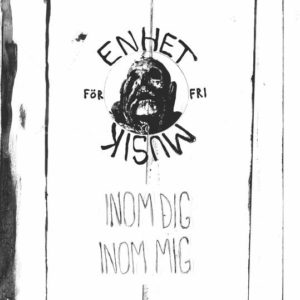
ENHET FÖR FRI MUSIK
“Inom Dig, Inom Mig”
Swedish outsider anti-folk.
Folk unit originated in the Swedish underground Enhet för Fri Musik -- featuring members of Sewer Election, Ättestupa, Neutral, Makthaverskan, and Blod - continually re-inventing what music is about through free improvisation and lengthy folk meanderings.
Embedded in the ever exciting Swedish underground scene Enhet För Fri Musik continues the quest for innovation numerous legendary Swedish bands started during the 70s, Pärson Sound, Trad Gras Och Stenar, Arbete Och Fritid. Taking the ideas of communal music craft and experimentation, on this album the group comes to a unique combination of Jandek-like atonal guitar, organ, tape effects, field recordings, saxophone and Sofie Herner’s amazing loner voice running over it. Adding another inspiring document to the world of open-minded music.
Silkscreened sleeves by Marijke Loozen. Music by Dan Johansson, Gustaf Dicksson, Hugo Randulv, Sofie Herner. Mastered by Kris Delacourt. Artwork by Dan Johansson. Edition of 150.
21,00€
In stock
LP
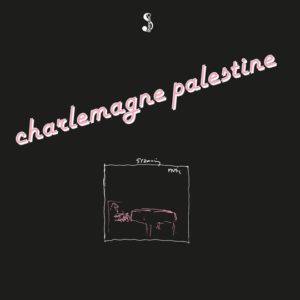
Charlemagne PALESTINE
“Strumming Music”
This classic minimal music album is now available again on vinyl for the first time since the 70s.
Primed with a glass of cognac Charlemagne Palestine sits at the keyboard of a Bösendorfer Imperial grand piano. One foot firmly holds down the sustain pedal while both hands perform an insistent strum-like alternation on the keys. Soon Palestine and his Bösendorfer are enveloped in sound and bathed in a shimmering haze of multi-coloured overtones. For 45 minutes this rich pulsating music swells and intensifies, filling the air.
When Strumming Music first appeared on the adventurous French label Shandar during the mid-1970s, it seemed a straightforward matter to place Charlemagne Palestine in the so-called Minimalist company of La Monte Young, Terry Riley, Steve Reich and Philip Glass, whose work also featured in the Shandar catalogue. Palestine too used a deliberately restricted range of materials and a repetitive technique, but as he has often pointed out in more recent times the opulent fullness of his music would more accurately be described as Maximalist.
Strumming Music, recorded in Palestine’s own loft in Manhattan, has no written score. In an age of recorded sound he still feels no need for traditional notation. The surging energy of this particular recording stands comparison with the improvising of jazz visionaries who impressed and inspired him while living in New York, as a young man. But, as Palestine himself has made clear, primarily he brings to music-making the sensibility of an artist rather than a musician.
Although the technique of the piece has roots in Palestine’s daily practice, when a teenager, of playing the carillon at a church, hammering sonorous chimes from a rack of tuned bells, it also draws on his later work as a body artist, staging vigorously muscular, physically demanding and often reckless performances. In addition, Strumming Music can be heard as a sculptural tour de force, while its textures connect with the colour moods, plastic rhythms and tactile space of Mark Rothko’s Abstract Expressionist canvases.
At the time when Philip Glass, Steve Reich and Terry Riley were becoming well-respected and widely heard composers, welcomed in concert halls and opera houses around the world, Charlemagne Palestine actually stopped making music altogether. He relocated to Europe and devoted his creative energies to the making of stuffed animal sculptures including the mighty God Bear, three-headed and six metres high. His involvement with music was revived and renewed during the 1990s, when younger generations of musicians and listeners, attuned to immersive noise and sensual sounds, were rediscovering Strumming Music and recognising that Palestine had blazed an idiosyncratic trail into their emerging world.
Since then he has returned enthusiastically to musical performance and his formerly meagre discography has steadily grown. Still Strumming Music remains the essential index of Palestine’s singular creative vision. Fundamentally this fascinating piece is a collaboration between an artist and an instrument. Palestine had first encountered the Bösendorfer Imperial back in 1969. He had already been playing church organs for several years, relishing their power and presence. Now he had found a piano that satisfied his need for sonic depth and weight. “The Bösendorfer at its best is a very noisy, thick molasses piano,” he has remarked. Charlemagne Palestine embraced its clinging sonorousness, its clangorous resonance and out of that embrace came the voluptuous sonic fabric of Strumming Music.
“My rhythms are sexual, not machine-like.” Charlemagne Palestine, in 2013.
Insert with liner notes by Julian Cowley. Comes with download code. Lacquer cut by Rashad Becker. Lay-out by Jeroen Wille. Re-mastered by Equus. Licensed from FGL Productions. Edition of 1000 copies
20,00€
Out of stock

2 LP
Terry RILEY
“Persian Surgery Dervishes”
This classic minimal music album is now available again on vinyl for the first time since the 70s.
Californian composer Terry Riley’s In C, first issued on vinyl in 1968, is widely acknowledged as a Minimalist landmark that altered the course of twentieth-century music. His influential album A Rainbow In Curved Air, which appeared the following year, is a vivid fusion of rock and raga, jazz and psychedelia realised through overdubbing on an 8-track machine which had recently been installed at the studios of Columbia Records.
In recent decades Riley has composed a series of critically acclaimed pieces for string quartet. He has also written for full orchestra and explored a variety of instrumental combinations. But during the 1970s, he concentrated on solo keyboard performances, continuing to make music yet writing down almost nothing. Riley selected a mode, chose a few motifs or basic patterns and then, seated on the floor in front of his audience, improvised on electronic keyboard. That instrument became an essential part of his musical identity for a while, although it was chosen in part for practical reasons. The electric organ, superseded at later concerts by a synthesizer, was portable and consistent. This enabled him to avoid unreliable pianos in venues which were less formal and more variable than the standard concert hall circuit.
By the early 70s Riley had come to feel that scores were a distraction. Faithful interpretation of an already written piece was a deviation from the true purpose of making music, which was spiritual quest. Fortunately, some of those live performances, personal journeys towards a state of transcendence, were captured on tape. Persian Surgery Dervishes, issued initially on the French label Shandar, features two such concerts for electric organ and reel-to-reel delay, one recorded in Los Angeles on 18th April 1971, the other in Paris on 24th May 1972.
At the start of that decade Riley became a dedicated student of the great Hindustani singer Pandit Pran Nath. Looking into North Indian classical tradition he found correspondences to modal and cyclic ideas that he was already working on. In 1971, as a way to learn more, Riley himself started teaching Indian music at Mills College, in Oakland. That experience fed directly into his solo keyboard performances, but other influences were also shaping the music heard on Persian Surgery Dervishes. Personal research into ancient Persian culture and the poetry of Rumi lit up his imagination, while the repetitive swirling of Sufi devotional music from North Africa, which Riley had first encountered in Europe during the early 60s, reverberates through these performances. Jazz, as conceived by such masters such as Bill Evans and John Coltrane, is also present as an enduring source of inspiration.
The Californian version of Persian Surgery Dervishes starts with low dark tones, dense and brooding like a huddled human figure, deep in introspection. But as the improvisation unfolds Riley’s buoyant spirit asserts itself, spiralling out in ecstatic coils, as though liberated from the grip of body consciousness. The Parisian concert conveys a different mood, brighter and more open in texture, more relaxed from the outset and breathing with greater freedom as it takes flight.
Echoes of Terry Riley’s inspired music have spread far and wide - into progressive rock, New Age and ambient soundings, film soundtracks, blissed-out electronica and dance-floor trance. His fluent and hypnotic keyboard playing can be heard as part of a continuum, transmitting energies from ancient and distant musical sources into the living here and now. Persian Surgery Dervishes is a significant part of that picture, a mesmerising record of a vital stage in Riley’s ongoing quest for connection with the universal mind and the sublime music that flows ceaselessly from it.
“Music is my spiritual path. It’s my way of finding out who I am.” Terry Riley, in 1976
28,00€