
In stock
CD
Toshi ICHIYANAGI
“Music for piano (1959-1961)”
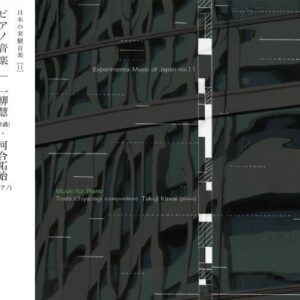
Experimental Music of Japan Vol. 11. The Music for Piano series was written under John Cage’s influence in his New York years. This CD is the premiere complete recording without simultaneous playing. The series was played and recorded by pianist Takuji Kawai at KEN in Tokyo in October 27, 2012. "Music for Piano No. 1-No. 7" was composed between 1959 and 1961. All the works were written using graphic notations (No. 1, No. 2, No. 5 and No. 6) and instructions (No. 3, No. 4 and No. 6). "This period of my compositions such as ’Music for Electric Metronomes,’ ’Stanzas for String Instrument,’ ’Duet for Piano and String Instrument,’ and ’Sapporo’ were all written by graphic notations, which expanded my idea of space in music in later compositions. The premiere of ’Music for Piano No.2’ took place in 1959, performed by David Tudor at Living Theatre in New York. No. 5 was by Yuji Takahashi, No. 4, No. 6 and No. 7 were by myself. This is the first time collecting all seven pieces played open to the public and recorded at the same time. Various techniques as well as different qualities of the sounds were created in an amazing manner by pianist Takuji Kawai through my graphic notations. He played all the noises and concrète sounds without using any electronic device but with live natural sounds only to reflect 1950s to early ’60s social situations." --Toshi Ichiyanagi
17,00€
Out of stock

CD
Toshi ICHIYANAGI
“Funakakushi” – Obscure Tape Music of Japan vol.17
“Funakakushi” (1963). This electronic work was composed for opening ceremony of hotel “Funakakushi-en” in Kagawa prefecture in 1963. It was realized like sound installation used many speakers built-in stone sculpture. They were designed by sculptor Mitsu-aki Sora (b. 1933) and were arranged here and there at main garden of the hotel. The sound was made from modified Japanese traditional instrument Biwa and sea wave sound. Engineer Junosuke Okuyama [3] assisted for electronic devices.
“Life Music (tape version)” (1964). Life Music was composed as tape version originally in 1964. After then, this work was played as another version with electronic modified orchestra (contact microphones were put on al instruments of the orchestra at Nissei Theatre in 1966. Junosuke Okuyama designed special effect machine named Electronics Sound Breaker (=ESB) for the concert. Kuniharu Akiyama, music critic, wrote about this machine on liner notes of “Orchestral Space” LP as follows, “…amplified sound of the orchestra was sent to some effect machines and ESB, and they were driven by tape version. Just then, electronic amplification was cut off synchronously by silent parts of the tape, and only non-effect live sound was played…”
“Life Music (tape version)” (1964). Life Music was composed as tape version originally in 1964. After then, this work was played as another version with electronic modified orchestra (contact microphones were put on al instruments of the orchestra at Nissei Theatre in 1966. Junosuke Okuyama designed special effect machine named Electronics Sound Breaker (=ESB) for the concert. Kuniharu Akiyama, music critic, wrote about this machine on liner notes of “Orchestral Space” LP as follows, “…amplified sound of the orchestra was sent to some effect machines and ESB, and they were driven by tape version. Just then, electronic amplification was cut off synchronously by silent parts of the tape, and only non-effect live sound was played…”
18,00€
Out of stock
CD
Toshi ICHIYANAGI
“Electronic field”- Obscure Tape Music of Japan vol.8
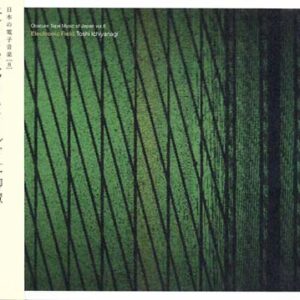
This performance is a part of concert series “Japanese Experimental Music 1960’s” carried out at Art Tower Mito in Ibaraki. Toshi Ichiyanagi played improvisation on prepared piano and the sound was modulated by live-electronics. However he is a ’maestro’ of contemporary music now, his quite non-declined experimentalism is appeared by this great and deep sound. Also painter Sadamasa Motonaga (b.1922, a member of Gutai) projected abstruct figures to walls of the space. “Electronic Field” (1997).
18,00€
Out of stock
CD
Toshi ICHIYANAGI
“Music for Tinguely” – Obscure Tape Music of Japan vol.5
“Ichiyanagi is the best known composer for domestic and foreign avant-garde music fans. Especially in his brilliant 60’s, he made many great tape music. But most of them has not published on discs or issued for very small edition. This CD consists of his obscure three tape works. “Music for Tinguely” was made from junk objects of kinetic sculptor Jean Tinguely. “Appearance” is live electronic music. It’s not only premiere performance but also John Cage and David Tudor participated in performance. Very noisy and hard core!! “Music for Living Space” was composed for inner space of “Sun Tower” of World Expo in Osaka. Computer generated voice reads architect Kisyo Kurokawa’s manifest. Strange!!”
18,00€